Northwestern wolf
The northwestern wolf (Canis lupus occidentalis), also known as the Mackenzie Valley wolf or Canadian timber wolf, is a large subspecies of gray wolf native to western North America. It is considered one of the largest and most widespread wolf subspecies, ranging from Alaska through the Yukon and western Canadian provinces to the northwestern United States. This apex predator influences prey populations and overall ecosystem health in its habitats. Its presence across Canada's remote wilderness makes it a significant part of the nation's natural heritage.
Taxonomy and Evolutionary History
The northwestern wolf was first formally described by the Scottish naturalist Sir John Richardson in 1829. He assigned it the subspecies name 'occidentalis', a Latin term meaning 'western', to denote its geographic distribution rather than describe its highly variable coat colour. It is recognized as a valid subspecies in the authoritative taxonomic reference Mammal Species of the World. Genetic and morphological studies indicate that gray wolves migrated from Eurasia into North America in multiple waves between 70,000 and 23,000 years ago. The northwestern wolf represents one of the most recent colonizations, descended from the last gray wolves to cross the Bering land bridge after the last ice age. This lineage is genetically distinct from other North American subspecies like C. l. nubilus and C. l. baileyi. As it expanded across the continent, C. l. occidentalis displaced earlier wolf populations, a dynamic that has continued into modern times, contributing to its current widespread distribution.
Physical Description
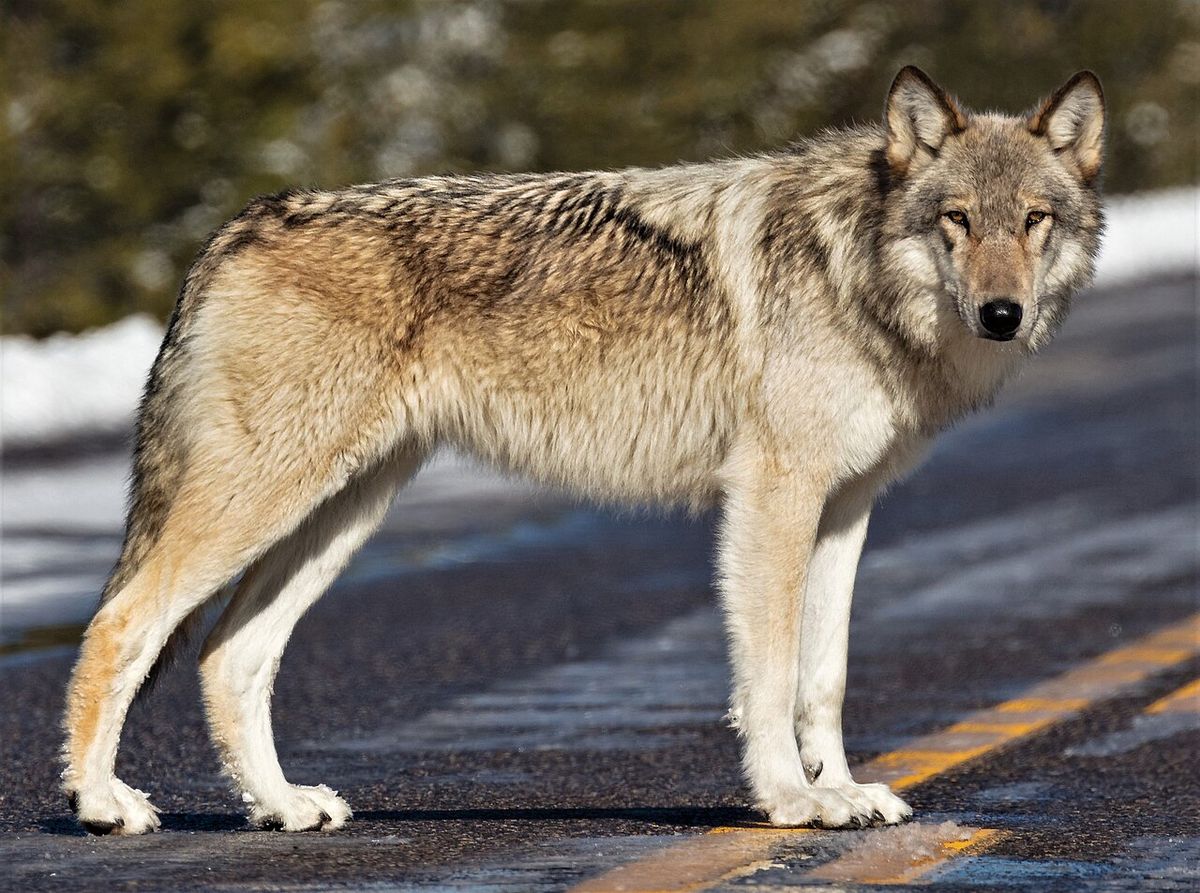
Renowned for its size and strength, the northwestern wolf is arguably the largest subspecies of gray wolf in the world. Adult males typically weigh between 45 and 72 kilograms, while females are generally smaller, ranging from 36 to 60 kilograms. Specific regional studies provide detailed averages, such as in British Columbia where ten adult males averaged 50.9 kilograms and five females averaged 42.5 kilograms. In Yellowstone National Park, reintroduced wolves show similar dimensions, with males averaging about 50 kilograms and females about 40 kilograms. The subspecies is also notably long, with a body length usually between 1.5 and 1.8 metres, and exceptional individuals reaching up to 2.1 metres. Their shoulder height ranges from 68 to 91.5 centimetres for both sexes. Compared to its closest rival in size, the Eurasian wolf, the northwestern wolf possesses a heavier build with a larger, rounder head, a thicker muzzle, shorter ears, and a bushier coat, as originally noted by Sir John Richardson. This substantial physique is an adaptation to its northern habitat and the large prey it hunts.
Habitat and Range
The northwestern wolf inhabits a vast and varied territory across western North America. Its range extends from the state of Alaska and the upper Mackenzie River Valley in Canada's Northwest Territories, southward through the western Canadian provinces of Yukon, British Columbia, and Alberta. It also occupies suitable habitats in the northwestern United States, including Montana, Idaho, and Wyoming. This subspecies generally avoids the open prairie landscapes found in the southern portions of its range, preferring forested, mountainous, and boreal regions. The expansive and often remote nature of its Canadian range highlights its status as a creature of the country's wilderness. The wolf's adaptability has allowed it to thrive in diverse ecosystems, from coastal rainforests to interior mountain ranges, though its presence is always tied to the availability of adequate prey and minimal human persecution. The primary jurisdictions and regions within its Canadian range include:
- Alaska (United States)
- Yukon
- Northwest Territories (Mackenzie River Valley)
- British Columbia
- Alberta
- Montana (United States)
- Idaho (United States)
- Wyoming (United States)
Diet and Hunting Behaviour
As an apex predator, the northwestern wolf primarily hunts large ungulates, employing sophisticated pack tactics to bring down prey. In ecosystems like Yellowstone National Park, where they were successfully reintroduced, elk constitute a major portion of their diet. Wolves use coordinated teamwork to stampede herds, isolating younger, older, or weaker individuals, and they also target calves that have become separated from adults. During winter, wolves play a critical role in culling elk populations by preying on animals weakened by the harsh conditions. It is estimated that wolves kill over 50 percent of winter-weakened or sick elk in Yellowstone. Beyond elk, northwestern wolves will also prey on other species such as deer and moose, and in Yellowstone they have been documented attacking bison, though these endeavours are risky and typically focus on sick animals or calves, as healthy adult bison can defend themselves powerfully with their hooves. The carcasses from wolf kills provide an important food source for a wide array of other wildlife, creating a cascade of ecological benefits, and the remains of wolf kills are scavenged by numerous other species, contributing to the nutrient cycle within the ecosystem.
In Yellowstone National Park, reintroduced northwestern wolves feed on elk. Winter-weakened or sick elk play an important part of Yellowstone wolf diets, and it is estimated that over 50 percent of winter-weakened or sick elk in Yellowstone are killed by wolves. Of these, about 12 percent of carcasses were scavenged by other predators. These scavengers include ravens, bald eagles, black bears, grizzly bears, and coyotes.
- Ravens
- Bald eagles
- Black bears
- Grizzly bears
- Coyotes
Studies indicate that approximately 12 percent of wolf-killed carcasses in Yellowstone are scavenged by other predators and birds. These scavengers include ravens, bald eagles, black bears, grizzly bears, and coyotes. Reintroduced northwestern wolves in Yellowstone have been well-documented feeding on elk. Winter-weakened or sick elk play an important part of Yellowstone wolf diets, and it is estimated that over 50 percent of winter-weakened or sick elk in Yellowstone are killed by wolves.
Reintroduction and Conservation
Wolves from Canadian populations were translocated to restore a missing ecological driver to the park's ecosystem. The subsequent recovery of the wolf population has had extensive and well-documented effects, a process often termed a 'trophic cascade'. By preying on elk, wolves reduced overbrowsing on willow and aspen, allowing these vegetation communities to recover, which improved habitat for beavers and songbirds and stabilized riverbanks. The presence of wolves also altered the behaviour of other species, such as coyotes, and provided carrion for scavengers. Beyond Yellowstone, northwestern wolves are present in various Canadian wildlife parks and safari parks, such as Parc Omega in Quebec, where they serve to educate the public. Their overall conservation status across Canada is relatively stable in core wilderness areas, though they face ongoing challenges from habitat fragmentation and conflicts with livestock in some regions. Northwestern wolves can be viewed in several parks internationally, including:
- Longleat (United Kingdom)
- Woburn (United Kingdom)
- Parc Omega (Quebec, Canada)
Cultural Significance and Viewing
The northwestern wolf holds a powerful place in the cultural imagination of Canada, representing the wild spirit of the nation's vast northern landscapes. It features prominently in Indigenous stories and traditions as a symbol of strength, family, and perseverance. For many Canadians and visitors, encountering a wolf in the wild is a rare and memorable experience connected to the country's natural heritage. While seeing them in their natural habitat requires luck and often travel to remote regions, they can be observed in controlled settings designed for education and conservation. Several wildlife parks across Canada house northwestern wolves, providing a chance for the public to learn about their biology and ecological importance, and internationally, they are also featured in safari parks, such as Longleat and Woburn in the United Kingdom. Responsible wildlife tourism and education are key to fostering public support for the continued conservation of this Canadian predator.
Questions about Northwestern wolf
How big is a northwestern wolf?
The northwestern wolf is one of the largest wolf subspecies. Adult males typically weigh between 45 and 72 kilograms (99 to 159 pounds), while females range from 36 to 60 kilograms (79 to 132 pounds). They measure 1.5 to 1.8 metres (5 to 6 feet) in length, with some individuals reaching up to 2.1 metres (7 feet). Their shoulder height is between 68 and 91.5 centimetres (26.8 to 36 inches).
Where do northwestern wolves live in Canada?
In Canada, northwestern wolves are found across the western provinces and territories. Their range includes the Yukon, the upper Mackenzie River Valley in the Northwest Territories, British Columbia, and Alberta. They inhabit forested, mountainous, and boreal regions, generally avoiding the open prairies in the southern parts of their range. This extensive distribution makes them a widespread species in Canada's western wilderness.
What do northwestern wolves eat?
Northwestern wolves are carnivores that primarily hunt large ungulates. Elk are a major prey item, especially in areas like Yellowstone National Park. They also hunt deer, moose, and bison, though attacks on healthy adult bison are risky and less common. Wolves employ pack hunting strategies to isolate and take down vulnerable individuals, such as calves, older animals, or those weakened by winter. Their kills provide food for many scavengers, including bears, eagles, and coyotes.
Are northwestern wolves dangerous to humans?
Northwestern wolves are wild predators, but unprovoked attacks on humans are extremely rare. They generally avoid human contact. In national parks like Yellowstone, they have become habituated to people but are not considered a significant threat when proper wildlife viewing distances are respected. Their primary focus is on hunting wild prey. Conflicts with humans typically arise in areas where wolves may prey on livestock, not from direct aggression toward people.
Can you see northwestern wolves in wildlife parks?
Yes, northwestern wolves can be seen in several wildlife and safari parks. In Canada, they are housed at facilities such as Parc Omega in Quebec. Internationally, they are also found in parks like Longleat and Woburn in the United Kingdom. These parks offer a controlled environment where the public can observe wolves and learn about their behaviour, ecology, and conservation, supporting education and awareness efforts for the species.
Why were wolves reintroduced to Yellowstone?
The notes provided do not contain specific information explaining why wolves were reintroduced to Yellowstone National Park. Therefore, an answer cannot be provided based solely on the given facts. The notes do describe the effects of their reintroduction, such as their feeding habits on elk and bison. They detail how northwestern wolves in Yellowstone stampede elk herds to separate younger individuals and target winter weakened or sick animals. It is estimated that wolves kill over 50 percent of winter weakened or sick elk in the park. The notes also mention that some wolf kills are scavenged by other predators like bears and eagles. However, the original reasons for the reintroduction program are not covered in the provided material.
Sources and further reading
- Northwestern wolf (Wikipedia)
- Northwestern Wolf (Canis Lupus Occidentalis) (wolf-stuff.com)
- Northwestern Wolf, Facts, Diet, Habitat & Pictures on ... (animalia.bio)
Checked by the Your Space Hamilton desk. Last updated 2026-10-31.