Northern cardinal
The northern cardinal (Cardinalis cardinalis) is a mid-sized perching songbird native to North America and a common resident across much of eastern Canada. Known for the male's brilliant crimson plumage and distinctive black face mask, this non-migratory species inhabits woodlands, gardens, and shrublands. Its range extends into southern Ontario, Quebec, New Brunswick, and Nova Scotia, where it remains throughout the year. The northern cardinal is noted for its clear, whistled song, its ecological role as a seed disperser, and its legal protection under Canadian and international migratory bird treaties.
Taxonomy and Naming
The northern cardinal was first described by Carl Linnaeus in the 1758 10th edition of Systema Naturae, where it was categorized as Loxia cardinalis, a genus now reserved for crossbills. In 1838, it was recategorized as Cardinalis virginianus, and in 1918, the scientific name was sometimes replaced with Richmondena cardinalis. The current scientific name, Cardinalis cardinalis, was established in 1983, with the common name changed to 'northern cardinal' to distinguish it from other species termed cardinals. The bird is named after the cardinals of the Roman Catholic Church, whose red robes and caps resemble the male's plumage, and the term 'northern' refers to its status as the northernmost species within the genus Cardinalis, with its range extending into southeastern Canada.
Physical Description and Plumage
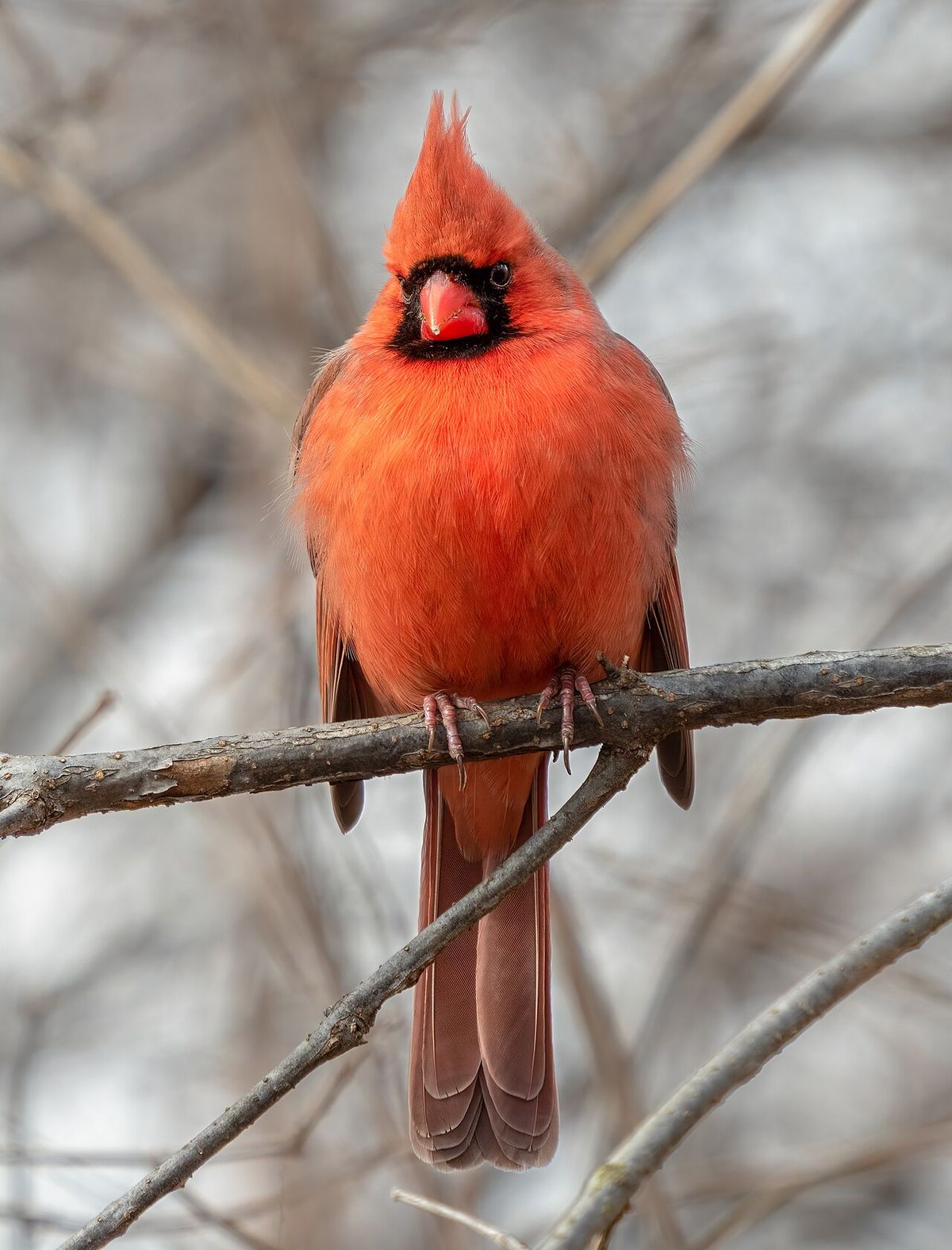
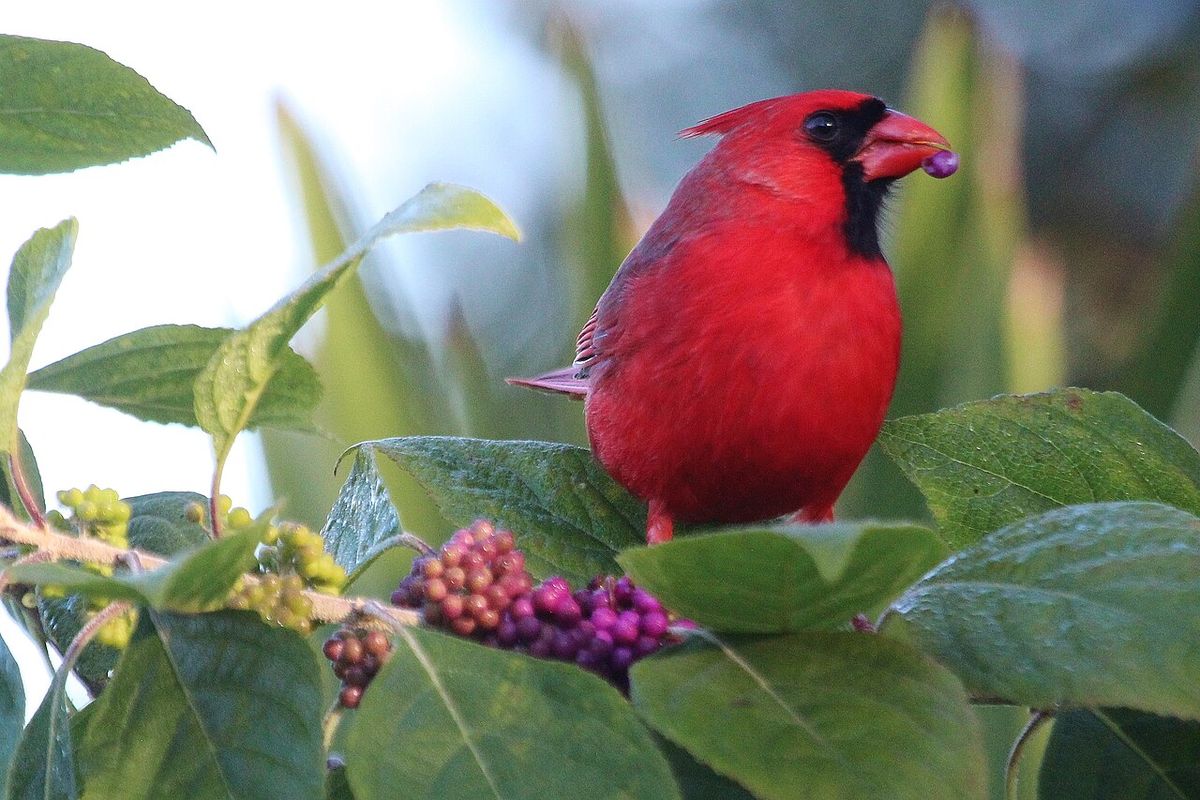
The northern cardinal is a mid-sized songbird with a body length of 21 to 23.5 centimetres and a wingspan of 25 to 31 centimetres. The adult weight ranges from 33.6 to 65 grams, with an average of 44.8 grams, and the male averages slightly larger than the female. The adult male is a brilliant crimson red colour with a black face mask over the eyes extending to the upper chest, while the colour becomes duller and darker on the back and wings. The adult female is fawn-coloured with mostly grayish-brown tones and a slight reddish tint on the wings, crest, and tail feathers, and her face mask is gray to black and less defined. Both sexes possess prominent raised crests and bright coral-coloured beaks that are cone-shaped and strong. Juvenile birds, both male and female, show colouring similar to the adult female until the fall molt, being brown above and red-brown below with brick-coloured crest, forehead, wings, and tail. The legs and feet are a dark pink-brown, and the iris of the eye is brown in all individuals. The plumage colour of the males is produced from carotenoid pigments in the diet, which they metabolize to create the red pigmentation from both red and yellow pigments. A few rare 'yellow morph' cardinals lack the enzyme to convert carotenoids and display yellow beaks and feathers with the black face mask, and when fed only yellow pigments, males become a pale red colour.
Distribution, Range Expansion and Habitat
Northern cardinals are numerous across the eastern United States from the southern half of Maine to Minnesota to the Texas-Mexico border. In Canada, they are found in the southern portions of Ontario, Quebec, New Brunswick and Nova Scotia, all the way east to Cape Breton Island. Its range also extends south through Mexico to the Isthmus of Tehuantepec, northern Guatemala, and northern Belize, with an allopatric population on the Pacific slope of Mexico from Jalisco to Oaxaca not shown on typical range maps. The species was introduced to Bermuda in 1700 and to all major islands of Hawaii since its introduction in 1929. In 1929, the species was described as rare in New England, but by 1955 Griscom reported the bird to be pushing northward when recorded annually at feeding stations. Audubon data shows the population grew rapidly in Massachusetts after 1960, a trend mirrored in adjacent Canadian regions. The cardinal's natural habitat includes woodlands, gardens, shrublands, and wetlands. In Massachusetts, and by extension similar Canadian habitats, the species is most abundant where dense cover is interspersed with open areas, such as woodland edges, brushy fields, wooded wetlands, parks, and suburban areas, while it tends to avoid extensive, unbroken woodlands which do not provide the necessary edge habitat.
Behaviour, Territoriality and Thermoregulation
Northern cardinals are non-migratory, territorial songbirds where the male sings in a loud, clear whistle from the top of a tree or another high location to defend his territory and will chase off other males entering his territory. He may mistake his image on various reflective surfaces as an invading male and will fight his reflection relentlessly, a common behaviour observed around windows. Mated pairs often travel together year-round but are not necessarily monogamous, as DNA studies of two populations found that 9 to 35 percent of nestlings were not fathered by the female's mate. During winter, cardinals employ several physiological strategies to survive cold Canadian temperatures, including fluffing up their down feathers which are small and hairlike at the base of each flight feather to retain warm air next to the body. Their thin, unfeathered legs and feet are vulnerable to rapid heat loss, so in cold temperatures, cardinals will shiver and tense their muscles, especially breast muscles, to generate heat, and they have the ability to drop their body temperature 3 to 6 degrees Fahrenheit (1.7 to 3.3 degrees Celsius) if needed in order to survive cold temperatures by reducing metabolic demand.
Vocalizations and Song Learning
Both sexes of the northern cardinal sing clear, whistled song patterns, which are repeated several times and then varied, with some common phrases described as 'cheeeer-a-dote, cheeer-a-dote-dote-dote', 'purdy, purdy, purdy...whoit, whoit, whoit, whoit', 'what-cheer, what-cheer... wheet, wheet, wheet, wheet' and 'cheer, cheer, cheer, what, what, what, what'. The species has a distinctive alarm call, a short metallic chip sound, often given when predators approach the nest to give warning to the female and nestlings. The songs of the two sexes, although not easily distinguishable by the human ear, are sexually dimorphic, which is suggested to be because of the differences in levels of hormones of the two sexes. The northern cardinal learns its songs, and as a result the songs vary regionally, with the songs of a northern cardinal usually overlapping more in syllables when compared to other northern cardinals near it than those far away from it, indicating local dialects and cultural transmission of song patterns within populations.
Diet and Foraging Habits
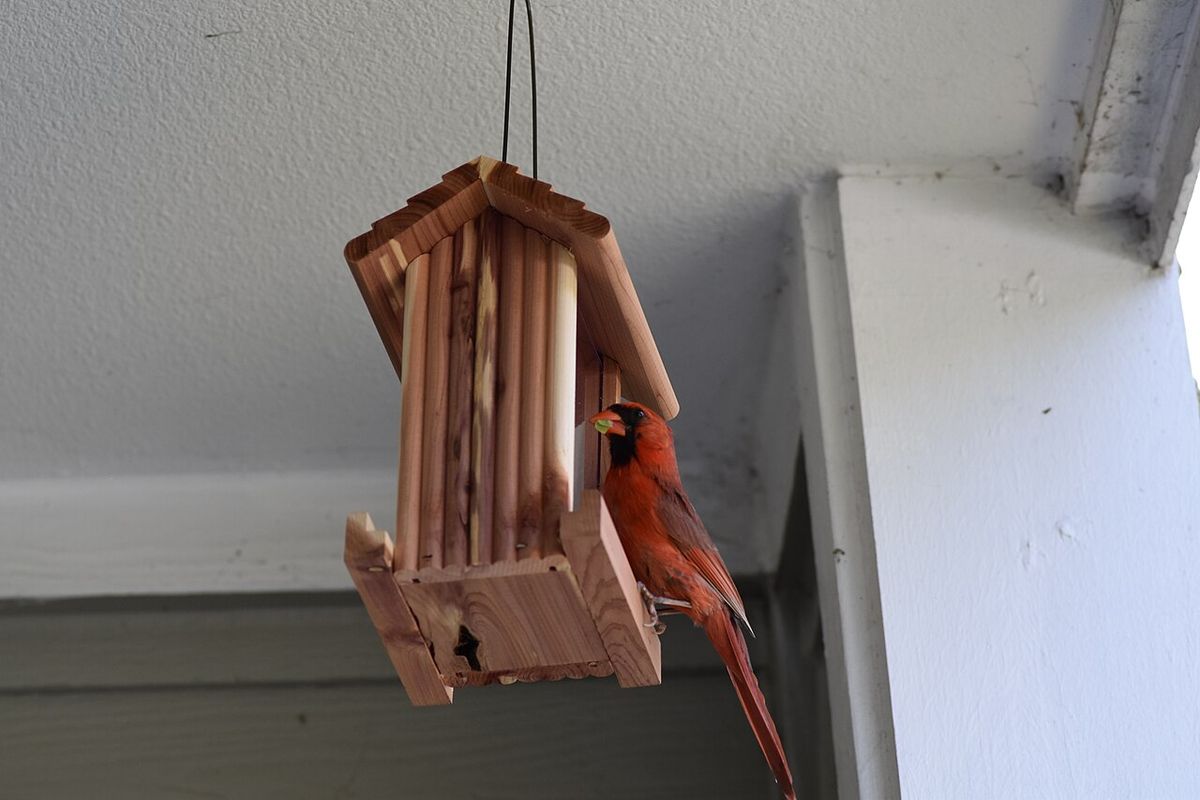
The diet of the adult northern cardinal consists mainly of weed seeds, grains, and fruits, comprising up to 90 percent of its intake, and it is a ground feeder, finding food while hopping on the ground through trees or shrubbery. It will also consume snails and insects, including beetles, cicadas, and grasshoppers, and the young are fed almost entirely on insects which adults crush with their beaks before feeding. Other common dietary items include corn, oats, sunflower seeds, the blossoms and bark of elm trees, and drinks of maple sap from holes made by sapsuckers, demonstrating a broad dietary flexibility. This varied foraging strategy supports the bird's year-round residence in Canada, as it can switch between food sources such as backyard bird feeder seeds in winter and protein-rich insects in the breeding season, and an increase in backyard feeding by humans has been credited with increasing the range of this species across North America.
Reproduction, Nesting and Development
Pairs may mate for successive years, but some also separate between seasons or choose a new mate when one dies, and during courtship they may participate in a bonding behaviour where the male collects food and brings it to the female, feeding her beak-to-beak. The female builds a cup nest in a well-concealed spot in a dense shrub or low tree one to three metres off the ground, and she crushes twigs with her beak until they are pliable, then turns in the nest to bend the twigs around her body and push them into a cup shape with her feet. The nest is made of thin twigs, bark strips, and grasses, lined with grasses or other plant fibers, and the cup has four layers: coarse twigs covered in a leafy mat, then lined with grapevine bark and finally grasses, stems, rootlets, and pine needles. The male sometimes brings nest material to the female, who does most of the building over three to nine days, with the finished product being 5.1 to 7.6 centimetres tall and 10.1 centimetres across, with an inner diameter of about 7.6 centimetres. Key stages in the reproductive cycle include:
- Egg laying: Usually three or four white eggs with a tint of green, blue, or brown, marked with lavender, gray, or brown blotches are laid one to six days after nest completion, and eggs measure approximately 26 by 19 millimetres.
- Incubation: The female generally incubates for 12 or 13 days, with the male rarely incubating for brief periods, and the female has brood patches for this purpose.
- Nestling phase: Newly hatched cardinals weigh 3 to 3.5 grams, are naked, blind, and immobile, and do not have feathers until 4-5 days old, and they gain weight at about 2 to 3 grams per day but grow slower until day 2, faster from day 2 to day 7 or 8, and then slower before fledging.
- Fledging and care: Young fledge 10 or 11 days after hatching, and the male cares for and feeds each brood as the female incubates the next clutch of eggs, with two to four broods raised each year.
Northern cardinals do not usually use their nests more than once. They build a new nest for each clutch of eggs. Nestlings vocalize to attract their parents for feeding. They defecate in the form of a fecal sac every three or four feedings. For the first four to five days of nesting, the parents eat these fecal sacs. After that, the parents carry the sacs away from the nest and drop them.
Predators, Parasites and Population Ecology
Northern cardinals are preyed upon by a wide variety of native North American predators, which influences their nesting behaviour and survival rates. Avian predators include falcons, all Accipiter hawks, shrikes, bald eagles, golden eagles, and several owls such as long-eared owls and eastern screech owls. Predators of chicks and eggs include milk snakes, coluber constrictors, blue jays, crows, eastern gray squirrels, fox squirrels, eastern chipmunks, and domestic cats, which is why nests are well-concealed. Brown-headed cowbirds are observed to parasitize cardinal nests, laying their own eggs for the cardinals to raise. Despite these pressures, the species has an estimated global population of some 100 million individuals across a range of 5,800,000 square kilometres, with populations appearing stable or increasing and annual survival rates for adults estimated at 60 to 65 percent. An increase in backyard feeding by humans is credited with supporting this expansion and northward range shift. A specific ecological study conducted in 2016 in Atlanta, Georgia, on West Nile virus transmission in the United States found that unlike other species, northern cardinals biologically suppress the disease upon infection, which may have implications for public health in areas where they are common.
Relationship with Humans, Legal Status and Symbolism
The northern cardinal has a significant relationship with humans, spanning cultural symbolism, legal protection, and commercial use. In Cherokee mythology, the cardinal is associated with the sun and is a symbol of good luck, reflecting its bright colour. The species was once prized as a pet due to its bright colour and distinctive song, but its sale was banned in the United States by the Migratory Bird Treaty Act of 1918, which also banned their sale as cage birds. This act makes it illegal to take, kill, or possess northern cardinals, with violation punishable by a fine of up to US$15,000 and imprisonment of up to six months, and the Convention for the Protection of Migratory Birds provides similar protection in Canada. The bird is the state bird of seven U.S. states, more than any other species, and it was also a candidate to become the state bird of Delaware but lost to the Delaware Blue Hen. This state bird designation led the Amtrak passenger train between Chicago and Washington D.C. to be named 'The Cardinal' because the bird is the state bird of the six states along its route. The species is a common mascot for athletic teams, including the St. Louis Cardinals of Major League Baseball's National League and the Arizona Cardinals of the National Football League, as well as numerous colleges and universities, and most mascot depictions portray the bird with a yellow beak and legs, unlike the natural coral-coloured beak.
Questions about Northern cardinal
Where can you find northern cardinals in Canada?
Northern cardinals are found in the southern regions of eastern Canada, specifically in southern Ontario, southern Quebec, New Brunswick, and Nova Scotia, including Cape Breton Island. They inhabit a variety of landscapes such as woodland edges, brushy fields, wooded wetlands, parks, and suburban gardens where dense cover is interspersed with open areas. The species has expanded its range northward over the past century, a trend noted since at least 1955 when it was reported pushing northward in New England, and is now a common year-round resident in these areas. They are non-migratory, so they can be observed in all seasons within their Canadian range, and they tend to avoid extensive, unbroken woodlands.
What do northern cardinals eat?
The adult northern cardinal's diet is primarily granivorous, consisting of up to 90 percent seeds, grains, and fruits like weed seeds, corn, oats, and sunflower seeds. They also consume insects such as beetles, cicadas, and grasshoppers, and the young are fed almost entirely on insects which the adults crush with their beaks before feeding. Cardinals are ground feeders, hopping along to find food, and are frequent visitors to backyard bird feeders which has helped increase their range. They have also been observed consuming snails, drinking maple sap from sapsucker holes, and eating the blossoms and bark of elm trees.
How can you tell a male and female northern cardinal apart?
Male and female northern cardinals exhibit pronounced sexual dimorphism in colouration and mask definition. The adult male is a brilliant crimson red colour with a stark black face mask over the eyes extending to the upper chest, while the adult female is fawn-coloured with mostly grayish-brown tones and a slight reddish tint on the wings, crest, and tail. The female's face mask is gray to black and is less defined than that of the male, and both sexes possess prominent raised crests and bright coral-coloured beaks. Juvenile cardinals of both sexes resemble the adult female until they molt and grow adult feathers in the fall, and they do not have the distinctive red-orange beak until they are almost fully mature.
Are northern cardinals protected in Canada?
Yes, northern cardinals are protected in Canada under the Convention for the Protection of Migratory Birds. This protection makes it illegal to harm, kill, or possess these birds without a permit, mirroring protections in the United States under the Migratory Bird Treaty Act of 1918. The U.S. act banned their sale as cage birds and imposes penalties of fines up to $15,000 and six months imprisonment for violations. These laws were enacted because the species was once prized as a pet due to its colour and song, leading to population pressures that required conservation action to prevent over-exploitation.
How many broods do northern cardinals have per year?
Northern cardinals are prolific breeders, typically raising two to four broods each year, and the clutch typically contains three to four eggs, though there are sometimes as few as one or as many as five. The eggs are incubated by the female for 12 or 13 days, and the chicks fledge about 10 or 11 days after hatching, gaining weight at a rate of about 2 to 3 grams per day. Often, the male will care for and feed each brood as the female incubates the next clutch of eggs, enabling this high reproductive output. This high reproductive rate helps sustain their population despite predation pressures from animals like hawks, owls, snakes, and domestic cats.
Why is the northern cardinal called 'cardinal'?
The northern cardinal is named after the cardinals of the Roman Catholic Church, who wear distinctive red robes and caps. The term 'northern' in its common name refers to its range, as it is the northernmost cardinal species known. The common name was formally changed to 'northern cardinal' in 1983 to avoid confusion with the several other species also termed cardinals. This change in scientific nomenclature accompanied a shift from the previous scientific name, Cardinalis cardinalis, which had also been known as Loxia cardinalis and Richmondena cardinalis at different points in history. The bird's lively red plumage, particularly in males, directly evokes the crimson vestments of its namesake.
Sources and further reading
- Northern cardinal (Wikipedia)
- Northern Cardinal, Cardinalis cardinalis (birdsoftheworld.org)
- Meet the Northern Cardinal (thamesriver.on.ca)
Checked by the Your Space Hamilton desk. Last updated 2026-10-21.