Leatherback sea turtle
The leatherback sea turtle (Dermochelys coriacea) is the largest of all living turtles and the heaviest non-crocodilian reptile, capable of reaching lengths over 2.7 metres and weights of 500 kilograms. Distinguished by its unique leathery, oil-saturated skin instead of a hard bony shell, it is the sole surviving member of its family, Dermochelyidae. For Canadians, the species is a seasonal visitor to Atlantic and Pacific coastal waters, where it feeds on jellyfish, making its conservation a domestic environmental concern. Globally, the leatherback is considered vulnerable, with several critically endangered subpopulations facing severe threats from human activity.
Taxonomy and Evolution
The leatherback sea turtle was first described scientifically in 1761 by Domenico Agostino Vandelli as Testudo coriacea after an animal captured at Ostia and donated by Pope Clement XIII. The current genus name Dermochelys was coined by French zoologist Henri Blainville in 1816, and the family Dermochelyidae was established by Leopold Fitzinger in 1843. The species' scientific name translates literally to 'Leathery Skin-turtle'. Older common names include 'leathery turtle', 'trunk turtle', and names incorporating 'lute' or 'luth', which refer to the seven ridges on its back resembling the strings or ribbed back of the musical instrument. Relatives of modern leatherbacks have existed in similar form since the first true sea turtles evolved over 110 million years ago during the Cretaceous period.
Genetic studies show the leatherback's family, Dermochelyidae, split from the family containing all other sea turtles, Cheloniidae, approximately 49 to 70 million years ago. The sister taxon to Dermochelyidae is the extinct family Protostegidae, which also included species that did not have a hard carapace. The only known fossil material of the extant leatherback sea turtle itself is a humerus reported from the Middle-Late Pleistocene strata from the bottom of the Taiwan Strait between Penghu Islands and Taiwan. Relatives of modern leatherback turtles have existed in relatively the same form since the first true sea turtles evolved over 110 million years ago during the Cretaceous period. The dermochelyids are relatives of the family Cheloniidae, and studies using fossil-calibrated genetic analyses have shown these families to have split approximately 49 to 70 million years ago.
Anatomy and Physical Description
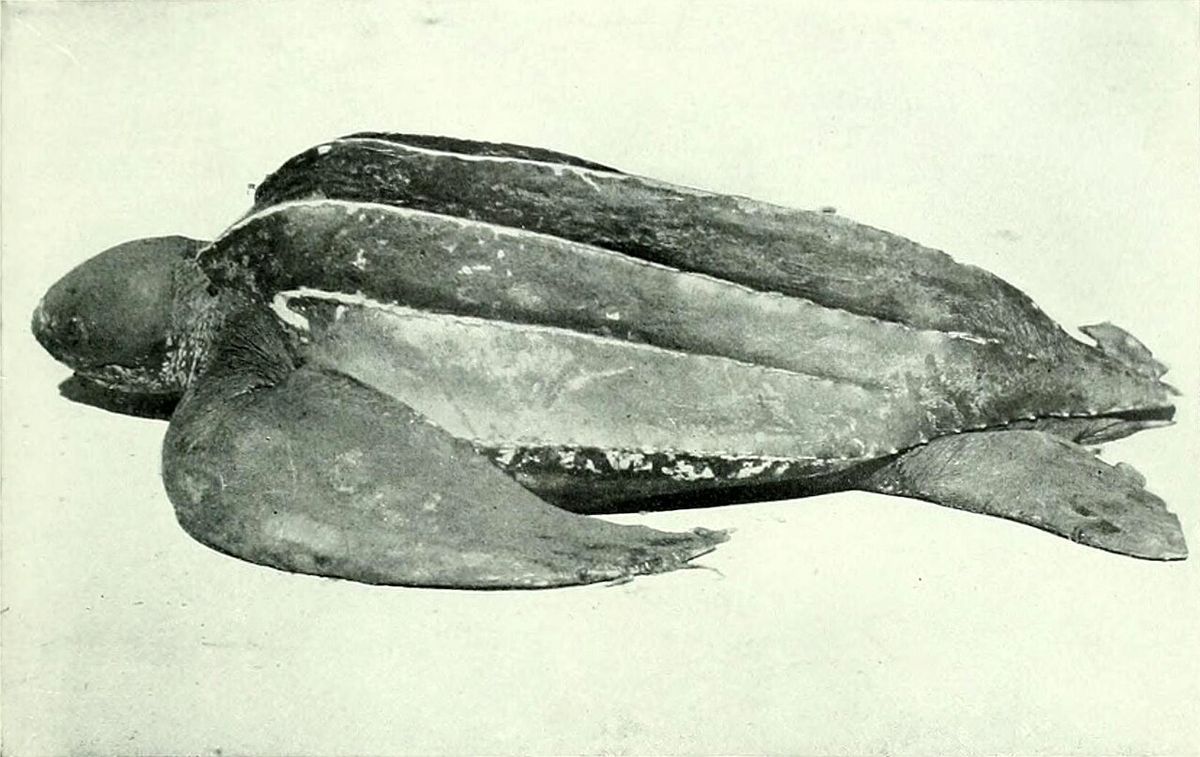
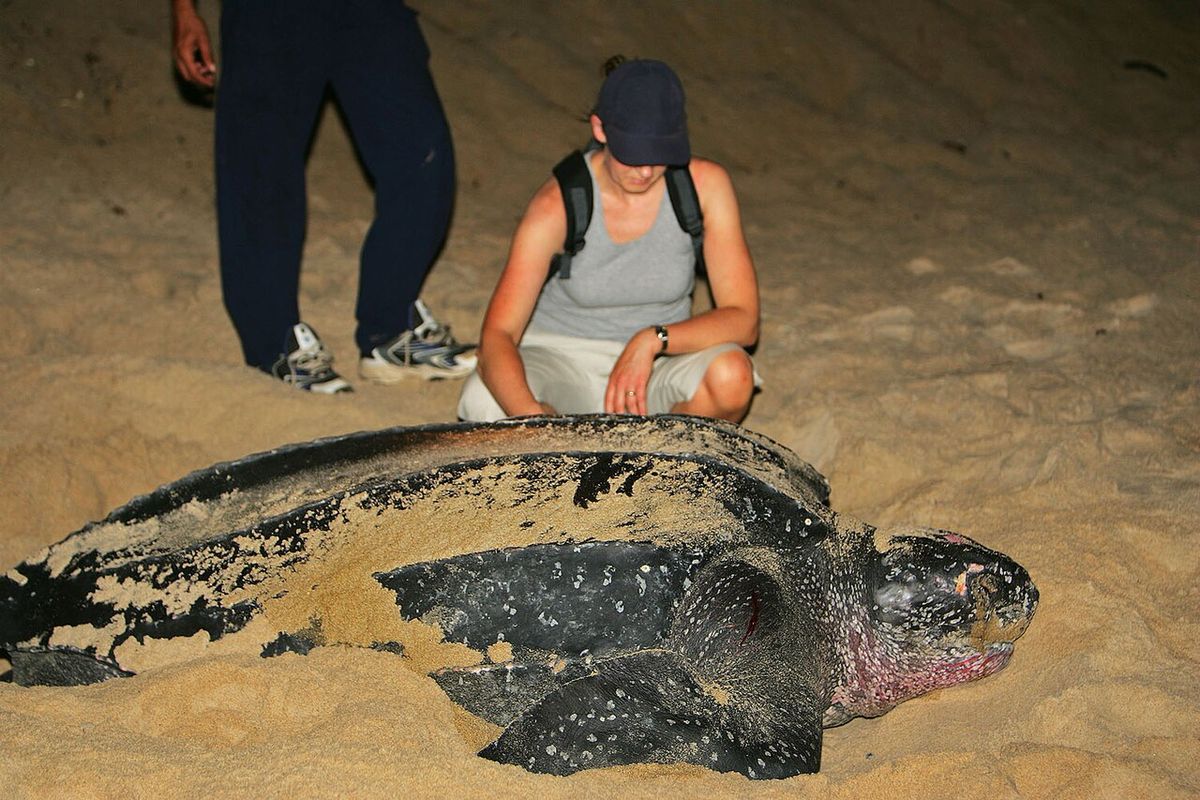
The leatherback has the most hydrodynamic body shape of any sea turtle, with a large, teardrop-shaped form powered by enormous front flippers. These flippers lack claws and can grow up to 2.7 metres from tip to tip in large specimens, the largest in proportion to body size among sea turtles. The most notable feature is the complete absence of a bony carapace. Instead, the carapace consists of thick, leathery skin embedded with minuscule bony plates called osteoderms. Seven distinct ridges rise from this leathery carapace, running from the head to the tail. The dorsal surface is dark grey to black with white-pink speckling, while the underside is lightly coloured in a countershading pattern.
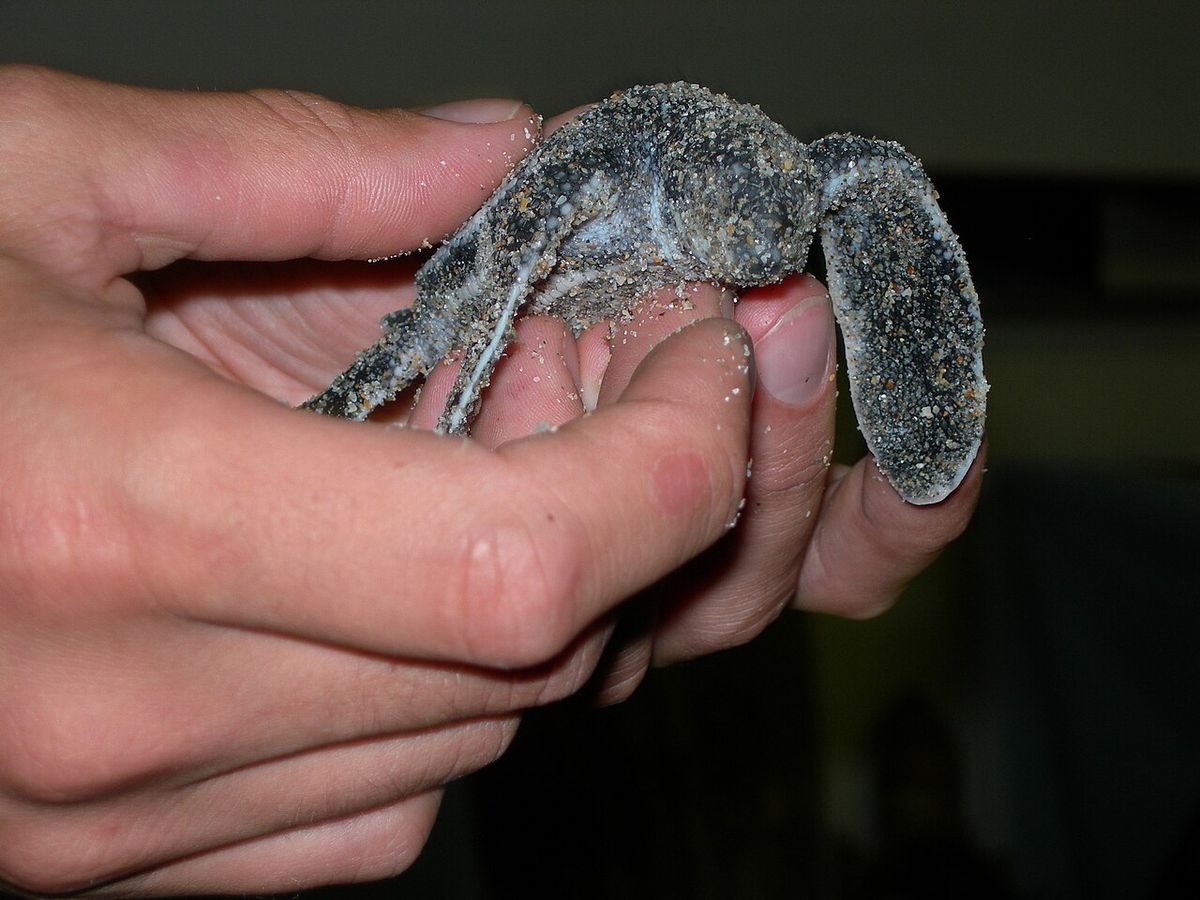
Adults average 1 to 1.75 metres in curved carapace length, with a total length of 1.83 to 2.2 metres, and weigh between 250 and 700 kilograms. In the Caribbean, adults average 384 kg and 1.55 m, while those nesting in French Guiana average 339.3 kg and 1.54 m. The largest verified specimen was found on Sandspit beach in Pakistan, measuring 213 cm and weighing 650 kg. Hatchlings are much smaller, averaging 61.3 mm in carapace length and weighing about 46 grams. The leatherback's throat contains backwards-pointing spines to help swallow slippery jellyfish prey and prevent escape, and instead of teeth it has points on the tomium of its upper lip.
- Carapace Mechanics: The osteoderms in the carapace are connected by flexible, interlocking sutures in a zig-zag configuration.
- Failure Modes: Under tension, the carapace can fail via brittle fracture of the osteoderm 'teeth' or ductile failure at the collagen interfaces between them.
- Crack Resistance: The suture design prevents crack propagation through a mechanism called crack bridging, where sutures resist the growth of cracks under load.
- Pressure Adaptation: This flexible structure allows the carapace to expand and contract with the lungs during breathing and deep dives, withstanding high hydrostatic pressures.
Physiology and Unique Adaptations
Leatherback turtles possess several anatomical characteristics for a life in cold waters, including an extensive covering of brown adipose tissue and networks of countercurrent heat exchangers. These exchangers are located between the large front flippers and the core body, and also surround the trachea. Early studies suggested leatherbacks had resting metabolisms three times higher than expected for a reptile of their size, but recent research comparing them to reptiles across all size ranges found their resting metabolic rate is not significantly different from predictions based on allometry. Their ability to maintain high body temperatures is linked to constant activity, as studies on wild individuals show they may spend as little as 0.1 percent of the day resting.
The heat generated by continuous swimming muscle activity, combined with their insulating fat and efficient heat exchangers, allows them to maintain core body temperatures up to 18°C above the surrounding water temperature. This enables them to hunt in waters as cold as 0.4°C, returning to warmer surface waters around 17.5°C to regain body heat between dives. Leatherbacks are the deepest-diving marine reptiles, with recorded dives to 1,280 metres, a depth surpassed only by some beaked whales and sperm whales among diving tetrapods. Typical dive durations are 3 to 8 minutes, with occasional dives lasting 30 to 70 minutes. They are also the fastest-moving reptiles. The 1992 Guinness Book of World Records listed a speed of 35.28 km/h, though typical swimming speeds range from 1.80 to 10.08 km/h.
Global Distribution and Subpopulations
The leatherback has a cosmopolitan global range, the widest of any sea turtle, reaching as far north as Alaska and Norway and as far south as Cape Agulhas in Africa and the southern tip of New Zealand. It is found in all tropical and subtropical oceans and ranges into the Arctic Circle. There are three major genetically distinct populations in the Atlantic, eastern Pacific, and western Pacific Oceans, with populations in the Indian Ocean remaining largely unassessed. Global nesting numbers have seen a dramatic decline from an estimated 115,000 females annually in 1980 to between 26,000 and 43,000 in recent years.
| Subpopulation | Key Nesting Sites | Conservation Notes |
|---|---|---|
| Atlantic | Suriname, Guyana, French Guiana, Trinidad and Tobago, Antigua and Barbuda, Gabon (Mayumba National Park). | Mayumba, Gabon hosts nearly 30,000 nesters yearly, possibly the largest site worldwide. Population appears female-dominated. |
| Western Pacific | Papua, Indonesia, Solomon Islands. | Part of the wider Pacific population estimated at only 2,300 adult females remaining. |
| Eastern Pacific | Mexico, Panama, El Salvador, Nicaragua, Costa Rica. | Considered the most endangered marine turtle subpopulation. |
| Historical Malaysia Site | Rantau Abang, Terengganu (now effectively eradicated). | Once hosted 10,000 nests per year. Egg consumption by humans was the major cause of decline. In 2008, only two nested there with infertile eggs. |
The Indian Ocean subpopulation is proposed to be a separate, genetically distinct Indian Ocean subpopulation, with known nesting populations from Sri Lanka and the Nicobar Islands. In the Pacific, a third possible subpopulation nesting in Malaysia has been effectively eradicated. The beach of Rantau Abang in Terengganu, Malaysia, once had the largest nesting population in the world, but the major cause of the decline was egg consumption by humans. Conservation efforts in the 1960s involved excavating and incubating eggs at artificial sites which exposed the eggs to high temperatures, and it is suspected that nearly all the artificially incubated hatchlings were female due to temperature-dependent sex determination. In 2008, two turtles nested at Rantau Abang, but the eggs were infertile. There are small nesting sites in southern Thailand where 18 turtles nested in 2021.
Ecology, Diet, and Life History
Leatherback turtles are pelagic, spending most of their lives in the open ocean and undertaking vast migrations. One tracked individual swam 20,000 kilometres from Jen Womom beach in Indonesia to the United States over 647 days. They follow their jellyfish prey on a daily vertical migration, preferring deeper water in the daytime and shallower water at night when jellyfish rise. Their favored nesting beaches are mainland sites facing deep water, and they typically avoid beaches protected by coral reefs. Adult leatherbacks subsist almost entirely on jellyfish, but also consume other soft-bodied organisms like siphonophores, salps, pyrosomas, and squid.
They may also feed on small crustaceans, fish, sea urchins, snails, seagrasses, and algae. An adult consumes roughly 73 percent of its body weight in prey daily. Pacific leatherbacks migrate about 9,700 kilometres across the Pacific from Indonesian nesting sites to forage on jellyfish off California. During these migrations, common remora fish often latch onto them in a commensal hitchhiking relationship. Plastic pollution is a major threat due to their diet. An estimated one-third of Pacific leatherback adults have ingested plastic bags mistaken for jellyfish.
These bags often enter oceans from west coast urban areas, with Californians having used over 19 billion plastic bags annually before a state ban in 2016. Ingestion can cause lethal blockages, nutrient dilution leading to stunted growth, and delayed sexual maturation. The highest risk areas for plastic ingestion are offshore of San Francisco Bay, the Columbia River mouth, and Puget Sound. Very little is known of the species' lifespan, with some reports claiming 30 years or more and others stating 50 years or more, with upper estimates exceeding 100 years.
Threats and Conservation Challenges
The leatherback turtle faces a range of severe threats leading to its vulnerable global status and the critically endangered status of subpopulations like those in the Pacific. Ingestion of plastic marine debris is a primary and direct cause of injury and death. Beyond plastic bags, all forms of plastic debris can obstruct digestive tracts and displace nutritious food. Historic and ongoing egg consumption by humans has devastated nesting colonies, as seen in Malaysia where a world-leading site was lost. Past conservation efforts sometimes caused harm, such as in Malaysia in the 1960s when eggs were excavated and incubated at artificial sites.
These sites exposed eggs to high temperatures, and since sea turtles undergo temperature-dependent sex determination, this resulted in hatchlings that were almost exclusively female. Fisheries bycatch remains a persistent threat, as turtles can become entangled in fishing gear. Coastal development also destroys critical nesting beaches. The World Wildlife Fund estimates only 2,300 adult females remain in the entire Pacific Ocean. A direct response to the threat of plastic bags to marine life like leatherbacks, California enacted a statewide ban on single-use plastic bags in 2016.
- Pacific Crisis: The World Wildlife Fund estimates only 2,300 adult females remain in the entire Pacific Ocean.
- California Legislation: A direct response to the threat of plastic bags to marine life like leatherbacks, California enacted a statewide ban on single-use plastic bags in 2016.
- Foraging Ground Protection: Key Canadian foraging areas in the Gulf of Saint Lawrence and off British Columbia require protection from ship strikes, fishing gear, and pollution.
- International Cooperation: The species' vast migrations across international waters necessitate cross-border conservation agreements and fishing regulations.
Adult leatherback turtles subsist almost entirely on jellyfish, and due to their obligate feeding nature, leatherbacks help control jellyfish populations. They are known to pursue prey deeper than 1000 metres, beyond the physiological limits of all other diving tetrapods except for beaked whales and sperm whales. Recent estimates of global nesting populations are that 26,000 to 43,000 females nest annually, which is a dramatic decline from the 115,000 estimated in 1980. The species as a whole is considered vulnerable, and some of its subpopulations are critically endangered, such as the Pacific leatherback where only about 2,300 adult females remain.
Questions about Leatherback sea turtle
Where can you see leatherback sea turtles in Canada?
In Canada, leatherback sea turtles are seasonal visitors to both coasts for foraging. In the Atlantic, they feed in the Gulf of Saint Lawrence near Quebec and as far north as Newfoundland and Labrador. On the Pacific coast, they visit the waters off British Columbia. They do not nest in Canada, as nesting requires warmer, tropical and subtropical beaches.
Why are leatherback turtles endangered?
Leatherback turtles face multiple threats leading to their vulnerable and, in some subpopulations, critically endangered status. Major threats include ingestion of plastic debris mistaken for jellyfish, which can be fatal. They are also victims of bycatch in fisheries, historical and ongoing harvesting of their eggs, and the destruction of nesting beaches due to coastal development. The Pacific subpopulation is especially at risk, with only an estimated 2,300 adult females remaining.
How deep can a leatherback turtle dive?
Leatherback turtles are one of the deepest-diving marine animals. Individuals have been recorded diving to depths as great as 1,280 metres. They are known to pursue prey deeper than 1000 metres, which is beyond the physiological limits of all other diving reptiles. Typical dive durations are between 3 and 8 minutes, with dives of 30 to 70 minutes occurring infrequently.
What do leatherback sea turtles eat?
The adult leatherback's diet consists almost entirely of gelatinous zooplankton, primarily jellyfish. They also consume other soft-bodied organisms like salps, siphonophores, and squid. An adult can eat approximately 73 percent of its own body weight in jellyfish each day. This specialized diet is why they are so vulnerable to ingesting plastic bags floating in the ocean, which they mistake for prey.
How big do leatherback turtles get?
Leatherback turtles are the largest living turtles. Adults average between 1 and 1.75 metres in curved carapace length and weigh from 250 to 700 kilograms. The largest verified specimen was found in Pakistan and measured 213 cm in carapace length and weighed 650 kg. Their front flippers are enormous, spanning up to 2.7 metres from tip to tip in the largest individuals.
Sources and further reading
- Leatherback sea turtle (Wikipedia)
- Leatherback Turtle (fisheries.noaa.gov)
- Leatherback Sea Turtle (nationalgeographic.com)
- Animals We Protect: Leatherback Sea Turtle (nature.org)
- 11 Amazing Facts About Leatherback Sea Turtles (oceanicsociety.org)
Checked by the Your Space Hamilton desk. Last updated 2026-10-23.