Grizzly bear
The grizzly bear (Ursus arctos horribilis) is a powerful subspecies of brown bear native to North America. In Canada, it inhabits regions from British Columbia to the Northwest Territories and Nunavut, representing a key part of the wilderness. Historically ranging across much of the continent, its population has contracted but remains a vital component of northern and western ecosystems. The grizzly is recognized for its physical strength, omnivorous diet, and complex behaviours, including a lengthy hibernation period, making it a subject of significant conservation interest and cultural importance.
Classification and Evolution
The grizzly bear's scientific name, Ursus arctos horribilis, was formally classified by naturalist George Ord in 1815, inspired by the animal's formidable character. The common name 'grizzly' is thought to derive from 'grizzled', referring to the grey-tipped hairs often found in its coat. Genetic studies have clarified the bear's taxonomy, revealing it to be a subspecies of the widespread brown bear (Ursus arctos) rather than a distinct species. Brown bears originated in Eurasia and first migrated to North America between 177,000 and 111,000 years before present, with most grizzlies belonging to this initial founding population. Subsequent migrations after the Last Glacial Maximum further populated Alaska and northern Canada from Eurasian sources. Historically, up to 86 distinct grizzly species were proposed, but modern genetics supports viewing North American brown bears, including grizzlies, as a single species with potential regional populations.
The taxonomic status of various populations, such as the coastal 'brown bears' and the Kodiak bear, remains an open question subject to ongoing genetic research, though many are often provisionally considered separate from U. a. horribilis. The genome of the grizzly bear was sequenced in 2018, measuring 2,328.64 megabase pairs in length and containing 30,387 genes. Mitochondrial DNA studies have shown that morphological differences, such as the larger size of coastal bears, do not correspond with distinct genetic lineages, complicating subspecies designations. One notable exception is the ABC Islands bear population, which shows genetic introgression from polar bears. This complex evolutionary history, combined with the fact that by 1953 only one global brown bear species was recognized, shows how scientific understanding continues to evolve with new genetic data.
Physical Characteristics
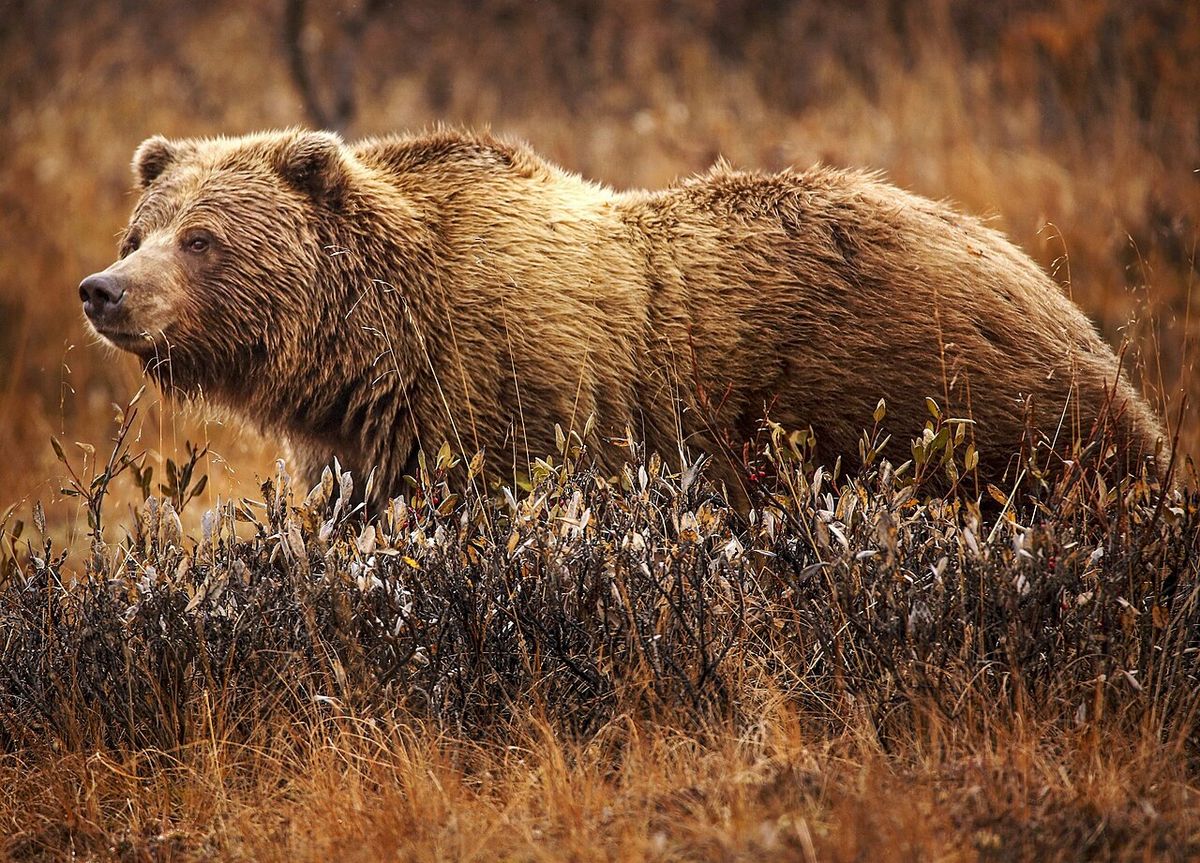
Grizzly bears are among the largest brown bear subspecies, typically surpassed only by Kodiak and Kamchatka brown bears. Their size exhibits significant geographic variation, largely influenced by diet. Coastal grizzlies from the Alaska Peninsula are the largest, with males averaging 389 kilograms and females 207 kilograms. In contrast, populations in northern interior Canada are much smaller, with males averaging 139 kilograms and females 95 kilograms, a size comparable to local American black bears. Average total length ranges from 198 to 240 centimetres, with a shoulder height around 102 centimetres. Newborn cubs are exceptionally small, often weighing less than 500 grams.
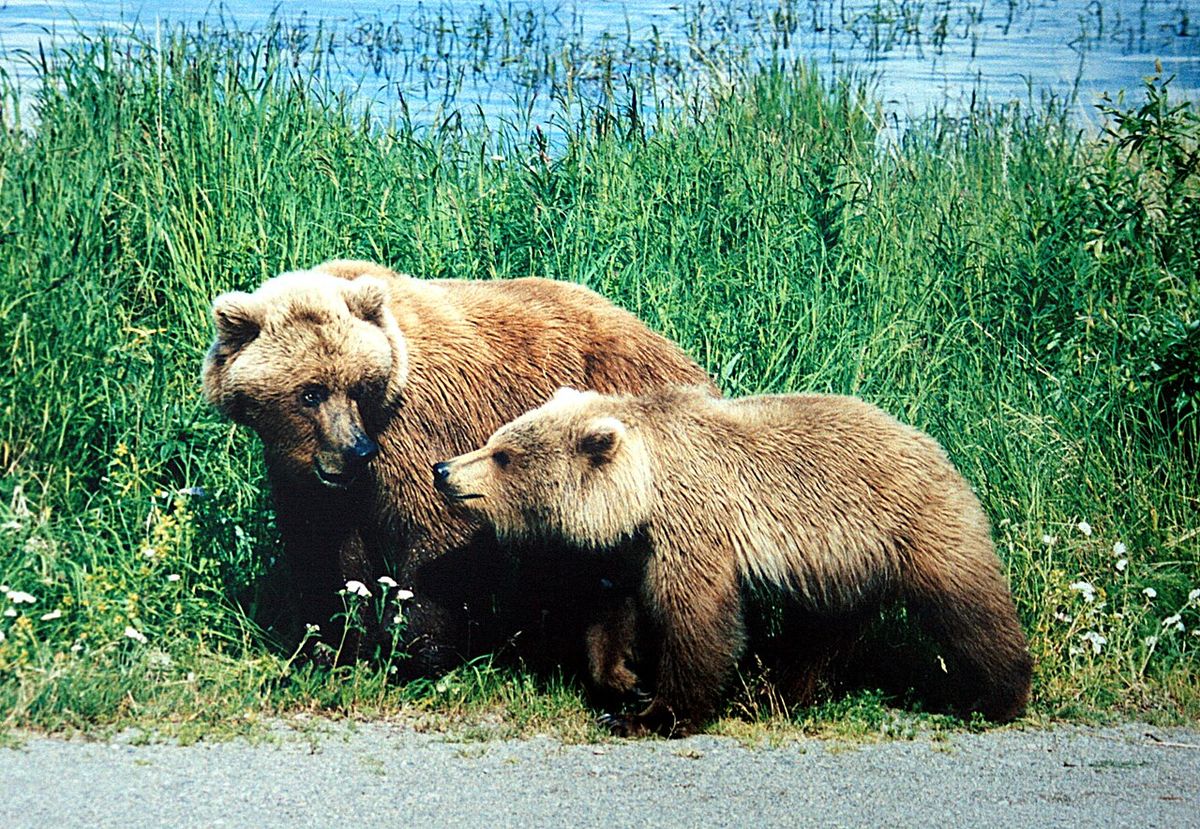
Grizzly bear fur ranges in colour from blond to nearly black but is most commonly brown with darker legs and white or blond-tipped guard hairs on the flanks and back, creating a grizzled appearance. Several key physical traits differentiate grizzlies from the black bears with which they share parts of their range. The most prominent is the large muscular hump on the shoulders, which is a mass of muscles used for digging. Grizzlies also have a concave or 'dished' facial profile and short, rounded ears, whereas black bears have a straighter profile and longer ears. A grizzly's rump is lower than its shoulders, while a black bear's rump is higher. Finally, grizzly front claws are formidable digging tools, measuring 51 to 102 millimetres in length, dramatically longer than the 25 to 51 millimetre claws of a black bear.
Range and Population in Canada
Historically, grizzly bears ranged across North America from Alaska down to Mexico and as far east as the western shores of Hudson Bay. Their range has since contracted significantly from these historical limits. In Canada, as of 2002, approximately 25,000 grizzlies occupied British Columbia, Alberta, the Yukon, the Northwest Territories, Nunavut, and the northern part of Manitoba. An article published in 1954 suggested they may have been present in the tundra areas of the Ungava Peninsula and the northern tip of Labrador-Quebec. The majority of Canada's grizzlies reside in British Columbia, which held an estimated 16,000 bears in 2008 and a revised count of 15,075 in 2012. This represents a significant decrease from the estimated 25,000 present at the time of European settlement, due primarily to hunting and habitat loss. British Columbia grizzlies still inhabit approximately 90% of their original territory within the province.
Population estimates for British Columbia are based on hair-snagging, DNA-based inventories, mark-and-recapture, and a refined multiple regression model. A notable 2003 sighting by researchers from the University of Alberta on Melville Island in the high Arctic represents the most northerly documentation of a grizzly bear. Across North America, an estimated 60,000 wild grizzly bears existed as of 2002. Alaska holds the largest single population at about 30,000 individuals, with densities highest along the protein-rich coast, such as on Admiralty Island which has 1,600 bears on a 1,600 square-mile island. Populations in the contiguous United States are much smaller and fragmented, with roughly 1,000 in the Northern Continental Divide ecosystem of Montana and another 1,000 in the Greater Yellowstone Ecosystem spanning Wyoming, Idaho and Montana.
Biology and Life Cycle
Grizzly bear biology is defined by seasonal cycles of intense feeding and prolonged hibernation. To prepare for winter denning, bears enter a state of hyperphagia, consuming vast amounts of food to gain approximately 180 kilograms of fat. They typically hibernate for five to seven months each year, though coastal bears with better access to food sources spend less time in dens and may skip hibernation altogether where food is plentiful year-round. Dens are typically at elevations above 1,800 metres on north-facing slopes, and bears often wait for a substantial snowstorm before entering to lessen the chances predators will find the den. During hibernation, bears do not eat, drink, defecate, or urinate, and females give birth to their offspring. The male grizzly bear's hibernation ends in early to mid March, while females emerge in April or early May.
Grizzly bears have one of the lowest reproductive rates of any terrestrial mammal in North America. Females do not reach sexual maturity until they are at least five years old. After mating in summer, embryo implantation is delayed until hibernation, and miscarriage can occur if the female does not receive proper nutrients. Litter size varies between one and four cubs, typically comprising twins or triplets. Cubs are always born in the mother's winter den while she is in hibernation and feed entirely on her milk until summer. They remain with their mother for up to two years, during which she will not mate, so a female may not produce another litter for three or more years. Males have large territories up to 4,000 square kilometres, making finding a female scent difficult in low population densities. The average lifespan is 22 years for males and 26 years for females, with the oldest known wild inland grizzly reaching about 34 years in Alaska and a coastal bear living to 39.
Diet and Foraging Behaviour
Although grizzlies are of the order Carnivora and have the digestive system of carnivores, they are normally omnivores with diets consisting of both plants and animals. Their diet includes a wide array of plant and animal matter, shifting with the seasons and local availability. They have been known to prey on large mammals such as moose, elk, caribou, white-tailed deer, mule deer, bighorn sheep, bison, and even black bears, though they are more likely to take calves and injured individuals rather than healthy adults. Grizzlies also prey on rodents, birds and their eggs, and are adept scavengers, feeding on carrion left behind by other animals. This dietary flexibility is key to their survival across diverse habitats. The most significant dietary divergence occurs between inland and coastal populations, leading to dramatic size differences.
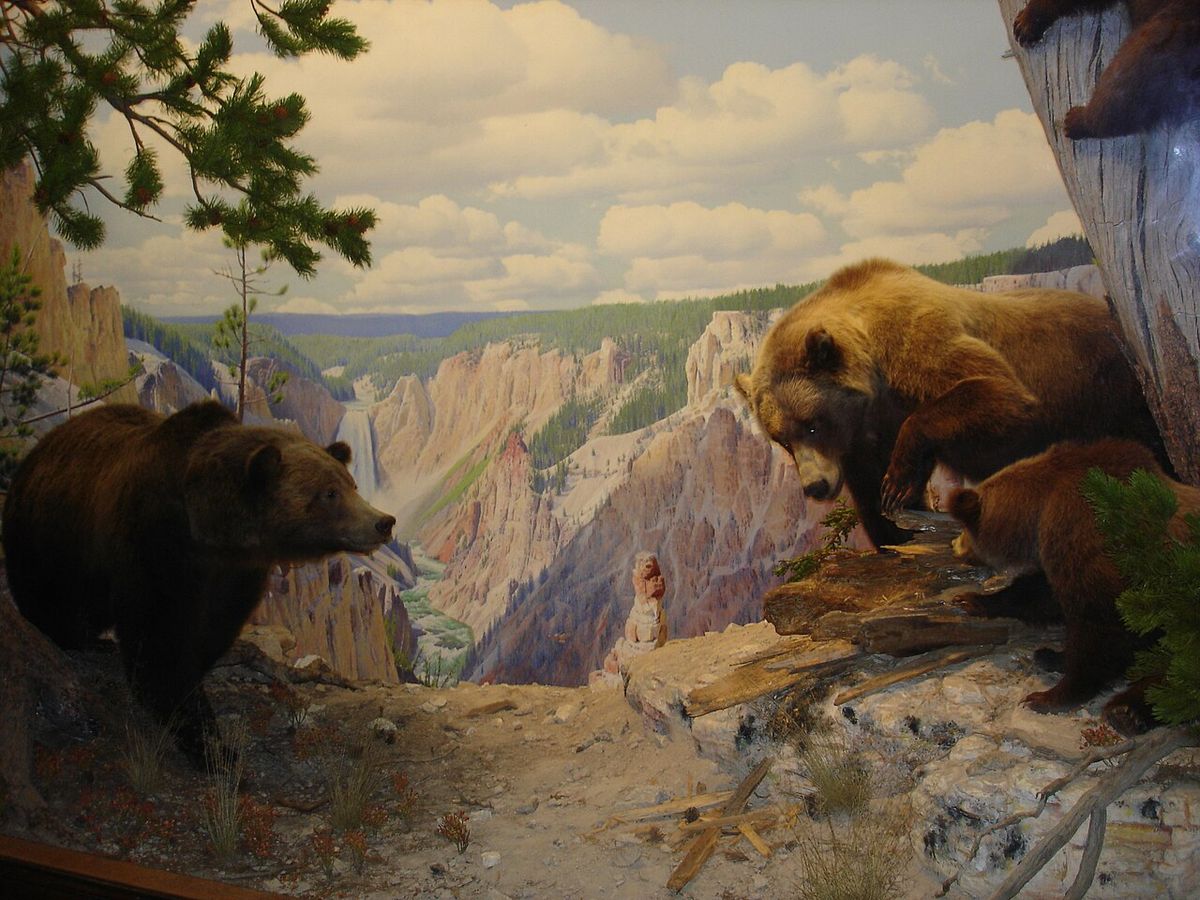
Inland grizzlies, such as those in Yellowstone National Park, rely on foods like whitebark pine nuts, tubers, grasses, various rodents, army cutworm moths, and scavenged carcasses. Coastal grizzlies in British Columbia and Alaska have access to far richer food sources, primarily salmon, trout, and bass, but also clams and other marine life. Salmon provide a high-fat diet that allows coastal bears to grow much larger. With the high fat content of salmon, it is not uncommon to encounter grizzlies in Alaska weighing 540 kilograms. Grizzlies exhibit skilled fishing behaviours, famously catching leaping salmon in their mouths at waterfalls like Brooks Falls in Katmai National Park and Preserve. They gather in large numbers at fishing sites to feed on spawning salmon, and big male grizzlies fight regularly for the best fishing spots at locations like Brooks Falls and McNeil Falls in Alaska.
- Large Mammals: Moose, elk, caribou, deer (often calves or injured adults).
- Fish: Salmon, trout, and bass, particularly during spawning runs.
- Plants: Berries, sedge grass, tubers, and whitebark pine nuts.
- Invertebrates: Army cutworm moths, clams.
- Other: Birds, eggs, carrion, and scavenged carcasses.
Conservation Status and Human Relations
The conservation status of the grizzly bear varies across its range, reflecting a history of range contraction and ongoing recovery efforts. The species is legally protected in Mexico, European countries, some areas of Canada, and in all of the United States. In Canada, the grizzly is not considered a nationally threatened species, but provincial management and conservation strategies are critical, especially in British Columbia which is home to the majority of the country's grizzlies. Habitat fragmentation due to development, forestry, and road construction continues to be a primary threat, potentially destabilizing populations through inbreeding depression.
Recovery of grizzly populations in areas where they have been extirpated, such as the Great Plains and the southwestern states, is expected to be a slow process due to the bear's slow reproductive habits and the effects of reintroducing such a large animal to areas prized for agriculture and livestock. In the North Cascades ecosystem of northern Washington, for example, grizzly bear populations are estimated to be fewer than 20 bears, but there is a long-term management plan to reintroduce the bears to North Cascades National Park. Human-bear conflicts, often arising from attractants like garbage, livestock, or fruit trees, remain a significant management challenge across the range. Education on bear-safe practices and the use of bear-proof containers are essential coexistence tools for communities living near grizzly habitat.
Population Estimates by Region
Grizzly bear population numbers are estimated using various methods, including DNA analysis from hair samples, mark-and-recapture studies, and statistical modeling. These figures are crucial for wildlife management and conservation planning. The following table provides a snapshot of key population estimates from different regions, illustrating the bear's distribution and the varying densities across its range. Other provinces and the United States may use a combination of methods for population estimates, so it is difficult to say precisely what methods were used to produce total continental figures.
| Region | Population Estimate | Notes / Year |
|---|---|---|
| North America (Total) | ~60,000 | As of 2002 |
| Alaska, USA | ~30,000 | Highest density along coast |
| Canada (Total) | Up to 29,000 | As of 2002 |
| British Columbia, CA | 15,075 | Revised count in 2012 |
| Northern Continental Divide (MT, USA) | ~1,000 | Ecosystem estimate |
| Greater Yellowstone Ecosystem (WY, ID, MT) | ~1,000 | Tri-state area estimate |
| North Cascades (WA, USA) | <20 | Ecosystem estimate, recovery plan in place |
Around 60,000 wild grizzly bears were located throughout North America as of 2002, with 30,000 of those found in Alaska. The majority of Canada's grizzlies live in British Columbia, which had an estimated 15,075 bears in 2012. In the lower 48 United States, small and isolated populations exist, such as the fewer than 20 bears estimated in the North Cascades ecosystem of northern Washington. There is a long-term management plan to reintroduce grizzly bears to North Cascades National Park. Population estimates are dynamic and are refined as new survey data, like DNA-based inventories, becomes available. These estimates inform ongoing conservation and management decisions for the species.
Questions about Grizzly bear
How many grizzly bears are there in Canada?
As of 2002, it was estimated that up to 29,000 grizzly bears live in Canada. The majority are found in British Columbia, which had a revised population count of 15,075 bears in 2012. Other Canadian populations exist in Alberta, the Yukon, the Northwest Territories, Nunavut, and northern Manitoba. These numbers represent a significant decrease from historical populations due to factors like habitat loss and hunting.
What is the difference between a grizzly bear and a black bear?
Several physical characteristics distinguish grizzly bears from black bears. Grizzlies have a pronounced muscular hump on their shoulders, which black bears lack. A grizzly's face profile is concave or 'dished', with short, rounded ears, while a black bear's face is straighter with longer ears. A grizzly's rump is lower than its shoulders, whereas a black bear's rump is higher. Finally, grizzly front claws are much longer (51-102 mm) and are adapted for digging, compared to the shorter claws (25-51 mm) of black bears.
What do grizzly bears eat?
Grizzly bears are omnivores with a highly varied diet. They eat plants like berries, grasses, tubers, and nuts, such as whitebark pine nuts. Animal prey includes large mammals like moose, elk, and deer (often targeting calves), as well as fish, especially salmon in coastal areas. They also consume rodents, birds, eggs, insects like army cutworm moths, and are frequent scavengers of carrion. Coastal bears with access to salmon and clams grow significantly larger than inland bears.
How long do grizzly bears hibernate?
Grizzly bears typically hibernate for five to seven months each year, depending on local climate and food availability. They prepare by entering a state of hyperphagia, gaining up to 180 kilograms of fat. During hibernation, they do not eat, drink, defecate, or urinate. Females give birth in the winter den. Coastal bears with access to food year-round may hibernate for shorter periods or skip it altogether. Males usually emerge in early to mid March, while females with new cubs emerge in April or early May.
Are grizzly bears endangered?
The grizzly bear is not considered endangered across its entire range, but its status varies by region. It has been extirpated from much of its historical range in the Great Plains, southwestern United States, and Mexico. In Canada, it is legally protected and managed by provinces. Populations in British Columbia are stable but lower than historical levels. In the contiguous United States, populations in areas like the Greater Yellowstone Ecosystem are protected under the Endangered Species Act, while very small populations, like in the North Cascades, are the focus of recovery plans.
How fast can a grizzly bear run?
Grizzly bears are capable of remarkable speed for their size. While anecdotal reports suggest speeds up to 56 km/h, the maximum speed reliably recorded, such as at Yellowstone National Park, is 48 km/h (30 mph). This speed, combined with their endurance, allows them to chase down prey over short distances. They are also adept climbers, especially as cubs and younger bears, and are powerful swimmers.
Sources and further reading
- Grizzly bear (Wikipedia)
- Grizzly bear, facts and photos (nationalgeographic.com)
- Grizzly Bear (defenders.org)
- Grizzly Bear (naturecanada.ca)
Checked by the Your Space Hamilton desk. Last updated 2026-10-19.