Elk
The elk (Cervus canadensis), also known by its Shawnee and Cree name wapiti, is a large species of deer native to North America and parts of Asia. It is the second largest extant deer species after the moose, distinguished by its impressive size, seasonal coat variations, and the large, branching antlers grown by males. The animal holds significant ecological, cultural, and economic importance in Canada, where it is found in provinces like British Columbia and Alberta, and is a prized game species for hunters. Elk are highly social, migratory herbivores whose adaptability has allowed them to thrive in various habitats, though this same trait poses challenges where they have been introduced outside their native range.
Naming and Etymology
The common name 'elk' has a complex history rooted in European linguistic confusion. By the 17th century, the original referent, the European moose (Alces alces), was long gone from the British Isles, leaving the word 'elk' vaguely meaning 'large deer' for English speakers. Early North American colonists, recognizing the similarity to the European red deer, often called Cervus canadensis 'red deer', as seen in texts by Richard Hakluyt in 1584 and John Smith in 1616. The more precise alternative name, 'wapiti', is derived from the Shawnee and Cree word 'waapiti', which translates to 'white rump', a direct reference to the distinctive light-coloured fur patch around the animal's tail. This name highlights a key identifying feature that the animals may fluff up as a signal during courtship, sparring, or when fleeing threats. The word 'elk' itself is of obscure etymology, possibly originating from Proto-Germanic roots and appearing in Old English as 'elch' or 'eolh' before evolving into its modern form.
Taxonomy and Subspecies
Elk are members of the genus Cervus, which first appears in the Eurasian fossil record about 25 million years ago during the Oligocene. For a long time, elk were classified as a subspecies of the European red deer (Cervus elaphus), but mitochondrial DNA studies beginning in 1998 and solidified by 2004 provided strong evidence that they are a distinct species, Cervus canadensis. Genetic evidence shows elk are more closely related to Thorold's deer and sika deer than to red deer, though the two can interbreed to produce fertile offspring, as has occurred in New Zealand's Fiordland National Park. Taxonomists have described numerous subspecies, though recent DNA analyses suggest there may be only three or four distinct groups. The traditional classification includes several North American and Asian subspecies, which vary in size, antler shape, and coloration based on their local environments and climatic factors.
In North America, four subspecies persist from the original six known historically. The Roosevelt elk (C. c. roosevelti), found in the Pacific Northwest and introduced to Alaska, is the largest. The Tule elk (C. c. nannodes) is native to California, while the Manitoban elk (C. c. manitobensis) and Rocky Mountain elk (C. c. nelsoni) inhabit central and western regions. The eastern elk (C. c. canadensis) and Merriam's elk (C. c. merriami) have been extinct for over a century. In Asia, notable subspecies include the Altai wapiti (C. c. sibiricus), the Tianshan wapiti (C. c. songaricus), and the distinctly darker Manchurian wapiti (C. c. xanthopygus). The Alashan wapiti (C. c. alashanicus) of northern Central China is the smallest and lightest-coloured subspecies. Some researchers argue the Manchurian wapiti may warrant classification as its own separate species.
- The Roosevelt elk (C. c. roosevelti), found in the Pacific Northwest and introduced to Alaska, is the largest.
- The Tule elk (C. c. nannodes) is native to California.
- The Manitoban elk (C. c. manitobensis) inhabits central regions.
- The Rocky Mountain elk (C. c. nelsoni) is found in western regions.
- The eastern elk (C. c. canadensis) has been extinct for over a century.
- Merriam's elk (C. c. merriami), which once ranged into Mexico, has been extinct for over a century.
Physical Characteristics
Elk are imposing animals with thick bodies, slender legs, and short tails. Their size varies significantly by sex and subspecies, with a shoulder height ranging from 0.75 to 1.5 metres and a nose-to-tail length of 1.6 to 2.7 metres. Males, known as bulls, are substantially larger than females, or cows, with weights between 178 and 497 kilograms, while females weigh between 171 and 292 kilograms. The Roosevelt elk is the largest subspecies, with the biggest Alaskan males estimated to weigh up to 600 kilograms, though a more typical range is 318 to 499 kilograms for bulls. The most distinctive feature of male elk is their large antlers, which are made of bone and can grow at an astonishing rate of 2.5 centimetres per day while covered in a soft, vascularized layer called velvet. Antlers are shed annually in late winter or early spring when testosterone levels drop, with mature bulls typically having around six tines on each antler. Roosevelt bull antlers can be particularly massive, weighing up to 18 kilograms.
Elk coats change with the seasons, providing both camouflage and insulation. In winter, they grow a thicker, grey or lighter-coloured coat, which is shed by early summer for a more reddish, darker summer coat. Subspecies in arid climates tend to have lighter coats than their forest-dwelling counterparts. All elk have a clearly defined, light-coloured rump patch and a short tail, with North American individuals of both sexes growing thin neck manes. Calves are born spotted, a common trait among deer species, and lose these spots by the end of their first summer. Adult Manchurian wapiti may retain a few orange spots on their backs into older age, a trait shared with some European red deer populations.
Behaviour and Social Structure
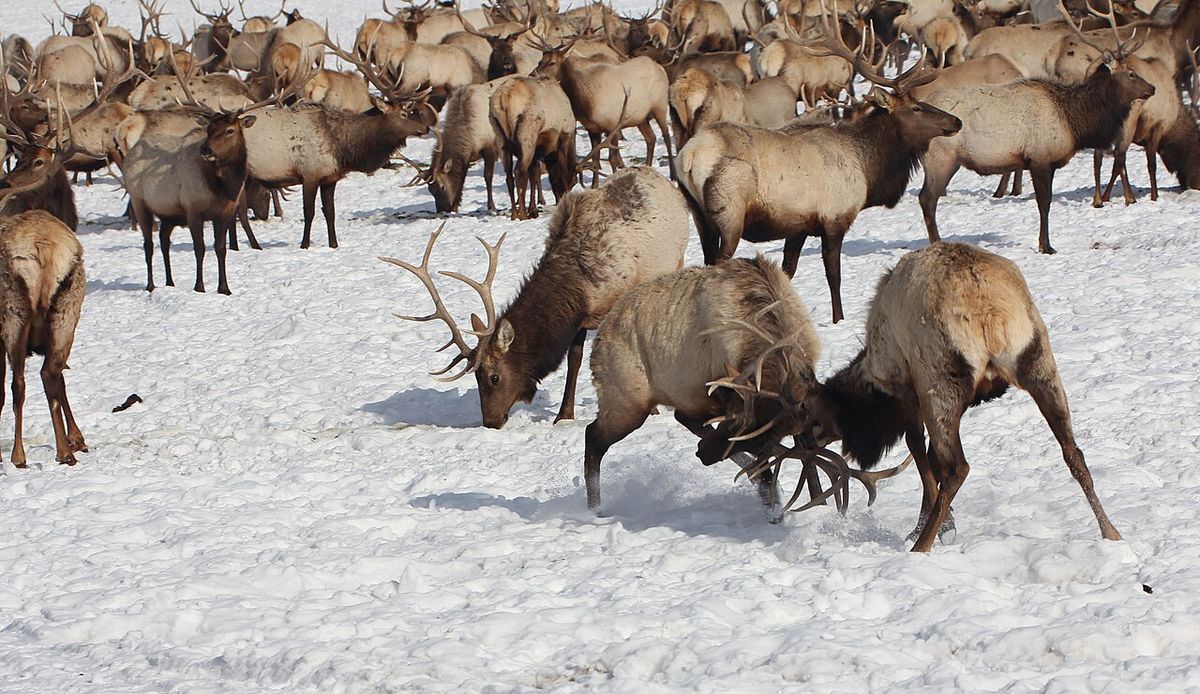
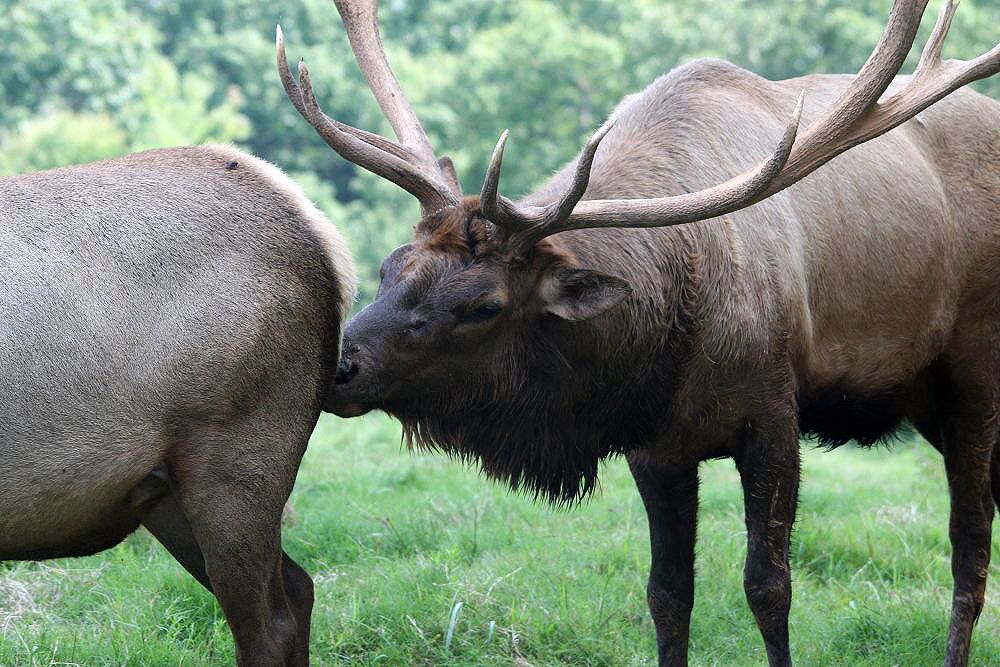
Elk are highly gregarious deer, forming large herds that can number up to 400 individuals during the summer months. For most of the year, adult males and females are segregated, with cows and calves forming larger herds and bulls forming smaller groups or travelling alone. Younger bulls may associate with older males or female groups. The social dynamic shifts dramatically during the late summer and autumn mating season, known as the rut, when bulls compete for access to harems of cows. Dominant bulls, which may gather harems of 20 or more cows, use a combination of vocal displays and physical intimidation to ward off rivals. The most recognizable behaviour is bugling, a loud, high-pitched whistle-like vocalization that can reach frequencies of 4000 Hz and serves to advertise a male's fitness over long distances. If intimidation fails, bulls will engage in antler wrestling, which can sometimes lead to serious injuries. Cows use an alarm bark to alert the herd to danger, and calves produce a high-pitched scream when attacked.
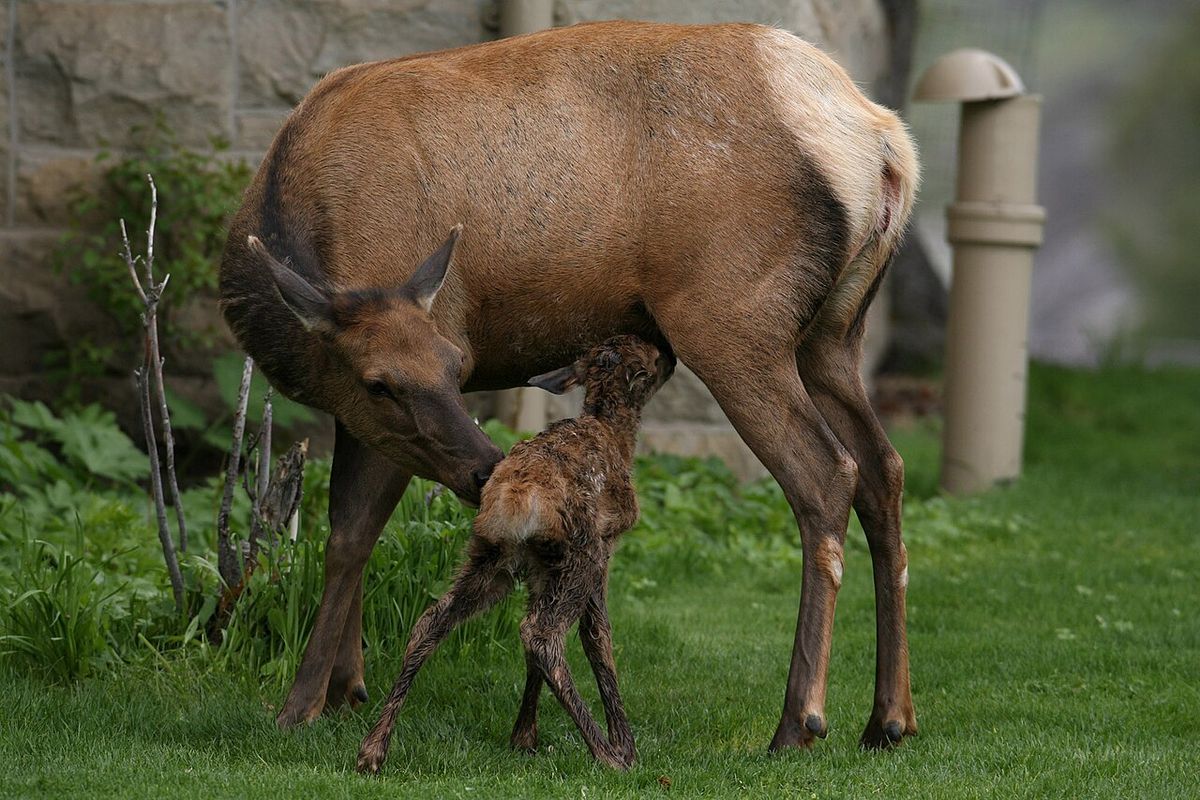
The reproductive cycle is intense and brief. Female elk have an estrus cycle lasting only a day or two, and matings involve numerous attempts. Dominant bulls diligently guard their harems, using herding behaviour to keep cows within a defined range and engaging in courtship rituals to test for receptivity. Younger, less dominant 'spike bulls', named for their unbranched antlers, often harass unguarded cows but are typically chased away by dominant males and have lower reproductive success. Bulls also engage in unique behaviours like creating wallows, where they urinate and roll to coat themselves in a distinct scent that attracts females. The gestation period lasts eight to nine months, after which a single calf, weighing about 16 kilograms, is usually born. Cows isolate themselves to give birth and remain secluded until the calf is large enough to evade predators, rejoining the herd after about two weeks. Elk calves are as large as an adult white-tailed deer by six months old, and they leave their birth ranges before three years of age, with males dispersing more often than females.
Habitat, Diet, and Migration
Elk are adaptable herbivores that inhabit open forests and forest-edge habitats. They are ruminants with a four-chambered stomach, and their diet reflects a mixed feeding strategy. Primarily grazers like cattle, they feed on grasses year-round, but they also browse on leaves, twigs, and bark, especially in winter when grasses are less available. Their winter diet includes the bark of trees such as cedar, hemlock, pine, and maple. Elk typically feed most actively during the mornings and evenings, seeking sheltered areas to rest and ruminate during the day. They do not rely on thermal cover for warmth in winter, instead favouring wooded areas for the greater availability of food.
Migration is a key aspect of elk ecology, particularly for populations in mountainous regions. They follow a seasonal pattern, moving to higher altitudes in the spring as snow retreats and descending to lower valleys in the fall. Hunting pressure can significantly influence these movement patterns. One of the most notable migrations occurs in the Greater Yellowstone Ecosystem, which supports herds totalling up to 40,000 individuals. The elk in this region undertake the longest migration in the continental United States, travelling as far as 270 kilometres between their summer and winter ranges. The Teton herd, numbering between 9,000 and 13,000 animals, winters on the National Elk Refuge after migrating south from Yellowstone National Park and west from the Shoshone and Bridger-Teton National Forests. Elk are herbivores that browse on higher-growing plants, including leaves, twigs, and bark, especially during winter. They dwell in open forest and forest-edge habitats where such vegetation is available. This browsing behavior is part of their adaptation to seasonal changes in food availability.
- Cedar
- Eastern hemlock
- Wintergreen
- Sumac
- Jack pine
- Red maple
- Staghorn sumac
- Basswood
Distribution, Conservation, and Human Interaction
The native range of the elk spans North America and parts of Central and East Asia, though prehistoric populations were more widespread across Eurasia and into Western Europe during the Late Pleistocene. In North America, their distribution has contracted since European settlement, with the extinction of the eastern and Merriam's elk subspecies. Today, healthy populations exist in western Canada and the United States, particularly in regions like British Columbia and the Rocky Mountains. Elk have also been successfully introduced to countries outside their native range, including Argentina and New Zealand, where their adaptability has sometimes led them to become invasive threats to local ecosystems and endemic species. Their history demonstrates a significant range reduction, as they once roamed as far south as Mexico and into Western Europe during the Late Pleistocene, surviving into the early Holocene in Southern Sweden and the Alps.
Elk interact with humans in multiple, sometimes conflicting, ways. They are a major game species across their range, valued for their meat, which is lean and higher in protein than beef or chicken, and as a trophy animal. In parts of Asia, elk antlers and velvet are used in traditional medicines, and a commercial industry for ground antler supplements thrives in countries like China, the United States, and Canada. Some cultures also attribute spiritual significance to the elk. From a conservation and agricultural perspective, elk can carry infectious diseases transmissible to domestic livestock, leading to ongoing, though mixed-success, management efforts such as vaccination programs. Their ability to adapt to human-altered landscapes, while a demonstration of their resilience, also creates challenges in managing populations to balance ecological health, agricultural interests, and recreational hunting.
The wapiti, or elk, has been successfully introduced to countries outside its natural native range of North America and Central and East Asia. These introduced locations include Argentina and New Zealand. The animal's adaptability in these new areas can be so successful that it may threaten sensitive endemic ecosystems and species. This introduction demonstrates the elk's capacity to thrive in non-native environments. The production of ground antler and velvet supplements is a thriving naturopathic industry in several countries. Antlers and velvet are used in traditional medicines in parts of Asia. This commercial use derives from the annual antlers grown by male elk, which are shed each year.
- United States
- China
- Canada
Questions about Elk
What is the difference between an elk and a moose?
Elk and moose are both large members of the deer family but are distinct species. The moose (Alces alces) is the largest deer species, with a characteristic drooping snout and broad, palmate antlers. The elk (Cervus canadensis) is the second largest, with a more slender build, a distinctive light-coloured rump patch, and large, branching antlers with multiple points. Historically, European colonists used the word 'elk' to refer to the moose, which caused confusion that persists in naming today.
Why are elk called wapiti?
The name 'wapiti' is derived from a Shawnee and Cree word meaning 'white rump'. This name references the distinctive light fur around the tail region of the animal. The animals may raise this white rump to signal agitation or distress. The term provides an alternative to 'elk', which originally referred to the European moose, helping to avoid confusion.
How big do elk get?
Elk size varies by sex and subspecies. Bulls are significantly larger than cows, with males weighing between 178 and 497 kilograms and females between 171 and 292 kilograms. Shoulder height ranges from 0.75 to 1.5 metres. The Roosevelt elk subspecies is the largest, with some large males in introduced Alaskan populations estimated to weigh up to 600 kilograms, though 318 to 499 kilograms is more typical for this subspecies.
What do elk eat?
Elk are ruminants and primarily grazers, meaning they eat grasses year-round. However, they also browse on higher-growing vegetation. Their diet changes with the seasons. In winter, when grasses are scarce, they consume the bark and twigs of trees such as cedar, hemlock, pine, and maple. They feed most actively during the mornings and evenings, resting in sheltered areas to digest their food during the day.
What is elk bugling?
Bugling is the loud, high-pitched vocalization made by bull elk, especially during the autumn mating season (rut). It is a series of throaty whistles, bellows, and screams that can reach frequencies of 4000 Hz. The bugle serves to advertise a male's fitness and dominance to rival bulls over long distances and to attract females. It is produced by blowing air from the glottis through the nasal cavities.
Where can you find elk in Canada?
In Canada, elk are found primarily in western provinces. The Roosevelt elk inhabits coastal regions of British Columbia. Rocky Mountain and Manitoban elk subspecies are found in the interior and prairie regions of British Columbia, Alberta, Saskatchewan, and Manitoba. They occupy open forest and forest-edge habitats, and some populations undertake significant seasonal migrations between mountain summer ranges and lower valley winter ranges.
Sources and further reading
- Elk (Wikipedia)
- Elk (nationalgeographic.com)
- Elk in Banff National Park (parks.canada.ca)
- North American Elk (hww.ca)
- Cervus elaphus (elk) | INFORMATION (animaldiversity.org)
Checked by the Your Space Hamilton desk. Last updated 2026-10-19.