Dolichovespula maculata
The bald-faced hornet ( Dolichovespula maculata ) is a large, distinctive species of wasp native to North America, including widespread regions across Canada. Despite its common name, it is not a true hornet but an aerial yellowjacket, recognized by its stark black body and white-marked face, legs, and abdomen. This eusocial insect constructs large, grey, papery nests suspended in trees and shrubs, with colonies that can contain up to 700 workers, the largest in its genus. While beneficial as a pollinator and predator of pest insects like flies and caterpillars, the bald-faced hornet is known for its aggressive defence of its nest, delivering painful, repeated stings to perceived threats.
Taxonomy and identification
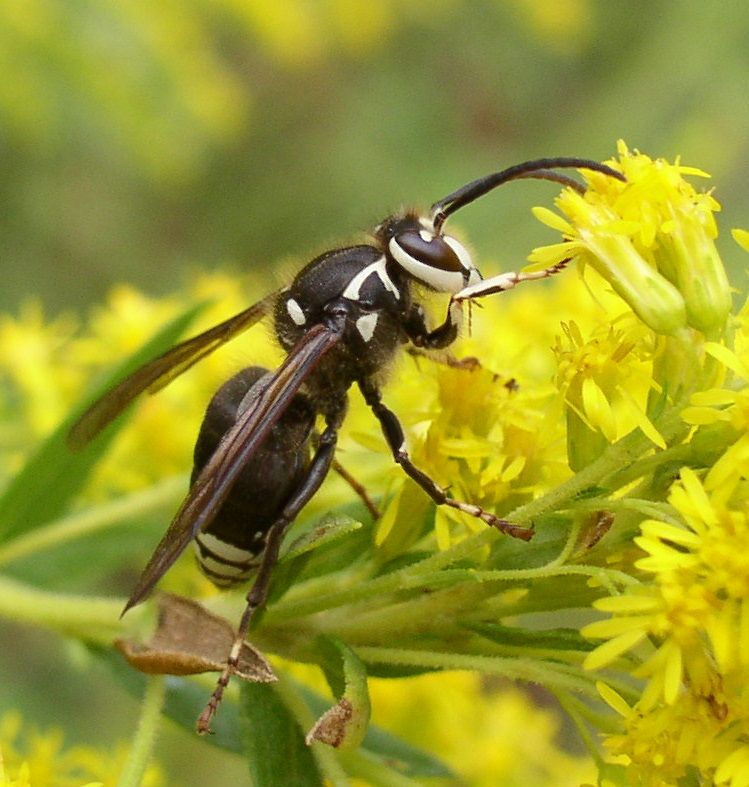
The bald-faced hornet was first scientifically described by Carl Linnaeus in his 1763 work Centuria Insectorum. Its common name derives from the characteristic white, or 'piebald', markings on its face, a feature that distinguishes it from most other yellowjackets, which are typically black and yellow. Taxonomically, it belongs to the cosmopolitan family Vespidae and the genus Dolichovespula, a group known as aerial yellowjackets and one of seven or eight such species in North America. It is the largest species within this genus, with queens reaching 18 to 20 millimetres in body length, while males measure between 13.5 and 16.0 millimetres. The insect's colouration is a striking deep black with white markings on the face, thorax, legs, and the end of the abdomen, and it has brown wings and eyes. Males can be differentiated by white markings on the first abdominal segment and by having 13-segmented antennae and 7-segmented abdomens, compared to the females' 12-segmented antennae and 6-segmented abdomens. The species is also known by numerous other colloquial names including bald-faced aerial yellowjacket, blackjacket, white-tailed hornet, spruce wasp, and bull wasp.
Habitat and distribution
The bald-faced hornet is found throughout the contiguous United States and the District of Columbia, throughout Canada, and in Alaska. It is absent only from the driest parts of the Great Plains region and is most common in the southeastern United States. In Canada, it is widespread in forested areas and is also commonly found in urban vegetation. The species builds its characteristic nests in a variety of locations, preferring trees and bushes but also utilizing rock overhangs and the sides of buildings. Nests have been recorded at heights ranging from 0.3 metres to as high as 20 metres above ground level, and in Pennsylvania they can be found in trees as high as 60 feet. This nesting habit differentiates it from ground-nesting yellowjackets and contributes to its visibility, especially in late summer when nests reach their maximum size. In Pennsylvania, it is the most common species in the genus Dolichovespula. The nests are typically located at least three feet off the ground.
Nest construction and colony life
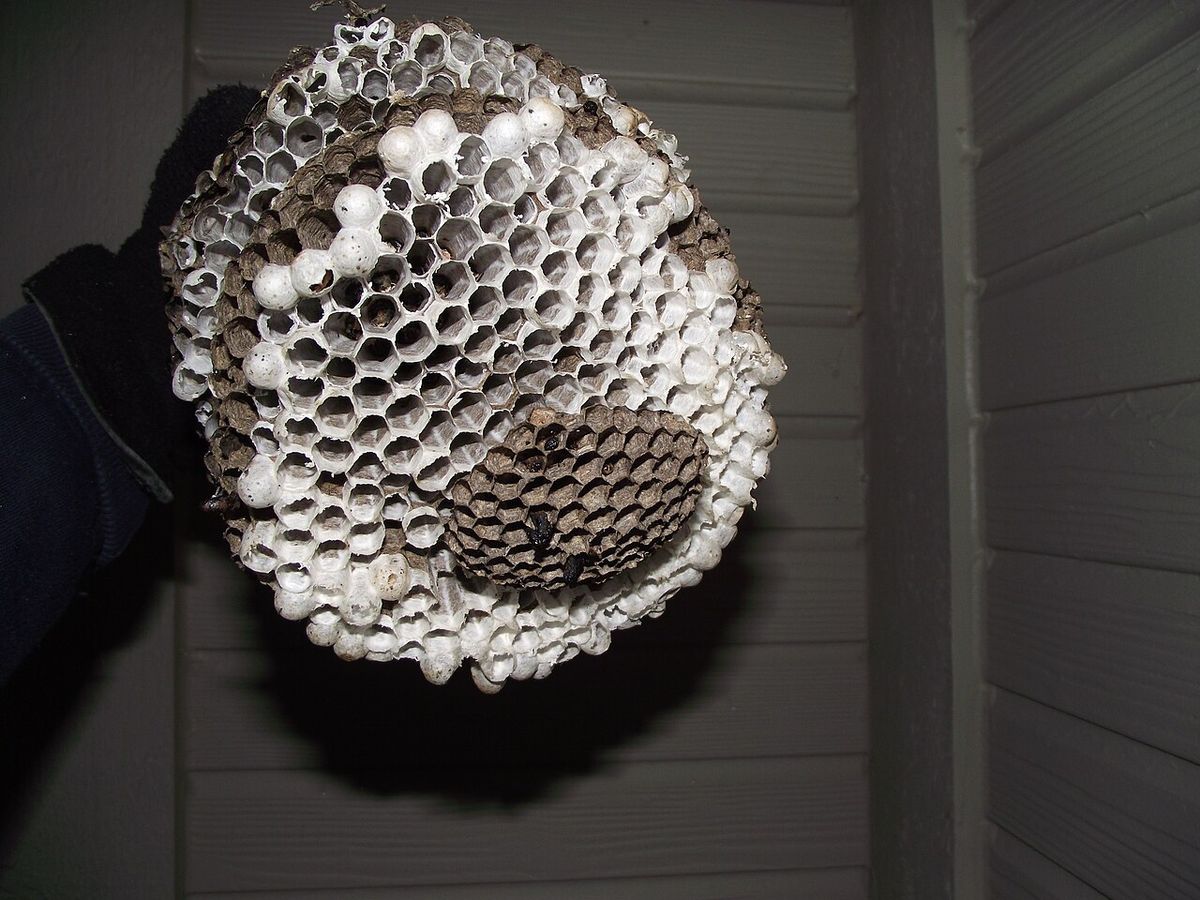
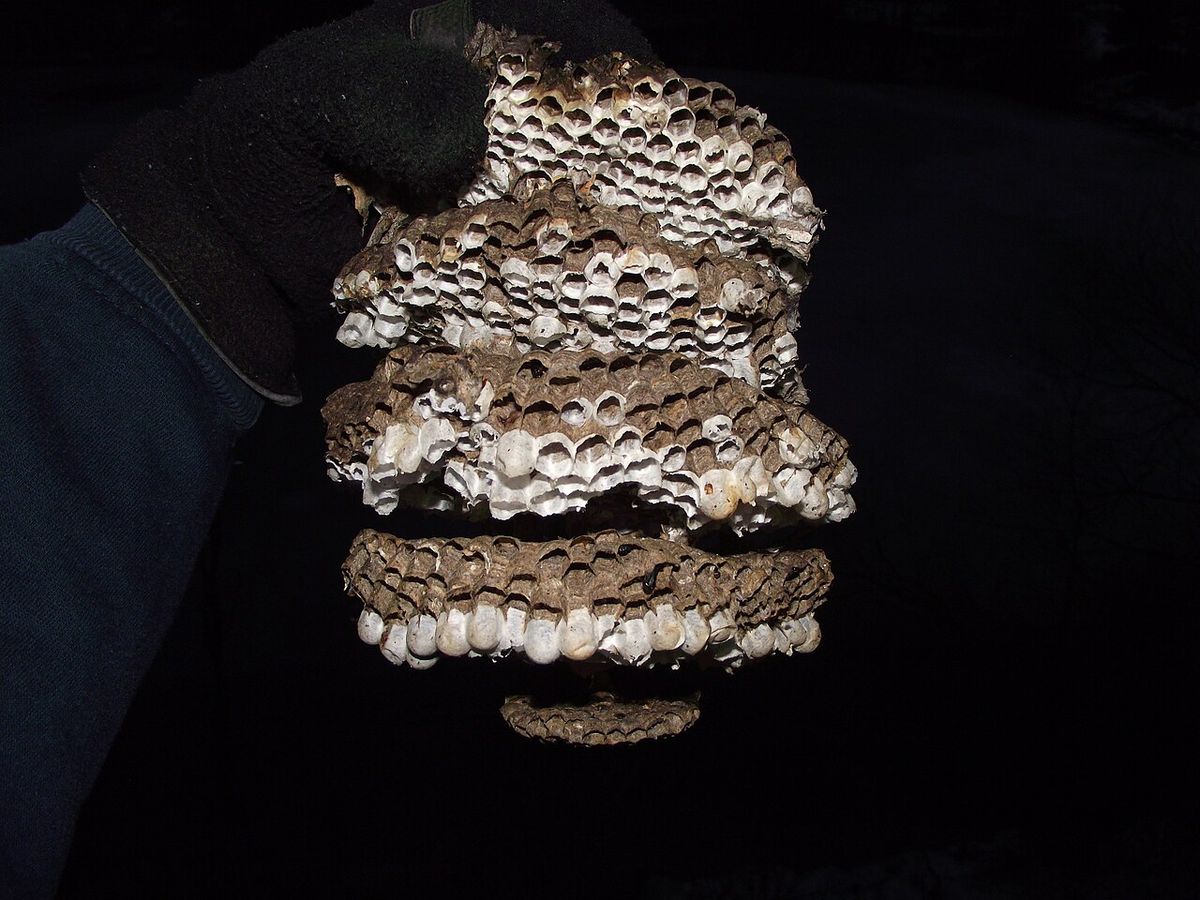
Each nest is founded in the spring by a single overwintered, fertilized queen. The queen selects a site in an open area near trees and begins constructing the nest by chewing weathered wood fibres from sources like old buildings, fence posts, or dead wood, mixing them with water and secretions from her mandibular glands to create a grey, papery pulp. She forms this into the initial brood cells, lays eggs, and feeds the first generation of larvae. These larvae develop into sterile female workers, which then take over all nest expansion, foraging, and defence duties. The colony cycle progresses through three distinct biological stages. The founding stage lasts approximately 23 to 24 days, encompassing a 6-day egg incubation, an 8-day larval growth period, and a 9 to 10 day pupation before the first workers emerge. During the ergonomic stage, workers focus on cell building and raising more workers, while the queen dedicates herself solely to egg laying. The reproductive stage begins before the midpoint of the colony's life, marked by the colony investing energy in producing reproductives. In a sampling from Maryland, workers were produced from mid-April to early October, and reproductives from mid-July through the end of November. The colony's lifespan varies significantly by latitude, lasting about four months (122 days) in Washington state, five months (153 days) in Indiana, and between 155 and 170 days in central California. In Pennsylvania, colonies can grow to have upwards of 300 individuals, while the largest recorded colonies in the genus contain 400 to 700 workers. By mid-autumn, the original queen, workers, and males die, leaving only the newly fertilized queens to overwinter in protected places like hollow trees, under bark, rock piles, or in building attics and walls, and begin the cycle anew the following spring.
Diet and foraging ecology
Bald-faced hornets are omnivorous, and their diet shifts throughout the season and varies between life cycle stages. Early in the spring and summer, their diet is protein-rich, consisting of live prey captured to feed the developing larvae. They are effective predators of flies, caterpillars, spiders, and many other types of insects, including other yellowjackets. Some nests accumulate so many yellowjacket remains that the interior takes on a yellowish cast. As the season progresses and there are fewer larvae to feed, the workers increasingly consume carbohydrates. They drink flower nectar, which they also feed to their larvae, and feed on tree sap, particularly from birch trees, and fruit pulp from apples and other fruits. This nectar foraging results in incidental pollination of flowers. The species is also known to scavenge from dead prey and raw meat when other resources are scarce. Adults communicate about food sources and nest safety using a combination of touch, vision, chemical pheromones, and wing vibrations. Like other bees, they can see ultraviolet light, which aids in foraging. Their role as predators provides significant biological control, helping to manage populations of foliage and seed-eating insects that can damage plants and agricultural crops.
Defensive behaviour and human interaction
Bald-faced hornets are known for their aggressive defence of the nest, though they are generally less aggressive than some smaller yellowjacket species when foraging individually. Workers will vigorously defend the nest by stinging repeatedly, a common trait among social wasps and bees. They possess a unique defensive adaptation among yellowjackets: the ability to squirt or spray venom from their stinger into the eyes of vertebrate intruders. This venom causes immediate watering of the eyes and temporary blindness. Nests located within approximately three metres of human activity, such as near building entrances, under low eaves, or in shrubbery next to a frequently mowed lawn, pose a significant sting risk. For individuals with known sensitivities to wasp and bee stings, any nest close to a home should be removed by professional pest management personnel. For those without medical concerns, control can be attempted using a 'wasp and hornet' spray applied directly into the nest opening at night. It is critical to spray the insecticide directly into the hole while holding the nozzle against it, as spraying only the exterior will anger the colony and increase the risk of stings in the following days. Protective clothing including long sleeves, long rubber gloves, and goggles is advisable during such an application.
Social organization and reproductive conflict
The colony is divided into a reproductive caste of one or more queens, a workforce of sterile female workers, and haploid males. All female larvae hatch with reproductive capacities, but their ultimate caste is determined by larval feeding regimens. The species is characterized by low paternity, worker reproduction, and consequent queen-worker conflict. Due to the haplodiploid sex determination system, workers are more genetically related to their own sons and to other workers' sons than to the queen's sons. This divergent genetic interest disrupts social organization and leads to intranest struggle for control. Workers are unable to mate, but their unfertilized eggs become males. Research on seven nests found that workers produced 20.9 percent of the male offspring, a percentage that did not correlate with the time of collection or colony size. Because worker relatedness is high, worker policing of egg production does not occur. However, the queen maintains a near monopoly on male production because worker reproduction is costly and reduces total colony reproduction, acting as a selective pressure for workers to exercise reproductive restraint. This conflict can escalate to matricide, where workers kill the queen after sufficient workers have been raised and queen-destined eggs have been laid. In a study of 19 nests during the reproductive phase, 14 nests did not have a queen, though matricide has not been directly observed. Cuticular hydrocarbons, which vary between species, nests, and castes, serve as a barrier to moisture diffusion and are a proposed mechanism for nest-mate recognition and caste differentiation. Analysis from northeastern Georgia showed the dominant hydrocarbons on workers were n-alkanes and methyl-branched alkanes with a C27 or C29 backbone, including n-heptacosane (28%) and 11-13-methylheptacosane (15%), while nonacosene composed 34% of the queen's cuticular lipids.
Detailed annual life cycle
The bald-faced hornet exhibits a complete annual colony cycle driven by the seasons. In the spring, fertilized queens that have overwintered in sheltered locations become active. They seek a nesting site, often high above the ground, and begin the solitary work of building the initial nest structure and laying the first batch of eggs. The queen feeds these first larvae until they mature into the initial worker force. This founding stage typically lasts 23 to 24 days. Once workers emerge, the colony enters the ergonomic stage, where worker numbers increase rapidly, and the nest is expanded. The queen retreats to a full-time egg-laying role. The transition to the reproductive stage occurs before the colony's midpoint, when resources are diverted to producing new males and queens. The timing of these stages varies geographically, as shown in the table below, which compares key events across different regions of North America.
| Region | Nest Initiation | Colony Termination |
|---|---|---|
| Washington State | Mid-May | Mid-September |
| Indiana | Early May | Late September |
| Central California | Late March | Late August / Early September |
| Central Pennsylvania | Spring | Mid-October |
After pupation, the new reproductive males and queens leave the nest to mate. Males die shortly after mating. The fertilized new queens then find sheltered spots to overwinter, while the original queen, all workers, and the remaining males die with the first hard frost. The nest is abandoned and decomposes over the winter, never to be reused. Active colonies have been documented in western Oregon on the Middle Fork Willamette River as late as October 28, 2022.
Parasites and population threats
The primary documented parasite of the bald-faced hornet is the female bee moth (Aphomia sociella). This moth lays its eggs inside the hornet nests, and the hatched larvae proceed to feed on the eggs, larvae, and pupae left unprotected by the wasps. The moth larvae tunnel throughout the nest looking for food, which can destroy large parts of the colony structure and its brood. Beyond this external parasite, the colony faces internal threats from the reproductive conflict between the queen and workers, which can limit the colony's overall reproductive success. An early switching time from worker production to reproductive production is highly adaptive for social-wasp colonies as it limits the risk of total loss from predation or early frost. The colony's workforce must remain high late into the season to maintain the food stores and defence needed to successfully rear the reproductive caste. Colonies whose workforce diminishes too early suffer a greater overall loss in reproductives. The species' annual cycle means the entire colony, save for the overwintering queens, is inherently ephemeral, with the old queen dying around mid-autumn alongside her workers.
Questions about Dolichovespula maculata
Are bald-faced hornets dangerous?
Bald-faced hornets can be dangerous due to their aggressive defence of their nest. Workers will sting repeatedly if the nest is threatened, and they possess a unique ability to spray venom into the eyes of intruders, causing temporary blindness. However, they are generally less aggressive when foraging away from the nest. For individuals with known allergies to wasp stings, a nest close to human activity poses a significant health risk and should be removed by professional pest control personnel.
What should I do if I find a bald-faced hornet nest on my property?
If the nest is located high in a tree or in an area not frequented by people, it is best left alone, as these wasps are beneficial pollinators and predators. If the nest is within about three metres of a building entrance, under a low eave, or in a shrub near a lawn, it may need to be managed. Those without sting allergies can use a wasp and hornet spray at night, applying it directly into the nest opening while wearing protective clothing like long sleeves, rubber gloves, and goggles. For safety, especially with large nests, hiring a professional pest control company is strongly recommended.
What is the difference between a bald-faced hornet and a true hornet?
The bald-faced hornet is not a true hornet. True hornets belong to the genus Vespa, with the European hornet (Vespa crabro) being the only species in North America, and it is an accidentally introduced insect. The bald-faced hornet is a species of yellowjacket in the genus Dolichovespula. Key differences include its black and white colouration compared to the brown and yellow of the European hornet, and its habit of building large, exposed, aerial nests, whereas European hornets often nest in hollow trees or wall cavities.
What benefits do bald-faced hornets provide?
Bald-faced hornets provide two major ecological benefits. First, they are important predators, feeding on a wide range of insects including flies, caterpillars, and spiders, which helps control pest populations in gardens, forests, and agricultural areas. Second, while foraging for nectar to feed themselves and their larvae, they act as pollinators for various flowering plants. Their role in the ecosystem makes them a beneficial species where they do not directly conflict with human activity.
Do bald-faced hornets reuse their nests?
No, bald-faced hornets do not reuse their nests. Each nest is founded anew in the spring by a single queen. The colony uses the nest for one season only, with all inhabitants except the new fertilized queens dying in the autumn. The abandoned paper nest decomposes over the winter and is not recolonized the following year. New queens will establish entirely new nests in different locations the next spring.
How can I identify a bald-faced hornet?
A bald-faced hornet is identified by its striking black and white colouring, including a white or 'bald faced' head and three white stripes at the end of its body. It is notably larger than other Dolichovespula species, with adults averaging about 19 millimetres in length, and queens measuring 18 to 20 millimetres. The species can also be recognized by its characteristic large hanging paper nest, which is egg-shaped, up to 58 centimetres in length, and covered by a mottled gray paper envelope. These nests are typically located in trees and bushes, or occasionally on buildings. The insect's appearance distinguishes it from the mostly black and yellow members of its genus.
Sources and further reading
- Dolichovespula maculata (Wikipedia)
- Dolichovespula maculata | INFORMATION (animaldiversity.org)
- Bald-faced Hornet (Dolichovespula maculata) (quoguewildliferefuge.org)
- Baldfaced Hornet (extension.psu.edu)
Checked by the Your Space Hamilton desk. Last updated 2026-10-21.