Canada jay
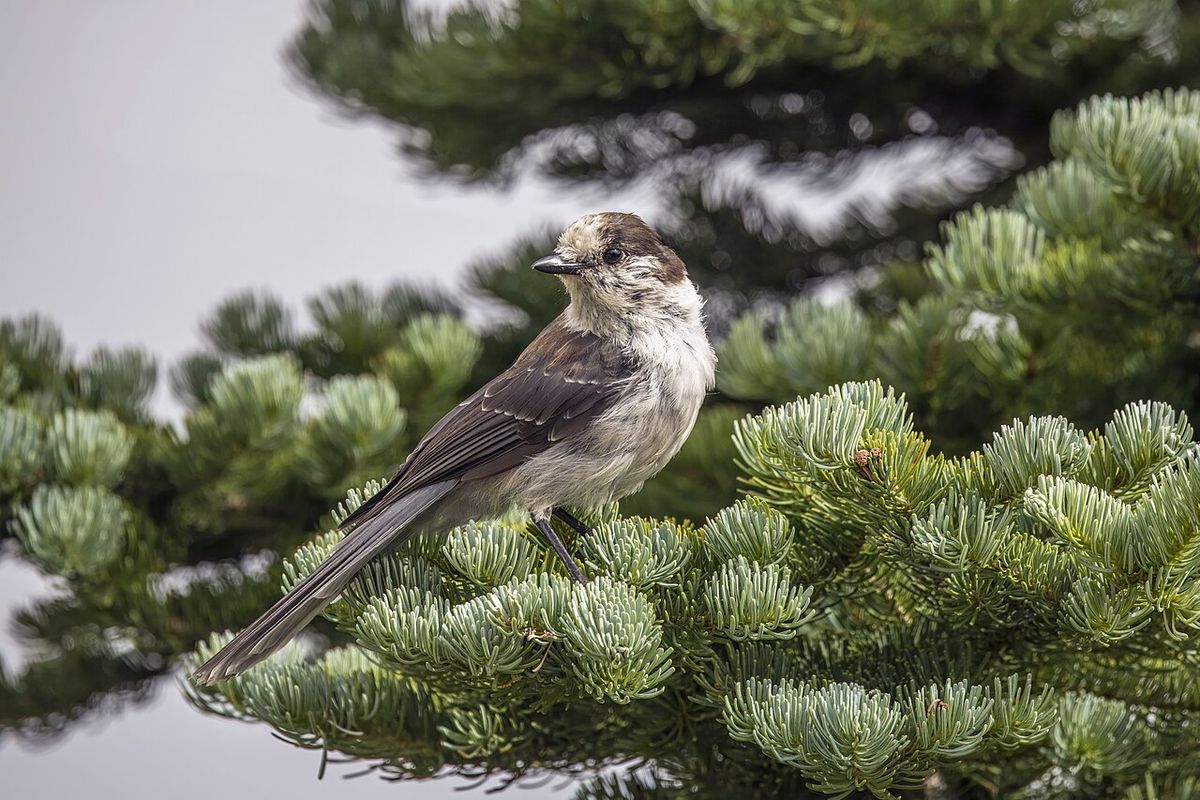
The Canada jay (Perisoreus canadensis) is a medium-sized, fluffy songbird native to the boreal forests of North America. Recognizable by its soft grey plumage, pale face, and darker grey cap, this bird is a year-round resident across all Canadian provinces and territories. It is renowned for its bold, curious nature, often approaching humans in the wild, and for its unique survival strategy of caching perishable food to endure harsh winters. In 2016, it was selected as Canada's national bird in a poll by Canadian Geographic, though the designation remains informal.
Taxonomy and evolutionary history
The species was first formally described by Carl Linnaeus in 1766, who named it Corvus canadensis based on a specimen from Canada described earlier by French zoologist Mathurin Jacques Brisson. It was later placed in the genus Perisoreus by French ornithologist Charles Lucien Bonaparte in 1838, along with the Siberian jay. The Canada jay belongs to the crow and jay family Corvidae, but genetic studies show it and its genus are more closely related to the magpie genus Cyanopica than to other birds called jays. Its ancestors are thought to have diverged from Eurasian relatives and crossed the Bering land bridge into North America.
A comprehensive 2012 genetic study revealed four distinct evolutionary clades across the Canada jay's range. The widespread 'boreal' or 'taiga' clade ranges from Alaska to Newfoundland and south to the Black Hills and New England. The 'transcascade' clade is found in eastern Washington and Oregon, ranging into Alberta and Montana. The 'Rocky Mountains (Colorado)' clade is located in the southern Rocky Mountains, and the 'Pacific' clade inhabits coastal British Columbia, Washington, and southwestern Oregon. Genetic dating suggests the Pacific clade diverged from the common ancestor of the other clades around three million years ago in the Late Pliocene. The genetic diversity within the boreal clade indicates Canada jays retreated to multiple refugia during past ice ages before recolonizing the region.
- First description: Mathurin Jacques Brisson, 1760 (French name: Le geay brun de Canada).
- Binomial name: Coined by Carl Linnaeus, 1766 (Corvus canadensis).
- Genus assignment: Perisoreus, by Charles Lucien Bonaparte, 1838.
- Clade divergence: Pacific clade split ~3 million years ago.
- Name change: Changed from Grey Jay to Canada Jay by American Ornithological Society, 2018.
- Related genera: Closer to Cyanopica (azure-winged magpie) than to other jays.
Physical description and vocalizations
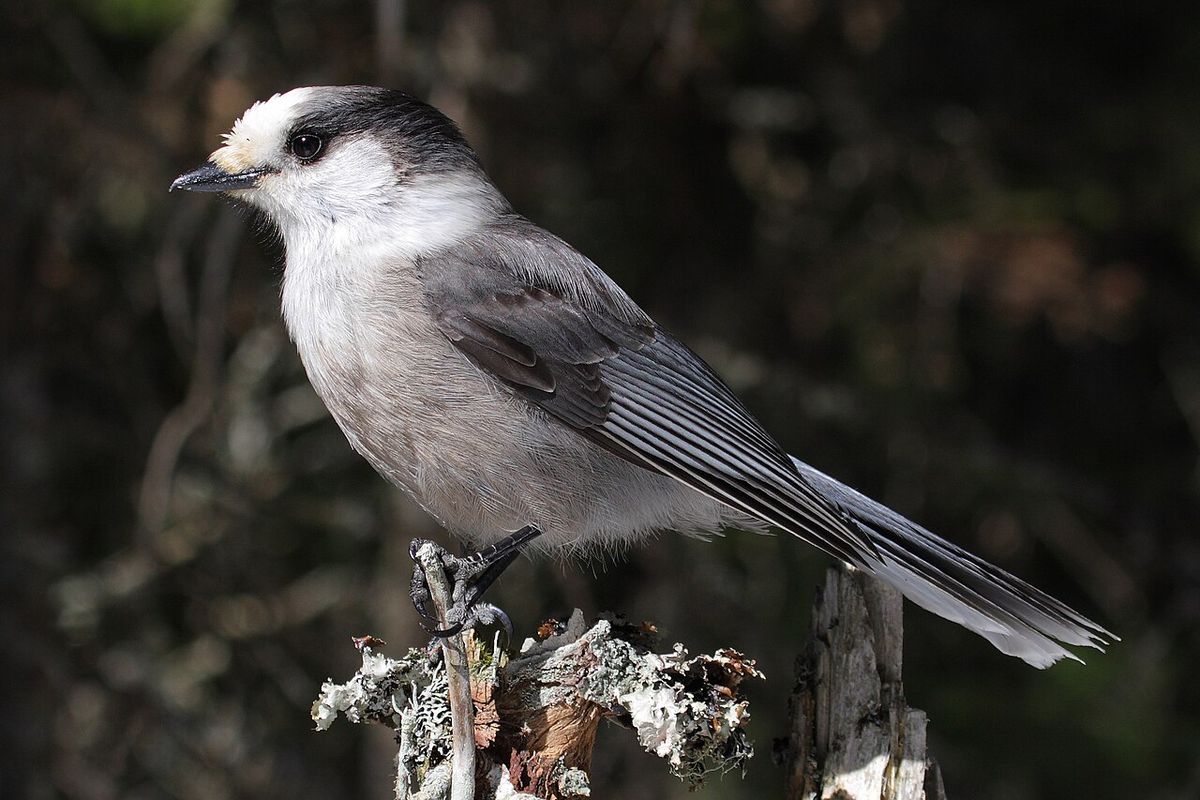
The Canada jay is a relatively large songbird, though smaller than other jays like the Blue Jay. Adults typically measure between 25 and 33 centimetres in length with a wingspan around 45 centimetres, and they weigh about 65 to 70 grams. Their plumage is primarily soft grey, with darker grey upperparts and lighter grey underparts, and thick feathering provides essential insulation against the cold. The head is mostly white with a distinctive dark grey or black nape and hood, giving it a capped appearance, complemented by a short black bill, dark eyes, and black legs and feet.
Males and females are not sexually dimorphic in colouration, though males are slightly larger on average. Juveniles are initially coloured very dark grey all over, gaining their adult plumage after their first moult in July or August. The Canada jay employs a variety of vocalizations for communication. Calls include a distinctive whistled 'quee-oo', as well as various clicks and chuckles used in different social contexts. They are also accomplished mimics. A survey of recordings found they can imitate the vocalizations of at least 40 species of birds, and have been recorded mimicking red squirrels and domestic cats. They use specific alarm calls, announcing a series of harsh clicks to signal a ground predator and a series of repeated whistles to indicate an aerial threat.
Habitat, distribution, and subspecies
The Canada jay inhabits boreal forests across northern North America, from northern Alaska east to Newfoundland and Labrador, and south through subalpine zones in the Rocky Mountains to New Mexico and Arizona. Its range extends into the northern United States in areas like Minnesota, Wisconsin, Michigan, the Adirondacks in New York, and New England. This bird is a permanent resident, living year-round on all-purpose territories that average about 150 hectares in size. It does not migrate, though individuals may wander irregularly south in winter to places like northwestern Nebraska, central New York, and Massachusetts. Fossil evidence indicates its range extended as far south as Tennessee during the last ice age.
The vast majority of Canada jays live in forests with a strong presence of black spruce, white spruce, Engelmann spruce, jack pine, or lodgepole pine. They are notably absent from the Sierra Nevada in California and lower elevations of coastal Alaska and British Columbia dominated by Sitka spruce. Key habitat requirements are believed to be sufficiently cold temperatures to preserve cached food and tree bark with pliable, shingle-like scales for secure storage. The antibacterial properties of boreal tree bark and foliage may also assist in food preservation. The well-marked subspecies P. c. obscurus is an exception, living right down to the coast from Washington to northern California without these specific conditions.
Nine subspecies are recognized, showing variation in size, colouration, and range. The nominate subspecies, P. c. canadensis, breeds from northern British Columbia to Prince Edward Island and south to the northern U.S. The darker P. c. nigricapillus, or Labrador jay, is found in northern Quebec, Labrador, and Nova Scotia. The larger, paler P. c. capitalis inhabits the southern Rocky Mountains from Idaho to New Mexico. P. c. pacificus ranges from central Alaska to northwestern Canada, while P. c. obscurus, the Oregon jay, lives along the coast from Washington to northern California. Other subspecies include P. c. griseus from southwestern British Columbia to California, P. c. albescens (Alberta jay) from northeastern British Columbia to South Dakota, P. c. bicolor in the inland northwest, and P. c. sanfordi, endemic to Newfoundland.
Social structure and breeding biology
Canada jays form monogamous pairs that typically mate for life, though a bird will find a new partner if widowed. They begin breeding at two years of age during March and April, depending on latitude, in permanent territories. A unique cooperative breeding system is common, where the mated pair is often accompanied by a third, juvenile bird from the previous season. A 1991 field study in Quebec and Ontario found approximately 65% of trios included a dominant juvenile from the pair's own previous brood, while about 30% included non-dominant juveniles who had left their parents' territory. Occasionally, two nonbreeding juveniles accompany a pair. The role of these juveniles is in allofeeding, retrieving caches and bringing food to younger siblings, but this is only permitted by the parents during the post-fledgling period to reduce predator-attracting visits to the vulnerable nest.
Breeding is remarkably early, with nest building and egg-laying in late winter, often in February or March when snow is still deep. The male chooses the nest site, most commonly in a mature black spruce, though white spruce and balsam fir are also used in Ontario and Quebec. With the male taking the lead, nests are constructed from brittle dead twigs, bark strips, and lichens. The cup is lined with feathers and insulated with cocoons of the forest tent caterpillar, measuring about 76 mm wide and 51 mm deep. Nests are usually built on the southwestern side of a tree for solar warming and are typically less than one nest diameter from the trunk, at a height of 2.4 to 9.1 metres above ground. An average of 264 nests surveyed in Algonquin Provincial Park was 4.9 metres above ground.
- Breeding system: Monogamous, cooperative, often with a third helper.
- Nest composition: Twigs, bark, lichens, lined with feathers and caterpillar cocoons.
- Clutch size: 2 to 5 eggs. Mean of 3.03 in Algonquin, 3.18 in La Verendrye Park.
- Incubation: 18.5 days, performed only by the female.
- Nestling period: Young fledge 22-24 days after hatching.
- Juvenile dispersal: Median 0.0 km for males, 2.8 km for females. Maximum recorded 11.3 km.
- Helper role: Dominant juvenile remains, others leave. Two-thirds of dominants are male.
After fledging, juveniles reach full adult measurements in 55 to 65 days, after which they battle until a dominant juvenile forces its siblings to leave. The dominant bird remains with its parents until the following season, potentially inheriting the natal territory. Mortality rates are high for dispersing juveniles. Studies show an 85% mortality rate from June to mid-October for those who leave, with a further 50% mortality from fall to the next breeding season. In contrast, territory-holding adults experience much lower mortality rates of 15.1% for males and 18.2% for females annually, contributing to an average lifespan of eight years for territory owners.
Diet, caching, and winter survival
Canada jays are omnivorous and highly opportunistic feeders. Their diet includes arthropods, worms, small mammals such as rodents and shrews, eggs, and nestling birds, which they often find by moving from perch to perch and scanning surroundings. They have been recorded taking a magnolia warbler in flight, hunting juvenile bats, and opportunistically capturing amphibians like the western chorus frog in Colorado and the long-toed salamander in Oregon. They have also been seen landing on moose in Algonquin Park during April and May to remove and eat engorged winter ticks. Researchers even found a Canada jay nest containing three warm, engorged deer ticks, hypothesized to serve as 'hot water bottles' to keep hatchlings warm.
Their most critical behavioural adaptation is food caching for winter survival. Throughout late summer and fall, they collect surplus food such as berries, mushrooms, insects, spiders, and bits of vertebrate flesh. They coat each morsel in sticky saliva and hide it behind flakes of bark, under lichen, between spruce needles, or in tree forks throughout their territory. One bird can hide up to a thousand pieces of food in a single day. During winter, they retrieve these caches not by random search or scent, but by relying on precise spatial memory, going directly to hidden larders when hungry. This strategy is essential for surviving the winter and for feeding their young in early spring when other food sources are unavailable.
Population trends and climate change impacts
The International Union for Conservation of Nature lists the Canada jay as a species of least concern globally. However, long-term research indicates serious population declines at the southern edges of its range. The study in Algonquin Provincial Park, Ontario, begun in the 1960s and the longest-running bird study in the world, shows that fewer than half of the Canada Jay territories identified in the 1970s are occupied today. Researchers, including longtime expert Dan Strickland and University of Guelph professor Ryan Norris, attribute this decline primarily to climate change and its effect on the bird's unique food storage system.
The central problem is 'fridge failure'. Canada jays depend on cold, stable winter temperatures to preserve their cached, perishable food. Warmer winters cause repeated freeze-thaw cycles, leading to the degradation and spoilage of these stores. This reduces the food available for adult survival and, crucially, for feeding early-spring nestlings, resulting in lower reproductive success. Naturalists have observed that birds seem to be abandoning hardwood territories and persisting better in boggy black spruce areas, where the bark's properties may slow decomposition. In March 2026, scientists at The Centre for Applied Genomics at SickKids announced they had assembled a high-quality Canada Jay genome. This work, part of a larger project sequencing several 'canadensis' species, aims to help researchers understand the genetic basis of the bird's adaptability to changing climates.
| Research Finding | Location/Study | Implication |
|---|---|---|
| Food cache degradation | Studies by Strickland & Norris | Warmer winters cause spoilage, reducing food for winter and breeding. |
| High juvenile mortality (85%) | Ontario & Quebec studies | Low recruitment exacerbates population declines. |
| Genome sequenced | TCAG at SickKids, March 2026 | Tool for understanding genetic adaptability to climate change. |
| Shift to spruce bog habitats | Algonquin Park observations | Spruce bark may offer better food preservation properties. |
Cultural significance and national symbol status
The Canada jay holds a deep place in Canadian culture and First Nations mythology. Its common nickname, 'whiskeyjack', is derived from the anglicization of Wisakedjak (Wìsakedjàk in Algonquin, Wihsakecahkw in Cree), a benevolent, trickster-cultural figure in stories. The bird's bold and curious demeanour, including stealing food from campsites, has inspired numerous colloquial names like 'camp robber', 'lumberjack', 'venison-hawk', 'moose bird', and 'gorby'. This familiarity with humans has made it a charismatic symbol of the northern wilderness.
In 2016, the Canada jay was selected as the national bird of Canada following an online poll and expert panel convened by Canadian Geographic magazine. Despite this popular designation and significant support from environmental groups and the public, the Government of Canada has not formally recognized any bird as the national symbol. Advocates like Dan Strickland, who led the campaign to restore the bird's name in 2018, continue to hope for official adoption. The bird's image has been celebrated on Canadian currency, including a 2026 one-ounce fine silver coin in the Royal Canadian Mint's Colourful Birds series. The reverse design by artist Tony Bianco features a pair of Canada jays on a white pine branch against a winter landscape, highlighting its status as a resilient, year-round resident of the boreal forest that defines much of Canada's identity.
Questions about Canada jay
Why is it called a Canada jay?
The bird's scientific name, Perisoreus canadensis, means 'hoarder of Canada', reflecting its food-storing behaviour and geographic range. It was known as the Canada Jay from the early 1800s until 1957, when the American Ornithological Society changed its common name to Gray Jay, using American spelling. After a campaign led by Canadian researchers like Dan Strickland, the name Canada Jay was officially restored by the AOS in a 9-to-1 committee vote in 2018. The bird is found in all Canadian provinces and territories, making the name geographically apt and patriotic.
How does the Canada jay survive harsh winters?
The Canada jay survives winter through a combination of physical and behavioural adaptations. Its thick plumage provides insulation, and it can fluff up its feathers to cover its legs and feet, and even its nostrils. Most critically, it caches massive amounts of perishable food like berries, mushrooms, and meat in late summer and fall. Using sticky saliva, it hides thousands of pieces behind tree bark and in other nooks throughout its 150-hectare territory, retrieving them via precise spatial memory during the winter months when other food is scarce. This strategy fuels both adult survival and their exceptionally early breeding season.
Is the Canada jay Canada's official national bird?
No, the Canada jay is not the officially recognized national bird of Canada. However, in 2016 it was selected as the national bird in a comprehensive poll conducted by Canadian Geographic magazine, which included input from an expert panel and the public. Despite significant popular and environmental group support for this designation, and its name being restored in 2018, the Canadian government has not yet given any bird official national bird status. Advocates continue to push for its formal adoption.
How is climate change affecting Canada jays?
Climate change is adversely affecting Canada jay populations, particularly in the southern parts of its range like Ontario. Warmer winter temperatures cause repeated freezing and thawing of their cached, perishable food, leading to spoilage or 'fridge failure'. This reduces the food available for adults to survive the winter and to feed their early-spring nestlings, resulting in lower reproductive success and territory abandonment. Long-term studies in Algonquin Park show a significant decline in occupied territories since the 1970s. Research suggests birds in black spruce bogs may be more resilient due to the bark's preservative qualities.
Where can I see a Canada jay in Canada and what should I look for?
Canada jays can be found year-round in boreal forests across every Canadian province and territory. They are common in provincial and national parks within this biome, such as Algonquin Provincial Park in Ontario. Look for a fluffy, medium-sized grey bird with a white forehead and chest, a dark grey 'hood' on the back of its head, and a short black bill. They are often bold and approachable, especially in fall and winter, and may greet hikers and skiers along trails, sometimes swooping in close. In some southern parks where populations have declined, visitors may need to inquire at park visitor centres for current locations of active territories.
What is the connection between the Canada jay and 'whiskeyjack'?
The name 'whiskeyjack' is an anglicization of Wisakedjak, a benevolent mythological figure from several First Nations cultures. The Canada jay is associated with this cultural trickster figure. This connection is part of the bird's rich cultural significance in Canada. In 2016, the Canada jay was selected as the national bird of Canada by Canadian Geographic, though this is not a formal designation. The species has many other colloquial names inspired by its behaviour, including camp robber and lumberjack.
Sources and further reading
- Canada jay (Wikipedia)
- Canada Jays: the real early birds (blog.ontarioparks.ca)
- Scientists assemble the Canada Jay genome to better ... (sickkids.ca)
- Colourful Birds: Canada Jays, 1 oz. Fine Silver Coin (mint.ca)
- Canada Jay (sierraclub.bc.ca)
Checked by the Your Space Hamilton desk. Last updated 2026-10-29.