Canada goose
The Canada goose (Branta canadensis) is a large, distinctive waterfowl species native to North America, easily recognized by its black head and neck, white cheek patches, and brown body. It is a familiar sight across Canada, from Arctic regions to urban parks, and holds significant ecological and cultural presence. The species is known for its seasonal migrations, though many populations have become year-round residents in human-altered landscapes. While celebrated as a symbol of wilderness, its adaptability and success have also led to complex interactions with people, often resulting in its classification as a nuisance species in many areas.
Taxonomy and Naming
The Canada goose was formally described by Carl Linnaeus in his 18th-century work Systema Naturae. It belongs to the Branta genus, which comprises geese with predominantly black plumage, setting them apart from the grey geese of the Anser genus. The genus name Branta is a Latinized form of the Old Norse term 'Brandgás', meaning 'burnt (black) goose'. The specific epithet canadensis is a Neo-Latin word meaning 'from Canada'. The common name 'Canada goose' first appeared in citation in 1772, and the bird is also colloquially called the 'Canadian goose'. Historically, the smaller cackling goose was considered part of the Canada goose species, but in 2004 the American Ornithologists' Union officially split them, recognizing the cackling goose as the separate species Branta hutchinsii. The British Ornithologists' Union followed this reclassification in June 2005. The distinctions between the species have caused confusion due to size overlap between small Canada geese and large cackling geese.
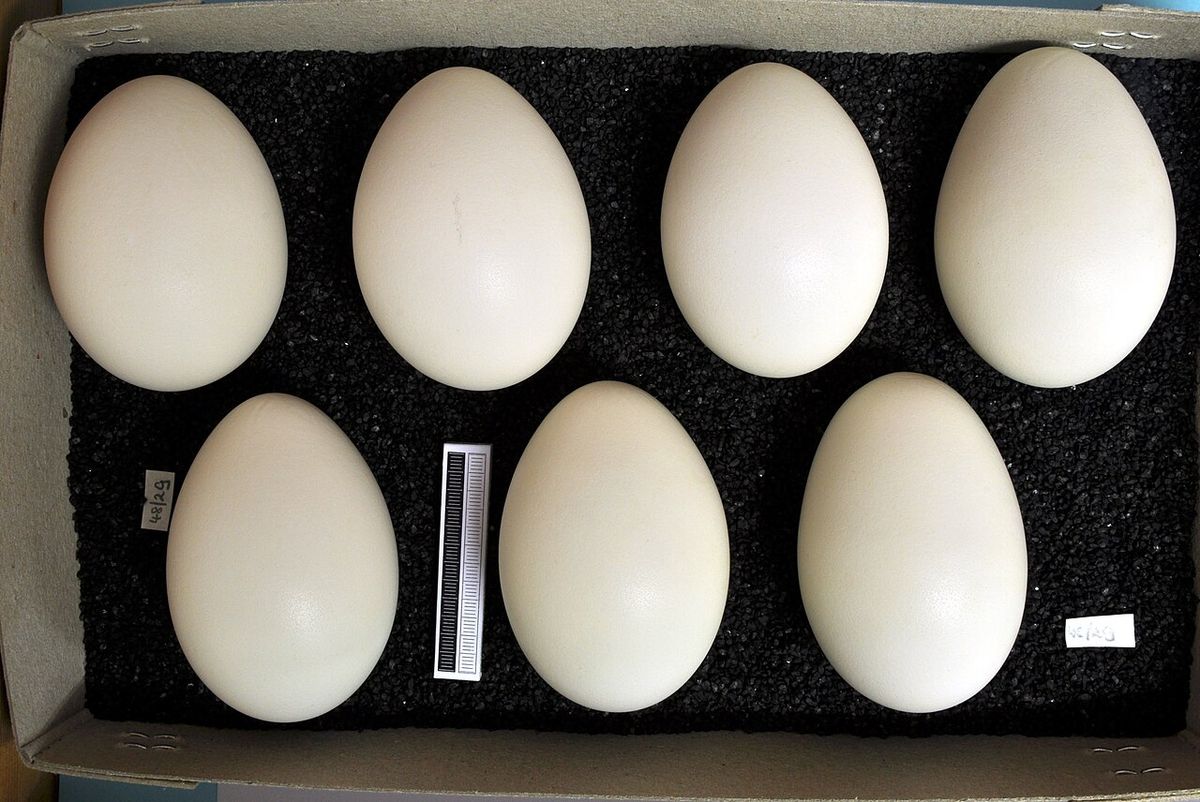
Physical Description and Vocalizations
The Canada goose is distinguished by its black head and neck, contrasting with prominent white cheek patches often described as a 'chinstrap'. The body plumage is predominantly brown, though colour variations including leucistic individuals with pepper-spotted, brown, or even white necks occur. The seven subspecies vary widely in size and plumage details but all are recognizable as Canada geese. The giant Canada goose (B. c. maxima) is the largest subspecies, while the lesser Canada goose (B. c. parvipes) is the smallest of the group following the separation of the cackling goose. Among standard measurements, the wing chord ranges from 39 to 55 cm, the tarsus from 6.9 to 10.6 cm, and the bill from 4.1 to 6.8 cm. An exceptionally large male giant Canada goose recorded in the wild weighed 10.9 kg (24 lb) with a wingspan of 2.24 m (7 ft 4 in), making it the largest wild goose ever documented of any species. On average, males weigh 3.9 kg and females 3.6 kg, with females being about 10% smaller in linear dimensions. The species communicates with at least ten different vocalizations. The male's call is a deep 'honk', whilst the female produces a shorter, higher-pitched call known as a 'hrink'. When agitated or defending territory, Canada geese initiate encounters with a high-pitched hiss.
Subspecies and Taxonomic History
The Canada goose comprises several subspecies that differ in size and distribution. Following the separation of the cackling goose, the recognized subspecies of the Canada goose include the Atlantic Canada goose (B. c. canadensis), the Interior Canada goose (B. c. interior), the Giant Canada goose (B. c. maxima), Moffitt's Canada goose (B. c. moffitti), the Vancouver Canada goose (B. c. fulva), the Dusky Canada goose (B. c. occidentalis), and the Lesser Canada goose (B. c. parvipes). Distinguishing the smaller Canada goose subspecies from the larger cackling goose subspecies can be challenging due to overlapping sizes, but cackling geese generally have shorter necks and smaller bills. The smallest cackling goose, B. h. minima, is scarcely larger than a mallard. Taxonomic history includes controversial proposals, such as ornithologist Harold C. Hanson's suggestion to split the group into six species and 200 subspecies after he rediscovered wild populations of the Giant Canada Goose. This radical proposal was criticized by ornithologists like Richard Banks of the AOU and was ultimately suppressed by the International Code of Zoological Nomenclature. Research has also determined that the barnacle goose is a derivative of the cackling goose lineage, while the Hawaiian Nene originated from ancestral Canada geese.
The American Ornithologists' Union has listed several recognized subspecies of the Canada goose. These include the Atlantic Canada goose, the Interior Canada goose, and the Giant Canada goose. Other subspecies are Moffitt's Canada goose, the Vancouver Canada goose, the Dusky Canada goose, and the Lesser Canada goose. These seven subspecies vary widely in size and plumage details but are all recognizable as Canada geese. The largest subspecies is the Giant Canada goose, while the smallest is the Lesser Canada goose.
- Atlantic Canada goose (B. c. canadensis), described by Linnaeus in 1758.
- Interior Canada goose (B. c. interior), described by Todd in 1938.
- Giant Canada goose (B. c. maxima), described by Delacour in 1951.
- Moffitt's Canada goose (B. c. moffitti), described by Aldrich in 1946.
- Vancouver Canada goose (B. c. fulva), described by Delacour in 1951.
- Dusky Canada goose (B. c. occidentalis), described by Baird in 1858.
- Lesser Canada goose (B. c. parvipes), described by Cassin in 1852.
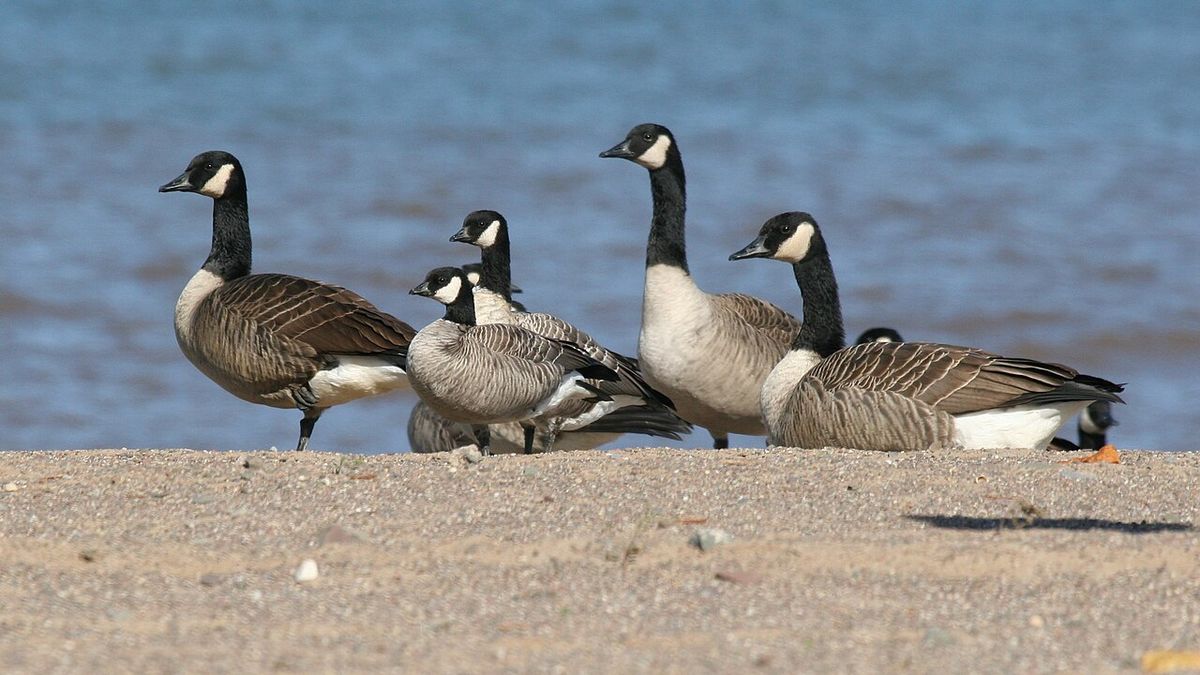
Native Distribution and Population Recovery
The Canada goose is native to North America, breeding across Canada and the northern United States in a wide range of habitats from the Arctic to temperate regions. The Great Lakes region maintains a particularly large population. They live year-round in the southern part of their breeding range, including the northern half of the United States' eastern seaboard and Pacific Coast. During winter, they migrate to areas between California and South Carolina and into northern Mexico. Historically, overhunting and habitat loss in the late 19th and early 20th centuries caused severe population declines. The giant Canada goose subspecies was thought to be extinct in the 1950s until Harold Hanson of the Illinois Natural History Survey discovered a small flock wintering in Rochester, Minnesota, in 1962. Intensive restoration programs followed, such as the project initiated at the Northern Prairie Wildlife Research Center near Jamestown, North Dakota, in 1964. Under the direction of Forrest Lee, the center's program started with 64 breeding pairs in pens and, by the end of 1981, had released more than 6,000 giant Canada geese at 83 sites in 26 counties in North Dakota. This recovery involved private, state, and federal resources and widespread cooperation.
Urban Adaptation and Current Populations
In recent decades, Canada goose populations in many areas have grown substantially, often becoming permanent residents in urban and suburban environments. This is due to the removal of natural predators, an abundance of safe human-made bodies of water, and plentiful food sources like lawn grass on golf courses, in public parks, and in planned communities. The interbreeding of various migratory subspecies with introduced non-migratory giant subspecies has further cemented this year-round residency. Large flocks have established permanent residence along the Pacific coast from British Columbia's Lower Mainland and Vancouver Island south to the San Francisco Bay area. Resident Atlantic coast populations exist on Chesapeake Bay, in Virginia's James River regions, and in North Carolina's Triangle area. Some geese reside as far south as Florida in apartment complex retention ponds. In Ohio, the population was reported as roughly 130,000 in 2015, a dramatic increase from the 10 pairs reintroduced in 1956 and the 18,000 estimated in 1979. This increase is directly attributed to a lack of predators, abundant water, and manicured lawns. These large, non-migratory populations are frequently considered pests for their droppings, the bacteria therein, noise, and confrontational behaviour, creating significant management challenges.
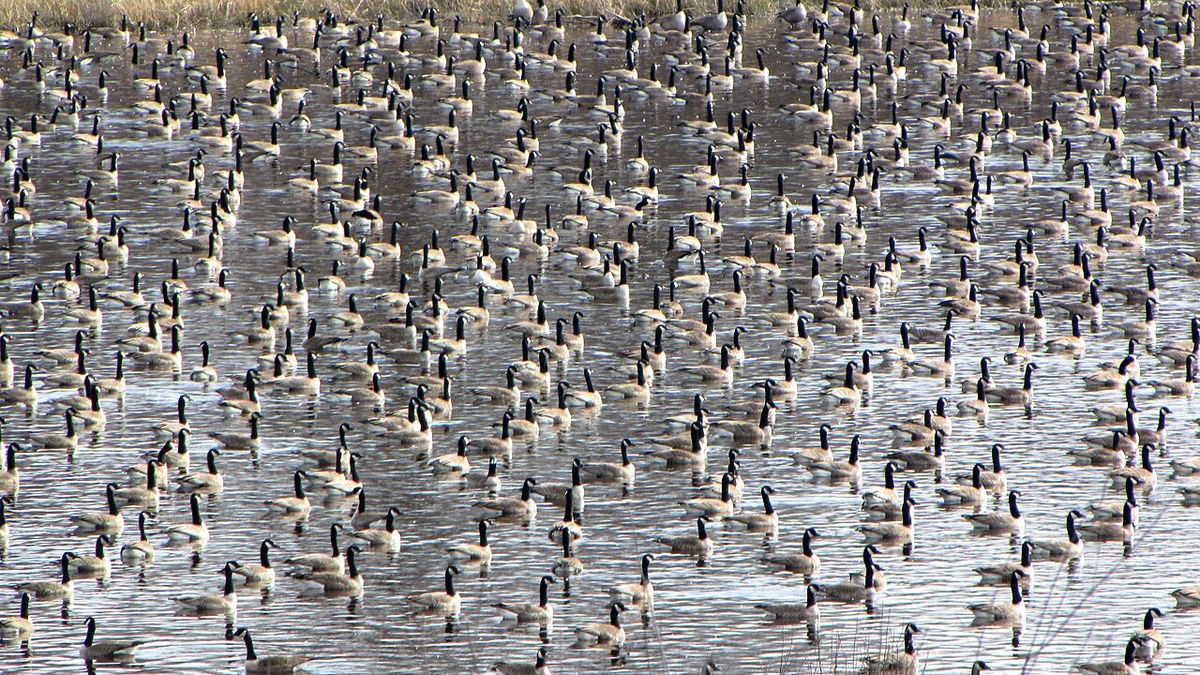
Introduced Populations Worldwide
Canada geese have been introduced to several regions outside their native range, often establishing significant and sometimes problematic feral populations. In Europe, they have reached Northern Europe naturally, as confirmed by ringing recoveries, with birds including the B. c. parvipes subspecies reaching the Kamchatka Peninsula and eastern China. They were also deliberately introduced by explorer Samuel de Champlain in the early 17th century when he sent several pairs to France as a present for King Louis XIII. They were introduced into Great Britain in the late 17th century as an addition to King James II's waterfowl collection in St James's Park. By the mid-18th century they had established in France, Great Britain, and Ireland, and were later introduced to the Netherlands, Belgium, Germany, Scandinavia, and Finland starting in Sweden in 1929. Most European populations are non-migratory, though those in northern Sweden and Finland migrate to the North Sea and Baltic coasts. In Great Britain, the population exploded from an estimated 2,670-3,482 in 1953 to 82,000 in 1999 and approximately 165,000 wintering individuals in 2017. An attempt to translocate breeding pairs in the 1950s and 1960s backfired, causing new subpopulations to establish. Canada geese were introduced as a game bird into New Zealand in 1905, where they became a problem by fouling pastures and damaging crops. They were protected under the Wildlife Act 1953 but had this protection removed in 2011, allowing anyone to kill the birds. Introduced populations also exist in Japan, Chile, Argentina, and the Falkland Islands.
Diet and Feeding Behaviour
Canada geese are primarily herbivores, although they sometimes eat small insects and fish. Their diet includes a wide variety of green vegetation and grains. When on land, they feed on grasses by grasping a blade with the bill and tearing it with a jerk of the head. They also consume agricultural crops such as beans, wheat, rice, and corn when available. In aquatic environments, they feed by sliding their bill along the bottom to reach submerged plants and will also feed on algae like seaweed. In urban areas, Canada geese are known to pick food out of garbage bins and are frequently hand-fed grains by people in parks. They show a strong preference for lawn grass in these settings and typically graze in open areas with wide clearance to maintain a sightline to avoid potential predators. This adaptable feeding strategy is a key factor in their success in human-dominated landscapes.
Reproduction and Breeding Biology
Canada geese are monogamous, with pairs usually forming during their second year and most couples staying together for life. If one mate dies, the other may eventually find a new partner. The nest is usually located on raised ground near water such as streams, lakes, or ponds, and sometimes on a beaver lodge. It consists of a shallow depression lined with plant material and down. The female lays a clutch of two to nine eggs, with an average of five. Both parents protect the nest during the incubation period, though the female spends more time incubating while the male remains nearby. Incubation lasts for 24 to 32 days after laying. Canada geese can adjust their laying date in response to spring maximum temperatures, which may benefit nesting success. The annual summer molt, during which adults lose their flight feathers for 20 to 40 days, coincides with the breeding season. Adults regain flight at about the same time their goslings start to fly. Goslings are precocial, capable of walking, swimming, and finding their own food immediately after hatching. Parents lead goslings in a line, often with one adult at the front and the other at the back, and they defend them aggressively. They first warn intruders, from small blackbirds to humans, with a hiss before attacking with bites and wing slaps. Although hostile to unfamiliar geese, family groups may sometimes form larger crèches with other goslings for protection.
Behaviour, Migration and Aggression
Like most geese, the Canada goose is naturally migratory with the wintering range being most of the United States. The calls from large groups flying in V-shaped formations signal the transitions into spring and autumn. In some areas, migration routes have changed due to alterations in habitat and food sources. In mild climates from southwestern British Columbia to California to the Great Lakes, some populations have become nonmigratory due to an adequate winter food supply and a lack of former predators. Males exhibit agonistic behaviour both on and off breeding and nesting grounds, though this rarely involves interspecific killing. One documented case involved a male defending his nest from a brant goose that wandered into the area. The attack lasted for one hour and resulted in the brant's death from suffocation or drowning in mud after the Canada goose pecked its head into the mud. Researchers attributed this extreme aggression to high hormone levels and the brant's inability to leave the nesting area.
Interactions with Humans and Management
The Canada goose's success in human-altered environments has led to it being considered a pest species in many regions. Primary complaints include accumulations of excrement in parks, on sports fields, and beaches, damage to agricultural crops, aggressive territorial behaviour during nesting season, and persistent noise. Management strategies vary widely by jurisdiction and context. In Ohio, for example, the Department of Natural Resources recommends several non-lethal scare and hazing tactics for nuisance geese initially. If such methods fail, they may issue a permit to destroy nests, conduct a goose roundup, or exterminate geese. The geese are considered a protected game species with a hunting season allowed in September. In New Zealand, management shifted from protection under the Wildlife Act 1953 to allowing unrestricted culling after 2011. In Europe, semi-tame feral birds are common in parks and have become a significant agricultural and park pest due to heavy grazing. Ecologically, introduced Canada geese have been observed to drive away native ducks and swans from nesting areas through greater numbers, overgraze aquatic plants, and contribute to water eutrophication through their droppings. In Europe, goslings and eggs are preyed upon by species like the European mink, Eurasian otter, and mute swans, though adult birds lack natural predators outside of humans. The species' spread is facilitated by its occupation of a large aquatic bird niche with little competition beyond the mute swan and the creation of favourable habitat through reservoirs and flooded gravel pits.
Questions about Canada goose
What do Canada geese eat?
Canada geese are primarily herbivores. Their diet consists of grasses, sedges, grains like wheat and corn, and aquatic vegetation. They will occasionally eat small insects or fish. In cities, they heavily graze on lawn grass and are known to scavenge for food in garbage bins. They feed by grasping and tearing grass blades or by submerging their heads to reach underwater plants.
How long do Canada geese live and how do they raise their young?
Canada geese are monogamous and often mate for life. They first breed in their second year. The female lays an average of five eggs in a nest near water, and both parents incubate the eggs for 24 to 32 days. Goslings are precocial, able to walk, swim, and feed themselves shortly after hatching. Parents protect the goslings vigorously, leading them in a line and aggressively chasing away perceived threats. Adults become flightless for 20 to 40 days during their annual molt, which coincides with the rearing period.
Are Canada geese and Canadian geese the same thing?
Yes, 'Canada goose' and 'Canadian goose' refer to the same species, Branta canadensis. The official common name is Canada goose, a designation first cited in the Oxford English Dictionary in 1772. The colloquial term 'Canadian goose' is also widely used. The bird was named for its prevalence in Canada, with the scientific epithet 'canadensis' being a Neo Latin word meaning 'from Canada'. The genus name Branta is a Latinized form of Old Norse Brandgás, meaning 'burnt (black) goose'.
What is the difference between a Canada goose and a cackling goose?
The cackling goose was originally considered part of the Canada goose species but was classified as a separate species named Branta hutchinsii in 2004. While both share the black head and neck with a white chinstrap, cackling geese are generally considerably smaller with shorter necks and smaller bills. There is some overlap in size between the smallest Canada goose subspecies and the largest cackling goose types, which has caused taxonomic confusion. The barnacle goose was determined to be a derivative of the cackling goose lineage, while the Nene originated from ancestral Canada geese.
Why are Canada geese considered a nuisance?
Canada geese are often considered a pest species due to several behaviours linked to their success in human altered areas. This includes their excrement fouling parks and beaches, their depredation of crops, their noise, and their aggressive territorial behaviour toward both humans and other animals. They also have a habit of stalking and begging for food, which is a result of humans feeding them. Their establishment in urban habitats with few natural predators has led to substantial population growth, amplifying these nuisance issues in many regions.
Do Canada geese migrate?
Like most geese, the Canada goose is normally migratory, with wintering ranges across much of the United States. However, many populations have become nonmigratory. In mild climates from British Columbia to California and the Great Lakes, geese often remain year round due to an adequate winter food supply, such as lawn grass, and a lack of former predators. Introduced populations in Europe and established flocks along North America's Pacific and Atlantic coasts are frequently permanent residents, having lost their migratory instinct.
Sources and further reading
- Canada goose (Wikipedia)
- Canada Goose (nationalgeographic.com)
- Animal Facts: Canada goose (canadiangeographic.ca)
- Canada Goose (ducks.org)
- Canada Goose (Branta canadensis) Printer Friendly (adfg.alaska.gov)
Checked by the Your Space Hamilton desk. Last updated 2026-10-20.