Blue jay
The blue jay (Cyanocitta cristata) is a passerine bird in the crow family Corvidae, native to eastern and central North America. It is a common and recognizable species across much of southern Canada, with breeding populations found from Newfoundland to southern Manitoba. Known for its blue, white, and black plumage and a distinctive crest, the blue jay is an intelligent and sometimes aggressive omnivore that adapts readily to both forests and urban areas. Its loud calls and complex behaviours, including food caching and tool use, make it a familiar subject of study and observation for Canadian birdwatchers and naturalists.
Taxonomy and scientific history
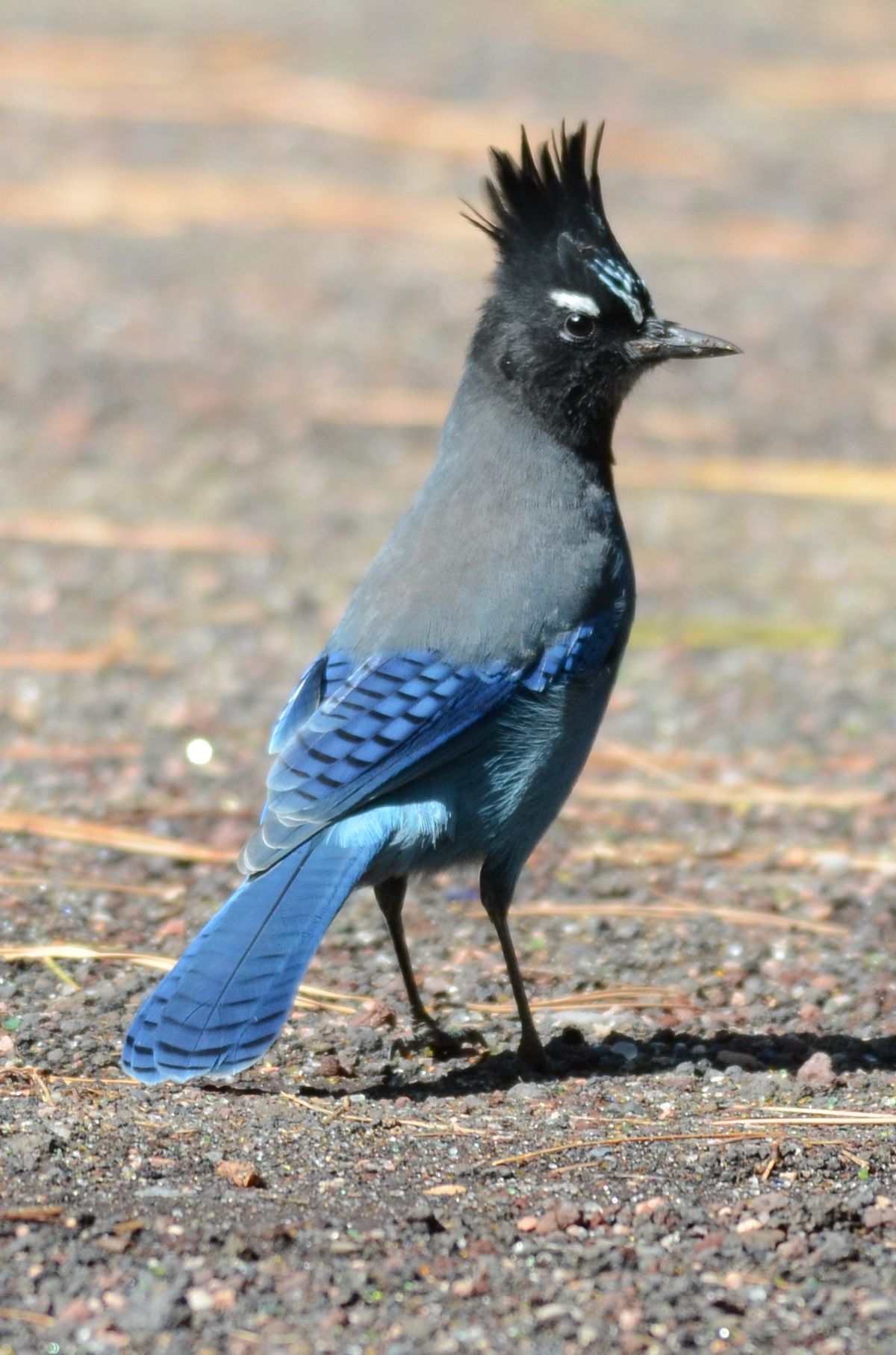
The blue jay was first formally described in English naturalist Mark Catesby's 1731 publication Natural History of Carolina, Florida, and the Bahamas, where it was named Pica glandaria cærulea cristata. Carl Linnaeus later reclassified it as Corvus cristatus in his 1758 Systema Naturae. French ornithologist Charles Lucien Bonaparte described it as Cyanocorax cristatus in 1838. The modern binomial name Cyanocitta cristata was established by Hugh Edwin Strickland in 1845. The genus name Cyanocitta is derived from the Greek kyaneos (blue) and kitta or kissa (chattering bird or jay), effectively meaning 'blue chatterer'. The specific epithet cristata comes from Latin, meaning 'crested' or 'tufted', in direct reference to the bird's prominent head crest. The blue jay is one of two species in the genus Cyanocitta, the other being the Steller's jay (C. stelleri). Four subspecies are generally recognized, though variation is subtle and clinal, with no firm boundaries between the inland subspecies.
Physical description and colouration
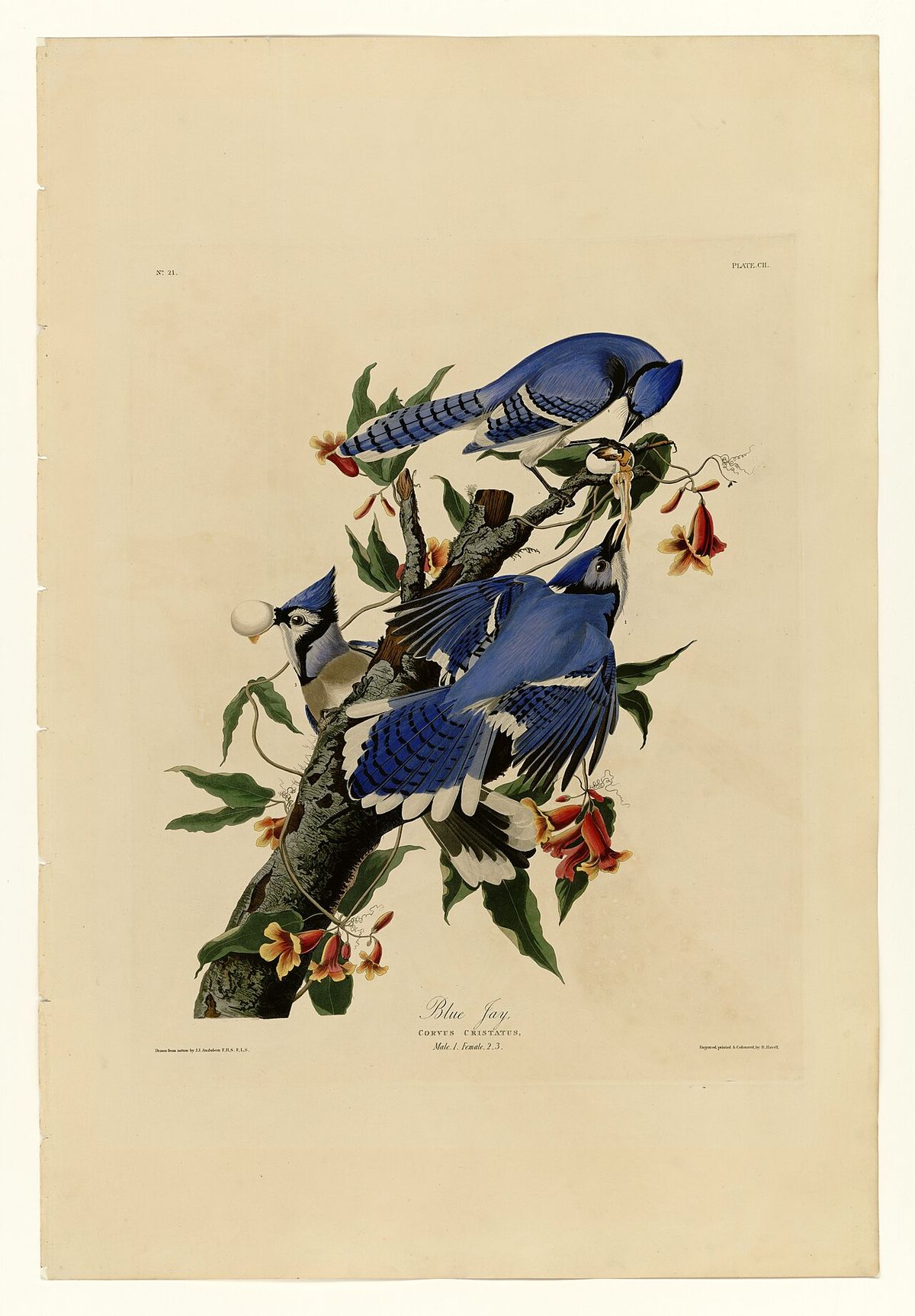
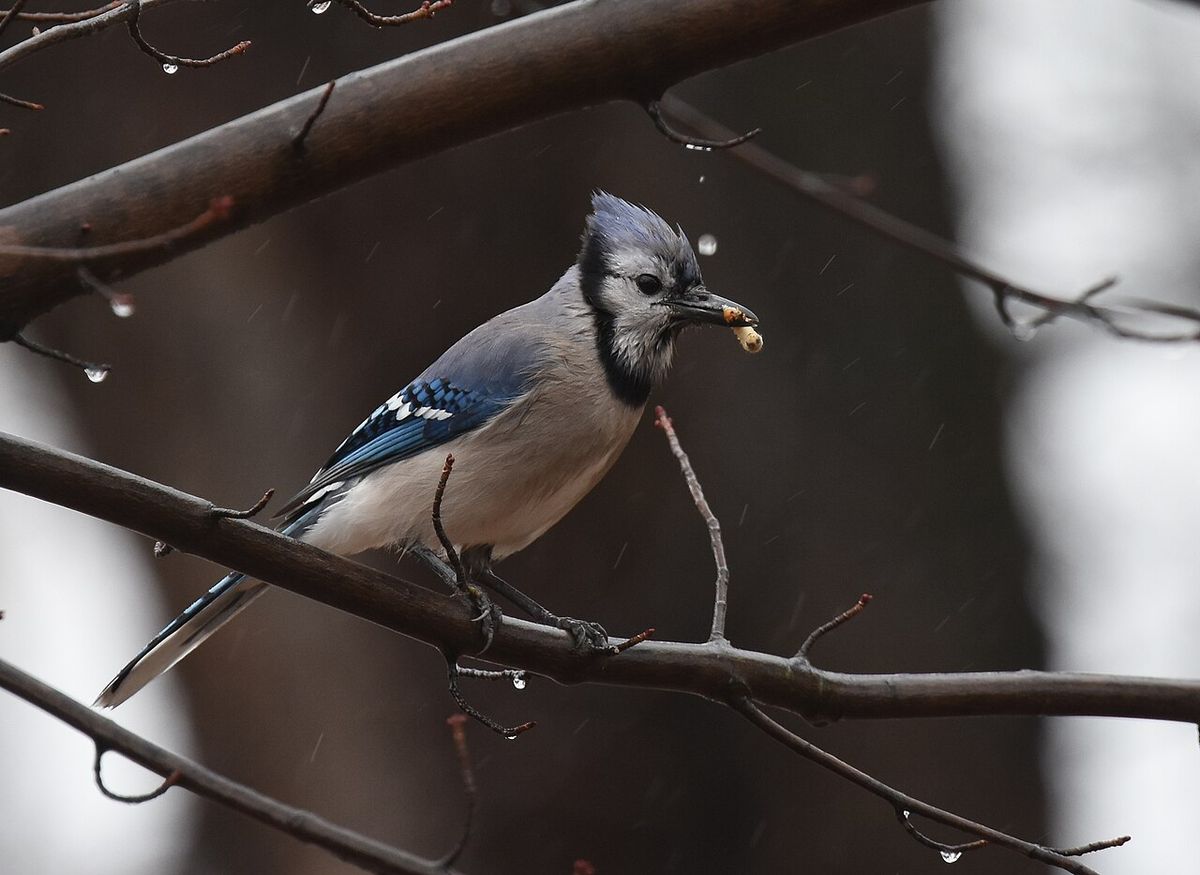
The blue jay measures 22 to 30 centimetres from bill to tail and has a wingspan of 34 to 43 centimetres. Weight ranges from 70 to 100 grams, with northern birds typically heavier than southern ones in accordance with Bergmann's rule. Jays from Connecticut averaged 92.4 grams while those from southern Florida averaged 73.7 grams. The plumage is lavender-blue to mid-blue on the crest, back, wings, and tail, with a white face and off-white underparts. A black, U-shaped collar extends around the neck to the sides of the head, and the wings and tail are barred with black, sky-blue, and white. The bill, legs, and eyes are all black. Males and females are nearly identical in plumage, though the male is slightly larger. The black markings on the nape, face, and throat show extensive individual variation, which may aid in individual recognition. The most dynamic feature is the crest of feathers on the head, which the bird can raise or lower. The crest is fully raised when the bird is excited or aggressive, bristles outwards when frightened, and lies flat when the bird is resting or feeding calmly. The blue colour is not produced by pigments but is a structural colour resulting from light interference within the microscopic structure of the feather barbules. If the feather structure is crushed, the blue colour vanishes, revealing the underlying brown melanin pigment.
Distribution, habitat and range expansion
The core range of the blue jay extends from southern Canada throughout the eastern and central United States south to Florida and northeastern Texas. The western edge of its range historically stopped where the arid pine forest habitat of the Steller's jay begins, generally in the eastern foothills of the Rocky Mountains. Over the past century, the blue jay's range has expanded northwestward, and it is now a rare but regular winter visitor along the northern US and southern Canadian Pacific Coast. This expansion has been facilitated by an increase in trees throughout the Great Plains due to fire suppression and tree planting, which created corridors for movement. From 1966 to 2015, data showed a population decline along the Atlantic coast but an annual increase of greater than 1.5% throughout the northern part of its range, including Labrador, Nova Scotia, southern Quebec, and southern Manitoba. The species occupies a highly varied array of habitats, from the pine woods of Florida to the spruce-fir forests of northern Ontario. It is less abundant in dense, unbroken forests, preferring mixed woodlands with oaks and beeches. It has adapted exceptionally well to human activity, thriving in parks, residential areas, and regions that have undergone deforestation if alternative food sources are available.
Migration patterns and hybridization
Migration in blue jays is a complex and variable behaviour that is not yet fully understood. The northernmost subspecies, C. c. bromia, is considered partially migratory and may withdraw several hundred kilometres south from the northernmost parts of its range. Thousands of blue jays migrate in flocks along the Great Lakes and Atlantic coasts, travelling during the day in loose groups of 5 to 250 birds. Young jays are more likely to migrate than adults, but many adults also migrate. Some individuals exhibit irregular patterns, migrating south one year, staying north the next winter, and migrating again the following year. The primary drivers are believed to be weather conditions and the abundance of winter food sources like acorns. As range expansions continue, blue jays now overlap with related species, leading to occasional hybridization. They are known to hybridize with Steller's jays where their ranges meet in the west. In a notable recent event, a hybrid between a male blue jay and a female green jay (Cyanocorax luxuosus) was found and photographed near San Antonio, Texas, in 2023. This bird, informally dubbed a 'grue jay', was genetically confirmed to be a hybrid in 2025, demonstrating interbreeding where the ranges of these two species overlap.
Behaviour, intelligence and predation
The blue jay is a bold, noisy, and aggressive passerine. It flies at a moderately slow speed of roughly 32 to 40 kilometres per hour with body and tail held level, making it vulnerable to predation in open areas. Virtually all raptorial birds sympatric with it may prey on adults, especially swift bird-hunting Accipiter hawks. A wide variety of predators take eggs and young, including tree squirrels, snakes, cats, crows, raccoons, opossums, and other jays. Blue jays exhibit complex social behaviours that can be both beneficial and detrimental to other birds. They often act as sentinels, sounding loud alarm calls at the approach of hawks or owls, which smaller birds recognize and use to hide. They will aggressively mob these predators to drive them from their territory. Conversely, blue jays can be aggressive towards smaller birds and are known to raid nests for eggs, chicks, and even nestlings, though one study found bird material constituted only about 1% of their diet. They are highly territorial and will dominate bird feeders, though they can be subservient to larger birds like common grackles and red-headed woodpeckers. As corvids, they are considered highly intelligent and curious. They have been confirmed to use tools, such as using strips of newspaper in captivity or a piece of bark in the wild to obtain food. Young jays often engage in play, snatching and carrying shiny objects like bottle caps or aluminum foil.
Diet and feeding ecology
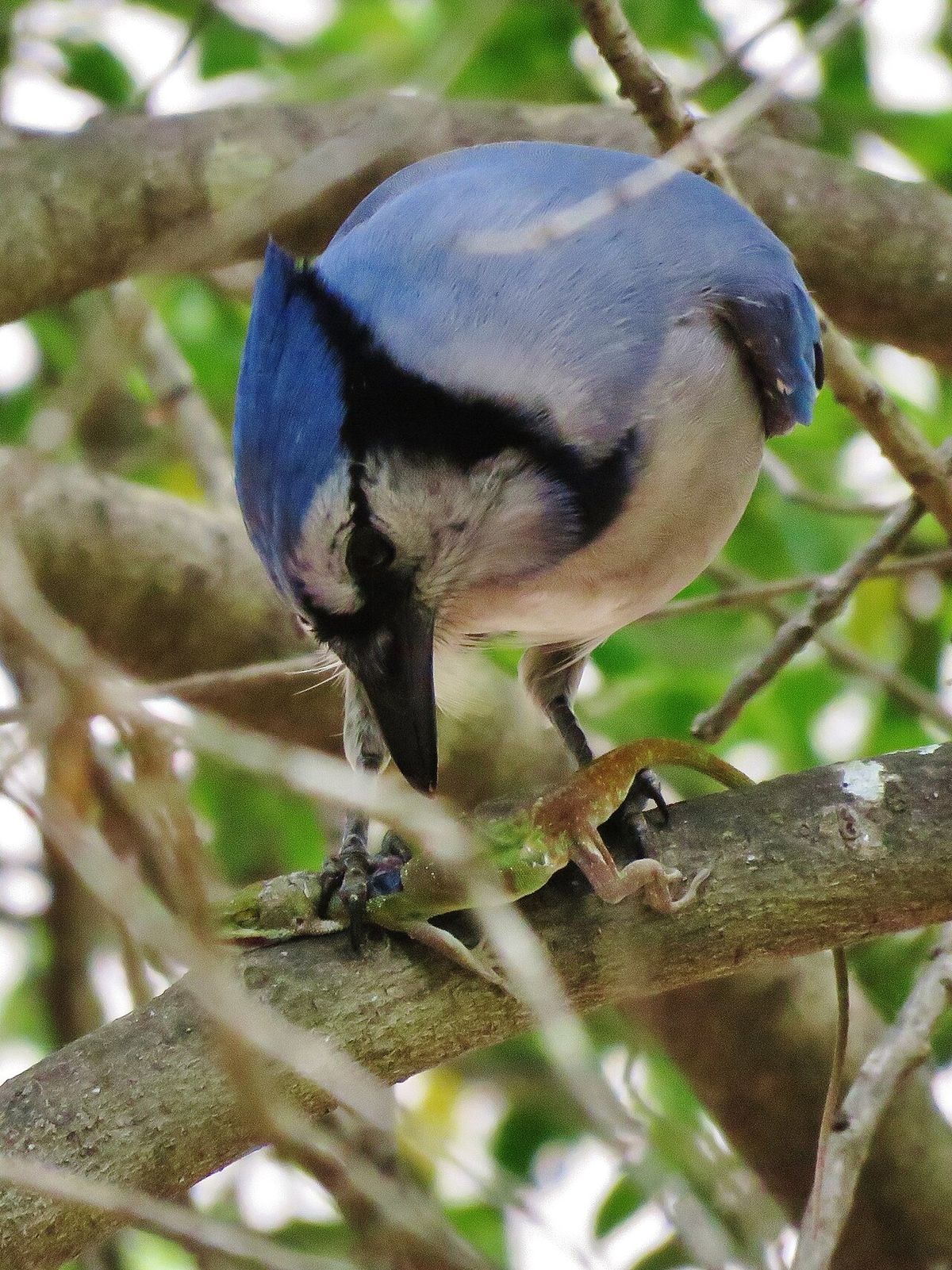
Blue jays are omnivorous, with the Audubon Society estimating that approximately 75% of their diet is vegetable matter. They have strong black bills used for cracking hard nuts and seeds, a task often performed while holding the item with their feet. Their diet is exceptionally broad and includes virtually all known types of plant and animal sources available in their habitat. Plant matter includes acorns, beech mast, weed seeds, grain, cultivated corn, fruits, other berries, peanuts, and bread. Animal matter includes a wide variety of small invertebrates, meat scraps, and, rarely, eggs and nestlings. They also readily consume human-provided food such as bird-table food, scraps in town parks, and peanuts in the shell, for which they show a particular fondness. Blue jays seek food both on the ground and in trees. Many individuals cache or hide food, especially nuts like acorns, though the extent of this behaviour varies widely. This caching plays a role in seed dispersal for some tree species. At feeders, their seemingly contentious nature is sometimes checked by other species. In Florida, blue jays were observed being dominated and aggressively prevented from feeding by eastern gray squirrels, Florida scrub jays, common grackles, and red-headed woodpeckers.
Reproduction, nesting and development
The blue jay breeding season begins in mid-March, peaks from mid-April to May, and can extend into July. They typically form monogamous pair bonds that last for life. Nesting sites are varied. Any suitable tree or large bush may be used, though evergreens are preferred. Nests are usually built at a height of 3 to 10 metres. The nest is an open cup constructed from twigs, small roots, bark strips, moss, and other plant material, often lined with cloth, paper, and feathers, with mud occasionally added to the cup. Blue jays are adaptable and not picky about nesting locations. In heavily deforested areas, they have been known to use structures like large rural mailboxes. They also appropriate and use old nests of other mid-sized songbirds, such as American robins, if the location is suitable. Both sexes build the nest and rear the young, though only the female broods the eggs. The male feeds the female during the incubation period. The clutch size ranges from two to seven eggs, with three to six being typical, averaging four or five eggs. The eggs are bluish or light brown with darker brown spots. Incubation lasts 16 to 18 days, and the young are altricial, brooded by the female for 8 to 12 days after hatching. The nestlings fledge 17 to 21 days after hatching. After fledging, the family group travels and forages together until early fall, when the young disperse to reduce competition for winter food. Sexual maturity is reached after one year of age.
Lifespan, mortality and population trends
The average lifespan for a wild blue jay that survives to adulthood is around 7 years. Notable longevity records exist from banding studies. The oldest known wild blue jay was at least 26 years and 11 months old when it was found dead after being caught in fishing gear in 2016. It had been banded in the Newfoundland, Labrador, and Saint-Pierre et Miquelon area in 1989. Another banded individual was found to be approximately 17 and a half years old. Beyond predation, a significant cause of mortality in recent decades has been the West Nile virus, to which corvids as a family are especially susceptible. Despite causing several major local declines, the disease has not seemed to deplete overall blue jay populations on a large scale. Long-term population data from the North American Breeding Bird Survey shows contrasting trends across their range from 1966 to 2015. The Atlantic Coast population experienced a decline, while populations in Labrador, Nova Scotia, southern Quebec, and southern Manitoba all showed annual increases greater than 1.5%. These trends reflect both natural shifts and the species' adaptability to changing habitats and food sources.
| Region | Population Trend (1966 to 2015) |
|---|---|
| Atlantic Coast | Decline |
| Labrador | Increase >1.5% per year |
| Nova Scotia | Increase >1.5% per year |
| Southern Quebec | Increase >1.5% per year |
| Southern Manitoba | Increase >1.5% per year |
| Northern Range (overall) | Increase >1.5% per year |
Vocal repertoire and communication
Blue jays possess a large and varied array of vocalizations, and individual calling styles can vary perceptibly. Their most commonly recognized sound is the loud, gull-like alarm scream, used to signal the presence of predators and to rally other jays to mob the threat. They also produce a high-pitched 'jayer-jayer' call that increases in speed as the bird becomes more agitated, which can sometimes be confused with the slower-starting song of a black-capped chickadee. Like other corvids, they are skilled mimics. They can learn to mimic human speech and are particularly adept at copying the cries of local raptors, especially the red-tailed hawk and red-shouldered hawk. This mimicry is so accurate it can be difficult to distinguish from the real hawk, and it may serve to test for hawks in the area or to scare off other birds from food sources. For close-range communication within a flock or pair, blue jays use quieter calls. One distinctive such call is often described as the 'rusty pump' due to its squeaky resemblance to the sound of an old hand-operated water pump. Unlike most songbirds, which have a separate musical song, blue jays use their entire repertoire of calls for functional communication, effectively using their calls as their song.
Cultural significance and symbolism
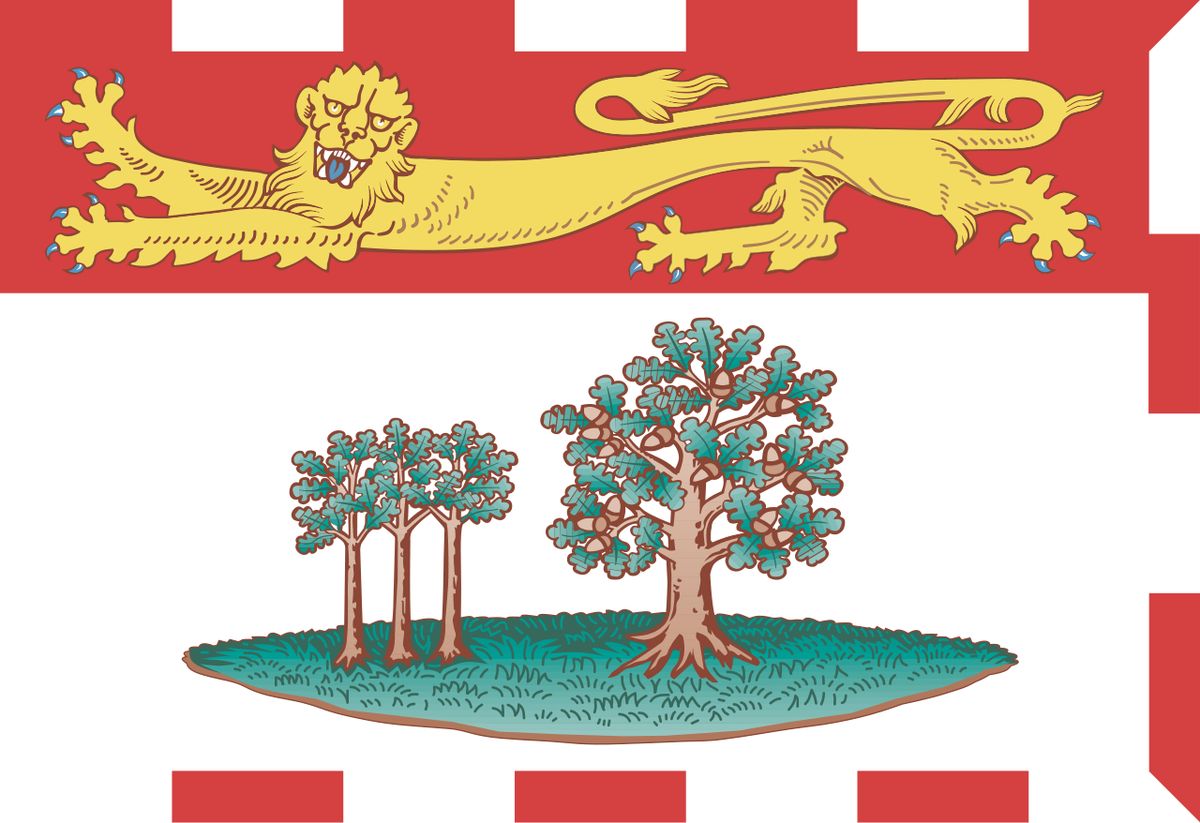
The blue jay holds a place in various aspects of North American human culture. In old African-American folktales from the southern United States, the blue jay was a significant metaphysical creature. In some stories, it was credited with making the earth 'when all de worl' was water' by bringing the first grit or dirt. In others, it was said to be a temporary servant of the Devil, gathering twigs on Fridays to furnish hell's kindling, and thus was not seen on that day. In modern popular culture, an anthropomorphic blue jay named Mordecai is a main character in the Cartoon Network animated series Regular Show. The bird serves as an official symbol for several institutions. It is the provincial bird of Prince Edward Island in Canada. In the United States, it is the official mascot for Johns Hopkins University, Elmhurst University, and Creighton University. Its most prominent sporting association is with the Toronto Blue Jays Major League Baseball team, which adopted the bird as its symbol, name, and for its mascot, an anthropomorphic blue jay named Ace. The species' striking appearance, familiar presence, and complex behaviours ensure its continued role as a subject of public interest and a symbol of local identity.
Questions about Blue jay
What does a blue jay eat?
Blue jays are omnivorous, with about 75% of their diet consisting of plant matter. They primarily eat seeds and nuts like acorns, which they crack with their strong bills, often while holding the nut with their feet. They also consume grains, fruits, berries, peanuts, and various small invertebrates. They are known to cache or hide food, especially nuts, for later consumption. While they occasionally raid nests for eggs or nestlings, studies suggest bird material is a very small portion of their overall diet.
Where do blue jays live in Canada?
In Canada, blue jays are found primarily in the eastern and central parts of the country. Resident populations exist in Newfoundland, and breeding populations are widespread across southern Canada from the Maritimes to southern Manitoba. They inhabit a variety of forest types, including deciduous, coniferous, and mixed woodlands, and have readily adapted to urban and suburban environments like parks and residential areas. Their range has been expanding northward and westward in recent decades.
How long do blue jays live?
The average lifespan for a wild blue jay that survives to adulthood is around 7 years. However, they are capable of living much longer. The oldest known wild blue jay on record was at least 26 years and 11 months old when it was found dead in 2016. It had been banded in the Newfoundland and Labrador area in 1989. Another recorded individual lived to about 17 and a half years. Mortality factors include predation, collisions, and diseases like West Nile virus.
Are blue jays migratory?
Blue jay migration is complex and not fully understood. Populations in the northernmost parts of their range, particularly the subspecies C. c. bromia, are partially migratory and may move south several hundred kilometres for the winter. Thousands migrate in loose flocks along the Great Lakes and Atlantic coasts. However, some individuals remain in their territories year-round. Migration appears to be influenced by age, weather, and food availability, with young birds more likely to migrate than adults, though many adults also undertake irregular migrations.
Why are blue jays so noisy?
Blue jays are highly vocal birds with a wide range of calls used for communication. Their loud, screaming alarm calls serve to warn other jays and birds of predators and to mobilize group defence, known as mobbing, against threats like hawks and owls. They also use calls to maintain contact with mates and signal agitation. Their reputation for noisiness is enhanced by their skill as mimics. They can accurately imitate the calls of hawks, possibly to test for predators or scare competitors, and can even learn to mimic human speech.
Is the blue jay a provincial bird in Canada?
Yes, the blue jay is the official provincial bird of Prince Edward Island. It was adopted as a symbol for its familiarity and prevalence in the region. Beyond this official status, the blue jay is also a prominent cultural symbol as the namesake and mascot of the Toronto Blue Jays Major League Baseball team, whose mascot is named Ace. The bird is also used as a mascot by several universities in the United States, including Johns Hopkins University.
Sources and further reading
- Blue jay (Wikipedia)
- Blue Jay (nationalgeographic.com)
- Blue Jay Animal Facts, Cyanocitta cristata (a-z-animals.com)
- Creature Feature, Blue Jay (cataraquiconservation.ca)
Checked by the Your Space Hamilton desk. Last updated 2026-10-20.