Black-capped chickadee
The black-capped chickadee (Poecile atricapillus) is a small, nonmigratory songbird native to North America and one of Canada's most familiar and beloved backyard birds. It is easily identified by its distinctive black cap and bib, white cheeks, and grey back, with a body length of about 11 to 15 centimetres and a weight of 9 to 14 grams. The species is renowned for its complex vocalizations, including the eponymous chick-a-dee-dee-dee alarm call and the two-note fee-bee song, as well as its remarkable spatial memory and food-caching behaviour. Widespread across southern Canada from British Columbia to Newfoundland, the black-capped chickadee is a permanent resident that adapts readily to human environments, serving as an important species for ecological study and public engagement with nature.
Taxonomy and Subspecies
The black-capped chickadee was first formally described by French zoologist Mathurin Jacques Brisson in 1760 based on a specimen from Canada. Swedish naturalist Carl Linnaeus provided the binomial name Parus atricapillus in 1766. Modern genetic and morphological studies led to its reclassification into the genus Poecile, a move formalized by the American Ornithologists' Union in 1998. Molecular phylogenetic studies confirm its closest relative is the mountain chickadee (Poecile gambeli). Historically, it was considered potentially the same species as the Eurasian willow tit and the Carolina chickadee, but studies in 1989 and 2005 confirmed all three as distinct species. Nine subspecies of black-capped chickadee are currently recognized, varying primarily in size and colouration across their range.
The nominate subspecies, Poecile atricapillus atricapillus, ranges across eastern and central Canada to the northeastern United States. Poecile atricapillus turneri, found in southern Alaska and northwest Canada, has the palest colouring. The smallest and darkest subspecies is P. a. occidentalis of southwest British Columbia to northwest California. The subspecies P. a. bartletti is unique, living only on the island of Newfoundland and possessing different mitochondrial DNA, likely due to long-term geographic isolation. Other subspecies include P. a. septentrionalis across western and central Canada, P. a. fortuitus in inland southwest Canada, and P. a. practicus in the Appalachian Mountains.
Physical Description and Identification
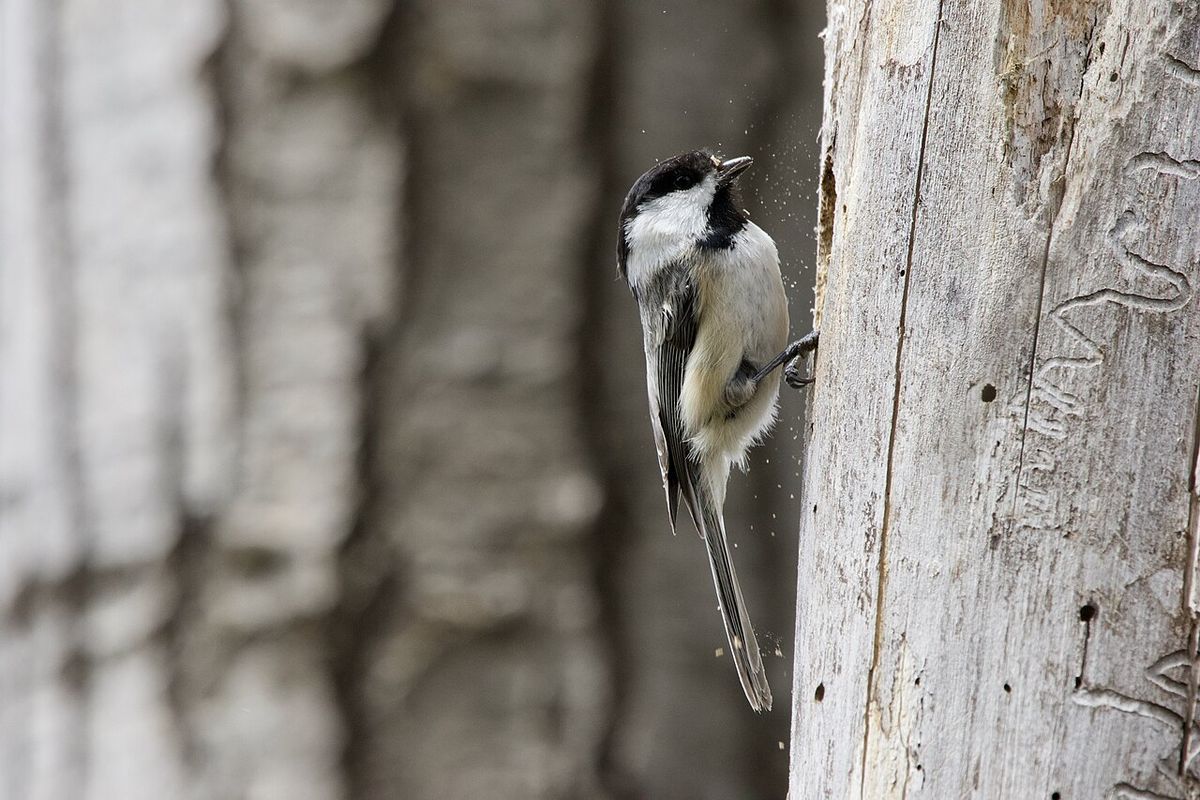
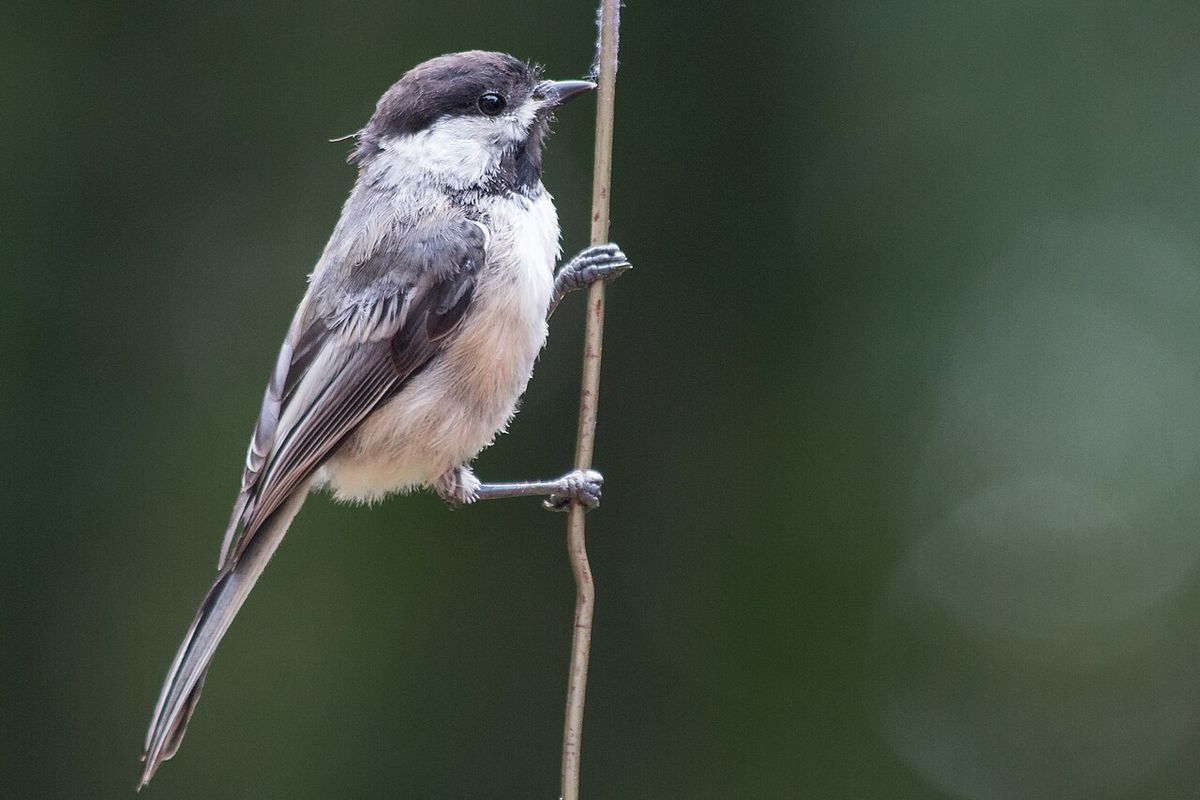
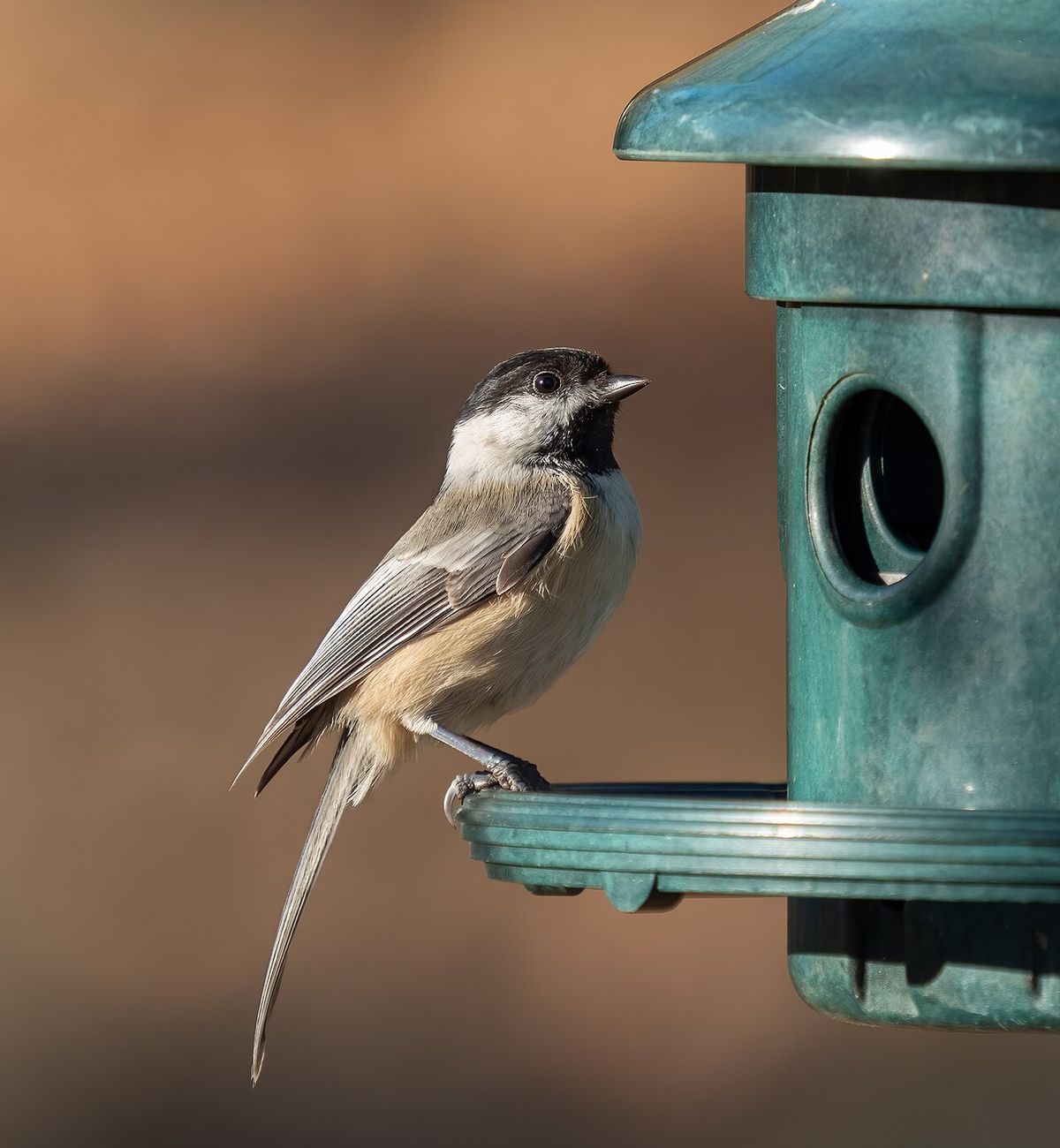
The black-capped chickadee is a small, plump bird with a short neck and a large head relative to its body. Its most prominent features are the solid black cap and bib, contrasting sharply with bright white cheeks. The underparts are white with buff-coloured flanks, and the back, wings, and tail are a greenish or slate grey. The beak and legs are black, and the irises are dark brown. Males and females are nearly identical, though males tend to have a slightly larger black bib and are on average very slightly larger in wing and tail length. Both sexes weigh between 10 and 14 grams. Juveniles resemble adults but have fluffier plumage.
Identification can be challenging where its range overlaps with similar species. It is most easily confused with the Carolina chickadee, from which it can be distinguished by its slightly paler wing edges, a messier border to its black bib, and most reliably by its vocalizations. The mountain chickadee has a distinct white eyebrow stripe, and the boreal chickadee has a brown cap instead of black. Visual identification should always be corroborated by the bird's call or song, especially in narrow hybrid zones like the one with the Carolina chickadee in the eastern United States.
Complex Vocalizations and Communication
The black-capped chickadee possesses a highly sophisticated vocal repertoire, with adults capable of producing up to 16 distinct call types to convey a wide array of information. This complexity is an adaptation to living in dense vegetation where flock members are often out of sight. The most famous vocalization is the chick-a-dee-dee-dee call, a complex alarm and contact call produced by both sexes year-round. This call is composed of four note types arranged in a strict order, with the number of repeated dee notes communicating the level of threat from a predator. A study of over 5,000 alarm calls found that small, dangerous raptors like pygmy owls triggered calls with more dees, with one extreme example containing 23 dee notes.
Another recognizable sound is the clear, whistled fee-bee song, most often sung by males. This two-note song, with the first note roughly a whole step above the second, is used to defend territory and attract mates. The song frequency typically starts around 400 Hz. Chickadees can adjust the frequency of their songs to overcome ambient noise or to match or challenge competing males in aggressive singing contests. Other notable calls include a gargle noise used in aggressive and sexual contexts, a broken dee, a variable see, and hisses. The gargle call is learned socially from parents and siblings, beginning development about 30 to 35 days after hatching.
- Fee-bee song: A two-note whistle used primarily by males for territory and mating.
- Chick-a-dee call: A complex call with A, B, C, D notes used for alarms and flock coordination.
- Gargle call: A rapid, complex series of notes used in aggression and courtship.
- Broken dee / Variable see: Calls associated with breeding and pair bonding.
- Hiss and snarl: Sounds used in territorial defence.
- High zee and tseet: Additional contact or alert calls.
These vocalizations have ecological importance beyond the species. During winter, mixed-species flocks containing nuthatches, woodpeckers, kinglets, and vireos often form, and these other birds learn to recognize and react to chickadee alarm calls. Studies show that red-breasted nuthatches, for example, react more strongly to chickadee alarm calls indicating a higher threat level, demonstrating an understanding of the call's syntax. The calls also coordinate group movement and facilitate recognition between individual birds and different flocks.
Distribution, Habitat, and Population
The black-capped chickadee is a non-migratory resident across a vast swath of North America. Its range extends from western and southern Alaska, through the southern half of Yukon, and across all Canadian provinces except Nunavut. In the east, it is found from Labrador to Newfoundland, and in the west, it is present in British Columbia except for Vancouver Island, the Gulf Islands, Haida Gwaii, and parts of the Sunshine Coast, where it is replaced by the chestnut-backed chickadee. Its range continues south through the northern United States to northern California, northern New Mexico, and New Jersey, with populations also in the Appalachian Mountains at higher elevations. There is evidence that the southern border of its range is slowly moving northward due to climate warming.
This adaptable bird inhabits deciduous, coniferous, and mixed forests, as well as open woods, willow thickets, cottonwood groves, and human-modified landscapes like urban parks, orchards, and suburban backyards. It is most common at elevations below 750 metres but has been recorded as high as 3,200 metres. The species does not change habitats seasonally, though in winter, flocks may move into dense conifer forests for shelter, and irregular movements or irruptions of juveniles sometimes occur. The global population is considered to be increasing, and the International Union for Conservation of Nature (IUCN) lists it as a species of Least Concern, though some data notes a decreasing population trend.
Diet, Foraging, and Food Caching
The black-capped chickadee is an opportunistic feeder with a diet that shifts dramatically with the seasons. Overall, its consumption is roughly 70 percent animal matter and 30 percent plant matter. During the breeding season, insects and other arthropods comprise 80 to 90 percent of its diet, with a heavy emphasis on caterpillars, spiders, insect eggs, larvae, and pupae. This high-protein diet is crucial for feeding nestlings, and spiders provide taurine, an amino acid essential for brain development. In fall and winter, the diet shifts to about half plant and half animal matter, including seeds, berries, and dormant insects or pupae. Chickadees are common visitors to backyard feeders, readily taking sunflower seeds, suet, peanuts, and mealworms. They have also been observed scavenging fat from dead mammals like deer and skunks.
This species is an avid food-cacher, a behaviour critical for winter survival. In autumn, a single chickadee can store up to 1,000 seeds per day, totalling an estimated 80,000 items per season. Food items, primarily seeds but also insects, are hidden singly in thousands of locations such as bark crevices, under dead leaves, in knotholes, or within clusters of conifer needles. Their spatial memory for cache locations can last at least 28 days, and they can even remember the relative quality of different stored items. This exceptional memory is supported by a large hippocampus, the brain region responsible for spatial navigation and memory.
The hippocampus of the black-capped chickadee exhibits remarkable plasticity. It grows in size in the autumn during peak caching activity, reaching its largest size in October, and shrinks by February as caches are depleted. Chickadees living in harsher northern climates, such as Alaska, have larger hippocampi and more neurons than their southern counterparts, an adaptation to greater reliance on cached food. Research also indicates that chickadees can replace old neurons with new ones, effectively overwriting old memories to make space for new cache locations. Access to supplemental food at bird feeders can significantly impact winter survival in severe climates, doubling survival rates during extended cold spells below -18°C.
Social Structure and Breeding
Black-capped chickadees are highly social, curious birds that live in structured flocks with strict linear dominance hierarchies for most of the year. Social rank is determined by aggressiveness, with males typically dominating females and adults dominating juveniles. Higher-ranking individuals enjoy better access to food and superior nesting sites. Conflicts are resolved through vocal displays and physical contests. During breeding season, song contests between males can escalate until the birds grapple, sometimes falling to the ground locked together. In winter, these flocks often expand to form mixed-species foraging groups with nuthatches, woodpeckers, kinglets, and other small birds, which benefit from the chickadees' vigilance and alarm calls.
The species is generally considered monogamous, with pairs forming for a breeding season, though it is not yet confirmed if they mate for life. The breeding season lasts from late April to early August. Pairs work together to excavate a nest cavity in soft, decaying wood of a dead tree or stump, or they may use an abandoned woodpecker hole or a nest box. The female builds the nest inside using moss and coarse vegetation, lining it with soft material like animal fur. She lays a clutch of one to 13 white, speckled eggs, though the typical number is six to eight. The female alone incubates the eggs for 12 to 13 days, during which the male feeds her.
- Nest excavation: Both sexes excavate cavity in dead wood or use old woodpecker holes.
- Clutch size: 1-13 eggs, typically 6-8.
- Incubation period: 12-13 days, performed by female only.
- Nestling period: Chicks fledge 12-16 days after hatching.
- Post-fledging care: Family group stays together for 5-6 weeks.
- Nest site fidelity: Rarely use the same nest site in consecutive years.
After hatching, both parents feed the nestlings a diet rich in caterpillars and spiders. The young fledge from the nest 12 to 16 days after hatching. The family group remains together for another five to six weeks before the juveniles disperse. Chickadees rarely reuse the same nest cavity in subsequent years.
Predators and Survival
Despite their adaptability, black-capped chickadees face predation pressure from a variety of animals throughout their life cycle. Their primary avian predators are hawks and the Northern shrike. Owls also pose a significant threat, especially at night. Nest predators include snakes, raccoons, weasels, chipmunks, opossums, mice, and squirrels, which may raid nests for eggs and nestlings. Adult females are sometimes killed on the nest by these predators. The species' complex alarm call system is a key anti-predator adaptation, allowing flock members to communicate specific threat levels and coordinate mobbing behaviour or escape.
Most black-capped chickadees live only two to three years, falling victim to predators, disease, or harsh winter conditions. However, their remarkable cognitive adaptations for food caching and spatial memory enhance winter survival. The oldest known black-capped chickadee on record lived over 11.5 years. Survival rates are strongly influenced by environmental severity. In regions with very cold winters, access to bird feeders providing supplemental food can double a chickadee's chance of surviving the season. Their status as a species of Least Concern indicates stable, widespread populations, though continued habitat preservation and public engagement through backyard feeding and citizen science remain valuable for their conservation.
Questions about Black-capped chickadee
What does a black-capped chickadee look like?
The black-capped chickadee is a small, plump bird about the size of a sparrow, measuring 11 to 15 centimetres long with a wingspan of 15 to 20 centimetres. It is easily identified by its solid black cap and bib, bright white cheeks, and grey back, wings, and tail. Its underparts are white with buff-coloured sides. Males and females look nearly identical, though males may have a slightly larger black bib. It weighs only 9 to 14 grams.
What do black-capped chickadees eat?
Their diet is seasonal. In spring and summer, they are primarily insectivorous, eating caterpillars, spiders, and insect eggs and larvae, which make up 80 to 90 percent of their diet. In fall and winter, they shift to eating roughly half seeds and berries and half animal matter like dormant insects. They are common at backyard feeders, preferring sunflower seeds, suet, peanuts, and mealworms. They are also known to cache thousands of seeds in autumn for winter retrieval.
Where do black-capped chickadees live in Canada?
Black-capped chickadees are found across southern Canada from British Columbia to Newfoundland, but are absent in Nunavut. They inhabit a wide variety of wooded areas, including deciduous, coniferous, and mixed forests, as well as urban parks, willow thickets, and suburban backyards. They are absent from Vancouver Island, the Gulf Islands, and Haida Gwaii in British Columbia, where the chestnut-backed chickadee is found instead. They are the provincial bird of New Brunswick.
How do black-capped chickadees survive the winter?
They survive harsh Canadian winters through several key adaptations. They cache up to 80,000 seeds and other food items in autumn and possess an exceptional spatial memory, supported by a hippocampus that grows seasonally, to retrieve them. They can lower their body temperature at night to conserve energy. They also forage in mixed-species flocks for safety and efficiency. Access to bird feeders providing supplemental food can significantly increase their winter survival rates during extreme cold.
How long do black-capped chickadees live?
Most black-capped chickadees have a short lifespan of only two to three years due to predation and environmental pressures. However, the oldest recorded individual lived for over 11.5 years. Their survival is influenced by factors like winter severity, predator abundance, and access to reliable food sources. Their remarkable brain plasticity and food-caching behaviour are crucial adaptations that help them endure challenging conditions and maximize their chances of longevity.
What is the black-capped chickadee's call?
The black-capped chickadee is named for its familiar chick a dee dee dee call. This call is a complex vocalization used for alarms and coordinating group movement, where the number of dee notes indicates the threat level from a predator. The bird also produces a clear, two note fee bee whistle, primarily sung by males. In total, black capped chickadees can make up to 16 distinct types of vocalizations. These include other sounds like gargles, hisses, and a tseet call, which are used for communication within flocks and during breeding.
Sources and further reading
- Black-capped chickadee (Wikipedia)
- Black-capped chickadee (nationalzoo.si.edu)
- Backyard Friends: Black-capped Chickadee, The Yellow Bird (theyellowbird.ca)
- A Familiar Winter Bird: Black-capped Chickadee (thamesriver.on.ca)
- Parus atricapillus (black-capped chickadee) | INFORMATION (animaldiversity.org)
Checked by the Your Space Hamilton desk. Last updated 2026-10-28.