Beluga whale
The beluga whale (Delphinapterus leucas) is a distinctive Arctic and sub-Arctic cetacean, renowned for its all-white colouration and lack of a dorsal fin. As one of two members of the Monodontidae family, alongside the narwhal, it is a culturally and ecologically significant species in northern Canadian waters. Belugas are highly social, vocal animals, often called 'sea canaries' for their complex range of chirps and whistles. In Canada, they inhabit regions from the High Arctic to the St. Lawrence River estuary, with several populations listed as endangered under Canadian species-at-risk legislation.
Physical Description and Adaptations
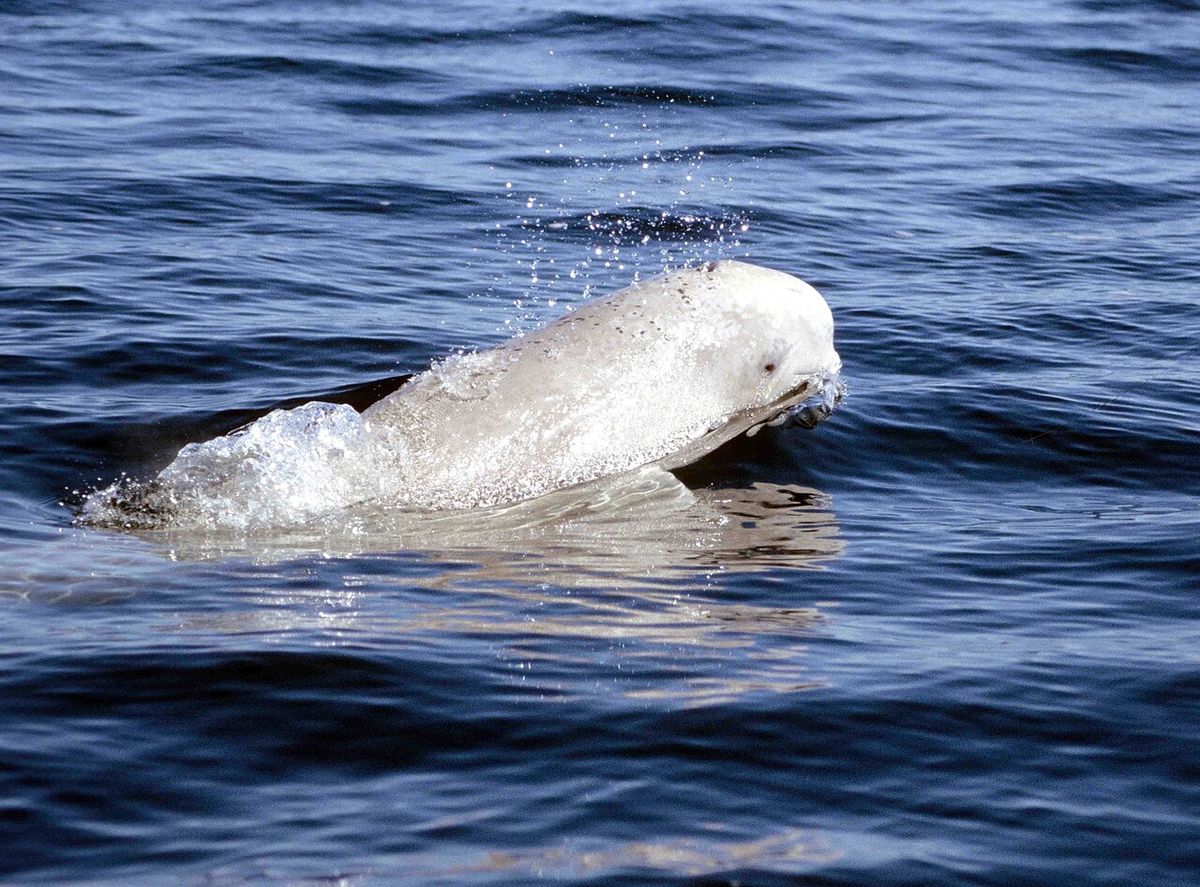
The beluga whale possesses a unique and highly adapted physical form for life in cold Arctic waters. Its most striking feature is its pure white or whitish-grey skin, which provides camouflage against ice floes and is achieved gradually, with calves born grey and turning fully white between seven and nine years of age. The species exhibits moderate sexual dimorphism, with males being about 25 percent longer and significantly heavier than females. A key adaptation is the absence of a true dorsal fin, replaced by a tough dorsal ridge that facilitates swimming under ice and may aid in heat conservation. Instead, the beluga has a prominent, bulbous forehead called a melon, which is composed of fatty tissue and is malleable, allowing the whale to focus sounds for sophisticated echolocation used in navigation and hunting.
Belugas have a stocky, fusiform body where between 40 and 50 percent of their total weight is blubber, a proportion higher than in non-Arctic cetaceans. This thick layer of fat provides essential insulation in near-freezing waters and serves as an energy reserve. Their neck vertebrae are not fused, granting them unusual lateral head mobility to improve their field of view and assist in catching prey. Their sense of hearing is exceptionally developed, with a range from 1.2 to 120 kHz, far exceeding human capabilities, and sound is primarily received through the lower jaw. While their vision is functional both in and out of water, it is considered relatively poor compared to dolphins, though their eyes are protected by a lubricating, gelatinous substance.
The beluga's rostrum contains 36 to 40 small, blunt, and slightly curved teeth, which are not used for chewing but for grasping prey. They have a single blowhole on the top of the head behind the melon, which is sealed by a muscular covering. Their thyroid gland is notably large, weighing three times more than that of a horse, which is believed to help regulate a higher metabolism during summer estuarine residence. The pectoral fins are small, rounded, and oar-shaped, and contain a thermoregulation mechanism where arteries are surrounded by veins that dilate or contract to manage heat loss.

Habitat, Distribution, and Migration
Beluga whales are circumpolar, inhabiting the Arctic Ocean and the seas and coastlines around North America, Russia, and Greenland. The global population is estimated at around 200,000 individuals, with significant numbers found in Canadian waters. They are a migratory species for the most part, with movement patterns dictated by the seasonal advance and retreat of sea ice. The majority of groups spend the winter in areas around the Arctic ice cap, utilizing leads and polynyas to breathe. During the summer months, they undertake substantial migrations to warmer, shallower waters, particularly river estuaries and coastal areas, where they feed, give birth, and molt their skin.
In summer, these migrations can lead to spectacular aggregations of hundreds or even thousands of belugas in specific estuaries, representing a large portion of a regional population. Some populations, however, are considered relatively sedentary and do not undertake long-distance migrations. Fossil evidence, such as the famous Charlotte whale discovered in Vermont, indicates that beluga ranges have historically expanded and contracted with ice ages. This fossil, preserved in sediments from the post-glacial Champlain Sea, shows that belugas once inhabited areas far inland from current coastlines when sea levels were higher.
The evolutionary history of the Monodontidae family shows they once inhabited warmer waters. Fossils of Casatia thermophila from five million years ago, found alongside fossils of tropical shark species, provide strong evidence for this warmer past distribution. The beluga's earliest known distinctive ancestors include Denebola brachycephala from the late Miocene (9-10 million years ago) and Bohaskaia monodontoides from the early Pliocene (3-5 million years ago). The Charlotte whale, discovered in 1849 during railroad construction in Vermont about 240 kilometres from the Atlantic, is now the official Vermont State Fossil, making Vermont the only U.S. state whose official fossil is from a still-living animal.
Diet and Feeding Behaviour
Beluga whales are opportunistic and flexible feeders, with diets that vary considerably based on their location, the season, and the local availability of prey. They are not picky eaters and will consume a wide variety of fish and invertebrate species. Their feeding strategies include foraging on the seafloor, hunting in the water column, and taking advantage of fish concentrations. Belugas do not use their teeth for chewing prey. Instead, they have 36 to 40 small, blunt teeth on each side of the jaw which are used to grasp and hold onto prey items, which are then typically torn apart and swallowed nearly whole.
Common prey items for belugas across their range include Arctic cod, capelin, sand lance, herring, smelt, and salmon. They also consume a significant amount of invertebrates such as shrimp, crabs, clams, worms, and octopus. Their ability to dive to depths of at least 700 metres allows them to access benthic, or seafloor, communities. The specific composition of their diet is a critical factor in monitoring ecosystem health, as contaminants like polychlorinated biphenyls (PCBs) can bioaccumulate in their prey and subsequently in the whales themselves.
As slow swimmers, belugas rely on stealth and echolocation to locate prey. Their diving capability is supported by physiological adaptations for pressure tolerance and oxygen conservation. The seasonal shift in habitat from open winter waters to shallow summer estuaries corresponds with changes in available food sources, requiring dietary flexibility. This opportunistic nature is a key to their survival in the variable Arctic environment, though it also makes them vulnerable to shifts in prey distribution caused by climate change and other ecological disruptions.
Social Structure and Vocalizations
Belugas are among the most gregarious and vocal of all cetaceans, earning the nickname 'sea canary' for their extensive repertoire of high-pitched clicks, whistles, squeals, and clucks. These sounds are crucial for communication within pods and for the echolocation used to move about and find prey under ice. Their social pods are fluid and dynamic, typically averaging about ten individuals but varying greatly in size. Research using radio tracking has shown that individual belugas can start in one pod and within a few days be hundreds of miles away from that group, indicating a loose and changing social network rather than rigid, permanent family units.
Pods often form around specific social functions, and observers generally categorize them into three main types. Nursery groups consist of mothers and their calves, providing protection and social learning for the young. Bachelor groups are composed entirely of males, while mixed groups contain individuals of both sexes and various ages. The large summer aggregations in estuaries see these different pod types mingling, creating temporary communities of immense size. Studies of pod genetics have found that members are not always closely related maternally, with many pods including paternal relatives and unrelated adults traveling together.
- Nursery Pods: Contain mothers and calves for protection and learning.
- Bachelor Pods: Composed exclusively of male belugas.
- Mixed Pods: Include belugas of both sexes and various ages.
- Summer Aggregations: Hundreds to thousands of whales gather in estuaries.
- Pod Instability: Individuals frequently move between different pods.
- Genetic Composition: Pods include both maternal and paternal relatives, as well as unrelated individuals.
The beluga's vocalizations are produced and modulated by the unique melon organ in its forehead. The melon's fatty tissue, rich in isovaleric acid (60.1%) and long-chain branched acids (16.9%), has a different composition from body fat and is integral to focusing emitted sounds. Belugas can change the shape of their heads by moving air around their sinuses to direct these sounds. Their hearing range, greatest between 10 and 75 kHz, is perfectly tuned to receive these social and echolocation signals, which are often transmitted through the lower jawbone to the middle ear.
Conservation Status and Threats
The beluga whale was classified as Near Threatened on the International Union for Conservation of Nature (IUCN) Red List in 2008, reflecting concerns over several declining populations. Threats are complex and vary by region, combining historical overhunting with modern anthropogenic pressures. Aboriginal subsistence hunting by Inuit in Canada and Greenland, Alaska Native groups, and some communities in Russia continues under exemptions to the International Whaling Commission's 1986 moratorium on commercial whaling. While hunt numbers have dropped substantially in Russia and Greenland, they have remained more stable in Alaska and Canada, requiring careful management to ensure sustainability.
Beyond hunting, belugas face significant threats from environmental contamination, climate change, and increased human activity in the Arctic. Industrial pollutants like PCBs accumulate in the food chain, leading to high concentrations in beluga blubber that can impact reproduction and health. Climate change is rapidly altering sea ice patterns, affecting migration routes, prey availability, and increasing access for shipping and industrial noise, which disrupts their acoustic environment. Natural predators include polar bears, which hunt belugas at ice holes, and killer whales, whose ranges are expanding northward with warming seas.
The population status across Canada is not uniform, with some groups being relatively healthy while others are in serious decline. Of the seven recognized Canadian beluga populations, those in eastern Hudson Bay, Ungava Bay, and the St. Lawrence River are officially listed as endangered. The isolated Cook Inlet population in Alaska is considered critically endangered and is protected under the United States Endangered Species Act. Conservation efforts involve habitat protection, contaminant monitoring, regulation of subsistence harvests, and mitigating the impacts of industrial development and vessel traffic in sensitive areas.
Other threats to beluga whales include infectious diseases and the direct and indirect effects of oil and gas exploration. The beluga's migratory pattern involves returning to the same estuaries annually, which makes localized populations particularly vulnerable to acute environmental disasters. These populations are also at risk from chronic pollution in those specific coastal areas. For example, the St. Lawrence River population resides in a heavily industrialized shipping corridor. This exposure subjects the whales to high levels of noise and chemical pollution. These factors have been linked to this population's failure to recover from historical overhunting.
Belugas in Captivity and Human Culture
Beluga whales are one of the most commonly kept cetacean species in captivity worldwide, housed in aquariums, dolphinariums, and marine parks across North America, Europe, and Asia. Their popularity stems from a combination of their docile demeanour, perceived smiling appearance, intelligence, and striking white colour. They are considered highly trainable and are often featured in public display programs. The captive management of belugas involves complex care related to their social needs, diet, and water quality, and it remains a topic of public and scientific debate regarding animal welfare and conservation value.
For millennia, beluga whales have held great cultural and subsistence importance for Indigenous peoples of the Arctic, including the Inuit of Canada and Greenland. Historically, virtually all parts of the whale were used, with the meat and blubber (muktuk) providing essential nutrition, the skin used for leather, and the oil for fuel and light. This relationship continues today through managed subsistence hunts that are integral to cultural identity and food security in northern communities. The beluga also occupies a place in wider popular culture, often representing the beauty and fragility of the Arctic marine environment.
Studies on captive belugas have provided much of the detailed knowledge about their physical contact needs, sensory capabilities, and longevity. Research shows they seek frequent physical contact with other belugas. They have chemoreceptors in the mouth that may allow them to detect different tastes, and they react immediately to the presence of blood in water with alarm behaviour. Like other toothed whales, their brains lack olfactory bulbs and nerves, indicating they likely have no sense of smell. The oldest beluga in captivity has provided data supporting the revised understanding that they can live into their seventies.
Population Trends and Scientific Research
Monitoring beluga whale populations is challenging due to their vast, remote habitats and seasonal movements. Scientists use a combination of aerial surveys, satellite tagging, photographic identification, and genetic sampling to estimate population sizes and trends. The global estimate of around 200,000 individuals masks significant regional variations, with some groups numbering in the tens of thousands and others only in the hundreds. Long-term research projects, such as those in the St. Lawrence Estuary and Cunningham Inlet, have provided invaluable data on beluga life history, social structure, and the impacts of human activity.
Recent scientific advancements have deepened understanding of beluga biology. A 2017 study that sequenced the beluga genome, comprising 2.327 Gbp, found a 97.87 percent genome-wide similarity with killer whales. Age determination methods have also improved significantly. Early methods counting dentin layers in teeth suggested annual deposits, but a 2006 radiocarbon dating study showed deposits occur less frequently, leading to the revised lifespan estimate of 70 to 80 years. In 2022, researchers confirmed belugas gain one dentin layer per year below the tooth enamel, solidifying this aging technique.
| Population Region | General Status | Notable Details |
|---|---|---|
| Global | Near Threatened (IUCN, 2008) | Estimated 200,000 individuals across all stocks. |
| Canadian (Multiple) | Varies by population | Seven populations. Eastern Hudson Bay, Ungava Bay, St. Lawrence River are endangered. |
| Cook Inlet, Alaska | Critically Endangered | Protected under U.S. Endangered Species Act. |
| Russian & Greenlandic | Declining | Substantial drops reported from historical hunting levels. |
| Other Alaskan & Canadian | More Stable | Hunting numbers have not dropped as substantially. |
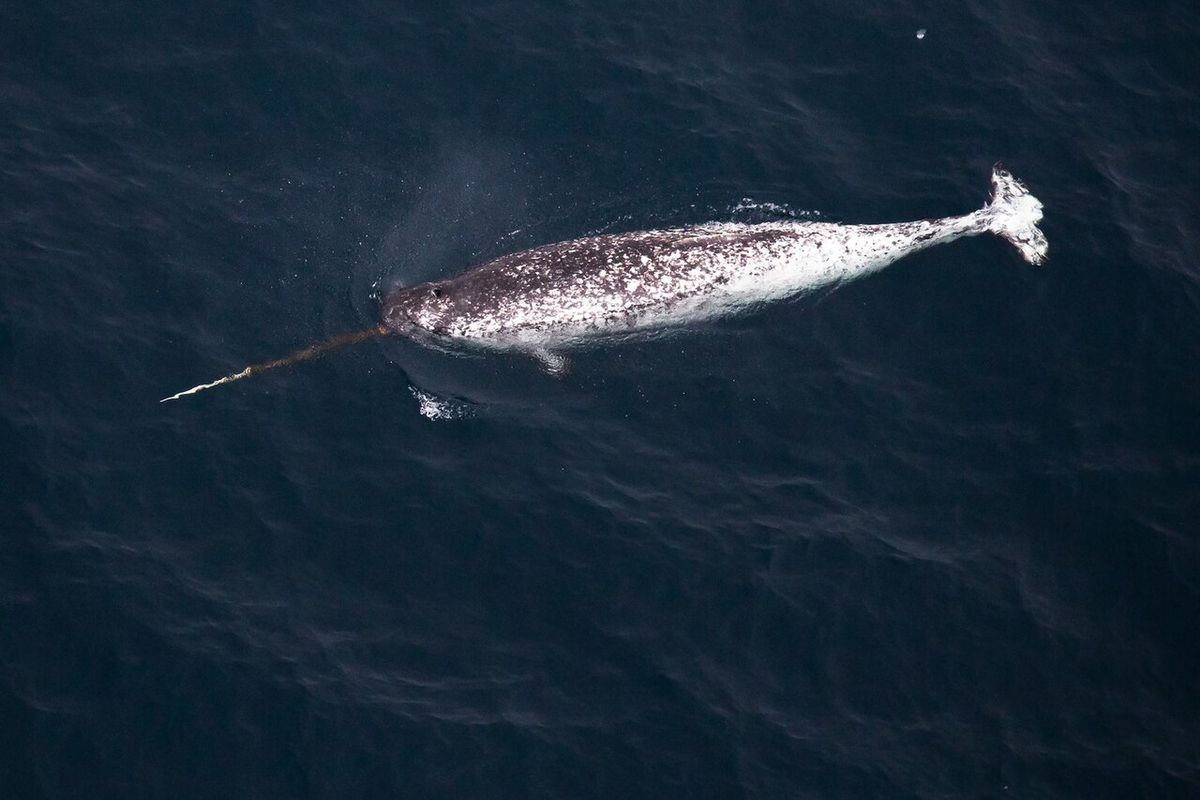
Ongoing research focuses on the impacts of climate change, contaminant loads, and underwater noise pollution. The beluga's status as a sentinel species makes it a critical indicator of Arctic marine ecosystem health. Genetic studies continue to clarify evolutionary relationships, supporting the hypothesis that hybridisation with narwhals is possible, based on a discovered skull with intermediate characteristics. The sequencing of its genome opens new avenues for understanding its physiological adaptations to the extreme Arctic environment, including its large thyroid gland and unique fat composition.
Questions about Beluga whale
Why are beluga whales white?
Beluga whales are white as an evolutionary adaptation for life in the Arctic. The white colouration provides camouflage against the ice and snow, helping to protect them from their main predators, polar bears and killer whales. Calves are born grey and gradually lose their pigmentation, with females turning fully white by around age seven and males by age nine. The skin also seasonally sheds, and during winter it can thicken and take on a yellowish hue, which is rubbed off during summer migrations to estuaries. This molting process helps remove harmful bacteria and damaged skin tissue.
How long do beluga whales live?
Beluga whales have a considerable lifespan. Early estimates based on tooth layer counts suggested they lived about 30 years, but more advanced techniques, including radiocarbon dating of dentin layers, have shown they can live for 70 or 80 years. The oldest confirmed beluga whale lived to be 79 years old. Researchers determine age by counting the annual layers of dentin and cementum deposited in their teeth, a method refined in a 2022 study that confirmed they gain one layer per year below the enamel. This revised aging process changed the understanding of beluga longevity.
What do beluga whales eat?
Beluga whales are opportunistic feeders with a diverse diet that changes with location and season. They primarily eat a variety of fish such as Arctic cod, capelin, herring, smelt, and salmon. They also consume significant amounts of invertebrates including shrimp, crabs, clams, worms, and octopus. They are capable divers, reaching depths of at least 700 metres to forage on the seafloor. They use their 36 to 40 small, blunt teeth to grasp prey, which they then tear apart and swallow nearly whole rather than chewing. Their diet directly influences contaminant levels in their bodies due to bioaccumulation in the food chain.
Are beluga whales endangered in Canada?
The conservation status of beluga whales in Canada varies by population. Of the seven recognized Canadian beluga populations, three are listed as endangered: the belugas of eastern Hudson Bay, Ungava Bay, and the St. Lawrence River. Other Canadian populations have healthier numbers but still face threats. Globally, the species is classified as Near Threatened by the IUCN. Threats in Canada include historical overhunting, ongoing regulated subsistence harvests, environmental contaminants like PCBs, climate change altering ice habitats and prey, and increased underwater noise from shipping and industrial development in the Arctic.
Why do beluga whales have a big forehead?
The beluga's prominent forehead, called a melon, is a specialized organ used for echolocation. It is composed of fatty tissue rich in isovaleric acid and long-chain branched acids and is uniquely malleable, allowing the whale to change its shape. By manipulating the melon and moving air in its sinuses, belugas can focus the beams of sound they emit for finding breathing holes and locating prey under ice and in murky waters. This sophisticated biological sonar system is critical for their survival, as their vision is relatively poor compared to other cetaceans like dolphins.
Can you see beluga whales in Canada?
Yes, beluga whales can be observed in several regions of Canada, particularly during the summer months when they migrate to coastal areas and river estuaries. Prime viewing locations include the Churchill River estuary in Manitoba, the St. Lawrence River estuary in Quebec, and Cunningham Inlet on Somerset Island in Nunavut. These summer aggregations, sometimes numbering in the hundreds or thousands, provide remarkable opportunities for wildlife viewing and tourism. It is important that such activities are conducted responsibly to minimize disturbance to the whales, especially in areas with endangered populations.
Sources and further reading
- Beluga whale (Wikipedia)
- Beluga Whale Facts and Information | United Parks & Resorts (seaworld.org)
- Beluga Whale (kids.nationalgeographic.com)
- Beluga whale (arcticwwf.org)
- Beluga Whale (fisheries.noaa.gov)
Checked by the Your Space Hamilton desk. Last updated 2026-10-20.