Atlantic puffin
The Atlantic puffin (Fratercula arctica) is a distinctive seabird of the auk family and the only puffin species native to the Atlantic Ocean. It is a bird of significant ecological and cultural importance in Canada, serving as the official bird of the province of Newfoundland and Labrador. The species breeds in coastal colonies across the North Atlantic, including major sites in Newfoundland and Labrador, Nova Scotia, and the Gulf of Maine. Known for its brightly coloured bill and upright stance, the Atlantic puffin is a charismatic species whose populations are facing rapid declines in parts of its range, leading to a vulnerable conservation status.
Physical Description and Identification
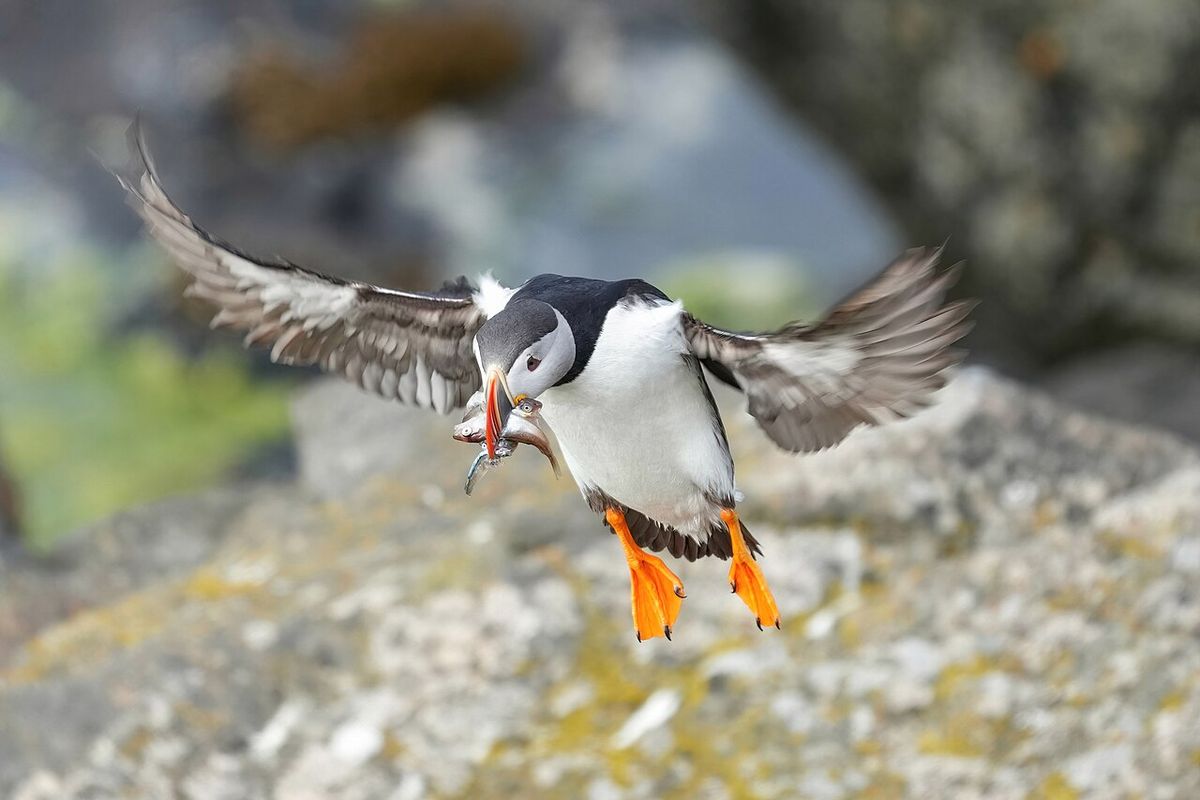
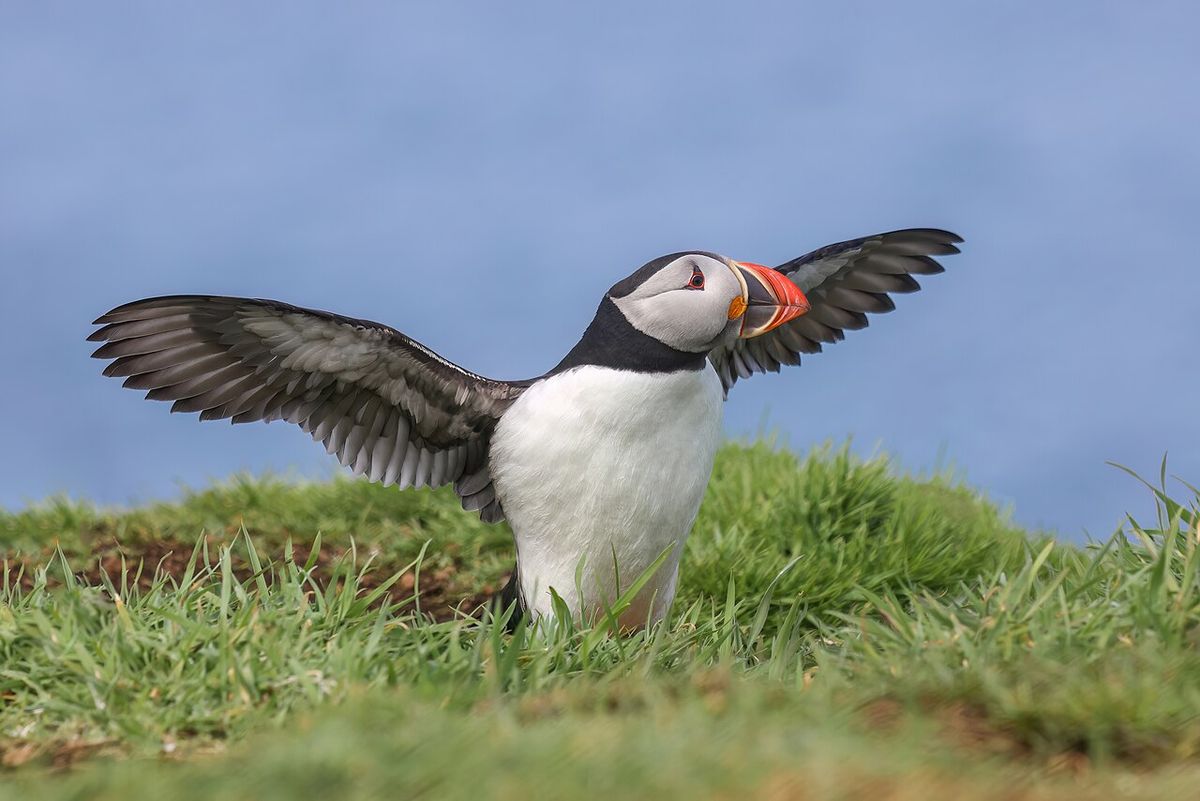
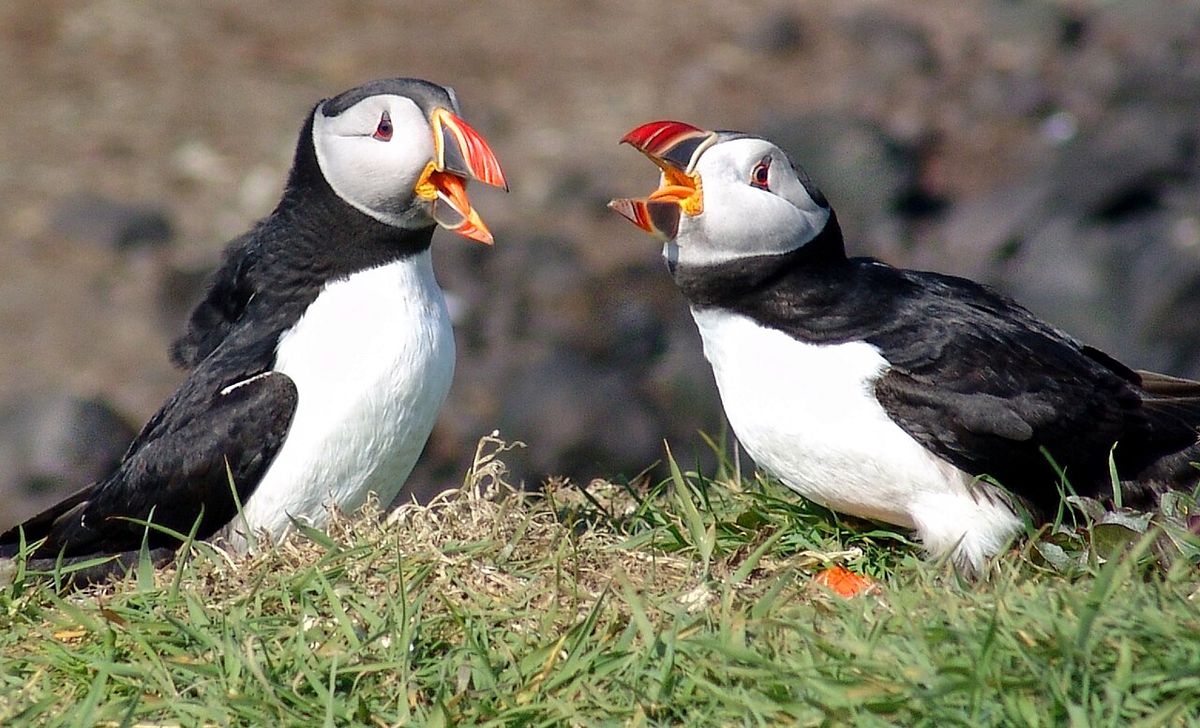
The Atlantic puffin is a stoutly built seabird with a thick neck, short wings, and a blunt tail, standing about 20 cm high on land. Its plumage is a striking contrast of glossy black on the head, back, and wings, with pure white underparts and distinctive, large pale grey cheek patches. The bird's most recognizable features are its broad, triangular bill, which is brightly coloured with an orange-red tip and a slate grey base separated by a yellow ridge, and its bright orange legs and webbed feet. The external appearance of males and females is identical, though males tend to be slightly larger. The species undergoes a partial moult at sea during winter, during which the bright bill plates and facial ornaments are shed, making the beak appear narrower and darker until colours return in spring for the breeding season. Juvenile puffins have similar but duller plumage, with dark grey face patches, a narrower dark grey bill with a yellowish-brown tip, and dark legs.
The bird's anatomy is adapted for a life spent both in the air and underwater. Its wings, while small relative to its body weight, allow for rapid flapping flight just above the ocean surface at speeds up to 80 km/h, and also function as paddles for swimming and diving. On land, the puffin's legs are set far back on its body, giving it the characteristic upright, waddling gait that has contributed to nicknames like 'clown of the sea'. The powerful beak is not only colourful but also highly functional, with inward-facing serrations and a hinged mechanism that allows it to hold multiple small fish in place while diving.
Taxonomy and Subspecies
The Atlantic puffin belongs to the order Charadriiformes and the auk family, Alcidae, which includes guillemots, razorbills, and auklets. Its genus, Fratercula, is derived from the Medieval Latin for 'little friar', a reference to its black-and-white plumage resembling monastic robes. The specific name 'arctica' denotes its northerly distribution. The Atlantic puffin is one of three puffin species, with its closest relative being the horned puffin of the Pacific. The tufted puffin is also a Pacific species. Within the Atlantic puffin species, three subspecies are generally recognized based on clinal increases in body size at higher latitudes. These are F. a. naumanni from northern Iceland and the high Arctic, F. a. arctica from southern Iceland and other intermediate areas, and F. a. grabae from the Faroe Islands and Britain. The primary morphological difference is size, with northern birds being significantly larger. For instance, a puffin from northern Iceland weighs about 650 grams with a 186 mm wing length, while one from the Faroes weighs only 400 grams with a 158 mm wing length.
Distribution and Habitat
The Atlantic puffin is a bird of the cold waters of the North Atlantic Ocean, with a breeding range that spans from the Arctic fringes to temperate zones. More than 90 percent of the global population breeds in Europe, with Iceland alone hosting approximately 60 percent of the world's Atlantic puffins. In North America, the species breeds from the coasts of Greenland and Labrador south to Nova Scotia and the Gulf of Maine. The largest colony in the western Atlantic, estimated at more than 260,000 breeding pairs, is located at the Witless Bay Ecological Reserve south of St. John's, Newfoundland and Labrador. Other significant North American breeding sites include coasts in Labrador and Nova Scotia. The birds show a strong preference for breeding on predator-free islands rather than mainland sites.
Outside the breeding season, puffins disperse widely across the open ocean, ranging as far south as the Mediterranean Sea and North Carolina in winter. Their oceanic range is vast, covering an estimated 15 to 30 million square kilometres. Tracking studies using geolocators on puffins from Maine have revealed remarkable journeys. One individual covered 7,700 kilometres of ocean in eight months, travelling north to the Labrador Sea and southeast to the mid-Atlantic before returning. This pelagic phase of their life cycle is poorly understood due to the difficulty of observing birds on the open ocean, but it is a critical period for survival, with most adult mortality occurring between departing breeding colonies in summer and returning the following spring.
Diet and Feeding Behaviour
The Atlantic puffin is a piscivorous seabird, with its diet consisting almost entirely of small fish. Its preferred prey includes sand eels, herring, capelin, and sprats, typically around 7 cm in length, though it can handle fish up to 18 cm long. An adult puffin needs to consume an estimated 40 of these fish per day to meet its energy requirements. The bird occasionally supplements its diet with shrimp, other crustaceans, molluscs, and polychaete worms, especially when foraging in coastal waters. Puffins are pursuit divers, using their semi-extended wings to 'fly' underwater and their webbed feet for steering, reaching considerable depths and staying submerged for up to a minute.
Their feeding technique is highly specialized. They hunt by sight and can swallow small fish while still submerged. For larger catches or multiple fish, the puffin's beak is perfectly adapted. The tongue is muscular and grooved to hold fish in place, and the hinged mandibles can be held parallel, secured by inward-facing serrations, allowing the bird to carry a row of fish crosswise. This efficient method enables a puffin to catch several fish in a single dive. To cope with the high salt intake from seawater and prey, puffins excrete excess salt through specialized glands located in their nostrils, in addition to kidney function.
Breeding and Life Cycle
Atlantic puffins are colonial breeders, returning to coastal cliff tops and islands in late spring. They exhibit strong philopatry, often nesting in the same colony where they were hatched and using the same burrow year after year. They are socially monogamous, a behaviour driven more by site fidelity than mate fidelity. The breeding season begins with mature birds congregating offshore before moving to land to reclaim nesting sites. The most desirable burrow locations are on grassy slopes just above the cliff edge, where take-off is easier. Later arrivals are forced to less optimal, more predator-prone periphery sites. The birds are energetic burrow engineers, digging tunnels in soft soil or using natural rock crevices, and a single white egg is laid in the burrow.
The chick, known as a puffling, is fed whole fish by its parents and grows rapidly. After about six weeks, the chick is fully fledged and leaves the burrow under cover of darkness, making its way to the sea where it will swim away and remain pelagic for several years before returning to land to breed. Young birds may come ashore a month after adults in their first potential breeding year and often find no available nest sites, delaying breeding until the following season. Key aspects of the puffin's breeding biology and behaviour include:
- Nesting: Digs burrows in clifftop soil or uses rock crevices. A single egg is laid.
- Chick Development: Chicks are fed whole fish and fledge after approximately 6 weeks.
- Post-Fledging: Juveniles depart at night, swim to sea, and do not return to land for 2-5 years.
- Colony Dynamics: Activity peaks in the evening. Birds often roost at sea on fishing grounds.
- Site Competition: Early arrivals secure the best burrows. Subadults may be excluded from breeding.
- Burrow Impact: Extensive tunneling can cause soil erosion and vegetation die-off on slopes.
Conservation Status and Threats
The species faces a multitude of threats both on land and at sea. On breeding colonies, adult birds and fledglings are vulnerable to predation by larger birds such as gulls and skuas. Terrestrial habitat degradation is another concern. Intensive burrowing can lead to soil erosion and colony collapse, as witnessed historically on Grassholm island where erosion left insufficient soil for burrow construction. Human disturbance, including incautious walking on nesting slopes, can also cause burrow collapse.
The most pressing threats are likely at sea, linked to changes in the marine ecosystem. Overfishing and climate change impacts have led to shifts in the abundance and distribution of key prey fish like sand eels and capelin, causing breeding failures and poor adult body condition. Survival during the winter pelagic phase is critical, and birds in poor condition at the start of winter are less likely to survive. Other marine threats include bycatch in fishing gear, oil spills, and plastic pollution. Conservation efforts are focused on protecting key breeding colonies, managing fisheries to ensure prey availability, and monitoring population trends. The vulnerability of this long-lived species with a low reproductive rate (one egg per pair per year) makes adult survival the most critical factor for population stability.
Population Estimates by Region
The global population of Atlantic puffins is concentrated in the northeastern Atlantic, with Europe hosting the vast majority of breeding pairs. The following table outlines the population distribution based on available estimates, highlighting the importance of Icelandic colonies and the significant, though smaller, populations in North America. These figures demonstrate the species' reliance on specific island ecosystems for breeding. Population trends are not uniform. While some colonies remain stable, others, particularly in the southern parts of the range like Norway and Britain, have experienced severe declines, driving the overall vulnerable status. Continuous monitoring is essential to track these changes and guide conservation actions.
| Region | Estimated Breeding Pairs | Notes |
|---|---|---|
| Europe (Total) | 4,770,000-5,780,000 | Represents >90% of global population |
| Iceland | Approx. 60% of global total | Largest national population. Key colonies in Westman Islands |
| Witless Bay, NL (Canada) | >260,000 | Largest colony in the western Atlantic |
| Norway | Significant colonies | Major populations on north and west coasts |
| Faroe Islands, UK (Shetland/Orkney) | Significant colonies | Important breeding archipelagos |
| Greenland | Significant colonies | Breeds on west coast |
| Other (Nova Scotia, Maine, etc.) | Smaller colonies | Southern edge of breeding range |
Questions about Atlantic puffin
Where can you see Atlantic puffins in Canada?
In Canada, Atlantic puffins breed primarily in Newfoundland and Labrador, Nova Scotia, and in the Gulf of Maine. The single largest and most accessible colony is at the Witless Bay Ecological Reserve, south of St. John's, Newfoundland and Labrador, which hosts over 260,000 breeding pairs. Other notable breeding sites include islands along the coasts of Labrador and Nova Scotia. The birds are present at these colonies during the breeding season, typically from late spring through summer, after which they disperse to the open ocean.
What do Atlantic puffins eat?
Atlantic puffins are primarily fish-eaters. Their diet consists almost entirely of small, slender fish such as sand eels (sand lance), capelin, herring, and sprats. An adult puffin needs to catch and eat about 40 of these fish daily. They occasionally consume other marine creatures like shrimp, crustaceans, and worms. Puffins are adept divers, using their wings to swim underwater and catch prey, often holding several fish crosswise in their beaks before swallowing them.
Are Atlantic puffins endangered?
The Atlantic puffin is currently classified as Vulnerable on the IUCN Red List of Threatened Species. This means it faces a high risk of extinction in the wild. The designation reflects rapid population declines observed in significant parts of its range, particularly in Europe. Threats include climate change affecting prey fish availability, overfishing, predation at colonies, pollution, and habitat disturbance. While global numbers remain in the millions, the downward trend in key populations is a major conservation concern.
How long do Atlantic puffins live?
Atlantic puffins are long-lived seabirds. While exact average lifespans in the wild are difficult to determine, they can live for over 20 years. Their life history strategy involves a long lifespan and low reproductive output, with pairs raising only one chick per year. This makes the survival rate of adult birds critically important for population stability. Most adult mortality occurs during the winter months when the birds are dispersed across the vast North Atlantic Ocean.
What is the difference between Atlantic puffins and Pacific puffins?
The Atlantic puffin is the only puffin species native to the Atlantic Ocean. It is closely related to two Pacific species: the horned puffin and the tufted puffin. The primary differences are in appearance and range. The Atlantic puffin has a black crown and back with pale grey cheek patches. The horned puffin has a white face and a small, fleshy 'horn' above the eye. The tufted puffin has distinctive long, yellow feather tufts curling back from its head during breeding season. All three share similar body shapes and burrow-nesting habits.
Why is the Atlantic puffin the bird symbol of Newfoundland and Labrador?
The Atlantic puffin is the official bird of the Canadian province of Newfoundland and Labrador. This designation reflects the bird's significant presence and association with the province's coastal regions. The largest colony in the western Atlantic, estimated at more than 260,000 pairs, is located at the Witless Bay Ecological Reserve, south of St. John's, Newfoundland and Labrador. The species breeds on the coasts of Newfoundland and Labrador as part of its eastern North American range. Its striking appearance and behaviour have given rise to nicknames like 'clown of the sea', making it a recognizable symbol of the area's natural heritage.
Sources and further reading
- Atlantic puffin (Wikipedia)
- Puffin Watching in Newfoundland (trinityecotours.com)
Checked by the Your Space Hamilton desk. Last updated 2026-10-22.