American robin
The American robin (Turdus migratorius) is a migratory songbird belonging to the thrush family, Turdidae. It is one of the most widespread and familiar birds across North America, recognized by its reddish-orange breast, gray-brown back, and cheerful, caroling song. The species holds significant cultural status in Canada, appearing on the now-withdrawn 1986 Canadian $2 banknote, and is a cherished herald of spring in many regions. With an estimated population of 370 million, it is considered the most abundant landbird on the continent.
Taxonomy and subspecies
The American robin was first formally described by the Swedish naturalist Carl Linnaeus in 1766. Its scientific name, Turdus migratorius, derives from Latin words meaning 'thrush' and 'to migrate'. Genetic studies, including one from 2020, indicate its closest living relative is the rufous-collared thrush of Central America. A 2026 genetic study suggested the rufous-collared thrush may be genetically embedded within American robin populations, while also proposing that the isolated Baja California population (subspecies confinis) is evolutionarily basal and may warrant classification as a separate species. Historically, some older studies had weakly suggested a closer relationship to certain African thrushes, but this is not supported by modern genetic evidence.
The species is divided into seven generally accepted subspecies, which intergrade where their ranges meet. The nominate subspecies, T. m. migratorius, breeds across much of Canada and the United States east of the Rocky Mountains. T. m. nigrideus breeds in coastal northern Quebec, Labrador, and Newfoundland, and is darker than the nominate form. T. m. achrusterus is found in the southeastern United States and is slightly smaller and paler. The northwestern subspecies, T. m. caurinus, breeds from Alaska to Oregon and is very dark-headed. T. m. propinquus occupies western North America from British Columbia to Baja California and is paler and more brownish-gray. T. m. phillipsi is a resident of Mexico south to Oaxaca. The distinctive T. m. confinis is a small, pale, non-migratory subspecies restricted to the mountains of southern Baja California.
Physical description
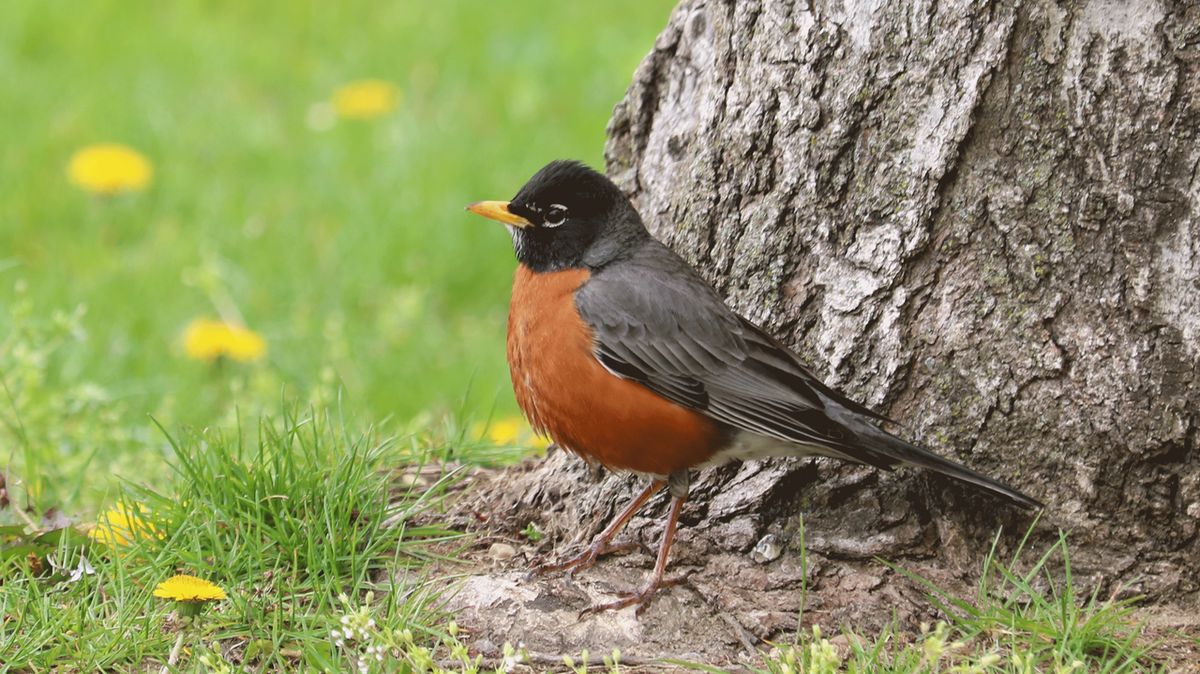
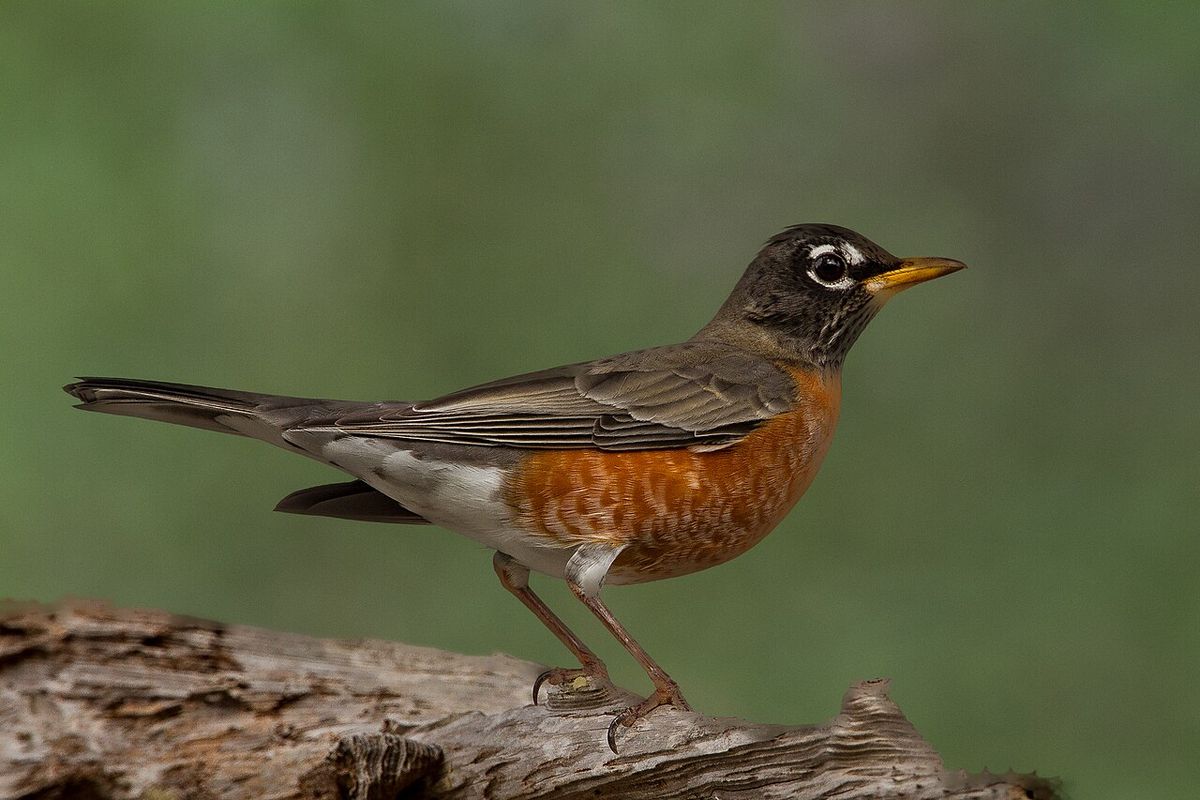
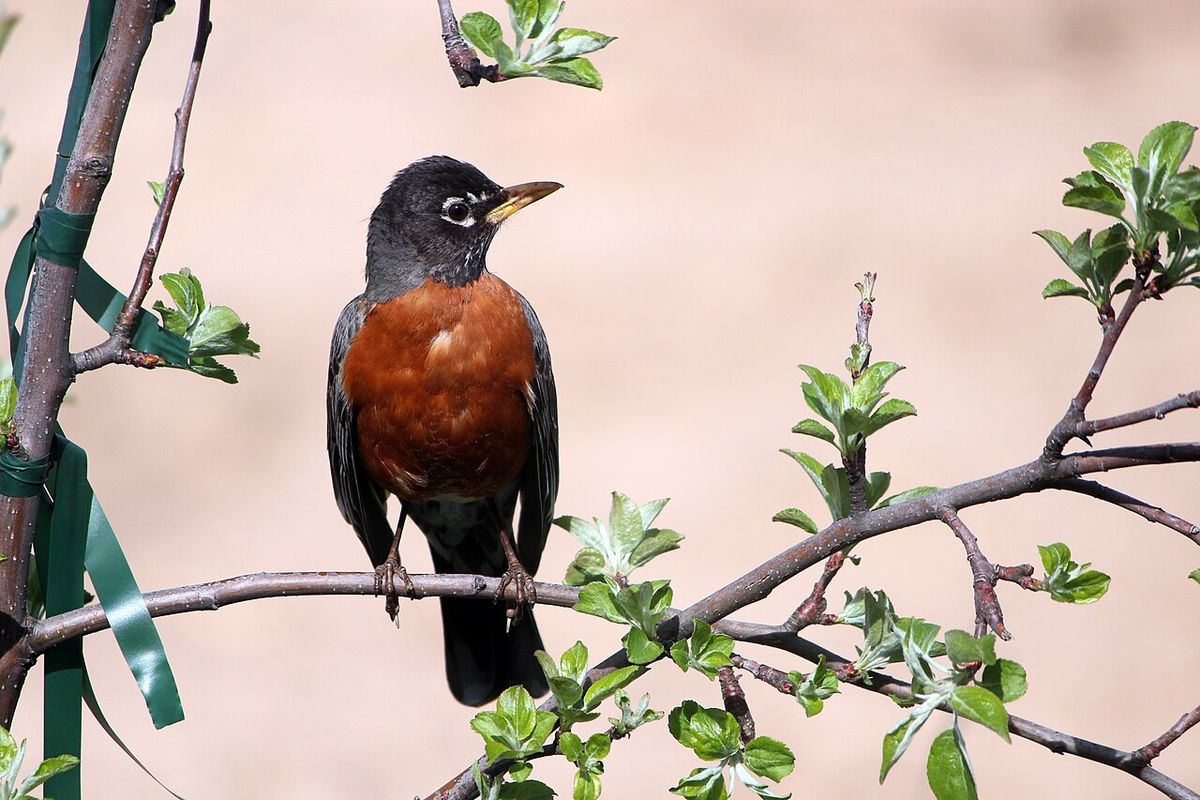
The American robin is a medium-sized thrush, with the eastern subspecies measuring 23 to 28 centimetres in length and having a wingspan of 31 to 41 centimetres. On average, an adult robin weighs about 77 grams, with males typically being slightly heavier than females. The plumage is characterized by a brown back and a distinctive reddish-orange breast that can range from a deep maroon to a peachy hue. The head varies from jet black to gray, with distinctive white eye arcs and supercilia (eyebrow stripes). The throat is white with black streaks, and the belly and undertail coverts are white. The bill is primarily yellow, often with a darker tip that becomes more extensive in winter, and the legs and feet are brown.
Sexual dimorphism is subtle, with females generally appearing duller than males, often with a brownish tint to the head and less bright underparts. However, plumage alone is not always a reliable indicator of sex. Juvenile robins are paler than adult males and have dark spots on their breasts and whitish markings on their wing coverts. First-year birds closely resemble adults but tend to be duller in coloration, and a small percentage may retain some juvenile feathers.
Distribution, migration and habitat
The American robin breeds across nearly all of North America, from Alaska and northern Canada south to northern Florida and Mexico. While some individuals may overwinter in the northern United States and southern Canada, the majority are migratory. Most birds depart their northern breeding grounds by the end of August and return north from February through March. They winter from southern Canada south through the United States to central Mexico, and along the Pacific Coast. Migration distance varies considerably by population. For example, robins tagged in Alaska have been recorded migrating 3.5 times farther than those tagged in Massachusetts.
The species is a rare vagrant to Western Europe, with most records occurring in Great Britain, where 30 individuals had been recorded by the end of 2024. Vagrants have also been recorded in Greenland, Sweden, Jamaica, and several other countries. The robin inhabits a wide variety of environments. Its breeding habitat includes woodlands, open farmland, suburban areas, and urban parks, often favouring lawns with large shade trees in the southern parts of its range. Its winter habitat is similar but includes more open areas. The species has an average lifespan in the wild of about two years.
Diet and foraging behaviour
The American robin has an omnivorous diet, consisting of approximately 40 percent invertebrates and 60 percent fruits and berries. Its animal prey primarily includes earthworms, beetle grubs, caterpillars, and grasshoppers. This ability to switch to a fruit-based diet in fall and winter allows it to survive much farther north than many other thrush species. Robins are known to become intoxicated after eating fermented berries, such as those from Pyracantha, which can cause them to stumble and fall. They are considered common pests in fruit orchards across North America. Notably, American robins have lost the ability to digest sucrose, making the sugar unpalatable to them. This trait can be exploited by humans as a feeding deterrent.
Robins forage primarily on the ground, using a distinctive run-and-stop motion to locate prey. Vision is their predominant mode of detection, but they also possess a keen sense of hearing and can locate earthworms underground by sound alone. They frequently cock their heads to the side, likely to better detect movement. In urban and suburban settings, robins often congregate on freshly mowed lawns or near sprinklers to hunt for insects and worms.
- Primary invertebrate prey: earthworms, beetle grubs, caterpillars.
- Common fruits and berries: wild and cultivated varieties, including Pyracantha.
- Foraging technique: run-and-stop motion, head-cocking to detect prey.
- Special dietary trait: cannot digest sucrose (table sugar).
- Hunting senses: primarily sight, but also hearing.
- Urban behaviour: gathers on mowed lawns and near water sources.
Breeding and life cycle
The American robin is one of the earliest North American birds to begin nesting, with the breeding season typically running from April to July. Shortly after returning to their summer range, males establish and defend breeding territories. A pair will normally raise two to three broods per season. The nest is built by the female alone, usually 1.5 to 4.5 metres above the ground in a dense bush or tree fork. The outer foundation is constructed from long grass, twigs, paper, and feathers, then lined with mud and cushioned with fine grass or other soft materials. A new nest is built for each brood, with first clutches in northern areas often placed in evergreens and later broods in deciduous trees.
A typical clutch consists of three to five cyan-coloured eggs, which are incubated solely by the female for about 14 days. The altricial chicks hatch naked and with their eyes closed. Both parents feed the nestlings a diet rich in earthworms, insects, and berries. The adults meticulously keep the nest clean by collecting and removing the chicks' waste, which is produced as a solid white clump. All chicks in a brood fledge within two days of each other, about two weeks after hatching. Juveniles achieve sustained flight about two weeks after leaving the nest and reach sexual maturity at one year of age. Survival rates are low for first-year birds, with only about 25 percent surviving their first year. The average lifespan is about two years, though the longest recorded wild lifespan is 14 years.
Vocalization and behaviour
The song of the male American robin is a complex, cheery carol composed of discrete, repeated phrases spliced together with brief pauses. It varies regionally and by time of day, and the song period generally lasts from late February or March through July or August, with some eastern birds singing occasionally into September. Robins are famously among the first birds to sing at dawn and among the last at dusk, usually singing from a high perch. The song of the isolated San Lucas subspecies (T. m. confinis) is notably weaker and lacks clear notes compared to the eastern subspecies. Beyond its song, the robin has a repertoire of calls used to communicate specific threats, such as the approach of a ground predator or a direct threat to the nest. Even during the territorial breeding season, robins may band together to mob and drive away predators.
Outside of the breeding season, American robins exhibit gregarious behaviour, forming large flocks that gather at night to roost in secluded swamps or dense vegetation. These flocks break up during the day to feed in smaller groups. The species is active primarily during daylight hours. While generally vigilant, especially in flocks where individuals watch each other for reactions to danger, their common presence in human-altered landscapes makes them a familiar sight.
Predators, parasites and disease
The American robin faces predation from a variety of animals throughout its life cycle. Eggs and nestlings are taken by squirrels, snakes, and some bird species. Fledglings on the ground are vulnerable to canids like foxes and dogs. Adult robins are primarily hunted by Accipiter hawks, domestic cats, and larger snakes such as rat snakes. Other predators include raccoons, which raid nests, and agile carnivores like martens and weasels. Raptorial birds pose the greatest predatory threat, with 28 different raptor species known to hunt American robins. Adults are most vulnerable during breeding activities, while feeding flocks use collective vigilance for protection.
The species is notably resistant to brood parasitism by brown-headed cowbirds, as robins typically recognize and reject the foreign eggs from their nests. Parasitic infections are common in juveniles, with one study finding 77.1 percent of young robins infected with endoparasites, most frequently Syngamus sp. The American robin is also a significant reservoir host for the West Nile virus. Unlike crows and jays, which die quickly from the virus, robins survive longer while infectious, thereby spreading the virus to more mosquitoes, which can then transmit it to humans. Research into a DNA vaccine for robins has shown promise, significantly reducing viral load when administered by injection, though an effective oral bait formulation requires further development.
Conservation and cultural significance
The American robin has an exceptionally large range, estimated at 16 million square kilometres, and a massive, stable population of around 370 million individuals. As a result, the International Union for Conservation of Nature (IUCN) evaluates it as a species of Least Concern. It is protected in the United States under the Migratory Bird Treaty Act. While climate change and severe weather are considered potential threats, populations, such as the western subspecies in central California, are generally stable or expanding. Historically, the bird was hunted for meat, but this practice is now prohibited.
The robin holds a prominent place in North American culture. It is the official state bird of Connecticut, Michigan, and Wisconsin. In Canada, it was featured on the 1986 Birds of Canada series $2 banknote, which has since been withdrawn from circulation. The bird also features in the mythology of several Indigenous peoples. One widespread story tells of a robin gaining its red breast by fanning the flames of a campfire to save a man and a boy, a narrative similar to legends surrounding the European robin.
Population and subspecies trends
According to the 2019 Partners in Flight database, the American robin is the most abundant landbird in North America. Its continental population is estimated at 370 million individuals, surpassing numbers of red-winged blackbirds, European starlings, mourning doves, and house finches. While the overall population trend is stable, specific subspecies show regional variations. For instance, the western subspecies T. m. propinquus in central California is known to be expanding its range, a pattern likely occurring with other subspecies in various parts of the United States as well. The isolated, non-migratory subspecies T. m. confinis of southern Baja California maintains a small, distinct population.
| Subspecies | Primary Breeding Range | Notable Characteristics |
|---|---|---|
| T. m. migratorius | Most of Canada & eastern U.S. | Nominate form. Common and widespread. |
| T. m. nigrideus | Coastal N. Quebec to Newfoundland | Darker, blackish head. Winters in eastern U.S. |
| T. m. achrusterus | Southeastern U.S. | Marginally smaller. Paler underparts. |
| T. m. caurinus | SE Alaska to NW Oregon | Very dark-headed. Feeds on beaches. |
| T. m. propinquus | SE BC to Baja California | Paler, brownish-gray. Range is expanding. |
| T. m. phillipsi | Central & southern Mexico | Resident. Smaller bill, rustier underparts. |
| T. m. confinis | Mountains of S. Baja California | Small, pale, non-migratory. Distinctive song. |
Questions about American robin
Is the American robin related to the European robin?
No, the American robin is not closely related to the European robin. They are named for their similar reddish-orange breasts, but they belong to different bird families. The American robin is a true thrush (family Turdidae), while the European robin is an Old World flycatcher (family Muscicapidae). Their resemblance is a result of convergent evolution, not shared ancestry.
What do American robins eat?
American robins have a varied diet consisting of roughly 40 percent invertebrates and 60 percent fruits and berries. Their animal prey includes earthworms, beetle grubs, caterpillars, and grasshoppers, which they hunt primarily on the ground. In fall and winter, they rely heavily on wild and cultivated fruits and berries. This dietary flexibility allows them to winter farther north than many other thrush species. They cannot digest sucrose (table sugar).
Where do American robins go in the winter?
Most American robins migrate south for the winter, though some may remain in southern Canada and the northern United States if food is available. The majority winter from the southern United States through central Mexico and along the Pacific Coast. They typically begin leaving their northern breeding grounds by late August and start returning north in February and March. Migration distances vary, with Alaskan robins travelling much farther than those from the eastern U.S.
How can you tell a male from a female American robin?
Sexes are similar, but females tend to be duller than males. Males usually have a darker, near-black head and a richer, more intense reddish-orange breast. Females often have a brownish tint to the head, browner upperparts, and paler underparts. However, these differences can be subtle, and some individuals cannot be reliably sexed by plumage alone. Juveniles have spotted breasts and are paler than adult males.
Why are American robins important for West Nile virus?
American robins are a key reservoir host for West Nile virus. Unlike crows and jays, which die quickly from the infection, robins survive longer while carrying the virus. This allows them to infect more mosquitoes over a longer period. These mosquitoes then transmit the virus to humans and other animals, making robins significant in the disease's transmission cycle. Research is ongoing into vaccines that could make robins non-infectious.
How many times a year do American robins nest?
American robins typically raise two to three broods per breeding season, which lasts from April to July. They are among the earliest birds to lay eggs in spring. For each brood, the female builds a new nest, often in a different type of tree. First nests in northern areas are frequently in evergreens, while later nests are built in deciduous trees. A clutch usually contains three to five light blue eggs.
Sources: Wikipedia and current public reporting, checked by the Your Space Hamilton desk. Last updated 2026-10-24.