Crawford Lake
Crawford Lake is a meromictic lake and the centrepiece of the Crawford Lake Conservation Area, a protected park near Campbellville in Milton, Ontario. The lake is globally significant for its uniquely preserved annual sediment layers, which have provided a precise environmental record dating back centuries, revealing evidence of pre-contact Indigenous agriculture and serving as a key scientific site for studying human impact on the planet. Managed by Conservation Halton, the 94-hectare park also features a reconstructed 15th-century Wendat village based on archaeological findings. Its combination of rare natural features, deep historical connections, and ongoing scientific importance makes it a unique destination within the Niagara Escarpment World Biosphere Reserve.
Geological Formation and Lake Characteristics
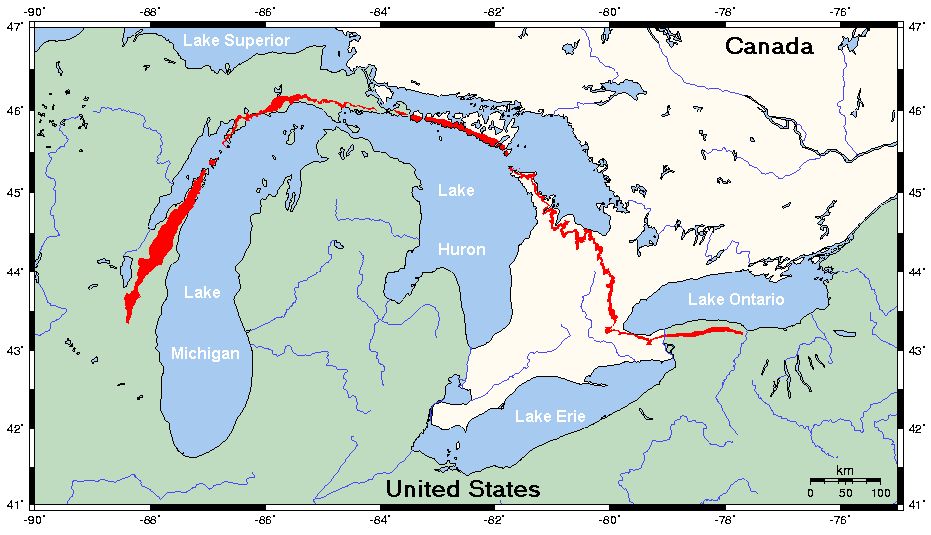
Crawford Lake formed over thousands of years as water filled a sinkhole in the limestone bedrock of the Niagara Escarpment. This geological origin contributes to its defining characteristic: it is a meromictic lake. In a meromictic lake, the upper and lower layers of water do not fully mix, creating distinct chemical and physical zones. The upper layer, or mixolimnion, is influenced by wind and seasonal temperature changes, while the deeper layer, known as the monimolimnion, remains undisturbed and isolated. This stable, unmixed bottom layer allows for the sequential deposition and preservation of fine seasonal sediments called varves, which accumulate year after year without being disturbed. Unlike most meromictic lakes where the bottom waters are devoid of oxygen, Crawford Lake's monimolimnion is unusually oxygenated, a rare trait that further aids in preserving the clarity of its sedimentary record. During warm summer months, high temperatures and acidity cause the water to precipitate calcite, which forms a distinct white layer over the darker sediment, adding another visual marker to the annual deposits. The lake reaches a depth of about 23 metres (75 feet) at its deepest point, and its primary inflow is an unnamed creek, though the lack of mixing means this inflow has minimal effect on the deep-water sediments.
Archaeological Discovery and the Reconstructed Village
Scientific study of Crawford Lake's sediment cores in the early 1970s led to a major archaeological discovery. Pollen analysis revealed the presence of corn and squash pollen dating from the 13th to the 15th centuries, providing the first evidence of pre-European Indigenous agriculture in the area. This botanical evidence prompted archaeological excavations, which uncovered the footprints of a substantial Wendat (Huron) village, also associated with the Attawandaron people. The village site contained evidence of 11 longhouses and thousands of artifacts, offering a detailed glimpse into community life centuries ago. Based on this archaeological work, historical references, and First Nations oral traditions, Conservation Halton reconstructed three longhouses on their original footprints within the conservation area. The reconstructed village serves as an educational centre, with programs, exhibits, and gardens developed in partnership with Indigenous communities to share knowledge about food, farming, family life, and trade from both historical and contemporary perspectives. The longhouses are open to the public year-round, with extended weekday hours from May 1 to September 7, though they may be reserved for pre-booked groups. Stratigraphic evidence from charcoal analysis in the lake's sediments correlates with this period, showing increased charcoal accumulation when pollen records indicate a shift from a northern hardwoods forest to one dominated by white pine and oak, likely linked to land clearing by the village inhabitants.
Scientific Significance and the Anthropocene Proposal
Crawford Lake's pristine varved sediments have made it an exceptional site for scientific research into environmental history. Geochemical analysis of the cores has reconstructed trends in air pollution and human impact over approximately the last 150 years, recording signals from industrial activity, leaded gasoline, and other pollutants. This well-preserved, annually resolved stratigraphy led the Anthropocene Working Group of the Sub-commission on Quaternary Stratigraphy to select Crawford Lake in July 2023 as the proposed Global Boundary Stratotype Section and Point (GSSP), or 'golden spike', for a formal Anthropocene epoch. The proposal pinpointed the year 1952 as the potential start date, marked by a sharp global increase in plutonium from nuclear weapons testing that is clearly recorded in the lake's sediments. The corresponding geological stage was proposed to be named the 'Crawfordian'. However, in March 2024, the Subcommission on Quaternary Stratigraphy voted 12 to 4 against formally establishing the Anthropocene as a new geological epoch, a decision later approved by the International Commission on Stratigraphy and upheld by the International Union of Geological Sciences. Despite this formal rejection, the term 'Anthropocene' remains in widespread informal use to describe the period of significant human impact on Earth's systems, and Crawford Lake continues to be a globally important site for studying these measurable changes. The lake was chosen over 11 other candidate sites worldwide due to the exceptional clarity of its geological record of human activity.
Park Features and Recreational Activities
Crawford Lake Conservation Area offers a range of recreational and educational activities set within a protected natural landscape. The park features several kilometres of trails suitable for hiking, snowshoeing, and cross-country skiing, which connect to the extensive Bruce Trail network along the Niagara Escarpment. One notable trail features larger-than-life wood carvings of species at risk, blending art with environmental education. The park's central feature, the one-kilometre boardwalk loop around Crawford Lake itself, was closed for a complete rebuild starting September 29, 2025, with completion expected in early fall 2026. During this closure, the main park remains open, with access to other trails such as the Woodland, Escarpment, and Pine Ridge trails. The park hosts seasonal events and guided tours, such as the 'Lake to Longhouse Tour' offered on weekends from September 19 to November 1, 2026, and special event days with hands-on activities and demonstrations like the one scheduled for October 17, 2026. Visitors should note that the terrain on some trails, including a steep rocky slope on the main trail network, can be difficult for wheelchairs and strollers to manage. The park recommends alternative accessible trails at other Conservation Halton properties like Mountsberg's Sugar Bush Loop. Key recreational guidelines and facilities at the park include:
- Park Hours: Open from 8:30 a.m. to 7 p.m., seven days a week.
- Visitor Centre & Longhouse Hours: Open from 10 a.m. to 4 p.m. daily, with extended weekday summer hours from May 1 to September 7, 2026.
- Reservations: Not required but recommended for guaranteed entry and reduced gate fees through parkvisit.ca.
- Trail Network: Includes connections to the Bruce Trail, with routes like the Canyon trail extending about 9.4 kilometres round trip. Some hikers continue farther towards Rattlesnake Point.
- Seasonal Activities: Includes fall programming from October 3 to November 1, 2026, and guided hikes such as the 'Hiking Crawford Lake' event scheduled for February 3, 2026.
- Accessibility Note: The steep rocky slope on main trails is not suitable for wheelchairs or strollers.
- Service Disruptions: Occasional closures occur, such as from October 14 to 16, 2026, when park access is maintained but some facilities may be limited.
Conservation and Protected Status
Crawford Lake and its surrounding area are protected under multiple designations that recognize its ecological and scientific value. The site is a designated Regionally Environmentally Sensitive Area and an Ontario Area of Natural and Scientific Interest. It also forms part of the UNESCO Niagara Escarpment World Biosphere Reserve, highlighting its importance within a larger protected landscape. These designations inform strict conservation rules to protect the sensitive lake ecosystem. To preserve the undisturbed sediment layers and water quality, activities such as swimming, boating, and fishing are strictly prohibited in the lake. Pets must be kept on a leash at all times to prevent them from entering the water. Alcohol consumption is also not permitted within any Conservation Halton park, including Crawford Lake. The park's management focuses on balancing public access and education with the paramount need to conserve the fragile meromictic lake and its invaluable environmental archive for future scientific study. This ongoing conservation work includes projects like the complete reconstruction of the lake boardwalk to ensure visitor access minimizes environmental impact, and it is part of broader restoration efforts by Conservation Halton to transform under-used areas into natural habitats with wetland features and over 60 native plant species.
Historical Context and the Crawford Family
The lake and conservation area derive their name from the Crawford family, prominent community members in Campbellville from the late 19th to mid-20th centuries. The family was involved in the local lumber business, operating a sawmill and lumber yard in the village from 1882 to 1963. Their industrial activity, along with that of European settlers, is recorded in the lake's sediments through indicators like sawdust and ragweed pollen. In 1969, Lloyd Crawford sold the lake property to Halton Conservation, ensuring its protection and leading to the establishment of the conservation area. This transition from a resource extraction landscape to a protected scientific and natural reserve marks a significant chapter in the site's history. The layered sediments tell this story, capturing not only ancient Indigenous agriculture but also the subsequent phases of European settlement and industrial activity, providing a continuous environmental ledger of human influence on the local landscape. The lake's Wyandot name, Kionywarihwaen, and its modern name together reflect the layers of human history embedded in both the land and the sedimentary record below the water.
Visitor Information and Practical Details
Planning a visit to Crawford Lake Conservation Area requires attention to several practical details to ensure a smooth experience. The park is located at 3115 Conservation Road in Campbellville, roughly a one-hour drive from Toronto, making it a popular destination for day trips. While reservations are not mandatory, booking online in advance is strongly advised as it guarantees entry during peak times and offers a discount compared to the standard gate fee. The park is open from 8:30 a.m. to 7 p.m. daily, while the longhouse village and visitor centre operate from 10 a.m. to 4 p.m. Visitors should wear sturdy footwear suitable for trails that can be rocky, root-covered, and steep in sections, especially given that wet leaves or snow can make even easier paths slippery. For those seeking less challenging terrain, the park suggests shorter, gentler loops, though the more ambitious Canyon trail connection offers a longer hike of approximately 9.4 kilometres. It is important to check the Conservation Halton website for service disruption notices before visiting, as there are scheduled maintenance periods, such as from October 14 to 16, 2026, when certain facilities may be limited even though the park remains open.
Visitors can explore the reconstructed Wendat village and learn about Indigenous history through programs and exhibits. The park provides several woodland trails, such as the Escarpment and Pine Ridge trails, suitable for various skill levels. Special events and guided tours, like the Lake to Longhouse Tour, are offered seasonally. The park also features a trail with large wood carvings of species at risk for educational purposes.
- Educational Tours: Guided 'Lake to Longhouse' tours are available on weekends in the fall for a fee of $10, with a maximum of 20 people per time slot.
- Seasonal Events: The 'Fall Into Nature' program offers weekend activities from October 3 to November 1, 2026.
- Winter Recreation: Trails are maintained for snowshoeing and cross-country skiing during the winter months.
- Parking: Available in the lower parking lot, which is also the meeting point for organized hikes.
- Prohibited Items: Alcohol, swimming gear, boats, and fishing equipment are not allowed on site.
- Pet Policy: Dogs are permitted but must be leashed at all times to protect the sensitive ecology.
Questions about Crawford Lake
Why is Crawford Lake scientifically important?
Crawford Lake is a rare meromictic lake, meaning its upper and lower water layers do not mix. This allows annual layers of sediment, called varves, to accumulate undisturbed at the bottom. These layers preserve a precise, year-by-year record of environmental changes, including evidence of 15th-century Indigenous agriculture, industrial pollution, and radioactive plutonium from mid-20th-century nuclear tests. This detailed record led scientists to propose it as the global reference site for the Anthropocene epoch in 2023.
Can you swim, boat, or fish in Crawford Lake?
No. To protect the ecologically sensitive meromictic lake and its unique sediment record, swimming, boating, and fishing are strictly prohibited at Crawford Lake. These activities could disturb the delicate water layers and compromise the scientific integrity of the site. Conservation Halton designates Kelso Conservation Area as the only park in its system where swimming is permitted, and separate rules apply for boating and fishing at other locations.
What are the reconstructed longhouses at Crawford Lake?
The reconstructed longhouses are based on the archaeological discovery of a Wendat (Huron) village dating from the 13th to 15th centuries. Excavations revealed 11 longhouse sites and thousands of artifacts. Three longhouses have been reconstructed on their original footprints to educate visitors about Indigenous history and culture through exhibits, gardens, and workshops developed with Indigenous partners. They are generally open from 10 a.m. to 4 p.m. daily, with extended weekday hours in the summer.
Do I need a reservation to visit Crawford Lake?
Reservations are not strictly required but are highly recommended. Booking online in advance guarantees your entry, especially on busy days, and often provides a discount compared to paying the gate fee. Reservations can be made through Conservation Halton's park visit website. The park itself is open from 8:30 a.m. to 7 p.m. daily, while the longhouses and visitor centre operate from 10 a.m. to 4 p.m.
Is the boardwalk around Crawford Lake open?
As of July 2026, the one-kilometre boardwalk loop around Crawford Lake remains closed for a complete reconstruction project that began on September 29, 2025. Completion is anticipated in early fall 2026. The rest of the park, including other woodland trails like the Escarpment and Pine Ridge trails, remains open to visitors during this time. Service disruption notices should be checked for the latest updates.
Where is Crawford Lake Conservation Area located?
Crawford Lake Conservation Area is located near the community of Campbellville, in the town of Milton, within the Regional Municipality of Halton, Ontario, Canada. It is situated along the Niagara Escarpment, which is a World Biosphere Reserve. The park is approximately a one hour drive from Toronto and its address is 3115 Conservation Road. This 94 hectare park is managed by Conservation Halton and is designated as a Regionally Environmentally Sensitive Area and an Ontario Area of Natural and Scientific Interest.
Sources and further reading
- Crawford Lake (Wikipedia)
- Crawford Lake (conservationhalton.ca)
- Crawford Lake Conservation Area: 9 Amazing Things to ... (torontoecoadventures.com)
Checked by the Your Space Hamilton desk. Last updated 2026-10-25.