Jacques Cartier Bridge
The Jacques Cartier Bridge is a major steel truss cantilever bridge spanning the Saint Lawrence River, connecting the Island of Montreal to the city of Longueuil on the south shore. Opened in 1930, it is a critical transportation link and the third busiest bridge in Canada, carrying approximately 35.8 million vehicles annually. The bridge is administered by the federal Crown corporation Jacques Cartier and Champlain Bridges Incorporated (JCCBI). It is renowned for its distinctive curves, its role in regional mobility, and its innovative 'Living Connections' lighting installation, which uses real-time data to illuminate its superstructure.
Planning and Construction
Discussions about constructing a new bridge to alleviate congestion on the Victoria Bridge, ferries, and ice bridges began as early as 1874. The official decision to proceed was made in 1924, with the bridge designed by engineer Philip Louis Pratley. Construction was awarded to the Dominion Bridge Company, beginning on May 26, 1925. The ceremonial first stone was laid on August 9, 1926, on Pillar No. 26, integrated into the pillar at the corner of Notre Dame Street and Saint Antoine Street opposite the Pied-du-Courant Prison. This stone contained a capsule with 59 items reflecting the year construction began. The superstructure was built between September 1926 and September 1929, requiring 33,267 tons of steel. The project was completed a year and a half ahead of schedule, at a cost of $23 million, without disrupting river traffic. The bridge opened to traffic on May 14, 1930, with a formal inauguration ceremony held on May 24 of that year. It was originally inaugurated as the Montreal Harbour Bridge but was renamed in 1934 following a citizen petition to honour the 400th anniversary of Jacques Cartier's first voyage up the St. Lawrence River.
Design and Structural Evolution
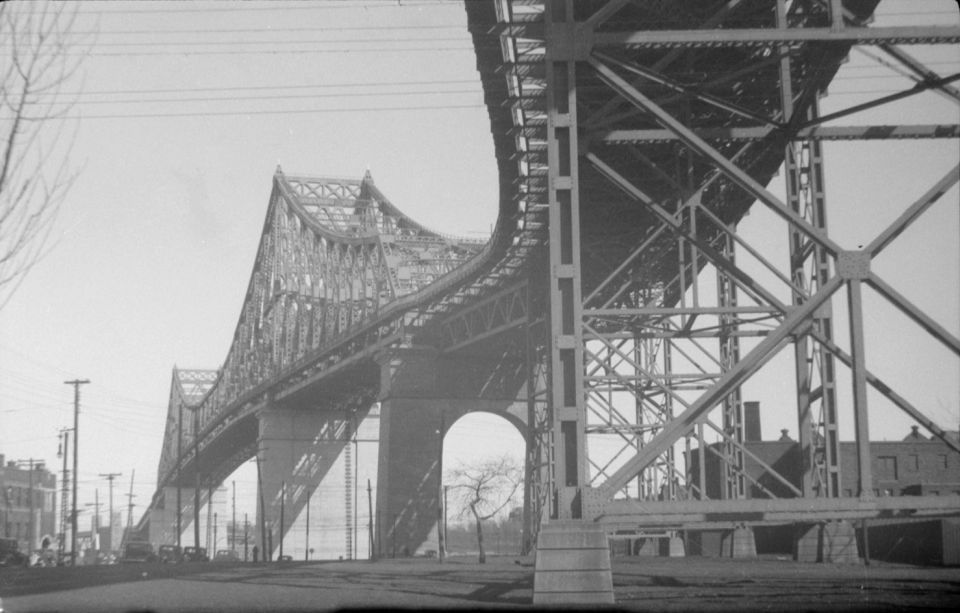
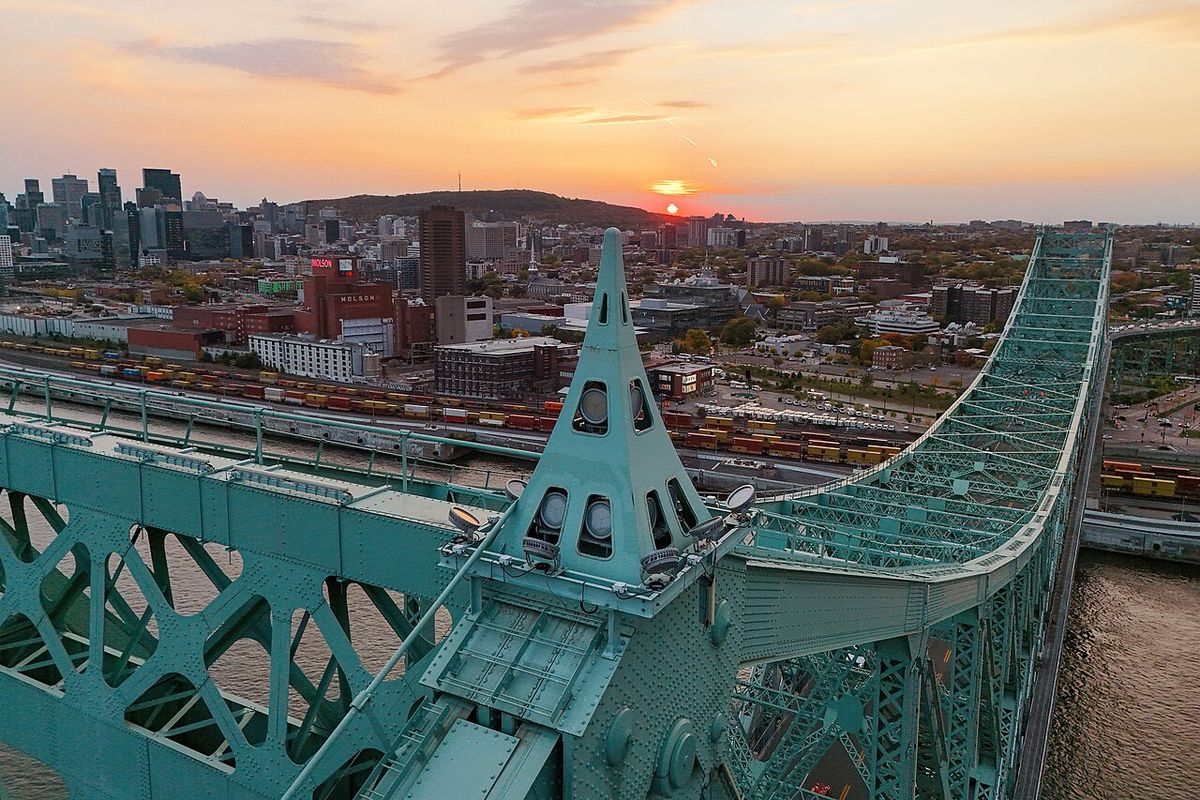
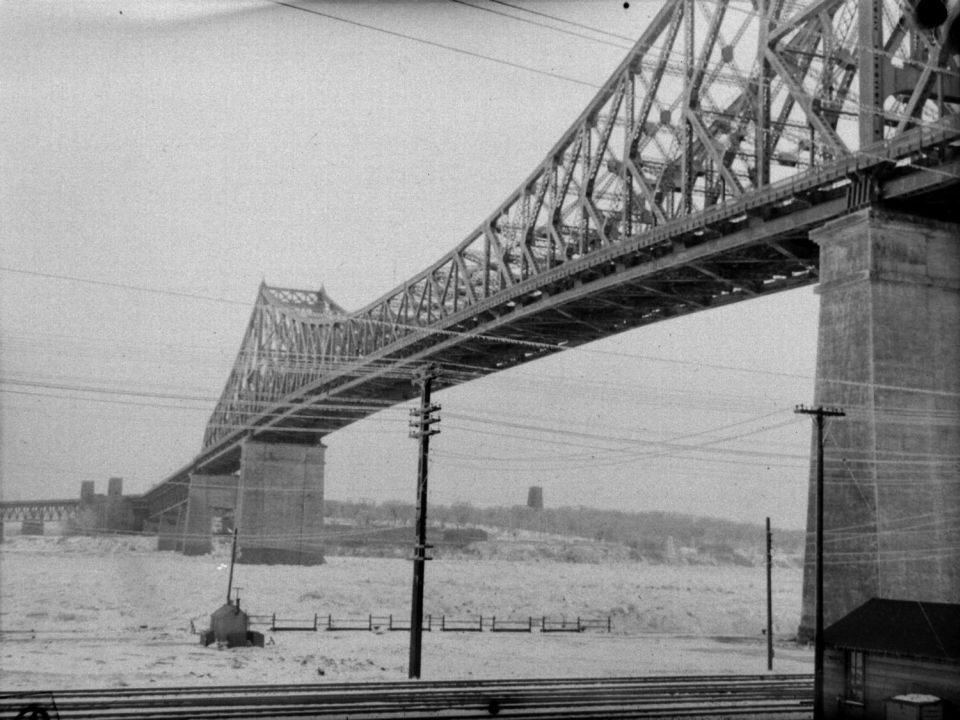
The bridge was originally designed to accommodate road traffic, a tramway, and pedestrians, featuring three traffic lanes and two sidewalks with space reserved for two tram lines. Tram tracks were installed but never used, leaving parallel empty spaces through which the bridge's girders were visible. Major modifications were undertaken over the decades to increase capacity, safety, and navigation clearance. In 1956 and 1959, the roadway was expanded by incorporating the unused tramway spaces, adding one lane in each direction to create the current five-lane configuration, with the two sidewalks remaining outside the bridge proper. To accommodate larger ships using the new St. Lawrence Seaway, the span over the river's east channel, a Warren truss, was raised by 24.4 metres to a total clearance of 36.6 metres in 1957 and 1958. This work was done without stopping traffic through the installation of two temporary Bailey bridges. A second access ramp to Saint Helen's Island was added on the east side in 1961 to eliminate a dangerous merge pattern and reduce accidents. The entire bridge deck was replaced between 2001 and 2002, during which the sidewalks were widened to 2.44 metres and the western sidewalk was converted into a dedicated bike path. A suicide prevention barrier was installed in 2004, addressing a tragic history of an average of ten suicides per year prior to its installation. The bridge is adorned with four 3-metre-high finials at its high points, architectural ornaments whose shape resembles the Eiffel Tower without being a direct replica.
Traffic and Transportation Role
The Jacques Cartier Bridge is a vital component of Montreal's road network, functioning as the continuation of Quebec Highway 134. On the Montreal side, it connects to De Lorimier Avenue East and Papineau Avenue West, and it links to an interchange with the multiplex of Highway 20 and the René-Lévesque Highway. On the south shore it links to a short autoroute section of Highway 134, which ends at an interchange with roads 112 and 116 before becoming Boulevard Taschereau. It is estimated that up to 115,000 vehicles use the bridge daily, amounting to an annual average of 34.7 million crossings, making it the third busiest bridge in Canada. The bridge features two directional lanes, two sidewalks for pedestrians and cyclists, and one centrally located reversible lane managed to optimize rush hour traffic flow. A notorious feature is the 'Craig curve' on the Montreal approach, a sharp, originally flat curve that was a frequent site of accidents. This deficiency was corrected in the early 2000s by raising the west side of the deck to create a slight tilt, improving safety for vehicles. The bridge's distinctive curves have historical origins. The initial curve at the Montreal entrance was designed to avoid the property of soap factory owner Hector Barsalou, who refused the city's compensation offer for his land. Another curve in the middle of the bridge, near Île Sainte-Hélène, resulted from aligning the bridge piers with the river's current, which did not match the axis of Montreal's street grid. These design characteristics earned the structure the enduring nickname 'the crooked bridge' and were a predominant factor in accidents leading to changes in signage over the years.
Ownership, Historical Tolls, and Maintenance
The bridge is owned and operated by the federal Crown corporation Jacques Cartier and Champlain Bridges Incorporated (JCCBI), which also manages the nearby Samuel-de-Champlain Bridge, the busiest in Canada located a few kilometres upstream. From its opening in 1930 until 1962, the Jacques Cartier Bridge was a toll bridge, with a toll plaza located on its southern approach. The plaza area now houses the offices of JCCBI. Tokens were issued for part of the toll collection period. The original toll structure was detailed and varied significantly by user type. Pedestrians and cyclists were charged 15 cents, while motorcyclists paid 25 cents. An automobile and its driver cost 25 cents, with each additional passenger charged 15 cents. Bus tolls ranged from 80 cents to one dollar depending on the class, and trucks paid between 25 cents and $1.50. Specialized vehicles like oil tanks were charged 60 cents, and animals cost between 3 and 15 cents each depending on the species. Even a wheelbarrow incurred a 15-cent toll, while children under five years old crossed for free. Major ongoing maintenance programs have been conducted over the last two decades to preserve the bridge's integrity. These have included complete deck replacement, extensive painting campaigns, and a pillar rebuilding cycle completed in 2016. JCCBI continues a structural steel reinforcement program originating from the 1920s design, replacing and reinforcing steel ribs and plates to extend the lifespan of the structure.
Living Connections Lighting Installation
To celebrate Canada's 150th anniversary and Montreal's 375th anniversary in 2017, the bridge was outfitted with a groundbreaking decorative lighting system called 'Living Connections'. Designed and installed over three years by Montreal's Moment Factory in collaboration with several local partners including Réalisations Inc. Montreal, Ambiances Design Productions, ATOMIC3, Éclairage Public/Ombrages, Lucion Média and UDO Design, the project is managed by JCCBI and is scheduled to remain active until 2027. The system makes the Jacques Cartier Bridge the world's first 'connected' bridge, using big data to modulate its lighting in real time. An interior lighting network changes colour progressively through a 365-day chromatic calendar, reflecting the seasons from an energizing spring green to a radiant summer orange, a voluptuous autumn red, and the icy blue of winter. The exterior lighting network is more dynamic, tracking fifty-three types of data across eleven categories related to Montreal life using physical sensors, cameras, and online hashtags and keywords. The data categories include weather, traffic, noise, and activity on social media. The intensity, speed, and colour of light movements on the bridge's superstructure respond to this data, with colours assigned to media discussion topics like society (red), environment (green), technology (light blue), business (gray), sports (blue), institutions (pink), and culture (purple). The system was first illuminated on May 17, 2017, the date associated with the founding of Montreal in 1642, officially kicking off the city's 375th-anniversary festivities. The scale and technical complexity of the installation are captured in several key figures, including 15,650 tonnes of illuminated superstructure, 10,000 fastening systems, 10.4 kilometres of cabling, and 2,807 luminaires installed by more than 200 professionals from various fields.
Notable Events, Inspirations, and Cultural Impact
The bridge has been the site of several disruptions, primarily from protesters climbing its superstructure or signage, often causing major traffic congestion during rush hours. Demonstrators have included members of the Fathers for Justice group and individuals acting alone, such as a man wearing a Canadian flag. In response to these incidents and to deter suicide attempts, the pedestrian paths were later modified with the installation of round metal fences around both directions. A bust of Jacques Cartier, donated by France, is located at the exit leading to Île Sainte-Hélène. The bridge's design followed the general concept of the Quebec Bridge and, in turn, served as a design influence for the Story Bridge in Brisbane, Australia, which was completed in 1940. Its imposing steel truss design most likely inspired the designers of the J. C. Van Horne Bridge spanning the Restigouche River between Campbellton, New Brunswick and Pointe-à-la-Croix, Quebec, which was not built until 1958. The bridge also provides access to Saint Helen's Island in the centre of the river, where offramps allow entry to Parc Jean-Drapeau and the La Ronde amusement park, making it a gateway for recreational and cultural activities.
Comparative Traffic and Structural Data
The Jacques Cartier Bridge is a central piece of infrastructure within a network of major St. Lawrence River crossings managed by JCCBI. While it handles immense volume, its traffic figures are distinct from those of the newer Champlain Bridge nearby. The following table outlines key comparative metrics for context, drawing from the operational data of these structures. The Victoria Bridge is included as the historical crossing whose congestion initially prompted the construction of the Jacques Cartier Bridge.
The Jacques Cartier Bridge remains a primary corridor with high traffic volume even after newer structures were built nearby. It is the third busiest bridge in Canada with approximately 35.8 million vehicle crossings annually. This continued use necessitates extensive maintenance and upgrade programs by its owner and operator, Jacques Cartier and Champlain Bridges Incorporated (JCCBI). These programs ensure the bridge's safety and operational viability and include an ongoing structural steel reinforcement program. JCCBI is a Canadian Crown Corporation that also owns and operates the Samuel-de-Champlain Bridge just a few kilometres upstream.
Questions about Jacques Cartier Bridge
Why is it called the 'crooked bridge'?
The bridge earned the nickname 'the crooked bridge' due to two pronounced curves in its alignment. The first curve at the Montreal entrance was designed to avoid the property of landowner Hector Barsalou, who refused the city's offer for his land. A second curve near Île Sainte-Hélène resulted from aligning the bridge piers with the river's current, which differed from the street grid on shore. These curves were a historical factor in many accidents.
What are the 'Living Connections' lights?
The 'Living Connections' is an innovative lighting installation added in 2017 for Montreal's 375th and Canada's 150th anniversaries. It uses real-time big data, including weather, traffic, and social media activity, to control the colour and movement of lights on the bridge's exterior. The interior lights follow a 365-day seasonal colour calendar. It is the world's first 'connected' bridge lighting system, involving 2,807 luminaires and 10.4 km of cabling, and is scheduled to operate until 2027.
When was the Jacques Cartier Bridge built and opened?
Construction on the Jacques Cartier Bridge began on May 26, 1925, and the superstructure was built between September 1926 and September 1929. It opened to traffic on May 14, 1930, with a formal inauguration ceremony held on May 24, 1930. The project was completed about a year and a half ahead of schedule without disrupting river traffic. The bridge was constructed of steel at a cost of C$23 million, requiring 33,267 tons of steel. It was originally named the Montreal Harbour Bridge but was renamed in 1934 to commemorate the 400th anniversary of Jacques Cartier's first voyage.
How many vehicles use the Jacques Cartier Bridge?
The Jacques Cartier Bridge is the third busiest bridge in Canada with approximately 35.8 million vehicle crossings annually. It is estimated that up to 115,000 vehicles use it per day. The bridge is a five lane highway bridge, 3,425.6 metres in length including approach viaducts. It serves as the continuation of Highway 134 and connects Montreal Island to Longueuil on the south shore. The same entity, JCCBI, owns and operates the Samuel de Champlain Bridge just a few kilometres upstream, which is the busiest in Canada.
Was there ever a toll to cross the bridge?
Yes, the Jacques Cartier Bridge was a toll bridge from its opening in 1930 until 1962. A toll plaza was located on the southern approach. Original toll rates included 15 cents for pedestrians and cyclists, 25 cents for an automobile and its driver, and additional passengers cost 15 cents each. Tolls for buses ranged from 80 cents to one dollar, and for trucks from 25 cents to one dollar fifty. The toll plaza area now houses the offices of Jacques Cartier and Champlain Bridges Incorporated (JCCBI), the Crown corporation that owns and operates the structure.
Who owns and maintains the Jacques Cartier Bridge?
The Jacques Cartier Bridge is owned and operated by Jacques Cartier and Champlain Bridges Incorporated (JCCBI), a Canadian federal Crown corporation. JCCBI administers the bridge and is responsible for its maintenance and major renovations. This includes a complete deck replacement in 2001 and 2002, a pillar rebuilding cycle completed in 2016, and an ongoing structural steel reinforcement program to extend the bridge's lifespan. The same corporation also owns and operates the nearby Samuel de Champlain Bridge. JCCBI also managed the installation of the bridge's decorative 'Living Connections' lighting system in 2017.
Sources and further reading
- Jacques Cartier Bridge (Wikipedia)
- Jacques Cartier Bridge | PJCCI (jacquescartierchamplain.ca)
- The Jacques Cartier Bridge (mtl.org)
- Jacques Cartier Bridge (legacy.csce.ca)
Checked by the Your Space Hamilton desk. Last updated 2026-10-23.