George Brown Polytechnic
George Brown Polytechnic, formally known as George Brown College of Applied Arts and Technology, is a publicly funded post-secondary institution with three campuses located in downtown Toronto, Ontario. Established in 1967 as part of Ontario's community college system, the institution was originally chartered by the government of Ontario in 1966. It adopted its polytechnic branding in 2025 to reflect its deepened commitment to industry-aligned, hands-on education and applied research. The college is recognized for its extensive program offerings in fields such as health sciences, culinary arts, construction management, and design, and it has been named one of Canada's Best Diversity Employers for 2026.
History and Evolution
The institution's origins trace back to the establishment of the Provincial Institute of Trades in 1951, which provided apprentice training at 21 Nassau Street in Kensington Market. By 1961, the institute had expanded with two additional buildings and offered programs in lathing and structural steel, barbering, diesel mechanics, jewellery arts, watchmaking and welding. In 1962 the province opened the Provincial Institute of Trades and Occupations, a sister training institute, at 555 Davenport Road near Casa Loma. When George Brown College was formally chartered in 1966 and opened in 1967, it absorbed both of these predecessor institutions, forming its initial Kensington and Casa Loma campuses. The college expanded significantly in its early decades, absorbing four Toronto Board of Education Adult Education Centres in 1969 to form a campus at 507 College Street and five Toronto-area Schools of Nursing in 1973, including St. Joseph's, St. Michael's, Toronto General, Atkinson (Toronto Western) and Nightingale. A new, expanded Casa Loma campus opened in 1973, followed by the St. James Campus at 200 King Street East in 1976, which repurposed buildings from Christie Bakery and Mark Cards.
A major expansion occurred in September 2012 with the opening of the Waterfront Campus at 51 Dockside Drive. On October 30, 2025, George Brown College announced it would rebrand to George Brown Polytechnic. This transition is a strategic response to evolving learner needs for employability and real world experience. To mark the transition, George Brown launched the 'George BrOWN Your Tomorrow' brand campaign, which reinforces its focus on future ready learning.
Campuses and Facilities
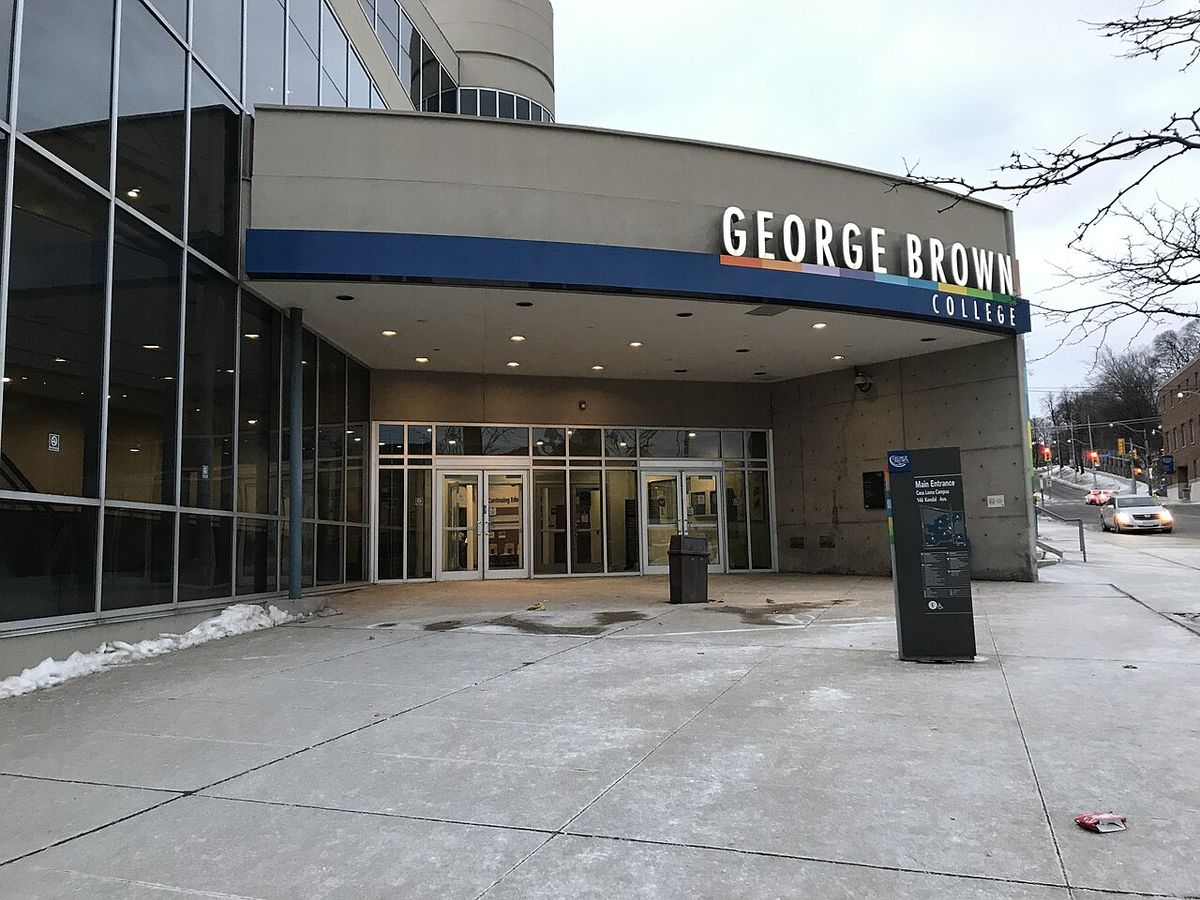
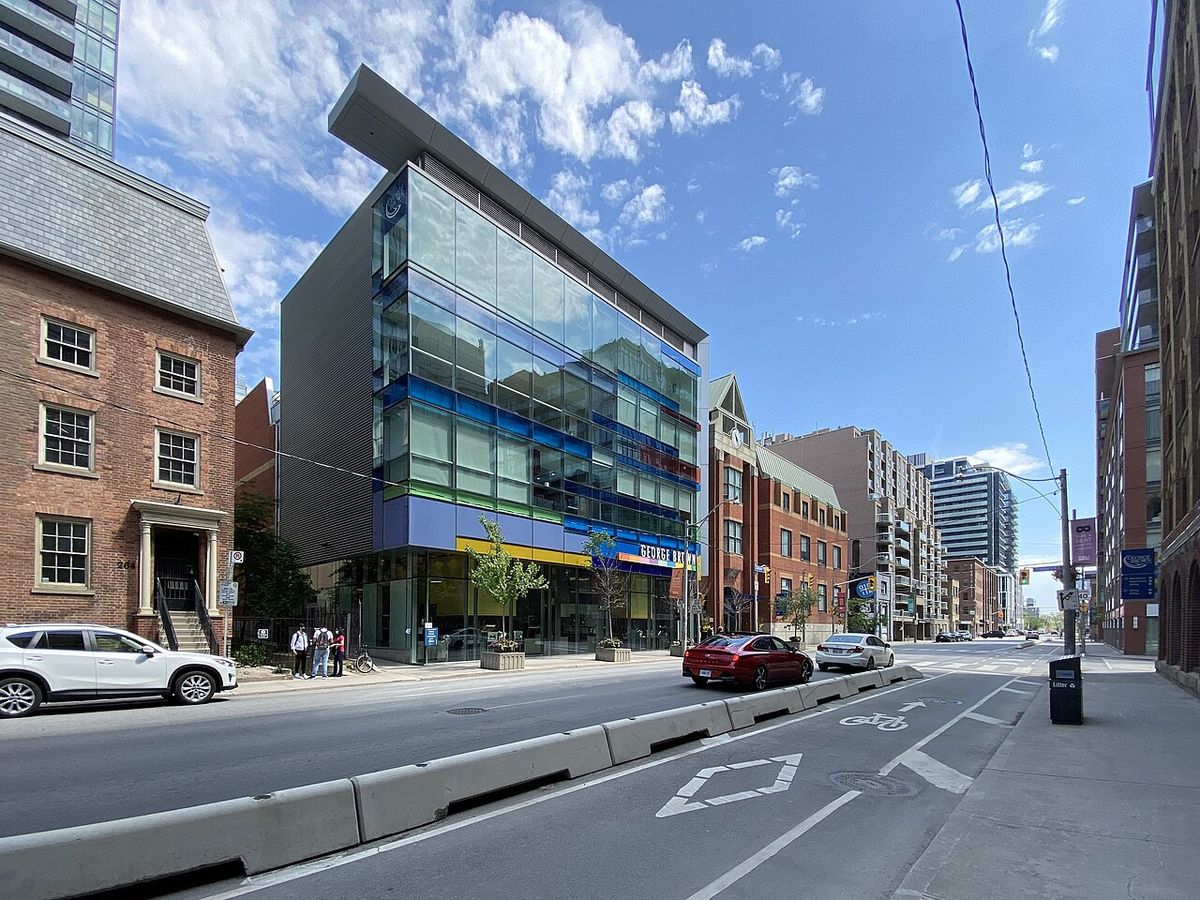
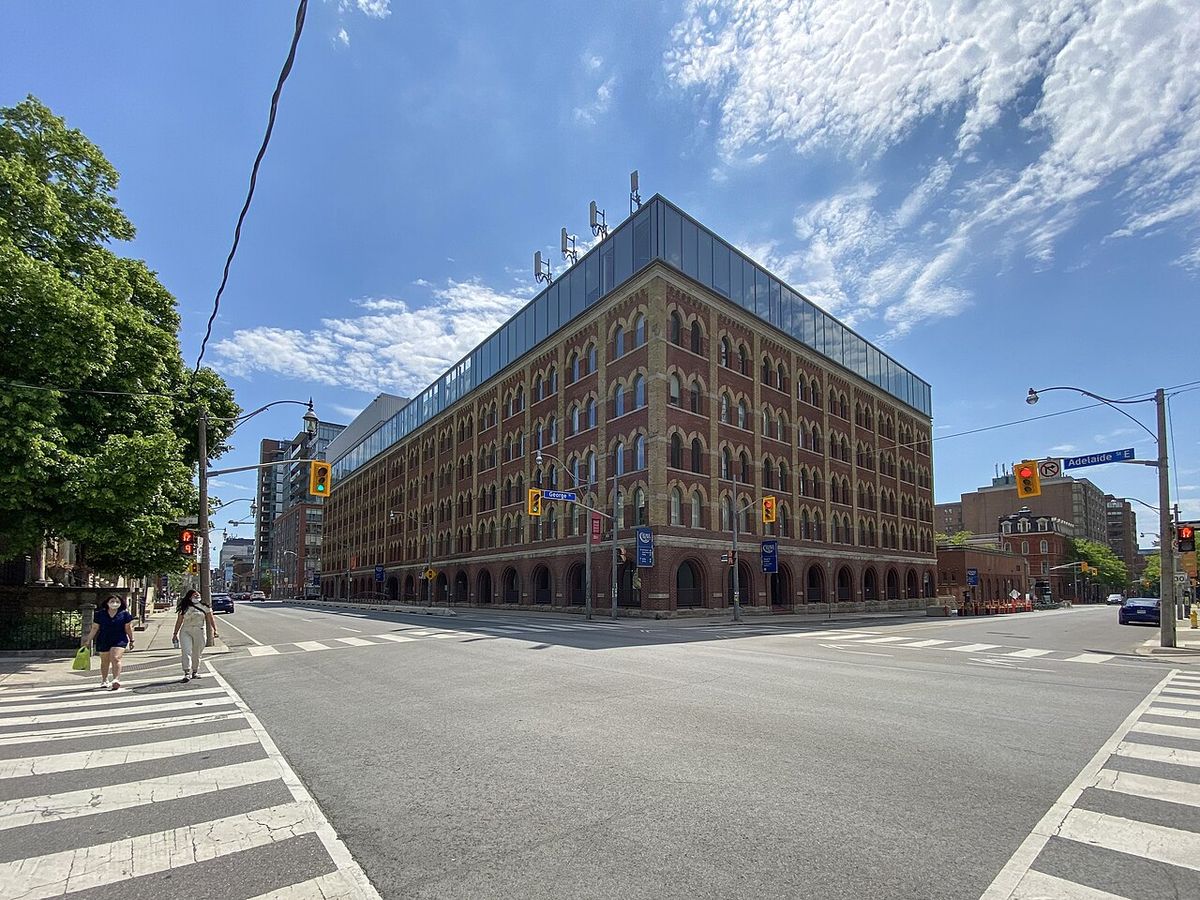
George Brown Polytechnic operates three primary campuses in downtown Toronto, each with a distinct academic focus. The Casa Loma campus, located on Kendal Avenue between Davenport Road and MacPherson Avenue, is a collection of five buildings near Casa Loma and the City of Toronto Archives. In 2004, its old A building was demolished due to health concerns related to sick building syndrome, creating a green space that once featured a moose sculpture until its removal around 2012 or 2013. The St. James campus consists of several buildings, including the main structure at 200 King Street East and the connected facilities at 290 and 300 Adelaide Street East, which house the Centre for Hospitality and Culinary Arts, Financial Services, Creative Arts, and Business Administration programs.
The Waterfront Campus, opened in September 2012 at 51 Dockside Drive south of Queen's Quay, is home to the Centre for Health Sciences. It has undergone significant expansion, first into the Daniels Waterfront, City of the Arts complex at 3 Lower Jarvis Street in 2019 for the School of Design, and most recently with the opening of Limberlost Place at 185 Queens Quay East in 2025. Limberlost Place is a 10-storey mass-timber building, Ontario's first institutional building of its kind, designed to achieve net-zero carbon emissions and housing the School of Architectural Studies, a research institute, and a child care centre. The institution also maintains an associate campus in the Sally Horsfall Eaton building at Toronto Metropolitan University (99 Gerrard St. E.) for programs like Early Childhood Education, Early Childhood Assistant, and Activation Coordinator Gerontology.
Key campus buildings include the Casa Loma campus on Kendal Avenue, which is a collection of five buildings. The St. James campus consists of buildings at 200 King Street East and at 290 and 300 Adelaide Street East, housing the Centre for Hospitality and Culinary Arts. The Waterfront Campus at 51 Dockside Drive is home to the centre for Health Sciences, with expansions at 3 Lower Jarvis Street and the new Limberlost Place at 185 Queens Quay East. The institution also has an associate campus in the Sally Horsfall Eaton building at Toronto Metropolitan University at 99 Gerrard Street East.
- Casa Loma Campus: Five buildings on Kendal Avenue, developed from the former Provincial Institute of Trades and Occupations site.
- St. James Campus: Includes the main academic building at 200 King St. E. and the specialized Hospitality building at 300 Adelaide St. E.
- Waterfront Campus: The original building at 51 Dockside Dr., plus the Daniels Waterfront annex (3 Lower Jarvis St.) and the new Limberlost Place (185 Queens Quay E.).
- The Young Centre for the Performing Arts: A theatre school venue in the Distillery District, built into 1800s-era Victorian industrial buildings with additional teaching facilities.
- The George Student Residence: Opened in 2016 at 80 Cooperage Street, formerly part of the 2015 Pan Am/Para Pan Am Games Athletes Village, and home to the Lucie and Thornton Blackburn Conference Centre.
Students have access to several libraries, including the Casa Loma Library Learning Commons, St. James Library Learning Commons, and Waterfront Library Learning Commons. They also have access to the Sunnybrook Health Science Centre Library for the Orthotics and Prosthetics Collection. Each college library primarily houses materials suitable for the programs taught at its respective campus. Students, faculty and staff have access to an extensive range of electronic resources including ebooks, articles, and image databases for use in the library and remotely.
Academic Programs and Applied Research
George Brown Polytechnic offers more than 170 full-time programs across a wide range of disciplines designed for direct career pathways. These include art and design, business, community services, early childhood education, construction and engineering technologies, health sciences, and hospitality and culinary arts, as well as preparatory studies and services for recent immigrants and international students. The institution provides diploma and advanced diploma programs, as well as several applied bachelor's degrees, some offered in conjunction with Toronto Metropolitan University. In a significant development aligning with its polytechnic mandate, the institution launched a Master of Construction Management program to support advanced career progression for professionals seeking senior leadership roles. The college also offers extensive continuing education, with 180 certificates and designations available as of 2022, and serves 15,000 distance education students in over 35 countries through programs like its award-winning Electronics Technician distance education program developed by Dr. Colin Simpson.
The student body is large and diverse. In 2021, there were 27,128 full-time students, with international students comprising 29 percent of that population. The institution served 3,123 part-time students and 58,119 continuing education registrants. This scale is supported by a strong research culture. In 2022, George Brown was ranked among the top 10 research colleges in Canada by Research Infosource, placing 8th for overall research income and 4th for both the number of paid student researchers and completed projects. This research activity is integral to the polytechnic model, connecting classroom learning with innovation and industry problem-solving.
George Brown offers a variety of degree programs. These include an Honours Bachelor of Commerce in Culinary Management and an Honours Bachelor of Food Studies in Hospitality and Culinary Arts. In Health Sciences, it offers a Bachelor of Science in Nursing and an Honours Bachelor of Science in Dental Hygiene. The college also offers an Honours Bachelor of Technology in Construction Management and recently launched a graduate level Master of Construction Management.
- Honours Bachelor of Brand Design (Arts, Design & Information Technology)
- Honours Bachelor of Digital Experience (Arts, Design & Information Technology)
- Honours Bachelor of Commerce (Financial Services) and (Culinary Management)
- Honours Bachelor of Business Administration (Business Analytics) and (Hospitality)
- Honours Bachelor of Technology (Construction Management)
- Bachelor of Science in Nursing and Honours Bachelor of Science (Dental Hygiene) (Health Sciences)
- Honours Bachelor of Food Studies (Hospitality & Culinary Arts)
- Honours Bachelor of Interpretation (American Sign Language) and Honours Bachelor of Early Childhood Leadership (Community Services & Early Childhood)
The institution's approach ensures that skill acquisition can develop into leadership through advanced credentials. For example, a student interested in culinary arts can progress to a four year Culinary Management degree. Graduate and certificate programs, pre college and apprentice programs round out the college's full time offerings. This creates multiple entry and exit points for learners along their career path.
Leadership and the Polytechnic Direction
The institution has been led by six presidents since its founding, shaping its evolution from a community college to a polytechnic. C.C. Lloyd served as the first president from 1968 to 1978, followed by D.E. Light (1978 to 1991), John Rankin (1991 to 1995), Frank Sorochinsky (1994 to 2004), and Anne Sado (2004 to 2021). The current president, Dr. Gervan Fearon, assumed the role in 2021 and has overseen the strategic transition to a polytechnic model. President Fearon, who is also a co-founder of the Canada-Caribbean Institute, has stated that the polytechnic model focuses on coherence in education, ensuring students can start at any point and work their way forward in a career.
He illustrates this by noting a student might begin with an interest in becoming a chef and later progress to running a business or managing a large operation, a pathway supported by the college's range of credentials from diplomas to degrees. This leadership direction is evident in program development and infrastructure. The expansion of culinary arts into a four-year Culinary Management degree and the creation of the Master of Construction Management are direct responses to industry evolution and learner demand for advancement. The institution's applied philosophy is physically embodied in projects like Limberlost Place, where students in construction and building programs gained direct, hands-on experience contributing to an active construction project.
The polytechnic shift is a strategic response to trends where students prioritize employability and hands on training. This comes amidst rising tuition costs and student debt, leading learners to seek education that connects directly to industry. For Toronto and Ontario, this continuity matters as construction and urban development remain critical to economic growth. It requires a workforce that is skilled, resilient, and forward looking.
Student Life, Athletics, and Media
Student life at George Brown Polytechnic is supported by a variety of services, facilities, and extracurricular activities. The student residence, The George, located at 80 Cooperage Street near the Distillery District, opened in 2016 and includes the Lucie and Thornton Blackburn Conference Centre. The conference centre is named after a wife and husband who escaped slavery, established Toronto's first cab company, helped found Little Trinity Anglican Church, and worked on anti-slavery initiatives. Their story is told in a student-created mural at the centre. Varsity athletics teams, known as the Huskies, compete in badminton, baseball, basketball, cross country, esports, indoor soccer, soccer, and volleyball. The volleyball team has been coached by Olympian Sam Schachter among others, and the school fields teams across these nine sports.
The student newspaper, The Dialog, has been published since 1974 and is a member of Canadian University Press, owned and operated by the Student Association of George Brown Polytechnic. It serves students on three downtown campuses as a bi-weekly paper printed in tabloid format, focusing on college news. It succeeded previous newspapers including The Globe (1967-71) and George Brown's Body (1971-73). Students have access to a network of campus-specific Library Learning Commons at 341 King St., Casa Loma, St. James, and Waterfront, as well as specialized collections at the Centre for Hospitality & Culinary Arts e-Library, the Sally Horsfall Eaton Academic Resource Centre at TMU, and the Sunnybrook Health Science Centre Library.
The college libraries provide extensive electronic resources, including ebooks, articles, and image databases, accessible both on campus and remotely. Their collections are tailored to the programs taught at each campus location. The Theatre School at George Brown College presents a season of productions at the Young Centre for the Performing Arts in the Distillery District. This theatre arts program enjoys a partnership with the Tarragon Theatre and Soulpepper Theatre Company.
Recognition, Community, and Indigenous Acknowledgement
George Brown Polytechnic has received significant recognition for its role as an employer and educator. It was named one of the Greater Toronto's Top Employers for 2022 and, for the first time, one of Canada's Best Diversity Employers for 2026, an honour that acknowledges the institution's commitment to inclusive workplaces. The college's research prowess is also nationally recognized, as noted in its top 10 ranking among Canadian research colleges by Research Infosource in 2022. Community and industry engagement are central to its mission, exemplified by partnerships with organizations like the Tarragon Theatre and Soulpepper Theatre Company at the Young Centre for the Performing Arts in the Distillery District.
The institution actively hosts events that connect it with future students and the broader community, such as its Open House scheduled for Saturday, October 24, 2026, where prospective students can tour classrooms and specialized labs. It also engages with professional networks, having recently welcomed leaders from across Canada and the United States to the 2026 National Association of Campus Auxiliary Services conference. George Brown Polytechnic acknowledges it is located on the traditional territory of the Mississaugas of the Credit First Nation and other Indigenous peoples who have lived in the region, reflecting its engagement with broader social and historical contexts. This acknowledgement is part of its public communications and aligns with a broader commitment to diversity and inclusion recognized by its recent employer awards. The institution also streams major events like convocation ceremonies, such as the one held on Tuesday, June 9, 2026, for the School of Deaf & Deafblind Studies and the School of Social & Community Services.
Questions about George Brown Polytechnic
What is Limberlost Place?
Limberlost Place is a 10-storey mass-timber academic building at 185 Queens Quay East, part of the Waterfront Campus, which officially opened in 2025. It is Ontario's first institutional mass-timber building designed to achieve net-zero carbon emissions. It houses the School of Architectural Studies, a research institute, and a child care centre. The building served as a hands-on learning project where construction students gained real-world experience contributing to its development.
When did George Brown College become George Brown Polytechnic?
George Brown College officially rebranded as George Brown Polytechnic on October 30, 2025. The announcement marked a strategic shift to reinforce the institution's commitment to applied education and career readiness. This transition is more than a name change. It is a response to evolving learner needs for hands-on training and clear pathways from diplomas to graduate studies. The change acknowledges the institution's long-standing practice of integrating theory with practical experience. To mark the transition, the college launched the 'George BrOWN Your Tomorrow' brand campaign, emphasizing future-ready learning.
Where are the campuses of George Brown Polytechnic located?
George Brown Polytechnic has three primary campuses located in downtown Toronto, Ontario. The Casa Loma campus is situated on Kendal Avenue between Davenport Road and MacPherson Avenue. The St. James campus is centered at 200 King Street East, with additional buildings at 290 and 300 Adelaide Street East housing the culinary arts and business programs. The Waterfront Campus is at 51 Dockside Drive, with expansions including the School of Design at 3 Lower Jarvis Street and the new Limberlost Place at 185 Queens Quay East. The institution also has an associate campus in the Sally Horsfall Eaton building at Toronto Metropolitan University (99 Gerrard St. E.).
What programs is George Brown Polytechnic known for?
George Brown Polytechnic is known for offering over 170 full-time programs with a strong focus on applied arts and technology. It is particularly renowned for its hospitality and culinary arts programs, including an Honours Bachelor of Commerce in Culinary Management. The college is also a leader in health sciences, offering a Bachelor of Science in Nursing and an Honours Bachelor of Science in Dental Hygiene. Other key areas include construction and engineering technologies, with an Honours Bachelor of Technology in Construction Management, and design, with an Honours Bachelor of Digital Experience. The institution also offers unique degrees like the Honours Bachelor of Interpretation for American Sign Language and recently launched a Master of Construction Management.
Does George Brown Polytechnic have student housing?
Yes, George Brown Polytechnic provides student housing at its residence called The George, located at 80 Cooperage Street in Toronto. The residence opened in 2016 and was originally part of the 2015 Pan Am/Para Pan Am Games Athletes Village before the college took ownership. The building is situated near the Distillery District and also houses the Lucie and Thornton Blackburn Conference Centre. This conference centre features a student-created mural that tells the story of Lucie and Thornton Blackburn, a couple who escaped slavery and established Toronto's first cab company.
Who is the current president of George Brown Polytechnic?
The current president of George Brown Polytechnic is Dr. Gervan Fearon, who began his term in 2021. He has led the institution through its strategic transition to a polytechnic model, emphasizing the integration of career pathways from diplomas to graduate studies. President Fearon has stated that the polytechnic model ensures students can progress within their careers, noting that a student might start in culinary arts and later advance to business management. Under his leadership, the college has expanded its graduate offerings, including the launch of a Master of Construction Management program.
Sources and further reading
- George Brown Polytechnic (Wikipedia)
- George Brown's polytechnic shift redefines career- ... (ronfanfair.com)
Checked by the Your Space Hamilton desk. Last updated 2026-10-24.