Forest Hill, Toronto
Forest Hill is a neighbourhood and former village in Midtown Toronto, Ontario, known as one of the city's most affluent residential districts. Originally incorporated as a village in 1923, it was amalgamated into the City of Toronto in 1967, retaining its distinct identity and name. The area is characterized by its grand, architect-designed homes, tree-lined streets, and a significant, long-established Jewish community. Forest Hill is divided for administrative purposes into two neighbourhoods, Forest Hill North and Forest Hill South, both of which consistently rank among the highest-income areas in Canada.
History and Development
The area now known as Forest Hill was originally called Spadina Heights, a name derived from the Ojibwe word ishapadenah, meaning a hill or sudden rise in land. It was incorporated as the Village of Forest Hill in 1923, named after the summer home of John Wickson, father of Toronto architect Frank Wickson. For over four decades, the village operated with its own local government, led by a reeve rather than a mayor. In the late 1960s, the City of Toronto planned to construct the Spadina Expressway, a highway from Highway 401 to downtown via the Cedarvale Ravine and Spadina Road. This route would have bisected Forest Hill and the Annex, requiring the demolition of numerous houses. Local residents organized protests that raised broader public awareness against the project. The situation changed when Bill Davis replaced John Robarts as head of the ruling Progressive Conservative Party of Ontario on March 1, 1971, facing a provincial election that fall. Public opinion on the expressway was divided, and while Toronto Metro Council was largely in favour, Davis accepted arguments that it would increase traffic congestion and pollution. On June 3, 1971, he announced its cancellation in the legislature, a move that also undercut a major issue for the opposition New Democratic Party. The village was formally amalgamated into the City of Toronto in 1967, along with the Village of Swansea. A term of this amalgamation granted Forest Hill residents doorstep garbage collection, a service that cost the municipal government $420,000 annually. This arrangement continued until 1993, when public opinion from other Torontonians forced the city to discontinue the service. The Forest Hill War Memorial, designed by Page and Steele Architects, was erected at Eglinton Avenue and Vesta Road in 1980 in memory of those lost in the First and Second World Wars.
Geography and Neighbourhood Divisions
The City of Toronto officially divides Forest Hill into two distinct neighbourhoods for social policy analysis and research: Forest Hill North and Forest Hill South. The original village boundaries were Bathurst Street to the west, Upper Canada College to the east, Eglinton Avenue to the north, and Lonsdale Road and a portion of Montclair Avenue to the south, corresponding to the original boundaries of School Section 30. Forest Hill North, designated as Toronto neighbourhood 102, extends from Briar Hill Avenue in the north to Eglinton Avenue West in the south, and from Latimer Avenue in the east to Allen Road and Marlee Avenue in the west. Forest Hill South, designated as neighbourhood 101, lies directly south, extending from Eglinton Avenue West north to Tichester Road south, and from Bathurst Street west to Elmsthorpe Road, Avenue Road, and Oriole Parkway east. A small commercial hub known as Forest Hill Village is centred on Spadina Road between Bathurst Street and Avenue Road. This area is further divided into the Upper Village, part of Forest Hill North north of Briar Hill, and the Lower Village, the major part of Forest Hill South along Spadina Road. The designations Upper and Lower refer specifically to the height of land, not positions on a map. The Upper Village was slower to develop as it was previously occupied by the old Belt Line Railway and then by industry, with most houses built in the 1940s and 1950s. Areas north of Eglinton are sometimes, though not unanimously, regarded as part of Forest Hill. Politically, residents of Forest Hill North are represented in either the Eglinton-Lawrence ward or the St. Paul's (west) ward, while Forest Hill South residents are in the St. Paul's (west) or St. Paul's (east) wards.
Character and Architecture
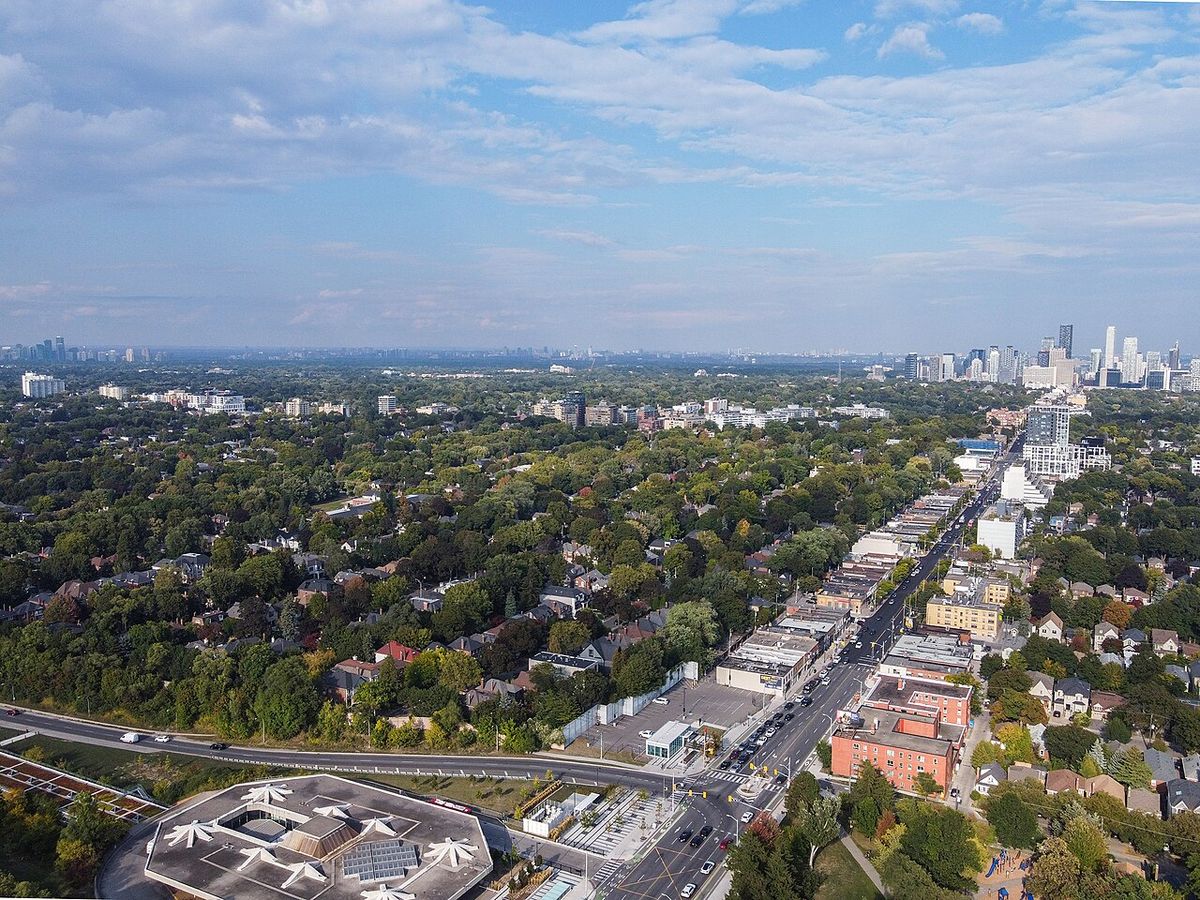
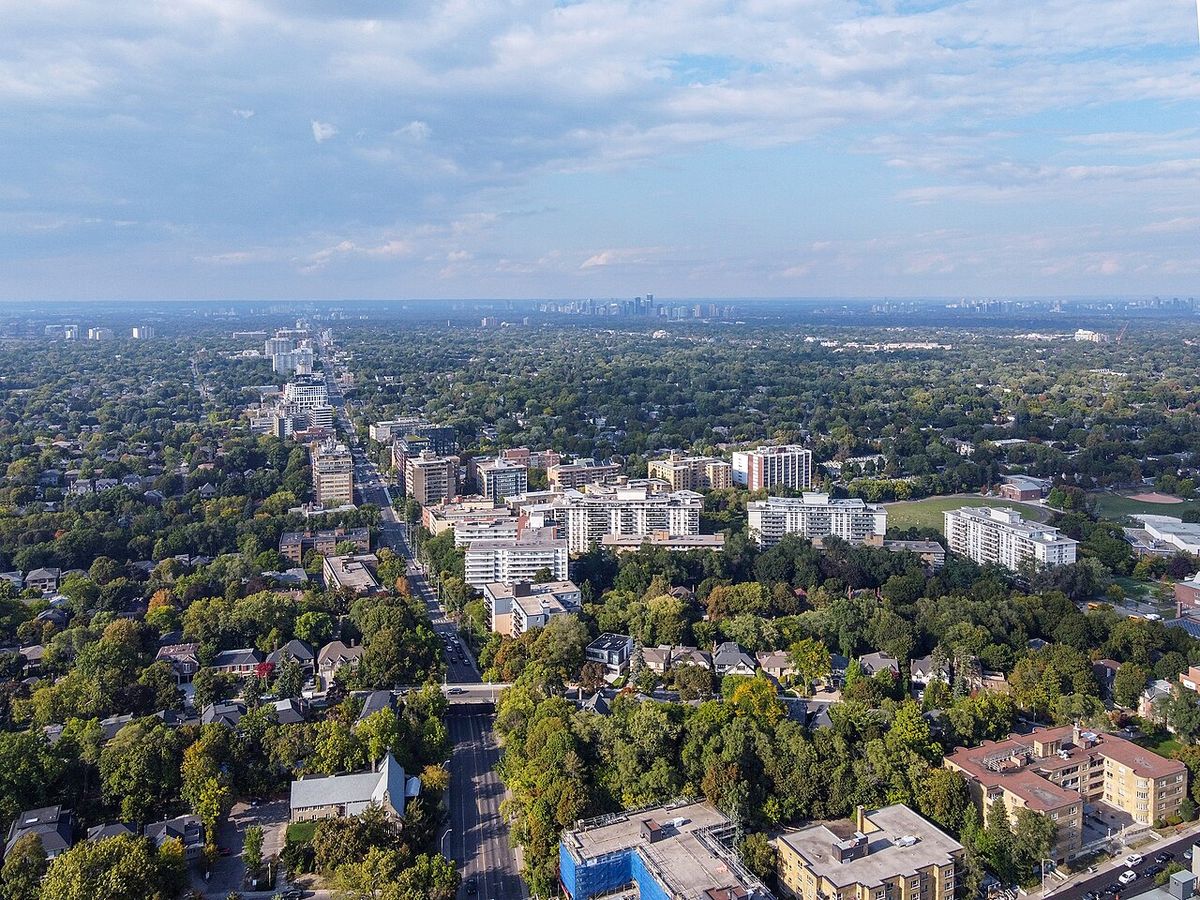
Forest Hill is renowned for its upscale, residential character and architectural grandeur, often compared to the neighbouring district of Rosedale. Journalist Robert Fulford noted in 1999 that while Rosedale houses shout 'history,' Forest Hill houses shout 'grandeur,' with the neighbourhood becoming a site for spectacular new 'neo-traditional' homes on a grand scale. Historically, village bylaws from the 1920s and 1930s required all homes to be designed by an architect and to have a tree planted in the front yard, leading to streetscapes of well-manicured brick and stone mansions. Lower Forest Hill, developed earlier, features these larger estates. Upper Forest Hill, developed mostly in the 1940s and 1950s, contains homes that are often smaller but on similar lot sizes, with many being significantly renovated or replaced by large neo-classical homes. The architectural styles throughout the area are diverse, encompassing Tudor, Georgian, French Colonial with terra cotta tiles, and English country manors with sweeping lawns. Luxurious details such as sculpture gardens, porte-cochères, and imposing gated entrances are widespread, with Old Forest Hill Road noted for a 'Stockbroker Baronial' style. The commercial stretch along Eglinton Avenue West from Bathurst to the former Spadina Expressway alignment contains a wide variety of small shops, restaurants, and food stores. At Spadina Road and Lonsdale Avenue is Forest Hill Village, a small shopping district with boutique shops, a small grocery, banking, and other services. To the west along Lonsdale and Heath Street there are several luxury condo buildings, and to the north along Eglinton there is a group of more modest co-op apartments. Notably, most residential interior streets in Forest Hill do not have sidewalks, and streets are often wide with many intersections controlled by stop signs.
Key landmarks and institutions in the area include the Eglinton Theatre, Grace Church on-the-Hill, and Timothy Eaton Memorial Church. The neighbourhood is also home to elite private boarding schools such as The Bishop Strachan School for girls and Upper Canada College for boys. Forest Hill Village, a small shopping district at Spadina Road and Lonsdale Avenue, contains boutique shops and services. Other notable features are the Forest Hill War Memorial at Eglinton Avenue and Vesta Road and the stretch of shops and restaurants along Eglinton Avenue from Bathurst Street to the Spadina Expressway.
- Forest Hill Village shopping district on Spadina Road
- Grace Church on-the-Hill
- Timothy Eaton Memorial Church
- Eglinton Theatre
- The Loblaws grocery at Bathurst Street and St. Clair Avenue West, noted for an inconvenient transfer from St. Clair West Station
Transit access is provided by the Spadina Road bus route, which is the only surface transit route running through the neighbourhood. The St. Clair Avenue streetcar line connects to Line 1 Yonge-University subway line. Line 5 Eglinton, which connects at Cedarvale station, runs along Eglinton Avenue West. The Loblaws grocery at Bathurst Street and St Clair Avenue West is accessible to the subway via St Clair West Station, though the walking distance from the station to the bus stop is considered inconvenient.
Demographics and Community
Forest Hill is one of Toronto's wealthiest neighbourhoods. As of recent census data, the average income for individuals 15 years and older in private households was $157,600 in Forest Hill South and $89,700 in Forest Hill North. These figures compare to an average of $59,250 in Toronto's Census Metropolitan Area and $54,450 in Canada as a whole. The area has a long-established and prominent Jewish community. Wealthy Jewish families began moving into the village in the 1930s, and by 1941 there were 1,295 Jewish residents, making up 11 percent of the village population. With post-1945 suburbanization, the Jewish population grew to 11,000 by 1961. The 2021 census, combining data for both neighbourhoods as compiled by the City of Toronto, recorded 8,925 people identifying their religion as Jewish, representing 38.5 percent of the total population. In response to the ethnic origin question, 5,125 people, or 22.1 percent, reported Jewish ancestry. Many businesses along Eglinton Avenue West cater to this community.
The ethnic composition of Forest Hill North and Forest Hill South shows distinct profiles. According to the 2021 census, the top reported ethnic or cultural origins by ancestry in Forest Hill North were Jewish, Filipino, Polish, Russian, and Canadian. In Forest Hill South, the top origins were Jewish, Polish, English, Irish, and Russian. The 2021 census figures for the combined neighbourhoods show that 22.1 percent of people reported Jewish ethnic origin, while 38.5 percent gave their religion as Jewish.
| Forest Hill North | Forest Hill South |
|---|---|
| Jewish (21.1%) | Jewish (23.3%) |
| Filipino (11.4%) | Polish (12.0%) |
| Polish (10.5%) | English (10.3%) |
| Russian (9.6%) | Irish (9.4%) |
| Canadian (6.6%) | Russian (9.3%) |
| English (5.4%) | Canadian (8.1%) |
| Irish (4.9%) | Scottish (8.0%) |
| Scottish (4.8%) | German (6.0%) |
| German (3.7%) | Chinese (5.2%) |
| Italian (3.6%) | Italian (5.2%) |
Family structures in Forest Hill are predominantly couple-based. According to the 2021 census, Forest Hill North had 2,710 couple families in private households. Married couples accounted for 2,390, or 88.2 percent, of these families, with 1,470 (54.2 percent of all couples) having children. There were 315 common-law couples (11.6 percent), with 95 (3.5 percent) having children. The neighbourhood reported 2,950 children living in two-parent families and 765 in one-parent families, with an average of 1.8 children in census families with children. In Forest Hill South, there were 2,540 total couple families. Married couples numbered 2,155 (84.8 percent), with 1,100 (43.3 percent) having children. Common-law couples numbered 380 (15.0 percent), with 80 (3.1 percent) having children. The area had 2,305 children in two-parent families and 510 in one-parent families, with an average of 1.9 children per family with children.
Education
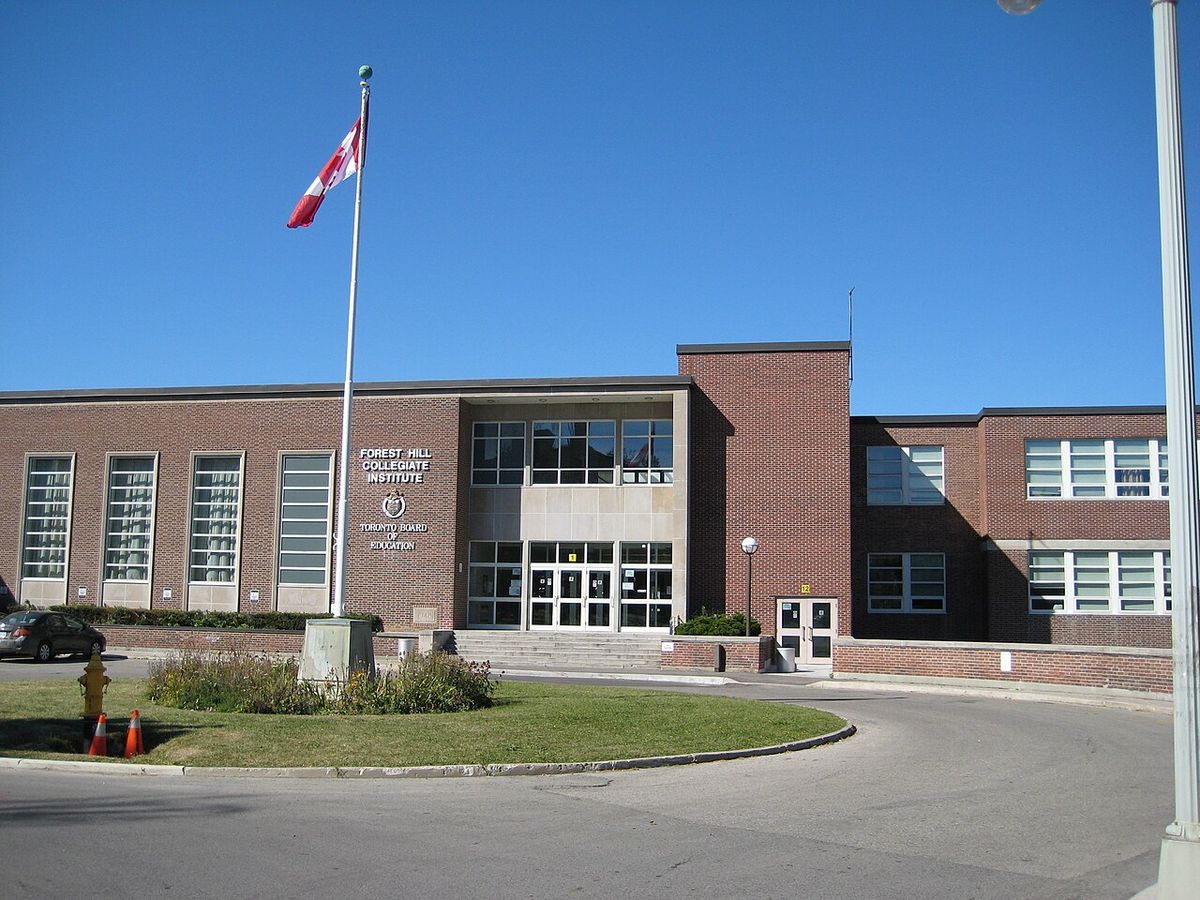
Forest Hill is served by several public and private educational institutions. Secular English-oriented public schools are operated by the Toronto District School Board. These include Forest Hill Collegiate Institute, Forest Hill Junior and Senior Public School (amalgamated from South Preparatory and Forest Hill Senior Public School), West Preparatory Public School, and North Preparatory Public School. The Toronto Catholic District School Board, Conseil scolaire Viamonde, and Conseil scolaire catholique MonAvenir also operate in Toronto but do not currently run schools within the Forest Hill neighbourhoods. The area is also notable for hosting several elite private schools, which draw students from across the Greater Toronto Area and are a defining feature of the neighbourhood. These institutions provide primary and secondary level education and contribute significantly to the community's character.
Politics and Governance
As a former village, Forest Hill was governed by a reeve. The list of reeves includes Lawrence H. Baldwin (1924-28), A.H. Keith Russell (1929-30), Andrew Hazlett (1931-32), Dr. Hugh M. Cook (1933-35), Arthur S. Leitch (1936-37), and Frederick Goldwin Gardiner (1938-49), who later became the first chairman of Metropolitan Toronto from 1953 to 1962. Subsequent reeves were Bruce Pettit Davis, a lawyer (1950-51), Stewart Robertson, an investment broker (1952), Charles O. Bick (1953-55), who resigned to become the first chairman of the Metropolitan Toronto Board of Police Commissioners, Laurie T. Simonsky, a merchant and past president of Holy Blossom Temple (1956-62), and finally Edwin J. Pivnick, a professional engineer and lawyer (1963-67). Following amalgamation in 1967, the area's residents are represented in Toronto's municipal wards of Eglinton-Lawrence and St. Paul's. Federally and provincially, the area has traditionally supported conservative parties. The riding of Toronto, St. Paul's, which encompasses much of Forest Hill, has been held by the Conservative Party of Canada and the Progressive Conservative Party of Ontario. In the 2024 Toronto, St. Paul's federal byelection, a Conservative Party candidate attributed the party's success in the area to its support of Israel in the war in Gaza, an issue resonating with the neighbourhood's significant Jewish community. At the time of the Spadina Expressway debate, the Progressive Conservatives held 12 of the 25 seats in Metro Toronto, while the Liberals had 7 and the NDP had 6.
Notable Residents
Throughout its history, Forest Hill has been home to many prominent Canadians from business, entertainment, sports, and philanthropy. The neighbourhood's affluence and central location have attracted high-profile individuals. Business leaders associated with the area include John Bitove, businessman behind Sirius XM Canada and the Toronto Raptors. George Cohon, founder of McDonald's in Russia. Peter Munk, founder of Barrick Gold Corporation. And Galen Weston of Loblaw Companies. Media and communications figures include Ted Rogers and Edward Rogers III of Rogers Communications, and David Mirvish, theatre producer and son of retailer Ed Mirvish. Entertainment world residents have included Lorne Michaels, creator of Saturday Night Live. Musicians Drake, Nelly Furtado, and producer Bob Ezrin. And comedians Frank Shuster, Johnny Wayne, and Rosie Shuster. Sports personalities have included NHL players Mats Sundin, Doug Gilmour, and Zach Hyman, and former Toronto Blue Jays outfielder Colby Rasmus. Philanthropists and community builders like Joseph Rotman, Isadore Sharp of Four Seasons Hotels, and Barry Sherman, chairman of Apotex, have also been linked to Forest Hill. Other notable figures include politician and diplomat Stephen Lewis, television hosts Valerie Pringle and Michael Landsberg, and tennis player Sharon Fichman.
Housing and Real Estate
The housing market in Forest Hill is among the most exclusive in Toronto, characterized by high-value properties and significant renovations. In 2007, the average sale price for a home in Forest Hill South was reported to be $4,320,000. While renting in the neighbourhood was noted as relatively affordable as of 2011, that is no longer the case, mirroring Toronto's overall market escalation. The demand for property has led to extensive redevelopment, particularly in Upper Forest Hill, where many original homes from the 1940s and 1950s have been torn down to make way for large new 'neo-classical' or 'neo-traditional' homes built on a grand scale. These new constructions often feature the luxurious details common to the area, such as imposing entrances and large lawns. The architectural requirement from the village era for professionally designed homes has set a precedent for quality that continues to influence building standards and aesthetic expectations in the neighbourhood today.
Questions about Forest Hill, Toronto
Where is Forest Hill located in Toronto?
Forest Hill is located in Midtown Toronto, north of the downtown core. It is bounded approximately by Briar Hill Avenue to the north, Bathurst Street to the west, Avenue Road to the east, and Lonsdale Road and Tichester Road to the south. The area is divided into two official city neighbourhoods: Forest Hill North and Forest Hill South, with the commercial hub of Forest Hill Village centred on Spadina Road. The original village boundaries were Bathurst Street, Upper Canada College, Eglinton Avenue, and Lonsdale Road.
Why is Forest Hill considered a wealthy neighbourhood?
Forest Hill is consistently ranked among Toronto's wealthiest neighbourhoods due to its high property values and resident incomes. As of recent census data, the average individual income in Forest Hill South was $157,600 and in Forest Hill North was $89,700, both far exceeding the Toronto CMA average of $59,250 and the Canadian average of $54,450. The neighbourhood features grand, architect-designed homes on large lots, historic bylaws that enforced high construction standards, and proximity to elite private schools, all contributing to its affluent status. In 2007, the average home sale price in Forest Hill South was over four million dollars.
What is the history of the Jewish community in Forest Hill?
Wealthy Jewish families began moving to Forest Hill in the 1930s, a trend that accelerated after the Second World War. By 1941, the village had 1,295 Jewish residents, comprising 11 percent of the population. The relocation of Holy Blossom Temple to Bathurst Street in 1938, just outside the village boundaries, reflected this demographic shift. With post-war suburbanization, the Jewish population grew to about 11,000 by 1961. Today, the community remains significant, with the 2021 census showing that 38.5 percent of the combined Forest Hill population identifies its religion as Jewish, and 22.1 percent reports Jewish ethnic or cultural origin. Many businesses along Eglinton Avenue West cater to this community.
When did Forest Hill become part of Toronto?
The Village of Forest Hill was amalgamated into the City of Toronto in 1967, along with the Village of Swansea. It had been an independently incorporated village since 1923. A condition of the amalgamation allowed for doorstep garbage collection for Forest Hill residents, a service that cost the city $420,000 a year and was paid for by the municipal government. This arrangement continued until 1993, when it was discontinued following public controversy and pressure from other Torontonians.
What architectural styles are common in Forest Hill?
Forest Hill features a diverse range of architectural styles, largely due to historic bylaws requiring architect-designed homes. In Lower Forest Hill, larger mansions from the 1920s and 1930s exhibit grandeur in brick and stone. In Upper Forest Hill, homes from the 1940s and 1950s show Tudor and Georgian influences, alongside French Colonial with terra cotta tiles and English country manors. Common luxurious details include sweeping lawns, sculpture gardens, porte-cochères, and gated entrances, with Old Forest Hill Road noted for a 'Stockbroker Baronial' style. Many original homes have been replaced by large new 'neo-traditional' constructions on a grand scale.
What are the main schools in Forest Hill?
The main schools in Forest Hill include public schools operated by the Toronto District School Board and several notable private institutions. The public schools are Forest Hill Collegiate Institute, Forest Hill Junior and Senior Public School, West Preparatory Public School, and North Preparatory Public School. The area is also home to three elite private schools: The Bishop Strachan School for girls, Upper Canada College for boys, and St. Michael's College School. While other publicly funded school boards operate in Toronto, such as the Toronto Catholic District School Board and French language boards, they do not operate schools within Forest Hill itself. These educational institutions are significant features of the neighbourhood's character and history.
Sources and further reading
- Forest Hill, Toronto (Wikipedia)
- Forest Hill, Toronto Neighbourhood guide (neighbourhoodguide.com)
- Forest Hill North Neighbourhood Guide (hoodq.com)
- Neighbourhood (southforesthill.com)
Checked by the Your Space Hamilton desk. Last updated 2026-10-20.