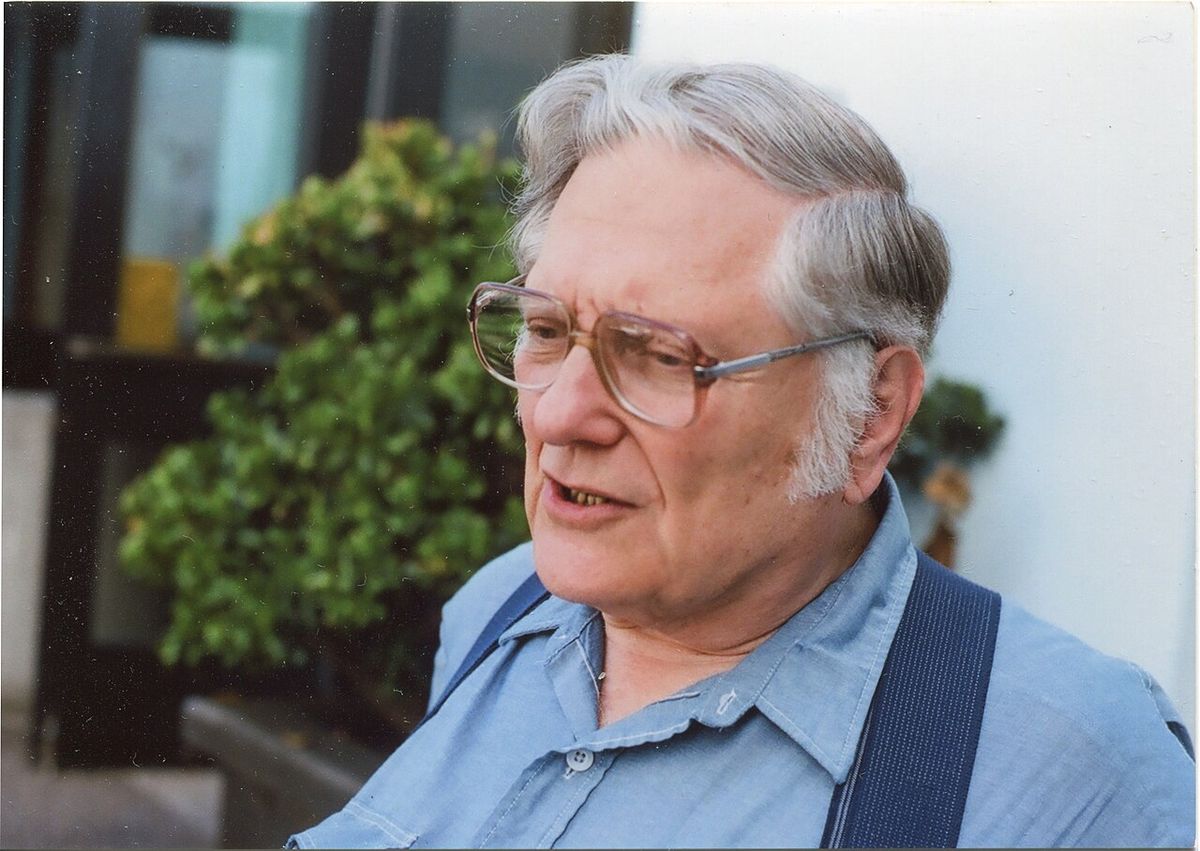
William Kahan
William Morton Kahan is a Canadian mathematician and computer scientist renowned for his foundational work in numerical analysis and floating-point computation. A professor emeritus at the University of California, Berkeley, his career is distinguished by the 1989 Turing Award, computing's highest honour, which he received for his fundamental contributions to the field. Kahan is best known as the principal architect of the IEEE 754 standard for floating-point arithmetic, a specification that ensures reliable numerical results across virtually all digital systems. His work, which includes the development of critical algorithms and educational advocacy, has had a lasting impact on the accuracy and reliability of scientific and engineering calculations worldwide.
Early Life and Academic Foundations
William Morton Kahan was born on June 5, 1933, into a Canadian Jewish family. He pursued his entire undergraduate and graduate education at the University of Toronto, a path that solidified his expertise in mathematics. He earned his Bachelor of Arts degree in 1954, followed by a Master of Arts in 1956, and completed his Doctor of Philosophy in 1958, with all his degrees concentrated in the field of mathematics. This rigorous theoretical background provided the essential foundation for his later work in numerical analysis and computer science. Following his doctoral studies, Kahan joined the faculty at the University of California, Berkeley, where he would spend the majority of his academic career. He held joint appointments in the Department of Mathematics and the Department of Electrical Engineering and Computer Sciences, reflecting the interdisciplinary nature of his research. Kahan achieved emeritus status at Berkeley, a title honouring his long and distinguished service to the university and the broader academic community, and he continues to be known as professor emeritus of mathematics and of electrical engineering and computer sciences.
Architect of Modern Floating-Point Arithmetic
Kahan's most celebrated achievement is his leadership in creating the IEEE 754 standard for floating-point arithmetic. As the primary architect of the 1985 standard, known as IEEE 754-1985, he provided a universal and reliable framework for representing and performing arithmetic on real numbers in digital computers. This standard resolved the chaos of incompatible, manufacturer-specific implementations that plagued early computing and has been called a landmark in computer engineering. Kahan continued his central role in the subsequent revision process, which culminated in the widely adopted IEEE 754-2008 standard that superseded the original. His work established consistent rules for rounding, exceptions, and basic operations, ensuring portability and predictability of numerical results across different hardware and software platforms. For this foundational contribution, Kahan has been widely referred to as "The Father of Floating Point," since he was instrumental in creating the original specification. His influence extended beyond the standard itself into its practical application, where he became a vocal advocate for its proper implementation and understanding among programmers and engineers.
William Kahan was the primary architect behind the IEEE 754-1985 standard for binary floating-point computation. He also contributed to its radix-independent follow-on standard, known as IEEE 854. His work was instrumental in creating the original IEEE 754 specification, earning him the nickname "The Father of Floating Point." Kahan continued his contributions by helping to revise the standard, which led to the current IEEE 754 standard. This comprehensive work addressed both binary and general radix systems for numerical computation.
The IEEE 754 standard forms the technical backbone for floating-point computation in virtually all modern microprocessors. These microprocessors are found in devices ranging from personal computers to embedded systems in consumer electronics. The creation and widespread adoption of this standard are a direct result of Kahan's technical vision and his persistent advocacy. His efforts ensured a reliable and consistent foundation for numerical calculations across different computing platforms.
Key Algorithms and Theoretical Contributions
Beyond the IEEE standard, Kahan developed several important algorithms and concepts that address the inherent challenges of finite-precision arithmetic. The Kahan summation algorithm, also known as compensated summation, is a clever technique designed to dramatically reduce the numerical error that accumulates when adding a long sequence of floating-point numbers. This algorithm is critical in fields requiring high-precision calculations, such as computational statistics and scientific simulation, and it remains a standard tool for improving accuracy. In the 1980s, he authored the program "paranoia," a benchmark that tests for a wide range of potential floating-point bugs and compliance with the IEEE standards. Kahan also coined the term "Table-maker's dilemma" for the unknown cost of correctly rounding transcendental functions to some preassigned number of digits, highlighting a fundamental challenge in mathematical software. In pure mathematics, his collaboration resulted in the Davis-Kahan-Weinberger dilation theorem, one of the landmark results in the dilation theory of Hilbert space operators which has found applications in many different areas. Kahan's specific technical creations and concepts have become essential tools and topics in numerical computing. His notable inventions include:
- The Kahan summation algorithm (compensated summation) for accurate floating-point addition.
- The "paranoia" floating-point diagnostic benchmark program, created in the 1980s.
- The term "Table-maker's dilemma," coined to describe the cost of rounding transcendental functions.
- The Davis-Kahan-Weinberger dilation theorem in operator theory.
Kahan's contributions provide practical methods for improving computational accuracy, such as his summation algorithm and benchmark program. They also offer a deeper theoretical understanding of computational limits, as illustrated by the concept of the Table-maker's dilemma. His work demonstrates considerable intellectual breadth, ranging from writing practical code to engaging with abstract mathematics. One example of his theoretical work is the Davis-Kahan-Weinberger dilation theorem, a landmark result in the dilation theory of Hilbert space operators.
Industry Collaboration and Practical Impact
Kahan's expertise was frequently sought by industry leaders to solve real-world numerical problems, and his collaborations had a direct effect on consumer technology. When the HP-35 was released, its numerical accuracy in evaluating transcendental functions for some arguments was not optimal, so HP worked extensively with Kahan to enhance the accuracy of the algorithms. This collaboration led to major improvements in the calculator's numerical fidelity, which was documented at the time in the Hewlett-Packard Journal, providing a public record of the engineering process. Kahan further contributed substantially to the design of the algorithms in the HP Voyager series of calculators and wrote part of their intermediate and advanced manuals. These partnerships demonstrated the direct application of his theoretical insights to consumer electronics, ensuring that millions of engineers, scientists, and students had access to reliable computational tools from their pockets.
William Kahan engaged directly with industry to improve the numerical accuracy of commercial products. His key collaboration was with Hewlett-Packard. When HP introduced the original HP-35 pocket scientific calculator, its accuracy for evaluating transcendental functions was not optimal. The company worked extensively with Kahan to enhance the accuracy of its algorithms, which led to major improvements documented in the Hewlett-Packard Journal. Kahan also contributed substantially to the algorithms in the HP Voyager series of calculators.
- HP-35 Pocket Scientific Calculator: Kahan worked extensively with HP to enhance the accuracy of its transcendental function algorithms.
- HP Voyager Series: He contributed to the algorithm design for this later series of calculators.
- HP Documentation: Kahan wrote portions of the intermediate and advanced user manuals for these calculators.
- Hewlett-Packard Journal: The technical improvements from his collaboration were documented in this publication.
Kahan's work with Hewlett-Packard successfully translated abstract numerical theory into tangible improvements in everyday calculator devices. This collaboration set a high standard for numerical reliability within the calculator industry. The improvements influenced the design of subsequent calculator models and other computational devices. His efforts ensured that complex mathematical functions could be evaluated more accurately in handheld scientific tools used by professionals and students.
Honours and Recognition
William Kahan's contributions have been recognized with the highest honours in computing and engineering over a long career. In 1989, he was awarded the ACM Turing Award, often described as the Nobel Prize of computing, specifically for his fundamental contributions to numerical analysis as cited in the award. The Association for Computing Machinery further honoured him by naming him an ACM Fellow in 1994, a recognition of his significant impact on the computing field. In 2005, his impactful work earned him induction into the National Academy of Engineering in the United States, marking his status as a leading figure in engineering research. These accolades highlight the practical and theoretical importance of his research on the entire field of computing, from hardware design to software implementation. Kahan's formal recognitions chart a career of exceptional influence in both academic and professional societies. His major honours are:
- 1989: Recipient of the ACM Turing Award for fundamental contributions to numerical analysis.
- 1994: Elected as a Fellow of the Association for Computing Machinery (ACM).
- 2005: Inducted as a member of the United States National Academy of Engineering.
The Turing Award, ACM Fellowship, and induction into the National Academy of Engineering represent significant peer validation. These honours come from the leading professional bodies in computer science and engineering. Collectively, they solidify Kahan's legacy as a key architect of reliable numerical computation. His work on floating-point standards and algorithms is formally recognised as foundational to modern computing.
Advocacy and Educational Legacy
Throughout his career, Kahan has been an outspoken advocate of better education of the general computing population about floating-point issues, regularly denouncing decisions in design that he believes impair good computations. He has consistently criticised design choices in programming languages and computer architectures that he views as detrimental to numerical accuracy and robustness, arguing for adherence to sound principles. His educational efforts aim to move the discipline beyond treating floating-point as a mysterious black box and instead promote a deep, intuitive understanding of its strengths and limitations among programmers and engineers. This advocacy is evident in his numerous interviews, lectures, and writings, where he explains complex numerical concepts with clarity and directness. By championing this cause, Kahan has helped cultivate a more numerically literate generation of computer scientists and engineers, ensuring that the reliability built into the IEEE 754 standard is properly leveraged in practice across the industry.
William Kahan has demonstrated a strong commitment to education and clear communication about floating-point issues. He is an outspoken advocate for better education of the general computing population on this topic. This outreach is documented through various public resources, including his personal home page and several recorded interviews. For example, interviews have been published in Dr. Dobb's Journal and other technical publications, where he explains the nuances of numerical computation.
- An oral history of William Kahan, Revision 1.1, from March 2016.
- A Conversation with William Kahan published in Dr. Dobb's Journal on November 1, 1997.
- An Interview with the Old Man of Floating-Point from February 20, 1998.
- An IEEE 754 interview with William Kahan from April 1998.
- His publicly accessible academic home page containing his writings and resources.
- The Paranoia source code in multiple languages, which serves as an educational tool.
Through interviews and his public advocacy, Kahan has directly engaged with the programming community to explain floating-point computation. His Paranoia benchmark program remains a vital tool for both teaching and testing. It is used to understand floating-point behaviour and to identify potential bugs in system implementations. This ongoing educational effort ensures that his practical insights continue to inform new generations of computer scientists and engineers.
Questions about William Kahan
What is William Kahan famous for?
William Kahan is most famous for being the principal architect of the IEEE 754 standard for floating-point arithmetic, which defines how computers represent and perform calculations with real numbers. This work earned him the title "The Father of Floating Point. He also received the 1989 Turing Award, computing's highest honour, for his fundamental contributions to numerical analysis. He developed the widely used Kahan summation algorithm for reducing numerical error and the Paranoia diagnostic benchmark.
What awards has William Kahan won?
William Kahan has received several prestigious awards. The most notable is the ACM Turing Award, which he was given in 1989 for his fundamental contributions to numerical analysis. He was also named a Fellow of the Association for Computing Machinery (ACM) in 1994. In 2005, he was inducted as a member of the United States National Academy of Engineering in recognition of the significant engineering impact of his work on floating-point standards.
How did William Kahan help Hewlett-Packard?
William Kahan collaborated with Hewlett-Packard engineers to improve the numerical accuracy of their early pocket calculators. When the HP-35, the first scientific pocket calculator, was released, its algorithms for functions like sine and logarithm were not optimal. Kahan worked extensively with HP to analyse and enhance these algorithms, leading to major improvements in accuracy documented in the Hewlett-Packard Journal. He also contributed to the algorithms for the later HP Voyager series and wrote parts of their technical manuals.
Where did William Kahan go to university?
William Kahan attended the University of Toronto in Canada for all his university education. He received his bachelor's degree in 1954, followed by his master's degree in 1956, and finally his Ph.D. in 1958. All three of his advanced degrees were in the field of mathematics. His academic journey at the University of Toronto provided the foundation for his later groundbreaking work. This comprehensive mathematical training directly informed his subsequent contributions to numerical analysis and computer science.
What is the Kahan summation algorithm?
The Kahan summation algorithm is an important numerical method developed by William Kahan to minimize error. It specifically addresses the accumulation of rounding errors that occur when adding a long sequence of finite precision floating point numbers. This algorithm is a key technique for improving the accuracy of numerical computations in computing. Kahan developed it during the 1980s, a period when he was deeply engaged in addressing floating point issues. His work on this algorithm is part of his broader legacy in creating strong and reliable numerical software.
Where does William Kahan teach?
William Kahan is a professor emeritus at the University of California, Berkeley. He holds emeritus status in two departments: mathematics and electrical engineering and computer sciences (EECS). His career at Berkeley followed the completion of his doctorate at the University of Toronto. As an emeritus professor, he remains affiliated with the institution where he conducted much of his seminal work. His academic home at Berkeley has been central to his research and advocacy in the field of numerical computing.
Sources and further reading
- William Kahan (Wikipedia)
- William M. Kahan | EECS at UC Berkeley (www2.eecs.berkeley.edu)
Checked by the Your Space Hamilton desk. Last updated 2026-11-01.