University of Prince Edward Island
The University of Prince Edward Island (UPEI) is a public, non-denominational university located in Charlottetown, Prince Edward Island. As the only university in Canada's smallest province, it plays a central role in the region's post-secondary education and research landscape. Founded in 1969 through the amalgamation of St. Dunstan's University and Prince of Wales College, UPEI's roots extend back to the early 19th century. The university offers a comprehensive range of undergraduate, graduate, and doctoral programs across seven faculties and two schools, including the internationally recognized Atlantic Veterinary College.
History and Foundation
The University of Prince Edward Island was formally established in 1969 by the government of Premier Alex Campbell, uniting two historic Charlottetown institutions: St. Dunstan's University, a Roman Catholic college founded in 1855, and Prince of Wales College, a non-denominational institution whose origins trace back to 1804. This merger was a significant step in integrating the province's separate educational communities. The first student to enrol at the newly formed university was Elizabeth Rollins Epperly, who would later serve as its president from 1995 to 1998. The university operates on the former campus of St. Dunstan's University, while the lands of Prince of Wales College became the campus for Holland College, which was created to fill the void left by the merger. In 2015, the first five presidents of UPEI were recognized as Founders of the University for their foundational roles.
The institution's lineage can be traced through a series of earlier academies. The call for a college dates to 1804 by Lt. Governor Edmund Fanning and the Legislative Council, leading to the establishment of Kent College. By 1820, the first Kent College building, known as the National School or James Breading's School, was erected. This was succeeded by Central Academy, which received a Royal Charter in 1834 and was later renamed Prince of Wales College in 1860 in honour of the future King Edward VII. The modern university continues to honour this long history, with Canada Post issuing a commemorative stamp in 2004 marking 'University of Prince Edward Island, 1804 to 2004' as part of its Canadian Universities series. The stamp was designed by Denis L'Allier based on a photograph by Guy Lavigueur, printed by Canadian Bank Note Company, and perforated 13.5.
During the COVID-19 pandemic, UPEI received a $500,000 grant from the Public Health Agency of Canada's Immunization Partnership Fund to develop and implement the Island Vaccine Education Program. The program was intended to increase uptake of COVID-19 vaccines among vulnerable families. The university traces its roots back to 1804 with a call for the establishment of Kent College. It was founded in 1969 by the amalgamation of Prince of Wales College and St. Dunstan's University.
- 1804: Lt. Governor Edmund Fanning calls for the establishment of Kent College.
- 1834: Central Academy receives a Royal Charter.
- 1855: St. Dunstan's University is founded.
- 1860: Prince of Wales College is renamed in honour of the future King Edward VII.
- 1969: UPEI is founded by amalgamating St. Dunstan's University and Prince of Wales College.
- 1993: The L.M. Montgomery Institute is founded.
- 2004: Canada Post issues a commemorative stamp for UPEI.
- 2015: The first five UPEI presidents are recognized as Founders.
Campus and Facilities
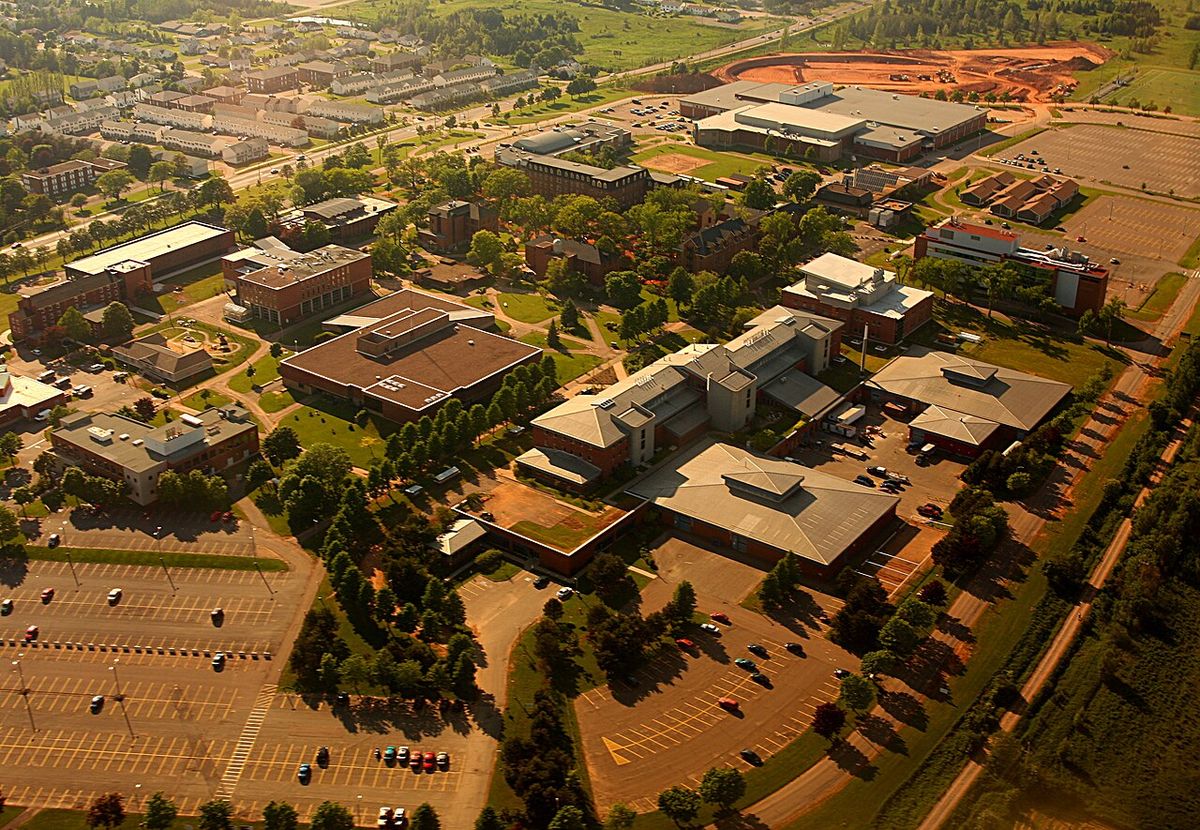
The UPEI campus spans 134 acres at the corner of Belvedere and University Avenues in the provincial capital, Charlottetown. The Confederation Trail runs alongside its eastern boundary. The central quadrangle features original St. Dunstan's University buildings that have been renovated to preserve their exterior aesthetic while meeting modern standards. Two of these, the Main Building (built 1854) and Dalton Hall (built 1917 to 1919), are listed on the registry of Historic Places of Canada. Another landmark is War Memorial Hall, built as a men's residence in 1946 to honour alumni who died in the First and Second World Wars.
Since its founding, the campus has seen substantial growth with numerous new buildings integrated into its landscape. Major additions began with the Duffy Science Centre in 1967 and Bernardine Hall in 1968. The 1980s brought the Atlantic Veterinary College in 1986, while the 1990s added the Chi-Wan Young Sports Centre (1990), Wanda Wyatt Dining Hall (1990), and the K.C. Irving Chemistry Centre (1997). The W.A. Murphy Student Centre opened in 2002, followed by MacLauchlan Arena in 2004. The Regis and Joan Duffy Research Centre, opened in 2007, houses researchers from UPEI, the National Research Council of Canada, and Agriculture and Agri-Food Canada. The most recent academic addition is the Health Sciences Building, home to the School of Nursing and Applied Human Sciences. A significant new mixed-use facility, the Performing Arts Centre and Residence, opened in 2023, featuring residence towers and a 400-seat auditorium.
The campus also hosts extensive athletic and recreational amenities for students and the public. The CARI Complex includes MacLauchlan Arena, a practice rink, and two 25-metre swimming pools, one a recreational wading pool and the other an eight-lane competitive pool with diving boards. UPEI Alumni Canada Games Place, inaugurated for the 2009 Canada Games, features a class 2 eight-lane 400-metre running track and a rugby field with spectator seating for 1,335. The Chi-Wan Young Sports Centre serves as the hub for varsity athletics and campus recreation. Student residences include Bill and Denise Andrew Hall, which has two-room suites with single bedrooms, Blanchard Hall with suites containing two single bedrooms and a kitchenette, Bernardine Hall offering suites with two double bedrooms, and the new Performing Arts Centre and Residence. In 2004, the university undertook an official campus plan to guide future development and improve the aesthetic integration of modern buildings with the historic campus core.
The campus is built on 134 acres of land at the corner of Belvedere and University Avenues in Charlottetown. Original St. Dunstan's University buildings in the central quadrangle have been renovated. Main Building, built in 1854, and Dalton Hall are on the registry of Historic Places of Canada. Over the past three decades, UPEI has experienced significant growth with many new buildings integrated into the campus. These include the Atlantic Veterinary College, the Chi-Wan Young Sports Centre, and the Health Sciences Building.
- Main Building (1854): Original SDU building, on the Historic Places of Canada registry.
- Atlantic Veterinary College (1986): Internationally recognized veterinary medicine facility.
- Regis and Joan Duffy Research Centre (2007): Houses UPEI, NRC, and Agriculture and Agri-Food Canada researchers.
- Performing Arts Centre and Residence (2023): Mixed-use facility with a 400-seat auditorium.
- Health Sciences Building: Home to the School of Nursing and Applied Human Sciences.
- K.C. Irving Chemistry Centre (1997): Dedicated chemistry research and teaching facility.
- W.A. Murphy Student Centre (2002): Central hub for student activities and services.
- MacLauchlan Arena (2004): Hockey rink part of the CARI Complex.
Academics and Rankings
UPEI is organized into seven faculties: Arts, Business, Education, Nursing, Science, Sustainable Design Engineering, and Veterinary Medicine. It also houses two schools: the School of Mathematical & Computational Sciences and the School of Climate Change & Adaptation. The university offers a wide spectrum of programs leading to bachelor's, master's, and doctoral degrees. Cooperative education programs are established in Business Administration, Computer Science, Physics, and Dietetics. The Faculty of Education offers specialized post-degree bachelor's programs in international, adult, and indigenous education, French immersion and human resources development, a Master of Education in leadership in learning, and a PhD in Educational Studies. The university is currently developing a Faculty of Medicine in association with Memorial University of Newfoundland.
Graduate studies expanded significantly from their origins in the Atlantic Veterinary College. A Master of Science degree was introduced in the Faculty of Science in 1999, the same year the Master of Education program admitted its first students. Other notable graduate offerings include a Master of Arts in Island Studies, an Executive Master of Business Administration, and a Master of Applied Health Services Research coordinated by the Atlantic Research Training Centre. The Department of Applied Human Sciences runs an accredited dietitian program through the Dietitians of Canada, enabling graduates to become registered dietitians. Professional development for the wider community is provided through the Faculty Development Office, which offers courses for administrative assistants, new managers, and training in collaboration, conflict, communication, and financial management.
In national rankings, UPEI consistently places among the top primarily undergraduate universities in Canada. In Maclean's 2023 Guide to Canadian Universities, UPEI was ranked eighth in the primarily undergraduate category. The university improved this standing in the 2025 rankings, moving up to seventh place. The university also offers certificate programs, such as the Certificate in Conflict Resolution Studies from the Centre for Conflict Resolution Studies, which has been available since 1998. The university's academic calendar includes several key annual events that bring the community together for scholarly and cultural exchange.
- Welcome Week (September 4-13, 2026): Orientation events including UPEI Music Fest and President's BBQ.
- Shannon K. Murray Lecture on Hope and the Academy (September 22, 2026): Featuring Dr. Kevin Gannon on 'Hope for Humans'.
- L.M. Montgomery Institute Biennial Conference (June 24-28, 2026): 17th conference on 'L.M. Montgomery and Change'.
- Atlantic Canada Studies Conference (June 2-5, 2026): Hosted by the Faculty of Arts in Charlottetown.
- UPEI Recognition of Founders Ceremony (2026): Honors the university's foundational leaders.
- Budget Address (April 14, 2026): Includes funding announcements for university priorities.
Research and Institutes
The University of Prince Edward Island manages over $17 million in annual research expenditures, supporting inquiry across scientific, health, social, and cultural fields. A key facility is the on-campus biosciences and health research building, used collaboratively by UPEI researchers, the National Research Council of Canada, and Agriculture and Agri-Foods Canada. The university is also a founding partner, with Dalhousie University and Memorial University of Newfoundland, of the Ocean Frontier Institute, a major research initiative focused on sustainable ocean development and harnessing the potential of the world's oceans. UPEI is an active member of the University of the Arctic (UArctic), an international cooperative network based in the Circumpolar Arctic region consisting of more than 200 universities and colleges, and participates in its north2north student mobility program.
A unique cultural and scholarly resource at UPEI is the L.M. Montgomery Institute, founded in 1993. The institute is dedicated to promoting scholarly inquiry into the life, works, culture, and influence of Lucy Maud Montgomery, the celebrated Canadian author of Anne of Green Gables. Its collection includes novels, manuscripts, letters, photographs, sound recordings, and other artifacts related to Montgomery. The institute hosts a biennial international conference, with the 17th biennial event, 'L.M. Montgomery and Change', scheduled for June 24-28, 2026. The 2026 conference will feature a keynote address by award-winning actress and director Megan Follows, renowned for her portrayal of Anne Shirley, and includes presentations by scholars like Dr. Katharine Slater and Dr. Allison McBain Hudson, the current Visiting Scholar at the institute.
Research at UPEI extends into health services with the Master of Applied Health Services Research program. The Centre for Conflict Resolution Studies has been offering courses leading to a Certificate in Conflict Resolution Studies since 1998. The on-campus biosciences and health research facility is used by researchers from UPEI, the National Research Council, and Agriculture and Agri-Food Canada. UPEI joined with Dalhousie University and Memorial University of Newfoundland to form the Ocean Frontier Institute.
Student Life and Athletics
Student life at UPEI is coordinated by the UPEI Student Union (UPEISU), which represents full-time undergraduate students and is funded by a student fee. The UPEISU Executive is elected by the student body and consists of a President, VP Academic, VP External, VP Student Life, and VP Finance. The UPEISU Council sits bi-weekly and includes representatives from faculty and special interest groups. The union provides advocacy, health and dental insurance, a Charlottetown Transit System U-PASS, and operates several businesses including The Fox and the Crow pub and café. It also publishes the editorially autonomous student newspaper, The Cadre, which gained attention for being one of the first Canadian publications to print the controversial Muhammad cartoons, and the official yearbook, The Nexus. A major campus hub is the W.A. Murphy Student Centre, operated in collaboration with the university.
Welcome Week is a major annual tradition, designed to integrate new and returning students into campus life. Welcome Week 2026 is scheduled for September 4 to 13 and will feature events like the UPEI Music Fest, a Back-2-School Fair on September 8, and the President's Welcome Back BBQ on September 9. The university fosters an inclusive environment through initiatives like the 'Ask Me' campaign, where faculty and staff wear identifying buttons or t-shirts to signal they are available to assist students. The Welcome Week Coordinators for 2026, Hasna Mady and Mary Truong, emphasize creating opportunities for students to build friendships and feel they belong at UPEI.
Athletics are a central part of campus culture, with the UPEI Panthers competing in nine varsity sports within Atlantic University Sport (AUS) and Canadian Interuniversity Sport (CIS). The teams include men's and women's ice hockey, soccer, and basketball, women's field hockey and rugby union, and a co-ed swimming team. Facilities like the CARI Complex and UPEI Alumni Canada Games Place support both varsity competition and recreational use by the entire campus community. The university also hosts lecture series open to the public, such as the Shannon K. Murray Lecture on Hope and the Academy. The 2026 lecture will be delivered on September 22 by Dr. Kevin Gannon, Director of the Center for the Advancement of Faculty Excellence at Queens University-Charlotte, on the topic 'Hope for Humans'.
Leadership and Notable Alumni
The university is led by a chancellor and a president and vice-chancellor. The current chancellor, installed on April 5, 2024, is the Honourable Diane Griffin, a former Canadian senator. Dr. Wendy Rodgers began her appointment as president and vice-chancellor on June 1, 2024, succeeding Gregory Keefe (2021 to 2024). The list of presidents reflects the institution's evolution since its 1969 founding, beginning with Ronald James Baker and including Peter P.M. Meincke, Charles William John Eliot, Elizabeth Rollins Epperly, Wade MacLauchlan, and Alaa Abd-El-Aziz. In 2015 each of the first five presidents were recognized as Founders of the University.
With deep roots in the province known as the Cradle of Confederation, UPEI and its predecessor institutions have educated many individuals who achieved prominence in diverse fields. The most famous graduate of Prince of Wales College is author Lucy Maud Montgomery. A distinguished St. Dunstan's graduate is James Charles McGuigan, who became a Cardinal and Archbishop of Toronto and Cardinal-Priest of Santa Maria del Popolo in Rome. Other notable alumni in religion include Archbishop Joseph Anthony O'Sullivan of Kingston and Archbishop James Morrison of Antigonish. In medicine, alumni include Sir Andrew Macphail, knighted in 1918 for literary and military work, Dr. Heather G. Morrison, the Chief Public Health Officer of PEI and a Rhodes Scholar, and Dr. Augustine A. MacDonald, who was awarded the Order of Canada for providing medical care in rural PEI for over sixty years.
The university has educated numerous premiers and lieutenant governors of Prince Edward Island, highlighting its connection to provincial leadership. Premiers include Louis Henry Davies, who later became the 6th Chief Justice of Canada, Thane Campbell, a Rhodes Scholar, and more recent leaders like James Lee, Keith Milligan, and Bennett Campbell. Other premiers were Alexander Warburton, John Howatt Bell, and Albert Charles Saunders. Lieutenant governors educated at UPEI or its predecessors include Marion Reid, the first woman to hold the office in PEI and a recipient of the Order of Canada, Willibald Joseph MacDonald, and Gordon Lockhart Bennett, a chemistry professor inducted into the Canadian Curling Hall of Fame. This extensive list of leaders in public service, combined with achievements in business, law, and academia, demonstrates the institution's significant contribution to the development of Prince Edward Island and Canada.
Notable alumni from UPEI and its predecessor institutions have made marks in fields ranging from literature and religion to medicine and politics. A well known graduate of Prince of Wales College is Lucy Maud Montgomery, author of Anne of Green Gables. A distinguished Saint Dunstan's graduate is James Charles McGuigan, a Cardinal. Other notable alumni include Heather G. Morrison, the Chief Public Health Officer of PEI, and Sir Andrew Macphail, a physician and writer.
- Lucy Maud Montgomery: Author of Anne of Green Gables, graduate of Prince of Wales College.
- Cardinal James Charles McGuigan: Archbishop of Toronto, graduate of St. Dunstan's University.
- Louis Henry Davies: 3rd Premier of PEI and 6th Chief Justice of Canada.
- Marion Reid: 24th Lieutenant Governor of PEI, first woman in the role, Order of Canada recipient.
- Sir Andrew Macphail: Physician, writer, knighted in 1918.
- Heather G. Morrison: Chief Public Health Officer of PEI, Rhodes Scholar.
- Don McDougall: President of Labatt Brewing Company, instrumental in establishing the Toronto Blue Jays.
- Thane Campbell: 19th Premier of PEI, Rhodes Scholar.
Questions about University of Prince Edward Island
What is the University of Prince Edward Island known for?
The University of Prince Edward Island is known as the only university in Canada's smallest province, offering a comprehensive range of undergraduate and graduate programs. It is particularly renowned for its Atlantic Veterinary College, one of only five veterinary schools in Canada. UPEI is also recognized for its L.M. Montgomery Institute, a leading centre for scholarship on the author of Anne of Green Gables, and for its strong placement in national rankings for primarily undergraduate universities, ranking seventh in Maclean's 2025 guide. The university manages over $17 million in annual research expenditures and is a partner in the Ocean Frontier Institute.
When was UPEI founded and what is its history?
UPEI was formally founded in 1969 through the amalgamation of two historic Charlottetown institutions: St. Dunstan's University (founded 1855) and Prince of Wales College (whose origins date to 1804). This merger was enacted by the provincial government of Alex Campbell to integrate the island's Roman Catholic and Protestant post-secondary education systems. The university operates on the former St. Dunstan's campus, while the Prince of Wales College lands became the site for Holland College. The institution's lineage extends back through earlier academies like Kent College, established in 1804, and Central Academy, which received a Royal Charter in 1834.
What programs and degrees does UPEI offer?
UPEI offers programs through seven faculties (Arts, Business, Education, Nursing, Science, Sustainable Design Engineering, Veterinary Medicine) and two schools (Mathematical & Computational Sciences. Climate Change & Adaptation). It grants bachelor's, master's, and doctoral degrees. Notable programs include cooperative education in Business Administration, Computer Science, Physics, and Dietetics, an accredited dietitian program, a Master of Arts in Island Studies, and professional degrees like the Executive MBA and a PhD in Educational Studies. The university also offers a Certificate in Conflict Resolution Studies and is developing a Faculty of Medicine in partnership with Memorial University of Newfoundland.
Where is the UPEI campus located and what are its facilities?
The UPEI campus is located on 134 acres at the corner of Belvedere and University Avenues in Charlottetown, Prince Edward Island, with the Confederation Trail on its eastern boundary. The campus blends historic buildings like the Main Building (1854) and Dalton Hall with modern facilities such as the Atlantic Veterinary College (1986), the Health Sciences Building, and the Performing Arts Centre and Residence opened in 2023. Athletic facilities include the CARI Complex with ice rinks and pools, UPEI Alumni Canada Games Place with a track and rugby field, and the Chi-Wan Young Sports Centre. Student residences include Bill and Denise Andrew Hall, Blanchard Hall, Bernardine Hall, and the new performing arts residence.
What student life and athletics are available at UPEI?
Student life is supported by the UPEI Student Union, which runs services, a pub, and the student newspaper The Cadre. Major traditions include Welcome Week each September, featuring events like the Music Fest and President's BBQ. The UPEI Panthers varsity teams compete in nine sports in the Atlantic University Sport conference, including men's and women's hockey, soccer, and basketball, as well as women's rugby and field hockey and co-ed swimming. Campus recreation facilities are extensive, featuring the CARI Complex with two swimming pools and ice rinks, and UPEI Alumni Canada Games Place. On-campus housing is available in several residence halls with various room configurations.
Who are some notable alumni of UPEI and its predecessor colleges?
Notable alumni include Lucy Maud Montgomery, author of Anne of Green Gables and a graduate of Prince of Wales College. Cardinal James Charles McGuigan, Archbishop of Toronto, is a distinguished graduate of St. Dunstan's University. Many premiers of Prince Edward Island are alumni, such as Louis Henry Davies (later Chief Justice of Canada), Thane Campbell, James Lee, and Bennett Campbell. The university has also educated several lieutenant governors, including the first woman to hold the office in PEI, Marion Reid, and Willibald Joseph MacDonald. Other alumni have achieved prominence in medicine, like Sir Andrew Macphail and Dr. Heather G. Morrison, and in business, such as Don McDougall, a president of Labatt Brewing Company.
Sources and further reading
- University of Prince Edward Island (Wikipedia)
- 2026, L.M. Montgomery and Change (lmmontgomery.ca)
- Welcome Week 2026 set for September 4-13! (upei.ca)
- University of Prince Edward Island, UPEI's 2026 Shannon ... (educationnewscanada.com)
Checked by the Your Space Hamilton desk. Last updated 2026-10-29.