Port Mann Bridge
The Port Mann Bridge is a major cable-stayed bridge that carries Highway 1 across the Fraser River, connecting the cities of Coquitlam and Surrey in British Columbia's Greater Vancouver region. Opened to traffic in 2012, this 10-lane bridge is a critical piece of the Trans-Canada Highway infrastructure. It was designed to alleviate severe congestion and includes space reserved for a potential future light rail line. In 2025, the bridge carried an average of 179,435 vehicles per day, making it the busiest bridge in Canada.
Historical Context and the Original Bridge
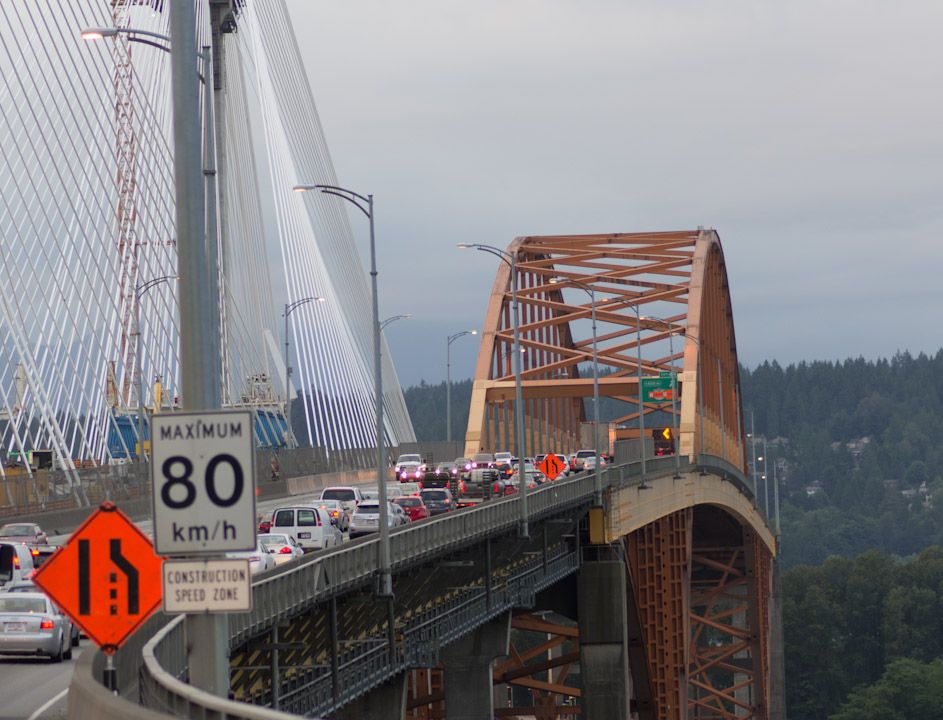
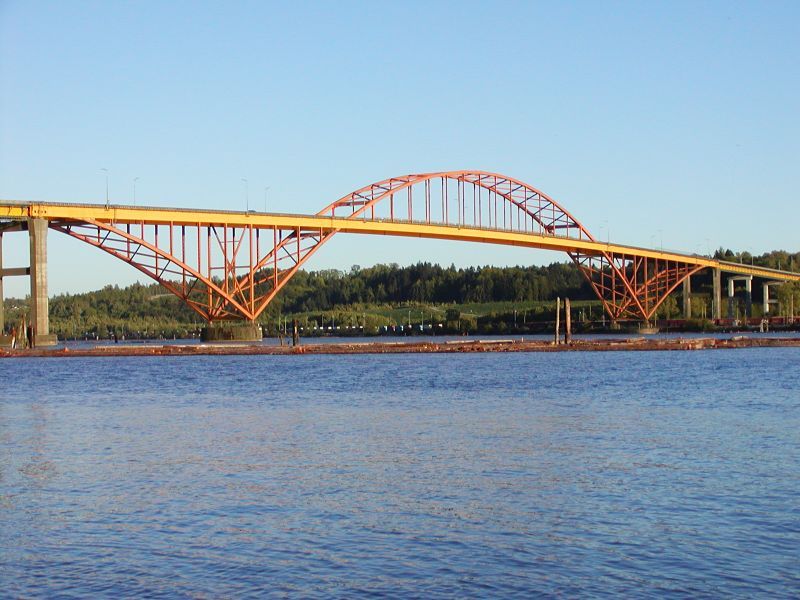
The current Port Mann Bridge replaced an earlier steel arch bridge that served the region for nearly five decades. The original bridge opened on June 12, 1964, and was named for the adjacent community of Port Mann. It featured a main steel arch span of 366 metres flanked by two 110 metre side spans, with a total length including approaches of 2,093 metres. At its inauguration, it was the longest arch bridge in Canada and the third longest in the world. The structure initially carried four lanes of the Trans-Canada Highway, which were later expanded to five lanes, and it was considered the most expensive piece of highway in Canada at the time of its construction. Traffic volumes on the old bridge reached approximately 127,000 trips per day, with about eight percent being commercial truck traffic. A seismic upgrade in 2001 also added an eastbound high-occupancy vehicle lane by cantilevering the deck outward, which involved moving the centre divider and extending the deck structure. The original bridge design used an orthotropic deck system supported by three main spans with approach spans built from three steel plate girders and a concrete deck.
Planning and Opposition for Replacement
On January 31, 2006, it introduced the Gateway Program, a major initiative to upgrade regional transportation. The initial concept involved twinning the existing bridge, but this was later changed to a plan for a complete ten lane replacement. Engineers noted that while the old bridge was in excellent physical condition, its fracture critical design lacked structural redundancy, posing a potential long term safety risk. A detailed assessment indicated that a single undetected fatigue crack in a critical tension member could lead to a catastrophic failure on a cold morning under the weight of a truck. This plan faced significant opposition from various groups who argued that increasing highway capacity would raise greenhouse gas emissions, encourage suburban sprawl, and only provide temporary congestion relief before induced demand filled the new lanes. Municipal councils in Burnaby and Vancouver, along with the Metro Vancouver board, passed resolutions opposing the expansion. Groups like the Livable Region Coalition and the David Suzuki Foundation advocated for investment in rapid transit and improved bus service instead of the new bridge, with the coalition directly urging then Minister of Transportation Kevin Falcon to reconsider. The David Suzuki Foundation specifically claimed the bridge plan violated the goals of Metro Vancouver's Livable Region Strategic Plan, and opposition also came from Washington state's Sightline Institute.
Construction and Engineering of the New Bridge
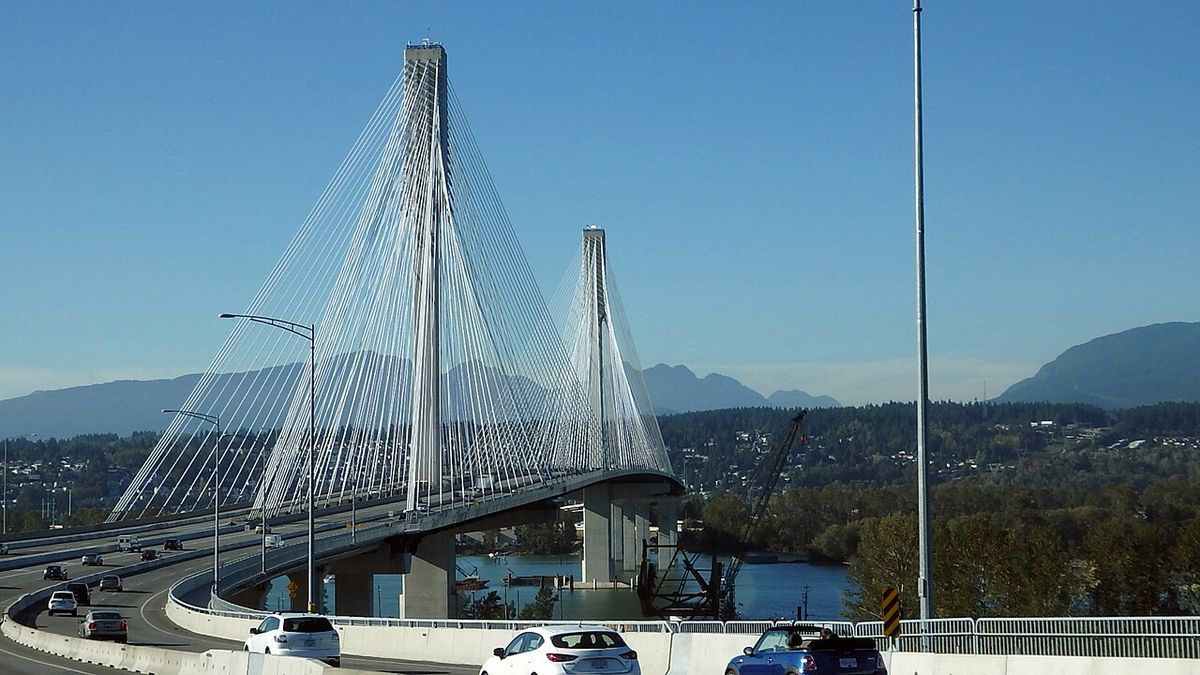
The project to replace the Port Mann Bridge was part of a larger 37 kilometre upgrade of Highway 1. Tendered in 2007, the design build contract was awarded to the Kiewit Flatiron General Partnership, with bridge design led by T.Y. Lin International in collaboration with International Bridge Technologies. The total estimated construction cost for the entire highway and bridge project was $2.46 billion, with the bridge itself accounting for roughly $820 million. The project was originally intended to be a public private partnership with the Connect B.C. Development Group, a consortium including the Macquarie Group, Transtoll Inc., Peter Kiewit Sons Co., and Flatiron Constructors, but after a memorandum of understanding, final terms could not be agreed upon and the province decided to fund the entire cost. Construction of the cable stayed bridge used the balanced cantilever method, erecting steel segments outward from the two main towers until they met over the river. The main span between the towers is 470 metres long, making it the second longest cable stayed span in the western hemisphere. The bridge incorporates 288 stay cables anchored to two towers that rise 163 metres from their footings, with the towers themselves approximately 75 metres tall above the deck level. The north and south main span superstructure consists of steel field sections, pre-cast deck panels and the stay cables, while the approach spans use a span-by-span method with pre-cast segment decks.
The fabrication and supply of the complex structural steel was a major undertaking. Canron Western Constructors LP was awarded the contract in 2009, fabricating components across its plants in Annacis, Delta, and Portland, which represented over 240,000 shop hours of work. Key challenges included manufacturing 272 unique cable stay anchor units, each slightly different due to the bridge's camber and varying slopes, and eight massive edge girders, each 24 metres long and weighing 110 tonnes. The welding on these fracture critical girders required an elaborate preheat system to control cool down and adhered to stringent American welding code A01.5. The scope of steelwork involved significant quantities, as detailed below.
- Main edge girders: 4 units
- Floor beams: 394 units
- Cable stay anchors: 272 units
- Median struts: 62 units
- Top flange bracing: 432 units
- Temporary bracing: 780 units
The new bridge opened to eastbound traffic on September 18, 2012. At 65 metres wide, it immediately claimed a Guinness World Record as the world's widest long span bridge, a title previously held by the 49 metre wide Sydney Harbour Bridge since 1932. The record was surpassed in 2013 by the 78.74 metre wide eastern span replacement of the San Francisco Oakland Bay Bridge. The main bridge section between the cable anchorages is 850 metres long, and the entire structure was built with future provision for a light rapid transit line. The project also required the complete redesign of the complex Cape Horn Interchange at the west end of the bridge to simplify traffic patterns and improve safety.
Features and Post Construction Issues
The new Port Mann Bridge is 2.02 kilometres long and maintains the same 42 metre river clearance as its predecessor. In addition to its ten traffic lanes, it includes a dedicated multi use pathway for cyclists and pedestrians that opened on July 1, 2015. The bridge was also designed with future provisions for a light rail transit line. The project reintroduced express bus service across the Fraser River for the first time in over twenty years, operating in the high occupancy vehicle lanes from Langley to Burnaby, though critics noted this service was delayed relative to the bridge opening. During construction, a significant incident occurred on February 10, 2012, when an overhead gantry crane collapsed, dropping a 90 tonne concrete box girder segment into the river and causing a delay, though no injuries were reported and WorkSafeBC conducted a safety evaluation. After opening, the bridge faced operational challenges, most notably in December 2012 when cold weather caused ice to accumulate on the stay cables. Chunks of ice, dubbed ice bombs, fell onto the deck, resulting in 60 vehicle damage claims reported by ICBC and one injury requiring an ambulance, prompting the RCMP to close the bridge between 1:30 p.m. and 6 p.m. while engineers investigated. In response, the government installed removable collars on the cables that are manually released to shed snow and ice buildup when conditions are expected, though similar slush bomb incidents occurred again in December 2016, leading to further closures due to the threat of falling snow and ice.
Tolling System and Subsequent Removal
To help recover construction and operating costs, the new Port Mann Bridge was electronically tolled from its opening until 2017. The tolling was managed by the Transportation Investment Corporation, a public Crown corporation. Toll rates increased over time, reaching $3.15 for cars, $1.60 for motorcycles, $6.30 for small trucks, and $9.45 for large trucks by August 15, 2015. The system used radio frequency identification decals or licence plate photography for collection, with a $2.30 per trip processing fee added for unregistered users who did not pay within seven days. Monthly passes for unlimited crossings were available, and accounts could be set up for online payment which provided an RFID decal for the windshield or headlight to avoid processing fees. The TI Corp forecasted that revenue would grow by 85 percent between the 2014 and 2017 fiscal years through a combination of increased rates and higher traffic volumes. Enforcement mechanisms were strict. British Columbia licensed drivers with over $25 in unpaid tolls after 90 days faced a $20 penalty and an inability to renew vehicle insurance or driver's permits. Out of province drivers were pursued for payment by a United States based contractor. However, on September 1, 2017, Premier John Horgan's government eliminated all tolls on the bridge. The toll equipment remained in place, and the province assumed the debt service costs, estimated at $135 million per year. Tolls had originally been projected to remain until approximately 2050 or until $3.3 billion was collected.
Traffic Performance and Demolition of the Original Bridge
The removal of tolls coincided with the bridge's status as a critical and heavily used corridor. In 2025, it carried an average of 179,435 vehicles per day, solidifying its position as Canada's busiest bridge and effectively doubling the capacity of the original five lane structure. Following the opening of the new bridge, the meticulous process of dismantling the original 1964 structure began in December 2012. The demolition used a reverse construction method, removing pieces in the opposite order of their assembly, starting with the road deck, then the approach girders, and concluding with the steel arch. The work was fully completed by October 21, 2015. The project incorporated significant sustainability measures, ensuring that materials from the old bridge were extensively recycled. All concrete removed from the site was reprocessed, and approximately 9,000 tonnes of steel from the demolition were recycled, with the salvaged materials valued at over CA$3 million.
Comprehensive Project Partners and Design Scope
The Port Mann Bridge and Highway 1 improvement project was a collaboration between numerous public and private entities spanning design, construction, and environmental management. The owner was the Transportation Investment Corporation, a provincial Crown corporation. The design builder was the Kiewit Flatiron General Partnership, a joint venture of Peter Kiewit Sons Co. and Flatiron Constructors. Highway and civil design was handled by the H5M joint venture of Hatch Mott McDonald and Marshall Macklin Monaghan, while the cable stayed bridge's primary design was led by T.Y. Lin International with International Bridge Technologies. Steel fabrication was a shared effort between Canron Western Constructors in Vancouver and Oregon Iron Works in Clackamas, Oregon. Consulting firm WSP, in a joint venture, was responsible for onshore design elements including transportation planning, construction review, and certification. Their role extended to managing the complete redesign of the complex Cape Horn Interchange at the bridge's west end to improve safety and traffic flow. WSP also applied detailed methods to assess air quality and human health risks for environmental assessments, engaged in public consultation with regulatory agencies, and provided air quality management services during construction to mitigate impacts. During project construction, WSP was further entrusted with construction management services and technical resources, managing the full spectrum of construction contract administration and field services activities until completion.
Technical Specifications and Design Details
The Port Mann Bridge is defined by a set of precise technical specifications that demonstrate its scale and engineering complexity. The total length of the bridge is 2.02 kilometres, with a main cable stayed span of 850 metres between the ends of the cable systems. The towers stand approximately 75 metres above the deck, contributing to a total structure height of about 163 metres from the top of the footing. The main navigational span between the two towers measures 470 metres. The bridge deck provides a clearance of 42 metres above the high water level of the Fraser River. Its width of 65 metres accommodated ten traffic lanes, bicycle and pedestrian pathways, and space reserved for future light rail. The balanced cantilever construction method involved building out symmetrically from each tower using steel field sections, pre cast deck panels, and the 288 stay cables until the two halves met at the centre. The north and south approach spans were built using a span by span method with pre cast segment decks. The project also included the upgrade of 23 miles of Highway 1 on each side of the river, integrating the new bridge into the wider transportation network. The bridge's design includes 144 cable stays extending from each of the two 535 foot tall towers, and the superstructure incorporates additional components such as sidewalk framing, wind fairings, and damper units.
Environmental and Community Considerations
The Port Mann Bridge project involved extensive environmental and community impact assessments as part of the planning and construction process. The consulting firm WSP applied state of the science methods to assess potential air quality and human health risk impacts in support of the required environmental assessments for the project. During and after these environmental assessments, the project team engaged and consulted with the public and regulatory agencies to address comments and concerns regarding the project's broader effects. A specific focus was placed on managing air quality during construction. WSP was contracted to provide air quality management services to ensure air emissions were being mitigated and managed to minimize air quality and human health impacts for nearby communities and workers. This comprehensive approach to environmental management was part of a wider trend in infrastructure projects to address sustainability and community health. The project's sustainability efforts extended to material reuse, with all concrete from the demolition site reprocessed and the 9,000 tonnes of steel recycled. These measures were implemented alongside the primary goal of improving traffic flow and safety on a highway segment that had been a major regional constraint.
Questions about Port Mann Bridge
When did the new Port Mann Bridge open?
The new Port Mann Bridge opened to eastbound traffic on September 18, 2012. It was opened as part of the broader Gateway Program to upgrade Highway 1 and replace the aging 1964 bridge. The full ten lane capacity and associated highway improvements were completed in the following years. The dedicated multi use pathway for cyclists and pedestrians opened later, on July 1, 2015.
Is the Port Mann Bridge still tolled?
No, tolls on the Port Mann Bridge were removed on September 1, 2017, by the government of Premier John Horgan. The bridge had been electronically tolled since its 2012 opening to help recover costs. Following the toll removal, the province of British Columbia assumed the debt service costs, estimated at $135 million annually. The physical toll gantries and equipment, however, remained in place as of 2026.
What records does the Port Mann Bridge hold?
Upon its completion in 2012, the Port Mann Bridge was awarded a Guinness World Record as the world's widest long span bridge, measuring 65 metres at its widest point. This record was broken in 2013. The bridge also features the second longest cable stayed span in the western hemisphere, at 470 metres. As of 2025, it holds the distinction of being the busiest bridge in Canada, with an average of 179,435 vehicle crossings per day.
What happened to the steel from the old bridge?
The demolition of the original 1964 Port Mann Bridge included a major recycling effort. Approximately 9,000 tonnes of steel from the old structure were recycled, with the salvaged materials valued at over CA$3 million. All concrete removed from the demolition site was also reprocessed. The dismantling process, which took nearly three years, was completed by October 21, 2015.
Why was the old Port Mann Bridge replaced?
The old Port Mann Bridge was replaced primarily to address severe traffic congestion and structural safety concerns. The original five lane bridge, handling 127,000 daily trips, was a major bottleneck. Although it was in excellent physical shape, it was a fracture critical structure, meaning a single undetected fatigue crack in a key tension member could cause catastrophic failure. The British Columbia Ministry of Transportation's Gateway Program proposed a wider replacement to double capacity. The new ten lane cable stayed bridge provides greater structural redundancy and was intended to ease congestion on this vital section of the Trans Canada Highway.
How much did the Port Mann Bridge project cost?
The total estimated construction cost for the Port Mann Bridge and the associated 37 kilometre Highway 1 upgrade was $2.46 billion. Of this total, the bridge structure itself accounted for approximately $820 million. When including long term operation and maintenance costs, the total projected project cost was $3.3 billion. This sum was also the revenue target for the bridge's original tolling system, which was intended to recover costs. The project was initially planned as a public private partnership but was ultimately funded entirely by the province of British Columbia after final terms with a private consortium could not be agreed upon.
Sources and further reading
- Port Mann Bridge (Wikipedia)
- Port Mann Bridge (fdcorp.com)
- Port Mann Bridge, WSP (wsp.com)
- Port Mann Bridge, CISC-ICCA (cisc-icca.ca)
Checked by the Your Space Hamilton desk. Last updated 2026-10-28.