Kin-Ball
Kin-Ball is a modern team sport invented in Quebec, Canada, in 1986 by physical education professor Mario Demers. The sport is distinguished by its use of a large, lightweight ball approximately 1.2 metres in diameter and its unique format where three teams of four players compete simultaneously on a single court. With an estimated 3.8 million participants worldwide, Kin-Ball is recognized for its strong emphasis on inclusion, cooperation, and fair play, making it popular in school programs and community clubs across Canada and internationally. The sport is governed globally by the International Kin-Ball Federation, which organizes world championships and promotes its growth.
Origins and Development
The sport of Kin-Ball originated in the mid-1980s in Quebec, where physical education students sought to create a new activity to address fitness, coordination, and social engagement. The inspiration came from observing giant, lightweight balls at a rock concert, which led to the development of various exercises. In 1986, Mario Demers, a physical education professor, formalized these ideas into the team sport known today. The foundational principles from the outset included nonviolence, equality among players, and consistent fair play, values later enshrined in a formal sportsmanship charter. The sport was first introduced as an extracurricular activity in Quebec schools, leading to a rapid increase in participating schools by 1991.
To systematically promote and market the sport, the inventors founded OMNIKIN Inc. in 1987. This was followed by the establishment of the Kin-Ball Association of the Province of Quebec in 1992, which gained official recognition from the province's Ministry of Recreation and Sports in 1993. A significant milestone in the sport's globalization was reached in 2000 with the founding of both a Canadian national association and the International Kin-Ball Federation. These bodies were created to organize the sport nationally and globally, including the coordination of world championship tournaments. The sport's inclusive philosophy has been key to its adoption in schools, clubs, and community groups across Canada and beyond.
Gameplay and Rules
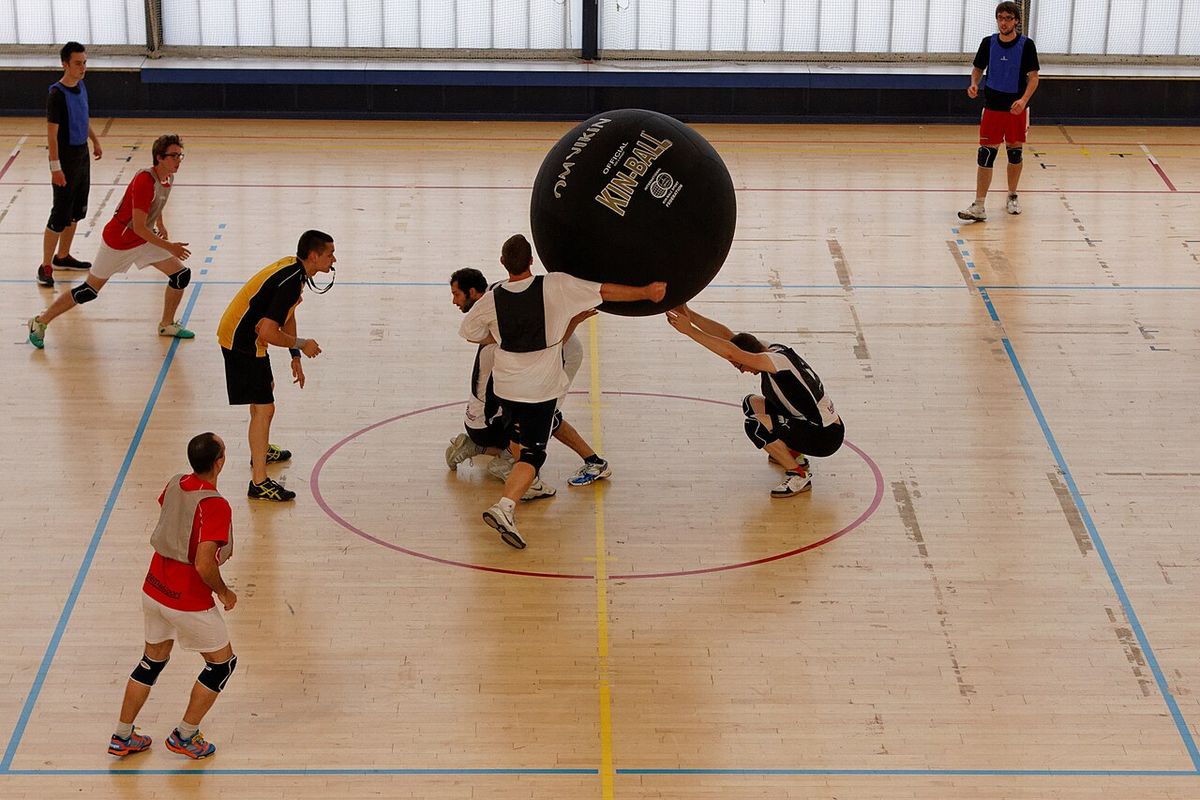
A Kin-Ball match is played on a square court measuring 20 by 20 metres, with the court lines included in this measurement. Three teams compete simultaneously, each consisting of four players and distinguished by the official colours of black, grey, and blue, though pink is sometimes used instead of blue. The primary equipment is a lightweight ball, 1.2 metres in diameter and weighing one kilogram. The team in possession of the ball is the attacking team, which must initiate a play by designating a defending team. This is done by a player calling out "Omnikin!" followed by the colour of one of the opposing teams, such as "Bleu," "Gris," or "Noir." After the designation, the ball must be struck with a body part above the hips while all other members of the attacking team maintain some contact with the ball.
The designated defending team must successfully control the ball before it touches the ground to become the new attacking team. If the ball hits the ground, the attacking team and the third, non-designated team each receive one point, while the team that failed the reception must execute the next attack. A common strategic rule requires teams to always attack the team with the highest score, which helps balance performance differences and keeps all teams actively involved. Matches are organized into periods, each typically lasting about 7 to 10 minutes, and are often played until one team reaches a defined score, such as 11 points. The overall match winner is the team that wins the majority of periods, usually requiring three period victories.
The rules include several specific fouls that maintain fairness and safety. Key fouls include failing to catch the ball before it touches the ground, hitting the ball out of bounds, or a player stepping out of bounds while touching it. Other infractions are walking with the ball after the third player's touch, hitting the ball with a downward trajectory, or hitting it a distance of less than 1.8 metres. Procedural fouls involve mistakes during the colour announcement, such as calling the wrong colour or having more than one player speak. Defensive fouls include having more than one player within 1.8 metres of the hitter or intentionally interfering with a defending player. Whenever a foul is committed, the other two teams each receive one point, a system designed to keep lower-skilled teams competitive if they avoid consecutive fouls.
Core Values and Inclusivity
Kin-Ball is fundamentally designed as an inclusive and cooperative sport, with rules engineered to prevent any single player from dominating the game. Teams can be mixed, comprising women and men, different age groups, and athletes of varying skill levels from recreational to competitive. The rules ensure all participants receive comparable playing time, reinforcing the sport's social nature. The principles of nonviolence, player equality, and fair play are not just encouraged but are formally integrated into the sport's rulebook and a dedicated charter on sportsmanship. This philosophical framework makes Kin-Ball particularly attractive for school physical education programs, community clubs, and inclusive group activities.
The role of the referee extends beyond enforcing technical rules to actively promoting fairness, cooperation, and respectful behaviour among all participants. Referees are empowered to impose graduated sanctions for rule violations or breaches of sportsmanship, which can escalate to the disqualification of an entire team. At larger tournaments, referees are supported by additional officials such as line judges, timekeepers, and scorekeepers to ensure a structured and transparent game flow. This officiating structure supports the sport's commitment to creating a positive and equitable environment for every player, regardless of their background or ability.
Global Expansion and Federation
Since its invention, Kin-Ball has expanded significantly beyond its Canadian origins. The International Kin-Ball Federation, founded in 2000, reports an estimated 3.8 million participants worldwide. The sport is particularly established in Canada, the United States, Japan, and across Europe in countries including Belgium, France, Switzerland, Spain, Germany, Denmark, and the Czech Republic. It has also gained footholds in Malaysia, China, and Hong Kong. The United Kingdom saw the formation of its national federation, Kin-Ball UK, in 2018, marking it as one of the newer member nations. Each country typically has a national federation that coordinates local clubs, tournaments, and development programs.
International competition is a key driver of the sport's growth. The International Kin-Ball Federation organizes world championships for men and women. European competitions are also well-established, with the 2026 European Championship scheduled to be held in Erfurt, Germany, featuring matches such as Belgium versus Spain versus the Czech Republic. National tournaments remain active, such as the Open National tournament held in Quebec in 2025/2026. Development initiatives continue, as seen with events like the 2026 Kin-Ball Bootcamp in Canada, led by national team coaches in collaboration with Kin-Ball Canada, aimed at training new players and coaches. The sport was introduced to a German audience at the 2004 German Gymnastics Festival, a Saarland delegation competed in a 2005 World Championship, and the German Kin-Ball Association was established in 2019.
- 1987: OMNIKIN Inc. founded to market the sport.
- 1992: Kin-Ball Association of the Province of Quebec established.
- 1993: Sport recognized by Quebec's Ministry of Recreation and Sports.
- 2000: International Kin-Ball Federation founded.
- 2004: Kin-Ball presented at the German Gymnastics Festival.
- 2008: European Championship held in Saarlouis, Germany.
- 2018: Kin-Ball UK formed.
- 2019: German Kin-Ball Association (DKBV) established.
Kin-Ball in Canada
As the birthplace of the sport, Canada remains a central hub for Kin-Ball activity and development. The sport is deeply integrated into physical education curricula and extracurricular programs in Quebec and has spread to other provinces. Kin-Ball Canada, the national governing body, works to promote the sport nationwide, organizing national tournaments, training coaches, and supporting club development. Local clubs are active in many communities, such as Kin-Ball Toronto, which hosts regular events and fundays, like one scheduled for June 29, 2026, at the Can Sports Center. Another session was held on September 22, 2026, at the Ark Christian Community Church in Markham, Ontario.
Canadian teams are consistently competitive on the international stage, and Canadian coaches are often involved in global development initiatives. The upcoming 2026 Kin-Ball Bootcamp, led by Canadian national team coaches, exemplifies this role in sharing expertise. Kin-Ball also aligns with broader Canadian community and charitable initiatives, such as the Kin Games Cause Challenge run in partnership with motionball, a national non-profit that empowers young Canadians to be community leaders by raising funds and awareness. This connection highlights how the sport's values of inclusion and cooperation extend beyond the court into community engagement and support for charitable causes.
Competitive Structure and Events
Kin-Ball features a range of competitions from local to international levels. The game can be adapted from a simple introductory activity to a highly dynamic, performance-oriented format, utilizing various hitting techniques, blocks, and feints. Higher-level competitions often employ rule variations such as "critical scores." In this format, when the first team reaches a set score like 9 points in a period, the team with the fewest points leaves the court, and the remaining two teams play until one reaches a higher target, such as 11 points, to win the period. This mechanism ensures continuous engagement and strategic depth during matches. Major international events are important for the sport's profile and athlete development, providing structured competition for players at all skill levels. The following table outlines recent and upcoming key tournaments that form part of the Kin-Ball calendar. These events include national opens, continental championships, and developmental camps that help to structure the competitive year for athletes and federations.
| Event | Year | Location / Notes |
|---|---|---|
| Open National Tournament | 2025/2026 | Quebec, Canada |
| Kin-Ball European Championship | 2026 | Erfurt, Germany |
| Kin-Ball Bootcamp | 2026 | Led by Canadian team coaches |
| European Cup | 2026 | Referenced in promotional material |
| Kin-Ball Funday (Toronto) | June 29, 2026 | Can Sports Center |
| Club Session (Toronto) | September 22, 2026 | Ark Christian Community Church, Markham, ON |
These events, from local club fundays to continental championships, provide competitive pathways for athletes and help to build a strong, interconnected global Kin-Ball community. Local events include a Kin-Ball Funday in Toronto scheduled for June 29, 2026. The streaming of events like the 2026 European Championship also makes the sport more accessible to a wider audience, supporting its continued expansion and visibility around the world. The International Kin-Ball Federation counts millions of participants in many countries, and these tournaments help engage this community. The sport's growth is further supported by national federations, such as Kin-Ball UK which formed in 2018.
Questions about Kin-Ball
Who invented Kin-Ball and when?
Kin-Ball was invented in 1986 by Mario Demers, a physical education professor from Quebec, Canada. The development began when Demers and his students were inspired by giant, lightweight balls seen at a rock concert. They created various exercises which were formalized into the team sport in 1986. The sport was designed to address physical fitness, coordination, and social engagement, with core values of inclusion and fair play established from the beginning.
How many teams play in a Kin-Ball game?
A unique feature of Kin-Ball is that three teams compete simultaneously in a single game. Each team consists of four players, for a total of twelve active players on the court at one time. Teams are identified by the official colours of black, grey, and blue, though pink is sometimes substituted for blue. This three-team format is central to the sport's strategy and its emphasis on constant engagement and teamwork among all participants.
What are the basic rules of Kin-Ball?
The attacking team starts a play by calling "Omnikin!" followed by the colour of an opposing team, then hitting the ball while all four teammates touch it. The designated team must catch the ball before it touches the ground. If they fail, the other two teams each score a point. Games are played in periods, often to 11 points or for a set time, with the match won by the team that wins the most periods. Common fouls include hitting the ball downward, not hitting it far enough, or making an error in the colour call.
Why is Kin-Ball considered an inclusive sport?
Kin-Ball is considered highly inclusive because its rules are designed to ensure equal participation. Teams can be mixed gender and mixed ability, and the gameplay mechanics prevent any single star player from dominating. The scoring system, where fouls award points to the other two teams, helps keep less skilled teams competitive. The sport's official charter enshrines values of nonviolence, equality, and fair play, making it suitable for schools, community groups, and players of all ages and skill levels.
Where is Kin-Ball popular outside of Canada?
Kin-Ball has a significant international presence, with an estimated 3.8 million participants globally. It is well-established in the United States, Japan, and many European nations including Belgium, France, Switzerland, Spain, Germany, Denmark, and the Czech Republic. The sport is also played in Malaysia, China, and Hong Kong. The United Kingdom is a newer member, with Kin-Ball UK forming in 2018. National federations in these countries organize local clubs and compete in events like the European Championship.
What major Kin-Ball events are happening in 2026?
Several significant Kin-Ball events are scheduled for 2026. The Kin-Ball European Championship will be held in Erfurt, Germany. A Kin-Ball Bootcamp, led by coaches from the Canadian national teams in collaboration with Kin-Ball Canada, is also planned for 2026. Local clubs like Kin-Ball Toronto have events scheduled, including a Funday on June 29, 2026, and a session on September 22, 2026, in Markham, Ontario. These events highlight the sport's ongoing growth and community activity.
Sources and further reading
- Kin-Ball (Wikipedia)
- KIN BALL European Cup 2026 - Kinball (kinball-euro2026.de)
Checked by the Your Space Hamilton desk. Last updated 2026-10-30.