Guelph
Guelph is a city in Southwestern Ontario, Canada, with a population of 143,740 as of the 2021 census. Known as The Royal City, it serves as the seat of Wellington County but operates as a politically independent municipality. Founded in 1827 by Scottish author and Canada Company superintendent John Galt, Guelph is a major educational and manufacturing centre, home to the University of Guelph and global firms like Linamar. Strategically located at the intersection of Highways 6 and 7, the city is roughly 22 kilometres east of Kitchener and 70 kilometres west of downtown Toronto.
History and Founding
The land that became Guelph was inhabited by First Nations peoples for thousands of years prior to European settlement, with the Attawandaron, or Neutral Nation, maintaining a community in the area. According to the University of Guelph, a First Nations community of about 4,000 people lived in a village near what is now the Badenoch area of Puslinch. In 1784, the British Crown purchased the tract, including present-day Guelph, from the Mississauga people for approximately £1,180. The modern city was founded on April 23, 1827, by John Galt, the first superintendent of the Canada Company, as a planned headquarters for the firm's colonization efforts in Upper Canada. Galt felled a tree in a ceremonial act with associate William 'Tiger' Dunlop to mark the town's establishment on St. George's Day, the feast day of England's patron saint.
Galt designed the street plan with a radial grid system branching from the downtown core, intending to create a European-style city centre with squares, broad main streets and narrow side streets to attract settlers to the surrounding Huron Tract. He named the settlement Guelph, derived via the Italian Guelfo from the Bavarian German Welf, to honour the House of Welf ancestry of the reigning British monarch, King George IV, which earned the city its enduring nickname. The Canada Company directors had wanted to name the settlement Goderich but reluctantly accepted Galt's choice. Early construction included The Priory, built in 1827 to 1828 on the Speed River banks to house up to 100 settlers and serve as the Canada Company office. Its site is near the current River Run Centre.
By the fall of 1827, 70 houses had been built, the first police constable was hired, and the first Guelph Farmers' Market was established in a Market House downtown. The first Board of Commerce also started in 1827 to stimulate economic growth. It was renamed the Board of Trade in 1866 and became the Chamber of Commerce in 1919. The community's early economy was bolstered by a grist mill built by the Canada Company to eliminate the need for farmers to take grain to Galt or Dundas, which was sold to William Allen in 1832. A sawmill was erected in 1833 by Charles Julius Mickle on Marden Creek. Its ruin survives today. Despite initial growth, Galt was dismissed by the Canada Company in 1829 for poor bookkeeping and not obeying policies, and the village's economy struggled until an influx of wealthy immigrants from England and Ireland arrived in 1832. By 1846, the town had a population of 1,240, a stone jail and court house, five churches, 15 stores, seven taverns, and industries including tanneries, breweries, and a starch factory.
- April 23, 1827: Ceremonial founding by John Galt and William Dunlop.
- 1827: Construction of The Priory begins. First police constable hired. First Farmers' Market built.
- 1829: John Galt dismissed by the Canada Company.
- 1832: Wealthy immigrants from England and Ireland arrive, providing economic relief.
- 1833: Charles Julius Mickle erects a sawmill on Marden Creek.
- 1846: Town population reaches 1,240 with established commerce and industry.
- 1855: Guelph is incorporated as a town. John Smith elected first mayor.
- 1856: Grand Trunk Railway arrives. Old City Hall is built.
Guelph was incorporated as a town in 1855, with John Smith elected as its first mayor. The arrival of the Grand Trunk Railway in 1856, en route to Sarnia, and soon thereafter the Great Western Railway branch from Harrisburg, spurred significant population growth. The Old City Hall, a stone building in the Italian Renaissance Revival style, was constructed in 1856 of local Guelph stone and contained a market house, offices and an assembly hall. It was modified in 1870, 1875 and 1961. Major industrial development in the 1800s included Allan's Mill, first established in 1830 on the Speed River and significantly expanded by the Allan family in the 1850s to include a distillery. It was damaged by fire in 1876. The Goldie Mill, a sawmill built in 1866 by James Goldie, replaced an earlier mill known as the Wellington Mill. Its limestone ruins, damaged by fire in 1953, are now part of Goldie Mill Park. The Guelph General Hospital was incorporated in 1861 with James Massie as chairman and opened its doors in 1875 at a cost of $9,869 with 12 beds, a small infectious room and a dispensary.
Municipal Incorporation and Late 19th Century Growth
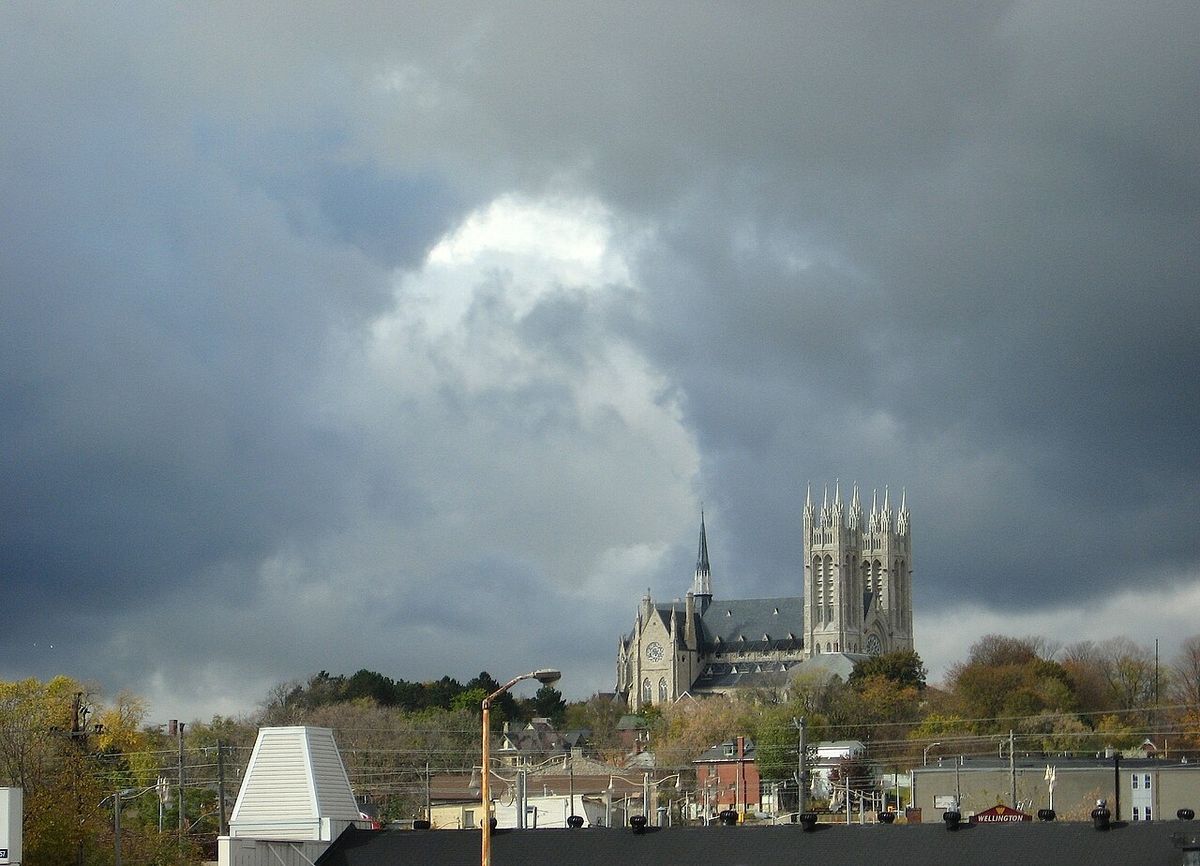
Guelph was incorporated as a city in 1879 with a Special Act of the Ontario legislature, politically separating from Wellington County at a time when its population was about 10,000. During the inauguration, Mayor George Howard first used the term Royal City. The only royal visit occurred when John Campbell, the Marquis of Lorne, and his wife, Princess Louise, Duchess of Argyll, a daughter of Queen Victoria, came to the city. Construction of the Church of Our Lady Immaculate, a Gothic Revival style Roman Catholic church on Norfolk Street, was underway at this time but would not be completed until 1883. Its twin towers were added in 1926, and it was designated a basilica in December 2014.
Transportation and utility infrastructure expanded rapidly in the late 19th century. George Sleeman Sr. founded the Guelph Railway Company, an electric radial railway that began with five miles of track by 1895 and was extended in 1902, eventually reaching Toronto as the Ontario Hydro Electric Railways, Guelph District. The railway carried passengers and coal to heat the Ontario Agricultural College. By 1886, telephones were common in private homes for ordering groceries, consulting doctors, and social communication, as described in an April news article of that year. An 1877 plan for a horse-drawn Guelph Street Railway never materialized.
Other institutions from this period include the Wellington County House of Industry and Refuge, a poor house with a farm that opened in December 1877 in a rural area near Guelph, which now houses the Wellington County Museum and Archives. The first section of the Wellington, Grey & Bruce Railway, between Guelph and Elora, opened in 1870, eventually running to Southampton with stations in Palmerston, Harriston, Listowel and Wingham, though it never reached its planned terminus of Owen Sound. The railway faced competition from the Northern Railway of Canada and the Toronto, Grey and Bruce Railway, entered financial trouble by the mid-1870s, and was later absorbed into the Grand Trunk and Canadian National systems. The Post Office was receiving mail daily by 1846, and the first police station opened in the town hall in 1856 before moving to the Annex building behind the court house in 1900.
20th Century Innovations and Modern Developments
The 20th century saw Guelph become a site of significant innovation and cultural development. The Communist Party of Canada began as an illegal organization in a barn behind a farmhouse on Metcalfe Street in Guelph in 1921. The city was home to North America's first cable TV system, created by Fredrick T. Metcalf for MacLean Hunter Television, which broadcast Queen Elizabeth's Coronation in 1953. Local inventions include the jockstrap, created in 1922 by the Guelph Elastic Hosiery Company, and five pin bowling, invented in 1909 by Guelph native Tom Ryan. The Yukon Gold potato was first bred at the University of Guelph in 1966 and became available on the market in 1981. Guelph's police force deployed Canada's first municipal motorcycle patrol, initiated by Chief Ted Lamb using an army motorcycle from the First World War.
Educational institutions expanded with the establishment of the University of Guelph in 1964 from the Ontario Agricultural College, the Ontario Veterinary College, and the Macdonald Institute. The city's covered bridge, built by the Timber Framers' Guild in 1992 using wooden pins, is one of only two of its type in Ontario and is now part of a walking trail. In 2017, Scientology Canada moved its Canadian headquarters to a facility at 40 Baker Street, a decision met with some resident protest. The Baker District redevelopment project, discussed since 2007 and finalized in 2018, plans to transform the Baker Street parking lot into a mixed-use development with a new library, commercial space, and underground parking at an estimated cost of $315 million to $369 million, with construction expected to start after 2023. Before construction, up to $7.5 million was allocated to acquire the required land.
Infrastructure and utility changes continued into the 21st century. In October 2018, the Ontario Energy Board approved the merger of Guelph Hydro and Alectra Utilities Corporation, completed in January 2019. The city received a 4.63 per cent stake in Alectra, a one-time dividend of $18.5 million, and one permanent seat on the company's board. Conservation work stabilized the historic Goldie Mill ruins between 2019 and 2021 to address sinkholes. In 2019, John Sleeman reinstated the Spring Mill Distillery on the site of the historic Allan's Mill, which also includes a condominium apartment complex. The city participates in annual events like the City Nature Challenge, scheduled for April 24 to 27, 2026, encouraging residents to document local biodiversity through iNaturalist observations.
Geography and Climate
Guelph is situated in Southwestern Ontario at the confluence of the Speed River and the Eramosa River, which merge southwest of downtown and eventually flow into the Grand River. The landscape is characterized by drumlins and numerous forested ravines created by creeks and smaller rivers, providing extensive areas for parks and recreational trails. A notable geographic feature is an underground creek flowing below the historic Albion Hotel, which was once a water source for brewing. Guelph is the largest Canadian city to rely almost entirely on groundwater for its municipal drinking supply, which is drawn from two main aquifers.
The city experiences a humid continental climate, classified as Dfb under the Köppen system, with cold winters and warm, humid summers. Its inland location and elevation generally make it a couple of degrees cooler than Great Lakes shoreline areas, particularly in winter, except on some spring afternoons when the lack of an onshore breeze can result in higher temperatures. The highest temperature ever recorded in Guelph was 38.3 °C on August 6, 1918, and July 13, 1936. The coldest temperature on record is -37.2 °C, measured on January 25, 1884. The region receives moderately high levels of both rainfall and snowfall throughout the year.
Economy and Employment
Guelph has maintained a diversified and resilient economy, historically recording some of Canada's lowest unemployment rates. In February 2016, the city's unemployment rate was 3.9 per cent, and by December 2018, Statistics Canada reported a rate of only 2.3 per cent. A December 2015 report by BMO senior economist Robert Kavcic noted Guelph had the best workforce participation rate in Canada at 72 per cent and the top job growth rate at over 9 per cent, rating it the best city in the country for job seekers at that time. The unemployment rate was 5.9 per cent in October 2017, compared to 5.1 per cent in Kitchener-Waterloo, and decreased to 4.5 per cent by June 2018.
The economy's diversity shields it from over-reliance on any single industry. Major sectors include advanced manufacturing, agri-food, technology, and education, anchored by the University of Guelph. The city is also home to Sleeman Breweries, and has a history of innovation including the invention of the jockstrap by the Guelph Elastic Hosiery Company in 1922. The 2017 crime severity index showed a 15 per cent increase from 2016, though for many years prior Guelph had ranked at or near the bottom of Canada's crime severity list. The city's economic planning includes the Baker District redevelopment, which involves a partnership with Ottawa-based Windmill Development Group and discussed additional partnerships with Conestoga College and the YMCA. The private enterprise partner for the project is Windmill Development Group, and the final cost was estimated at between $315 million and $369 million.
| Economic Indicator | Period | Rate or Figure |
|---|---|---|
| Unemployment Rate | February 2016 | 3.9% |
| Unemployment Rate | June 2018 | 4.5% |
| Unemployment Rate | October 2017 | 5.9% |
| Unemployment Rate | December 2018 | 2.3% |
| Workforce Participation Rate | December 2015 | 72% |
| Job Growth | December 2015 | Over 9% |
Municipal Government and the 2026 Election
Guelph operates with a mayor and council system, having been politically separate from Wellington County since its incorporation as a city in 1879. The role of the mayor, as head of council, is to preside over council meetings, represent the municipality at official events, and fulfill duties outlined in provincial legislation. According to the Association of Municipalities of Ontario, the head of council acts as the leader of the municipality. Councillors represent one of six wards and balance the dual responsibility of representing constituent interests with ensuring the long-term wellbeing of the municipality. The next municipal election is scheduled for Monday, October 26, 2026, with the nomination period for candidates running from May 1 to August 21, 2026. Advance voting will be available from October 10 to October 18, 2026.
As of June 24, 2026, 38 candidates had registered for the municipal and school board elections. The Guelph and District Labour Council conducted a non-partisan candidate survey, with questions from 17 local organizations put to every mayoral and councillor candidate, to provide voters with clarity on local issues. The goal of this initiative is civic transparency and accountability for the winning candidates' future term. GDLC president Nicole Clark stated the survey serves as a vital tool for ensuring the community can make an informed choice. Several candidate debates and town halls were scheduled throughout September and October 2026, including a mayoral town hall hosted by the Guelph Wellington Coalition for Social Justice on September 24, a debate hosted by the Guelph Chamber of Commerce on October 7, and various ward-specific debates for councillor candidates.
Voter engagement tools, such as the Guelph Healthy Democracy Toolkit, have been developed to improve voter turnout and participation. The toolkit provides a step-by-step process to help identify audiences and encourage greater participation in local elections. Additional resources include a guide from Open Council detailing municipal government responsibilities and the Alliance for a Liveable Ontario's roadmap of ten actions municipal governments can take. The election evaluation encompasses verified candidates from all six municipal wards as well as individuals running for the office of Mayor. For inquiries related to the 2026 election, the City Clerk's Office can be contacted at 519-837-5625. The website guelphelection.ca provides the most up-to-date candidate information.
- Nomination Period: May 1 to August 21, 2026.
- Advance Voting: October 10 to October 18, 2026.
- Election Day: October 26, 2026.
- Registered Candidates (as of June 24, 2026): 38.
- Number of Municipal Wards: 6.
- Key Voter Resource: Guelph Healthy Democracy Toolkit.
- Contact for Election Inquiries: City Clerk's Office, 519-837-5625.
Questions about Guelph
Why is Guelph called The Royal City?
Guelph earned the nickname The Royal City from its founding name, chosen by John Galt in 1827. The name Guelph is derived from the Bavarian German Welf, a reference to the House of Welf. This was intended to honour King George IV, the reigning British monarch at the time, whose Hanoverian family descended from the Welf lineage. The term was first used officially during the city's inauguration in 1879 by Mayor George Howard, though the only royal visitors were the Marquis of Lorne and Princess Louise.
What is the University of Guelph known for?
The University of Guelph is renowned for its strengths in agriculture, veterinary science, and environmental research. It was established in 1964 through the merger of three founding colleges: the Ontario Agricultural College (founded 1874), the Ontario Veterinary College (founded 1862), and the Macdonald Institute (founded 1903). The university's Ontario Agricultural College is particularly famous and was instrumental in breeding the Yukon Gold potato, which was first developed there in 1966 and released to the market in 1981. According to Maclean's, the university grew out of these three founding colleges.
What are the major industries in Guelph?
Guelph has a diversified economy with major industries including advanced manufacturing, agri-food, technology, and education. The city is home to global manufacturing firm Linamar, a significant employer. The presence of the University of Guelph also drives research and innovation, particularly in agricultural sciences. Historically, brewing has been important, with Sleeman Breweries based in the city and James Hodgert's brewery founded in 1827. This economic diversity has contributed to the city's historically low unemployment rates, which were 2.3 per cent in December 2018.
When is the next municipal election in Guelph?
The next municipal election in Guelph is scheduled for Monday, October 26, 2026. The nomination period for candidates runs from May 1 to August 21, 2026. Advance voting will be available from October 10 to October 18, 2026. As of June 24, 2026, 38 candidates had registered for the positions of mayor, councillor, and school board trustee. Several debates and town halls are scheduled for the campaign period, including events hosted by the Guelph Chamber of Commerce and various community groups.
What historic sites can be visited in Guelph?
Guelph features several National Historic Sites, including the Old City Hall, a stone building constructed in 1856 and designated in 1984. McCrae House, the birthplace of poet and physician John McCrae, is another historic site. The Basilica of Our Lady Immaculate, a Gothic Revival church completed in 1888 and designated a basilica in 2014, is also a key landmark. Visitors can see the ruins of the 1866 Goldie Mill in Goldie Mill Park, the former Canadian National Railways Station at 79 Carden Street listed in 1992, and a unique covered bridge built in 1992.
How does Guelph supply its drinking water?
Guelph is the largest city in Canada that relies almost entirely on groundwater for its municipal drinking water supply. The water is sourced from two main aquifers beneath the city. This reliance on groundwater is a distinctive feature of Guelph's geography and infrastructure, setting it apart from many other Canadian municipalities that use surface water from lakes or rivers. The city's location above the confluence of the Speed and Eramosa rivers contributes to the aquifer system.
Sources and further reading
- Guelph (Wikipedia)
- Municipal Election 2026 - Guelph & District Labour Council (guelphlabour.ca)
- Guelph 2026 election resources (getinvolvedguelph.ca)
Checked by the Your Space Hamilton desk. Last updated 2026-10-24.