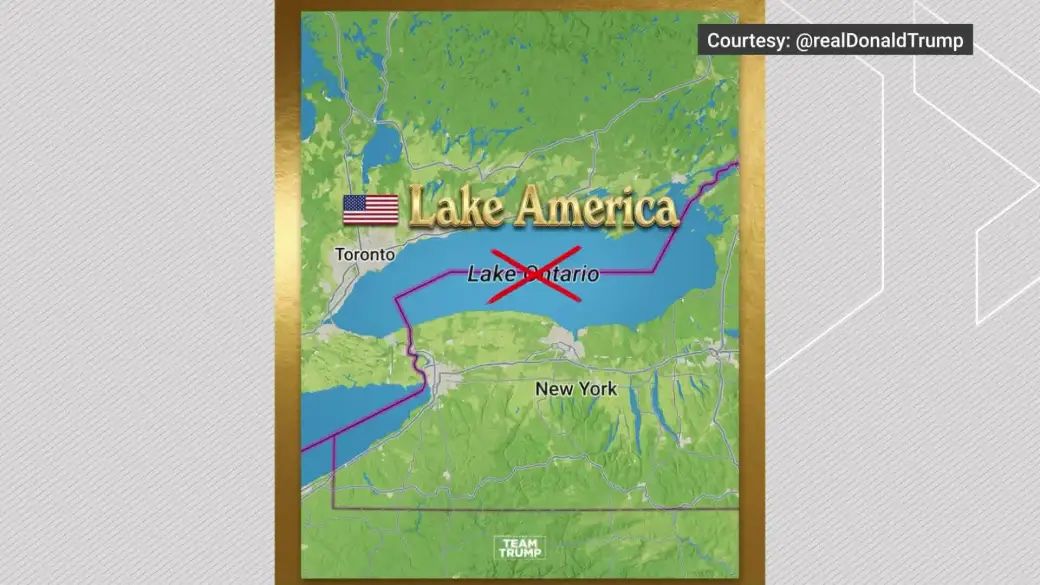
U.S. name change for Lake Ontario a distraction from real threats, expert says
A Great Lakes policy expert says the U.S. renaming of Lake Ontario to Lake America distracts from deregulation and funding cuts harming the shared waters.
U.S. President Donald Trump's order to rename Lake Ontario to Lake America is a distraction from policies harming the shared waters, a Canadian Great Lakes expert says.
Gail Krantzberg, a McMaster University professor and former director of the International Joint Commission's Great Lakes regional office, said the name change steers conversation away from environmental actions.
"There's all this conversation, but it steers the conversation away from what Trump is actually doing for Ontario and all the Great Lakes," Krantzberg said.
READ MORE: Space startups lobby Ottawa for funding as launch industry grows
READ MORE: McMaster professor Claudia Emerson wins Trailblazer Award for science policy work
She pointed to deregulation, including air emissions from coal-fired utilities that put more mercury into the lakes, and pushback on banning persistent chemicals like PFASs.
"These things will last in the Great Lakes for centuries, they basically do not break down," she said.
Krantzberg also highlighted cuts to monitoring, including a roughly 35 per cent reduction to the U.S. National Oceanic and Atmospheric Administration's Great Lakes Environmental Research Laboratory.
"You lose the capacity to monitor and understand the lakes, and if you can't understand the lakes, you can't protect the lakes," she said.
The executive order applies only to U.S. federal agencies and institutions, she said, noting that online maps like Google's now show Lake America in the U.S. and Lake Ontario in Canada.
"But frankly, it's the same body of water and it's governed the same way," Krantzberg said.
She said New York's governor, Canada's prime minister and Ontario's premier have all affirmed the lake's original name.
The lake's management is governed by the 1909 Boundary Waters Treaty and the Great Lakes Water Quality Agreement, first signed in 1972 and updated several times.
These agreements set the framework for co-operation between the two countries on issues like pollution, invasive species and climate change.
Krantzberg said no single country controls the massive lake, but actions on one side affect the other.
"What you can do is make it better or worse on your side of the border," she said. "And what we're worried about right now is that it's going to get worse on the U.S. side of the border, which means since the water goes all through the system, it will get worse on the Canadian side."
She characterized the name change as a political gesture.
"The name of the lake is only about how Trump and Ford don't like each other, and so Trump said, 'You know what, bully Mr. Ford. I'm not going to call it Ontario because I don't like Ontario, so I'm going to call it America,'" Krantzberg said. "That's all that that is."
She also raised concerns about restrictions on U.S. federal scientists sharing information at international gatherings, which she said hampers the coordinated monitoring essential for understanding climate change impacts on the lakes.
Lake Ontario's name dates back to the 17th century and comes from the Wendat word Ontarïio', meaning the lake is beautiful and great.
With files from The Narwhal