Painted turtle
The painted turtle (Chrysemys picta) is the most widespread native turtle in North America, ranging from southern Canada to northern Mexico. This resilient freshwater reptile is easily identified by its smooth, dark shell adorned with red, orange, and yellow markings on its skin and shell margins. In Canada, three subspecies are present: the Eastern, Midland, and Western painted turtles, each adapted to different regions from the Maritimes to British Columbia. While the global species is considered of Least Concern, habitat loss and road mortality pose significant threats to local populations, with the Western painted turtle listed as endangered within Canada.
Taxonomy and Evolution
The painted turtle belongs to the pond turtle family Emydidae and is one of two species in the genus Chrysemys. Its scientific name derives from the Greek for 'gold' (chryso) and 'freshwater tortoise' (emys), with the species name picta meaning 'coloured' in Latin. Taxonomists recognize three primary subspecies within Canada: the Eastern painted turtle (C. p. picta), the Midland painted turtle (C. p. marginata), and the Western painted turtle (C. p. bellii). A fourth group, the Southern painted turtle (C. dorsalis), was historically considered a subspecies but is now generally treated as a separate species. The evolutionary history of the painted turtle is rich, with the oldest fossils, found in Nebraska, dating back about 15 million years.
These subspecies are believed to have diverged during the last Ice Age, between 100,000 and 11,000 years ago, when painted turtles were divided into three different populations in glacial refugia: eastern turtles along the southeastern Atlantic coast, southern turtles around the Mississippi River, and western turtles in the southwestern United States. When glaciers retreated about 11,000 years ago, all three groups moved north. One theory suggested the midland subspecies originated as a hybrid between western and southern turtles in Missouri, but morphological evidence better supports it being a hybrid of the eastern and western subspecies. The subspecies intergrade (hybridize) where their ranges meet, creating border regions with intermediate turtles.
Taxonomic debate has long surrounded the painted turtle and its relatives. After 1952, some biologists combined the genera Chrysemys and Pseudemys due to similar appearance. In 1964, Samuel B. McDowell proposed merging Chrysemys, Pseudemys (cooters), and Trachemys (sliders) into one genus based on skull and foot measurements, but this was contradicted by further studies in 1967. That same year, paleontologist J. Alan Holman noted that although the three turtles often shared habitats and had similar mating patterns, they did not crossbreed. Studies in the 1980s on cell structures, biochemistry, and parasites further solidified that the three should remain in separate genera. The painted turtle's karyotype consists of 50 chromosomes, the same as its subfamily-mates and the most common number for Emydidae turtles.
Physical Description and Identification
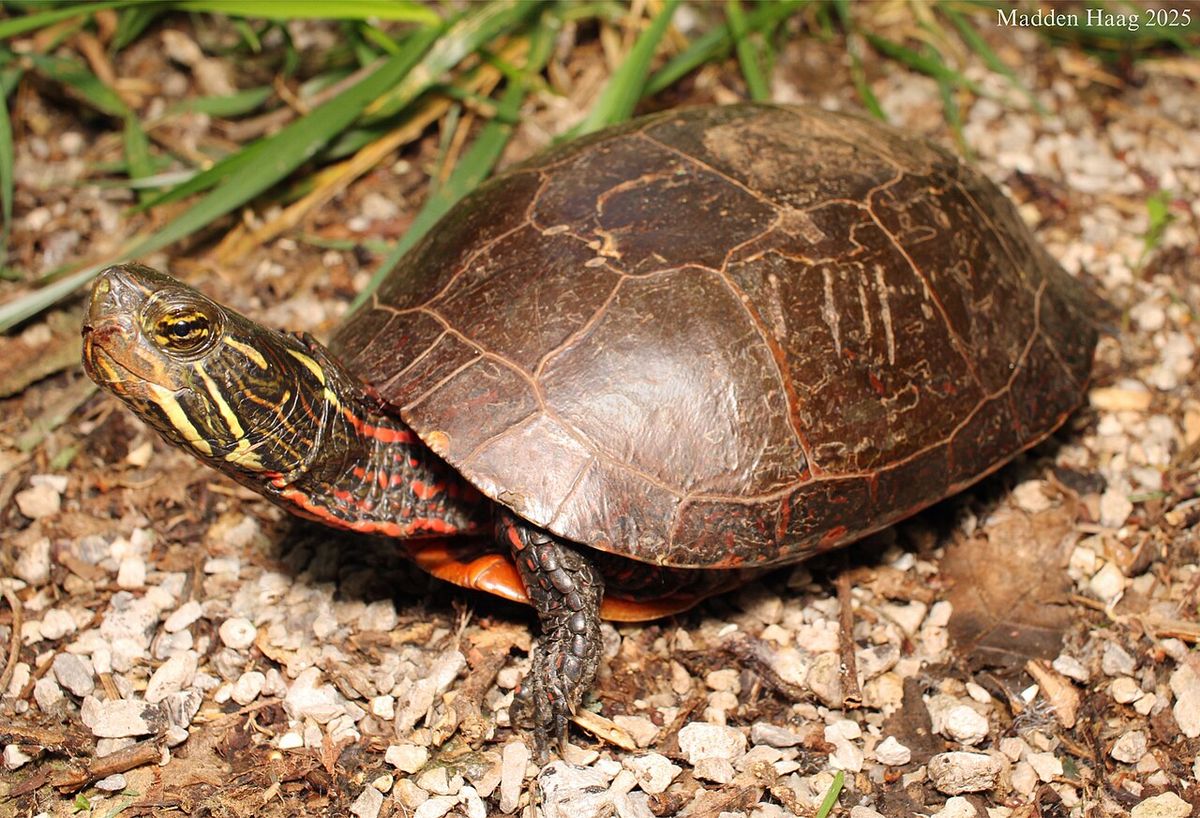
The painted turtle is a medium-sized reptile with a smooth, flat, and oval carapace (upper shell) that ranges in colour from olive to black, often darker in water bodies with dark bottoms. Its skin is olive to black with distinctive red, orange, or yellow stripes on its neck, legs, and tail. The plastron (lower shell) is typically yellow, sometimes red, sometimes with dark markings in the center. Adults measure between 13 and 25 centimetres in length, with females generally being larger and having a more rounded, higher-domed shell than males. The average weight for a female is around 500 grams, while males average roughly 300 grams, a difference that supports the female's egg-production. Males possess longer foreclaws and a longer, thicker tail, with the cloaca positioned further from the body. The head is distinctive, with yellow stripes, a large yellow spot and streak behind each eye, and two wide yellow stripes on the chin that meet at the jaw tip.
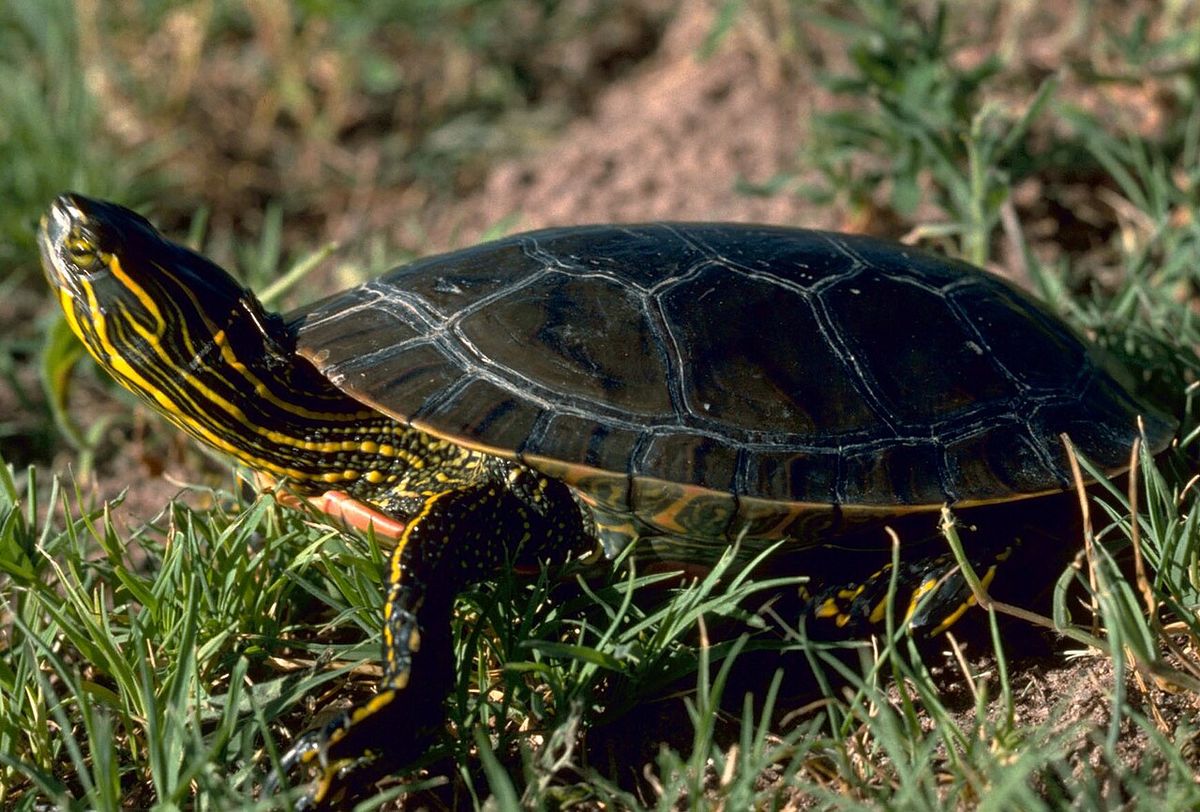
Each subspecies can be distinguished by specific shell characteristics. The Eastern painted turtle has scutes (shell segments) aligned in straight rows across its back, a feature unique among North American turtles. Its plastron is plain yellow or may have as few as one dark grey spot. The Midland painted turtle's plastron typically features a symmetrical dark 'butterfly' marking along the midline, which varies in size and prominence. The Western painted turtle is the largest subspecies, capable of growing to 26.6 cm, and often has a mesh-like pattern of light lines on its carapace and a large, colourful splotch on its plastron that extends to the edges. The species is often confused with the non-native red-eared slider, but the painted turtle is flatter and lacks the slider's prominent red ear marking and spotted plastron. Hatchlings have a proportionally larger head, eyes, and tail, and a more circular shell than adults.
- Eastern (C. p. picta): Straight-aligned carapace scutes. Plain yellow plastron. 13-17 cm long.
- Midland (C. p. marginata): Distinct dark symmetrical 'butterfly' marking on plastron. 10-25 cm long.
- Western (C. p. bellii): Largest subspecies (up to 26.6 cm). Red pattern on plastron. Mesh-like carapace lines. Often lacks a distinct dorsal stripe.
Distribution and Habitat in Canada
The painted turtle holds the distinction of being the most widespread native turtle in North America, with a native range extending from the Atlantic to the Pacific. It is native to eight of Canada's ten provinces, forty-five of the fifty United States, and one state in northern Mexico. Its range includes much of southern Canada, making it the northernmost native turtle on the continent. The species inhabits slow-moving freshwater bodies such as ponds, marshes, lakes, and slow-moving creeks that provide soft bottoms, abundant aquatic vegetation, and ample basking sites like logs, rocks, and shorelines. It shows a documented preference for large wetlands with long periods of inundation and emergent vegetation.
The three Canadian subspecies have distinct but sometimes overlapping ranges where they intergrade. The Eastern painted turtle ranges from southeastern Canada to Georgia, with a western boundary at approximately the Appalachians. In Canada, it lives in New Brunswick and Nova Scotia but is uncommon in far northern New Hampshire and in Maine is common only within about 50 miles of the coast. It is not found in Quebec, Prince Edward Island, or the coastal lowlands of the southeastern U.S. The Midland painted turtle lives from southern Ontario and Quebec, through the U.S. Midwest, to Kentucky, Tennessee, and northwestern Alabama. It is also found eastward through West Virginia, western Maryland, and Pennsylvania, and appears to be moving east, especially in Pennsylvania. In the northeast, it intergrades extensively with the eastern subspecies, sometimes forming a 'hybrid swarm'.
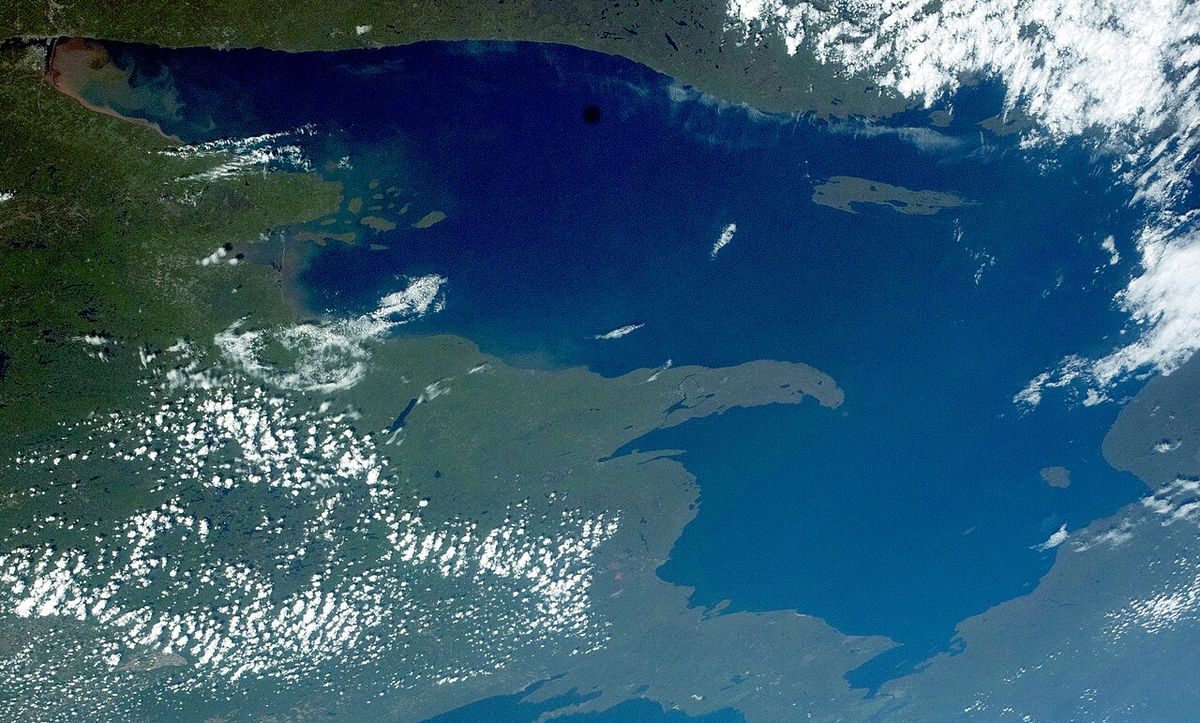
The Western painted turtle's northern range includes southern parts of western Canada from Ontario through Manitoba, Saskatchewan, Alberta, and British Columbia. In Ontario, this subspecies is found north of Minnesota and directly north of Lake Superior, but there is a significant 130 km (80 mi) gap to the east of Lake Superior, in an area of harsh winter climate, where no painted turtles of any subspecies occur, thus preventing intergradation with the midland subspecies in southeastern Ontario. In British Columbia, populations exist in the interior in the Kootenai, Columbia, Okanagan, and Thompson river valleys, and at the coast near the mouth of the Fraser River and on southern Vancouver Island. Its range within the province is not continuous and is better understood as northward extensions from the United States, with high mountains presenting barriers to movement.
Life History and Behaviour
Painted turtles are diurnal, relying completely on external warmth and spending hours basking on logs or rocks during the day to regulate their body temperature. They are omnivorous opportunistic feeders, consuming aquatic vegetation, algae, insects, snails, crustaceans, small fish, frogs, and carrion. They feed primarily while in water and are adept at locating and subduing prey even in heavily clouded conditions. Mating occurs in both spring and autumn. Females dig nests in sandy or loamy soil in sunny areas from late May to early July, laying clutches of 4 to 13 eggs. The temperature during incubation determines the sex of the offspring, a phenomenon known as temperature-dependent sex determination.
Hatchlings may emerge in the fall or overwinter in the nest, emerging the following spring. They possess a biological antifreeze in their blood that allows their tissues to tolerate freezing temperatures as low as -10°C, a critical adaptation for survival in Canadian winters. Adults brumate (a form of reptilian hibernation) during winter, usually buried in the mud at the bottom of water bodies. This species is specially adapted to tolerate freezing temperatures for extended periods due to this antifreeze-like substance. Growth to sexual maturity is slow and varies dramatically by latitude and sex. In northern populations, males may take 7 to 10 years to mature, while females can take 12 to 15 years. In more southern areas, maturity can be reached in as little as 2-9 years for males and 6-16 for females. This slow life history, combined with a potential lifespan of over 55 years, makes population recovery from losses a lengthy process. Adults are protected from most predators by their hard shells, but they are still preyed upon by animals such as foxes, raccoons, coyotes, and otters, while eggs and hatchlings are frequently consumed by rodents, canines, and snakes.
| Life Stage | Key Characteristic | Approximate Duration/Age | Notable Adaptation |
|---|---|---|---|
| Egg | Laid in sandy soil. Temperature determines sex | Incubation through summer | Vulnerable to nest predators |
| Hatchling | Proportionally large head and tail. Circular shell | Emerges in fall or spring | Antifreeze proteins allow survival to -10°C |
| Juvenile | Rapid growth. Highly vulnerable to predators | Up to sexual maturity | Webbed feet for swimming |
| Sexual Maturity (Male) | Longer foreclaws and tail develop. Cloaca further out | 2-10 years (7-10 in north) | Smaller size (7-15 cm) |
| Sexual Maturity (Female) | Larger body size and more rounded shell for egg production | 6-16 years (12-15 in north) | Larger size (10-25 cm). Avg. weight 500g |
| Adult | Omnivorous. Daily basking. Brumates in winter | Can live over 55 years | Hard shell protects from most predators |
Conservation Status and Threats
Globally, the painted turtle is listed as Least Concern by the International Union for Conservation of Nature, a status last confirmed in August 2010, due to its extensive range, overall abundance, and ability to live in human-disturbed settings. However, this status masks significant regional pressures, particularly in Canada. The Western painted turtle (C. p. bellii) is listed as endangered in Canada, facing serious threats within its limited and fragmented range in southern British Columbia where it requires specific wetland habitats. The Midland painted turtle is assessed as Special Concern under the federal Species at Risk Act as of 2021, though it was assessed as Not at Risk by the Committee on the Status of Species at Risk in Ontario in 2020 and has no status under the Ontario Endangered Species Act. In Ontario, it is designated as a Specially Protected Reptile under the Fish and Wildlife Conservation Act, which offers some protection to individuals and their habitat.
The primary threats across all populations are habitat loss, degradation, and fragmentation from urban development, agriculture, and drainage of wetlands. Road mortality is a severe and pervasive threat, especially to nesting females who often cross roads or use the soft shoulders of roads as nest sites. Nest predation by raccoons, foxes, and skunks is exacerbated in areas where human activity, such as waste availability, supports artificially high predator populations. The species' long lifespan and slow maturation mean that the loss of even a few adults each year has a disproportionately negative impact on population stability, as it takes many years for new individuals to replace them. In Alberta, the western subspecies may number only around 100 individuals, all found very near the U.S. border. Isolated populations reported further north in British Columbia and Alberta are likely the result of pet releases, not natural range.
Cultural Significance and Human Interaction
The painted turtle has held a place in human culture for centuries. In the traditional tales of Algonquian tribes, the colourful turtle often played the role of a trickster. In modern times, its striking appearance and widespread presence have led four U.S. states, Colorado, Illinois, Michigan, and Vermont, to name it their official state reptile. An alternate East Coast common name is 'skilpot', derived from the Dutch word for turtle, 'schildpad'. The turtle's adaptability has allowed it to persist as the most abundant turtle in North America even as habitat loss and road killings have reduced some populations. This frequent visibility, especially during spring and summer basking, makes it an excellent subject for public education and wildlife observation, as noted in a May 2026 educational video guide.
Human interaction is a double-edged sword for the species. While many people enjoy observing painted turtles in local ponds, they are sometimes mistakenly captured or confused with the non-native red-eared slider, a common pet turtle that is often irresponsibly released into the wild. Such introductions can compete with native turtles for resources. Public education initiatives, like the 2026 colouring sheets highlighting the endangered status of the Western subspecies and organized turtle-viewing events at nature centers, are important tools for fostering stewardship. Citizens are encouraged to watch for turtle crossing signs, protect nesting sites, and report sightings to conservation authorities to aid in monitoring efforts. The painted turtle's story is a compelling reminder of the resilience of wildlife and the ongoing need for habitat protection and mindful coexistence.
Questions about Painted turtle
Where can you find painted turtles in Canada?
Painted turtles are found in eight Canadian provinces: British Columbia, Alberta, Saskatchewan, Manitoba, Ontario, Quebec, New Brunswick, and Nova Scotia. They are absent from Newfoundland and Labrador and Prince Edward Island. They inhabit slow-moving freshwater bodies like ponds, marshes, and lakes with plenty of basking sites. In British Columbia, the Western painted turtle is the only native freshwater turtle, found in interior river valleys like the Kootenai and Okanagan, and coastal areas like southern Vancouver Island and the Fraser River delta. In Ontario, the midland subspecies is widespread, while the western subspecies is found north and west of Lake Superior.
How can you tell a painted turtle apart from a red-eared slider?
The painted turtle has a flatter, smoother carapace and lacks any prominent red marking on the side of its head. Its plastron is usually a plain yellow or has a dark central marking like a 'butterfly', but is not spotted. The red-eared slider, a common pet turtle often released into the wild, has a more domed shell, a distinctive red 'ear' patch behind each eye, and a spotted yellow plastron. The painted turtle's skin features red and yellow stripes, while the slider's patterning is different. The painted turtle's upper jaw is also shaped into an inverted 'V' (philtrum) with a downward-facing projection on each side.
How long do painted turtles live?
Painted turtles are remarkably long-lived reptiles. In the wild, they commonly live from 50 to 55 years, with some individuals documented living for more than 55 years. Their slow life history contributes to this longevity. Females in northern populations may take 12 to 15 years to reach sexual maturity, while males take 7 to 10 years. This extended period before reproduction means that populations are slow to recover from losses, and the survival of adult turtles is critical for maintaining stable numbers over decades.
How do painted turtles survive Canadian winters?
Painted turtles brumate, a form of reptilian hibernation, during winter. They typically bury themselves in the mud at the bottom of ponds or lakes, becoming inactive. They are one of the few turtle species specially adapted to tolerate freezing for extended periods. Both adults and hatchlings produce natural antifreeze-like proteins in their blood that prevent ice crystals from forming inside their cells, allowing them to survive body temperatures as low as -10°C while dormant. This adaptation is crucial for survival in the frozen mud of Canadian water bodies.
Are painted turtles endangered?
The painted turtle species as a whole is listed as Least Concern globally due to its wide distribution and abundance. However, conservation status varies significantly by subspecies and region within Canada. The Western painted turtle (Chrysemys picta bellii) is listed as endangered in Canada, facing serious threats in its fragmented British Columbia range. The Midland painted turtle is listed as Special Concern under the federal Species at Risk Act as of 2021. Primary threats everywhere include habitat loss and fragmentation, road mortality (especially of nesting females), and increased nest predation from animals like raccoons whose numbers are boosted by human activity.
What do painted turtles eat?
Painted turtles are omnivorous and opportunistic feeders. Their diet consists of a mix of aquatic vegetation and algae, as well as small animal prey. They eat insects, snails, crustaceans, small fish, frogs, and carrion. They feed almost exclusively in the water and are adept at locating and capturing prey even in cloudy or murky conditions. This varied diet contributes to their adaptability and success across a wide range of freshwater habitats, from weedy ponds to slow-moving creeks. They are largely diurnal, foraging during the day.
Sources and further reading
- Painted turtle (Wikipedia)
- » Midland Painted Turtle (ontarionature.org)
- Painted Turtle (eco-odyssee.ca)
Checked by the Your Space Hamilton desk. Last updated 2026-10-31.