Common garter snake
The common garter snake (Thamnophis sirtalis) is a widespread, non-venomous colubrid snake native to North America. It holds the distinction of having the northernmost range of any snake on the continent, being found in every Canadian province and into the southern Northwest Territories. Recognizable by its typically striped pattern of yellow on a black, brown, or green background, this adaptable reptile is a familiar sight in meadows, wetlands, and even suburban areas across Canada. The species plays a significant role in local ecosystems as both a predator of pests like slugs and rodents and as prey for numerous birds and mammals.
Description and Physical Characteristics
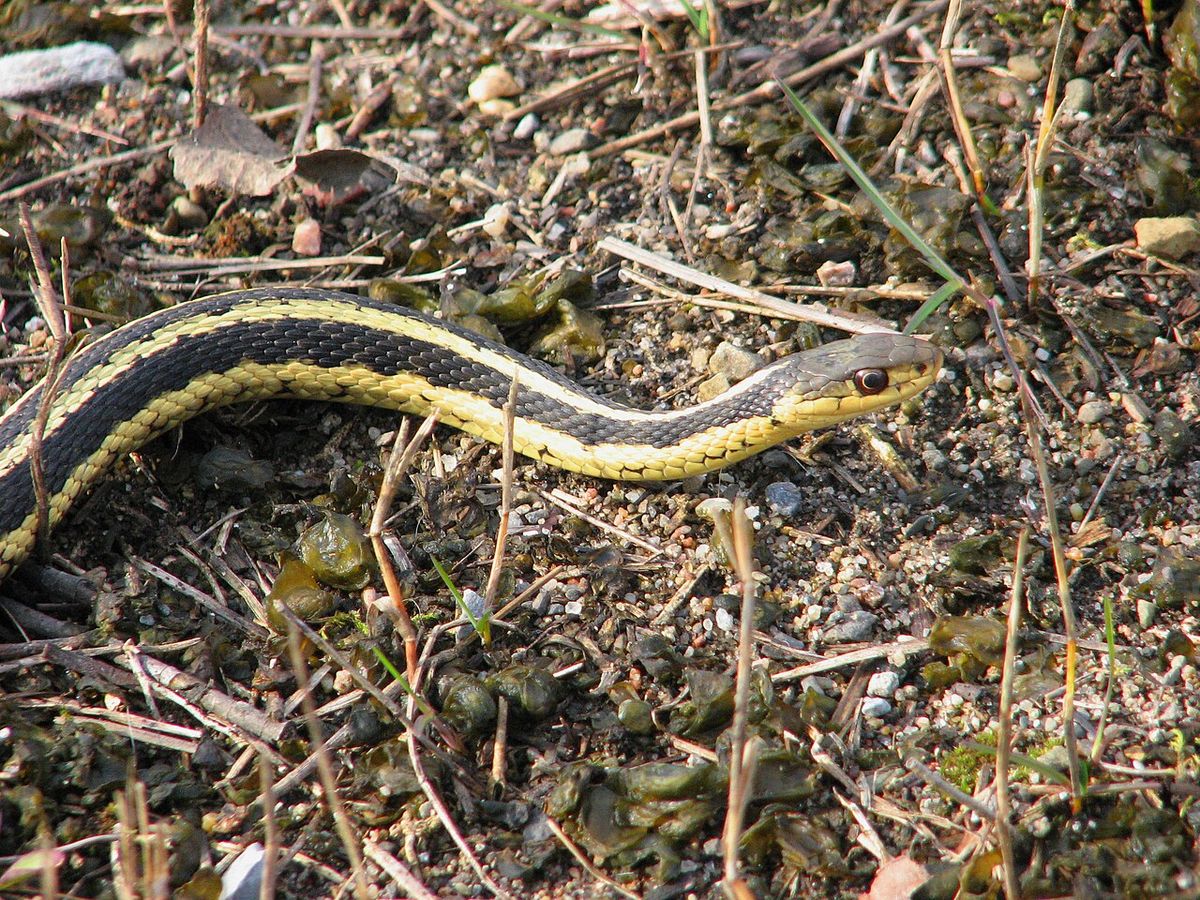
The common garter snake is a slender, medium-sized snake with considerable variation in appearance across its range. Most individuals exhibit a pattern of three longitudinal stripes running the length of the body on a darker background. The central stripe travels down the spine, with the other two on the second and third scale rows along the sides. These stripes are most commonly yellow or cream-coloured in Canadian populations, but can also appear white, blue, greenish, or brown. The background colour ranges from black and greyish-brown to olive green. The snake's head is wider than its neck, uniformly dark, and features a red tongue tipped in black. All scales are keeled, meaning each has a raised central ridge, giving the snake a rough texture. Sexual dimorphism is present, with females being significantly larger than males and having proportionally shorter tails. While the average total length is about 55 centimetres, the species can reach a maximum of 137 centimetres, though few exceed 90 centimetres in the wild.
Colour and pattern variations are extensive and often linked to specific subspecies and regions. Some populations, particularly within the range of the Eastern gartersnake (Thamnophis s. sirtalis), feature melanistic individuals that are solid black. The red-sided gartersnake (Thamnophis s. parietalis) and the valley gartersnake (Thamnophis s. fitchi) are distinguished by prominent red or orange bars between their stripes. The Maritime gartersnake (Thamnophis s. pallidulus) often has poorly defined stripes with a checkered pattern of dark spots. The Puget Sound gartersnake (Thamnophis s. pickeringii) is typically black with less vivid red bars and stripes that may be yellow, pale green, or bluish-grey. Newborn snakes are independent at birth, measuring between 12.5 and 23 centimetres long, and resemble miniature adults with often brighter colouration.
Distribution and Habitat in Canada
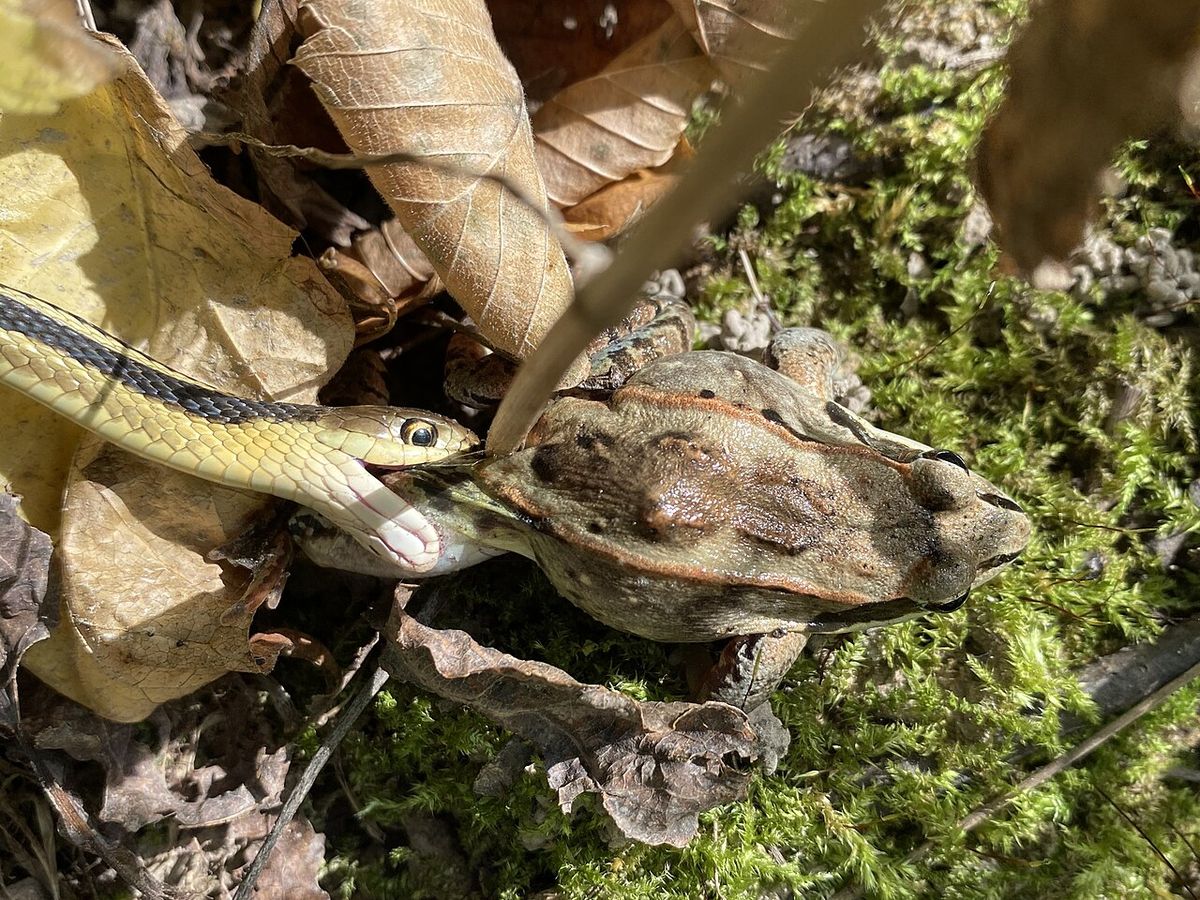
The common garter snake is the most widespread snake species in North America, and its range extends farther north than any other snake on the continent. In Canada, it is found in every province and territory except Nunavut, with its northern limit reaching the southern shores of James Bay and a small portion of the southern Northwest Territories. Its presence was undocumented in Newfoundland until around 2010, but sightings of pregnant individuals and juveniles on the island's west coast now suggest an established, breeding population likely introduced through human activity. The species is divided into five recognized subspecies across the country, each with a distinct geographic range.
- The Maritime gartersnake is found throughout Prince Edward Island, Nova Scotia, New Brunswick, and southern Quebec.
- The Eastern gartersnake ranges from western Quebec through southern, central, and northern Ontario to the James Bay coast.
- The red-sided gartersnake has the most extensive Canadian distribution, spanning from northwestern Ontario through Manitoba, Saskatchewan, and Alberta into eastern British Columbia and the southern Northwest Territories.
- The valley gartersnake inhabits southern and central British Columbia.
- The Puget Sound gartersnake has a restricted range limited to Vancouver Island, the Gulf Islands, and the adjacent mainland coast of British Columbia.
This snake is a habitat generalist, thriving in a wide variety of environments. It is commonly associated with moist areas and is often found near the edges of ponds, lakes, streams, marshes, and ditches. Its habitat also includes meadows, grasslands, forests, rocky outcrops, and the shorelines of rivers. The common garter snake is highly adaptable to human-modified landscapes and is frequently encountered in suburban gardens, parks, old fields, and areas with ample cover such as logs, rocks, or debris.
Behaviour and Life History
The common garter snake is diurnal, meaning it is active during the day. Its daily pattern shifts with the seasons. In summer, it is most active in the morning and late afternoon, while in cooler weather it restricts activity to the warmest part of the day. In warmer southern parts of its range, it may remain active year-round, but across most of Canada it hibernates during the winter. Snakes often congregate in large numbers in communal hibernation sites called hibernacula, which are typically underground burrows or rocky crevices that protect them from freezing. On unseasonably warm winter afternoons, individuals may briefly emerge to bask in the sun. The average lifespan in the wild is approximately two years, with many dying in their first year, though some individuals can live for more than 20 years. They reach sexual maturity at about 1.5 years for males and two years for females, achieving their maximum size at three to four years old.
Mating occurs in the spring shortly after emergence from hibernation. Males typically emerge first and gather around the den entrances. When females emerge, they are often surrounded by multiple males forming 'mating balls'. A fascinating reproductive strategy involves some males exhibiting female mimicry. They emit a fake female pheromone to lure rival males away from the den, then revert to male behaviour and race back to mate with the emerging females. Females can store sperm internally after mating, sometimes from a fall encounter, and delay fertilization until spring. The common garter snake is ovoviviparous, meaning the young develop in eggs that hatch inside the mother's body, and she gives birth to live offspring. Gestation lasts two to three months, with most litters born between late July and October across northern regions.
Reproductive Details| Factor | Detail |
|---|---|
| Litter Size Range | 4 to 80 young |
| Typical Litter Size | 10 to 40 young |
| Birth Size | 12.5 to 23 cm long |
| Female Reproductive Frequency | Every 1 to 3 years |
Litter size is strongly correlated with the size of the female, with larger females producing larger litters. The females give birth ovoviviparously to 12 to 40 young from July through October. Upon birth, the young are immediately independent and receive no parental care. They may remain near their mother for several hours or days before dispersing to find their own food. Common garter snakes are effective at catching fast-moving creatures such as fish and tadpoles.
Diet, Hunting, and Defence
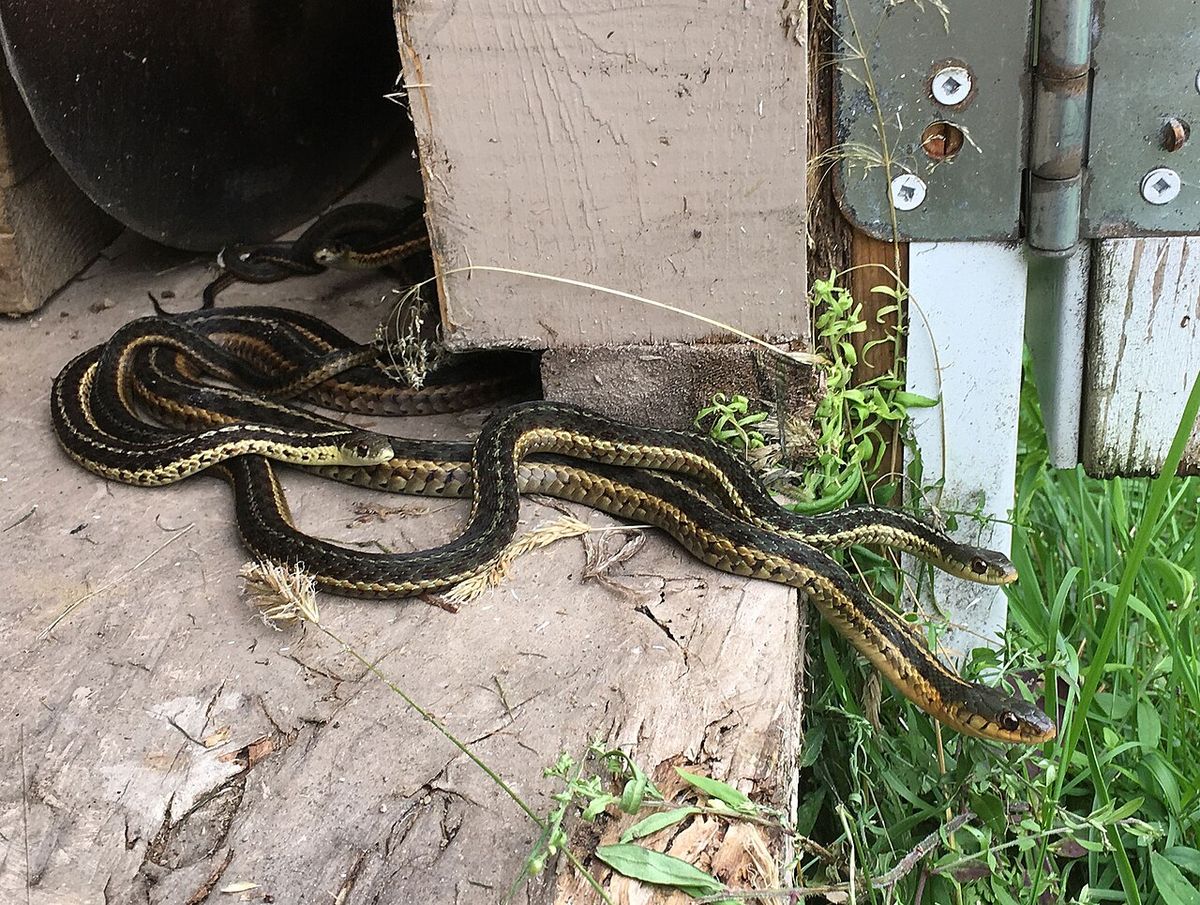
The diet of the common garter snake is highly varied, reflecting its opportunistic nature as a predator. Its primary prey includes amphibians such as frogs, toads, and salamanders, as well as earthworms. It also consumes leeches, slugs, snails, insects, crayfish, fish, small rodents, lizards, other snakes, and occasionally small birds. They are effective hunters of fast-moving prey like fish and tadpoles. The snake's skull is kinetic, containing movable joints that allow it to adjust the geometry of its head and jaws to swallow prey items much larger than its head would suggest possible. This adaptability in feeding makes it an important controller of pest populations in many ecosystems.
For defence, the common garter snake employs a suite of behaviours rather than relying on potent venom. When threatened, its first response is often to flee. If cornered, it may flatten its head and body, strike with a closed mouth in a bluff, or release a foul-smelling musk from postanal glands, a deterrent known as 'musking'. While it possesses a mild venom in its saliva that is toxic to its small prey, this venom is not dangerous to humans. A bite may cause slight itching, burning, or swelling but rarely breaks the skin. The species exhibits a remarkable evolutionary adaptation in its resistance to tetrodotoxin, a potent neurotoxin produced by prey such as the rough-skinned newt. Populations that co-evolve with these newts develop high levels of resistance, storing the toxin in their own tissues to become poisonous and deter their predators, a classic example of an evolutionary arms race.
Natural Predators- Birds of prey, including hawks.
- Larger snakes.
- Mammals such as raccoons, foxes, and domestic cats and dogs.
- American bullfrogs.
- Large fish like bass and catfish.
- Common snapping turtles.
- Wild turkeys.
Antipredator displays are influenced by several factors. Warmer snakes are more likely to flee, while cooler ones may remain stationary or attack. Males are more prone to flight than females. A snake that has just eaten a large meal is less mobile but more likely to strike if provoked. The location of an attack also dictates response. If attacked near the head, a snake will more likely hide its head and thrash its tail, whereas an attack on the body may trigger an open-mouthed warning or flight.
Subspecies and Identification
Across its vast range, the common garter snake is broken into numerous subspecies, with up to 13 recognized scientifically. In Canada, five primary subspecies are identified, each with characteristic markings that aid in differentiation. The Maritime gartersnake of Atlantic Canada and southern Quebec tends to have poorly defined stripes and a checkered pattern of black spots along its sides. The Eastern gartersnake, found in Quebec and Ontario, usually has well-defined stripes and alternating dark spots, with melanistic (all-black) individuals being common in parts of its range. The widely distributed red-sided gartersnake, ranging from Ontario to the Northwest Territories, is notable for the prominent red or orange bars that appear between its stripes.
In British Columbia, two subspecies are present. The valley gartersnake, found throughout southern and central parts of the province, has a bright, well-defined yellow dorsal stripe and vivid red side bars. The Puget Sound gartersnake, restricted to Vancouver Island, the Gulf Islands, and the adjacent mainland coast, is typically black with less prominent red bars and stripes that can be yellow, pale green, or bluish-grey. These snakes can be confused with other garter snake species in Canada, such as Butler's gartersnake, the terrestrial gartersnake, the Northwestern gartersnake, and the Plains gartersnake. Key identification features for the common garter snake include its keeled scales, a head wider than its neck, and typically seven scales on the upper lip.
Conservation Status and Threats
The common garter snake is classified as a species of Least Concern by the International Union for Conservation of Nature (IUCN) due to its extremely wide distribution and generally large, stable population. In Canada, most subspecies are considered secure, though they face localized pressures. The primary threats to these snakes are habitat loss and fragmentation caused by urban expansion, agricultural development, and industrial activity. Water contamination from pesticides and runoff can also negatively impact their health and reduce prey availability. Road mortality is a significant cause of death, especially for snakes migrating to and from their hibernation sites. As prey for many species, they are also vulnerable to predation, particularly when young. While the species as a whole is not at risk, certain subspecies with restricted ranges face greater peril.
The San Francisco garter snake (Thamnophis sirtalis tetrataenia), found only in California, has been listed as endangered by the U.S. Fish and Wildlife Service since 1967 and is considered endangered by the IUCN, with an estimated 1,000 to 2,000 individuals left in the wild. In Canada, no subspecies are currently listed as federally at risk, but provincial assessments may note sensitivities. Their adaptability to human-altered environments, such as city parks and gardens, has allowed them to persist in many areas despite development. Conservation efforts generally focus on protecting crucial habitat features like hibernacula, wetlands, and connective corridors, as well as public education to reduce unnecessary persecution.
Questions about Common garter snake
Are common garter snakes venomous?
Common garter snakes possess a mild venom in their saliva that is toxic to their small prey, such as amphibians and earthworms. However, this venom is not dangerous to humans. A bite may cause slight itching, burning, or minor swelling but rarely breaks the skin due to the snake's small size. Their primary defensive mechanisms are fleeing, releasing a foul-smelling musk, and bluffing strikes rather than envenomation.
What do common garter snakes eat?
Common garter snakes have a varied, opportunistic diet. Their primary prey includes amphibians like frogs, toads, and salamanders, as well as earthworms. They also commonly eat leeches, slugs, snails, insects, crayfish, and small fish. Larger individuals may consume small rodents, lizards, other snakes, and occasionally small birds. Their ability to swallow large prey relative to their head size is aided by a kinetic skull with movable joints.
Where are common garter snakes found in Canada?
The common garter snake is found in every Canadian province and into the southernmost Northwest Territories, holding the record for the northernmost range of any North American snake. It is largely absent only from Nunavut. Five subspecies occupy different regions: the Maritime (Atlantic Canada), Eastern (Quebec and Ontario), red-sided (Prairies to NWT), valley (southern BC), and Puget Sound (Vancouver Island and coast). A population has also become established in western Newfoundland since around 2010.
How can you identify a common garter snake?
Most common garter snakes have three longitudinal stripes running from head to tail on a darker background, with the stripes typically yellow or cream-coloured in Canada. The background can be black, brown, grey, or green. They have keeled scales (with a ridge), a head wider than the neck, and a red tongue with a black tip. Key subspecies markers include red side bars on the red-sided and valley gartersnakes, and checkered spotting on the Maritime gartersnake. They are often confused with ribbon snakes or other garter snake species.
Are common garter snakes dangerous to pets?
Common garter snakes are not considered dangerous to pets like cats and dogs. Their mild venom is ineffective against larger animals. However, pets may be curious and harass or injure the snakes. Conversely, domestic cats and dogs are listed as natural predators of the common garter snake and can kill them. It is advisable to supervise pets in areas where snakes are present to prevent harm to either animal.
How do common garter snakes survive the winter?
Common garter snakes survive Canadian winters by hibernating underground in frost-free refuges called hibernacula. These are often former rodent burrows, rock crevices, or compost heaps. Snakes frequently hibernate communally, sometimes in large numbers, which helps conserve heat. They enter hibernation in the fall and emerge in the spring. On unusually warm winter days, individuals may briefly emerge to bask in the sun before returning to their den.
Sources and further reading
- Common garter snake (Wikipedia)
- Thamnophis sirtalis (Common Garter Snake) (animaldiversity.org)
- Common Gartersnake (thecanadianencyclopedia.ca)
- Common Gartersnake, B.C. Reptiles & Amphibians (bcreptilesandamphibians.ca)
- Common Garter Snake (nps.gov)
Checked by the Your Space Hamilton desk. Last updated 2026-10-31.





