Regina Cyclone
The Regina Cyclone, also known as the Regina tornado of 1912, was a catastrophic F4 tornado that struck the city of Regina, Saskatchewan, on the afternoon of June 30, 1912. The storm remains the deadliest tornado in Canadian history, resulting in 28 fatalities and leaving approximately 300 people injured. In a devastating twenty-minute path through the city, it destroyed or damaged around 500 buildings, rendered 2,500 people homeless, and caused over $1.2 million in property damage. The disaster had a major and lasting effect on the young prairie city, requiring years of recovery and debt repayment.
Meteorological Formation and Path
The tornado formed in the unstable atmospheric conditions of a late June afternoon approximately 18 kilometres south of Regina. By the time it reached the southern edge of the city around 4:50 p.m., the funnel was roughly 150 metres wide. Meteorologists have estimated its wind velocity reached 400 kilometres per hour, which corresponds to a high-end F4 rating on the Fujita Scale. The tornado displayed a multiple vortex structure as it moved northward, which contributed to its erratic and selective pattern of destruction. Its path continued for another 12 kilometres north of the city before the storm finally dissipated, resulting in a total track length of about 30 kilometres. The storm's intensity was remarkable given that Regina is situated on a flat plain with no natural topographic features to influence such weather systems.
Devastation in the City
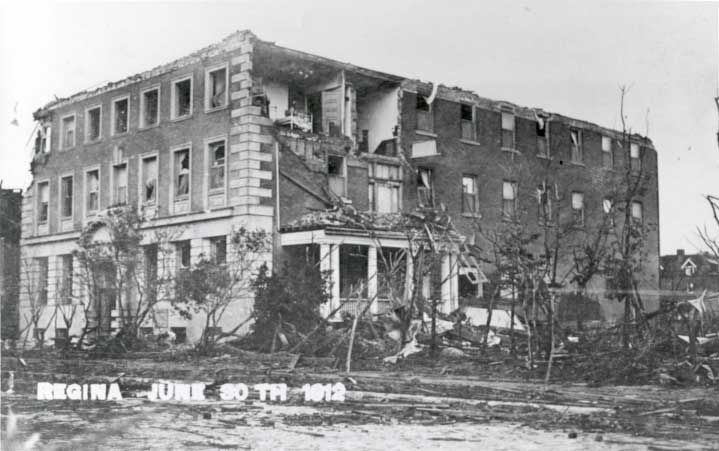
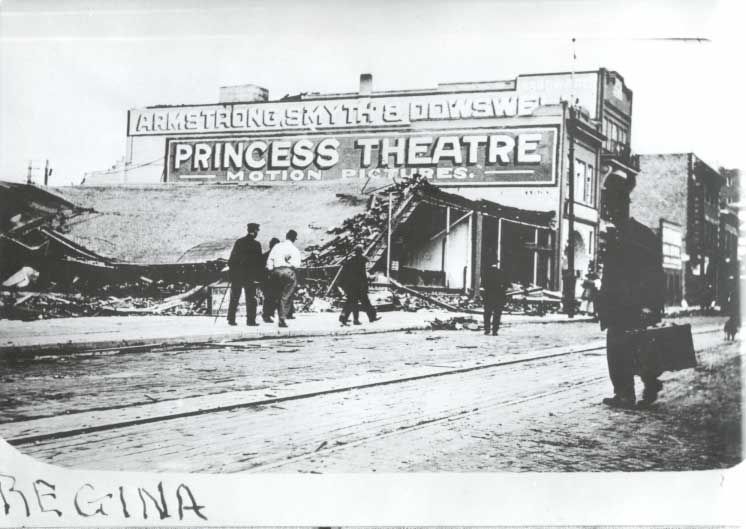
The tornado tore directly through the heart of Regina, causing the worst damage in the residential area north of Wascana Lake and the central business district. Entire city blocks were levelled as the storm moved from south to north. Many brick and wooden buildings were completely destroyed, with some houses reported to have exploded due to rapid pressure changes as the tornado passed overhead. The affluent residential areas to the south were also heavily damaged, with the tornado's multiple vortices leaving a bizarre pattern of destruction where one house was flattened while its immediate neighbour remained untouched. The storm then ripped through the downtown core, the warehouse district, and the Canadian Pacific Railway yards before moving into northern residential neighbourhoods.
Critical infrastructure and public buildings suffered extensive damage. The new Central Library, which had opened just six weeks prior on May 11, 1912, was among the structures damaged. The Metropolitan Methodist Church, Knox Presbyterian Church, First Methodist Church, and the YWCA and YMCA buildings were all hit. In the industrial and rail areas, the tornado stripped the massive CPR Roundhouse down to its rafters and hurled boxcars from their tracks. The sheer force of the wind cleared the area of debris, leaving the city centre a scene of utter devastation in a matter of minutes.
Immediate Aftermath and Rescue
In the chaotic moments following the storm, survivors emerged to a cityscape transformed into rubble. The immediate priority was rescuing those trapped in collapsed buildings and providing first aid to the hundreds of injured. Among those who assisted in the search and rescue efforts was a young actor named Boris Karloff, who was in Regina performing with a travelling theatrical troupe. Karloff would later recount this experience during a 1960s appearance on the CBC series Front Page Challenge. The city's emergency response was overwhelmed, and makeshift aid stations were set up to treat the injured.
The city administration faced the monumental tasks of housing the displaced, clearing debris, and restoring order. Officials set up cots in schools and city parks to shelter the 2,500 people left homeless. In a controversial decision that would later be criticized, the city required those rendered homeless to pay for the nightly use of these cots. Homeowners were also made responsible for the cost of removing rubble from their properties. Despite these policies, the initial cleanup of debris proceeded relatively quickly as the community rallied in the face of the catastrophe.
Long-Term Recovery and Financial Impact
The financial toll of the Regina Cyclone was staggering for the young prairie city. The immediate property damage was quantified at $1.2 million in 1912 Canadian dollars. However, the total cost of rebuilding and repairing public and private infrastructure created a massive debt burden. It took the city two years to complete the physical repairs to its infrastructure and buildings. The process of financially recovering from the storm was far longer, as it took approximately forty years for Regina to fully repay the $4.5 million in public and private debt incurred for reconstruction. This long-term financial strain affected municipal services and development for decades.
Several of the damaged landmark buildings were rebuilt, leaving a subtle architectural legacy. Knox Presbyterian, Metropolitan Methodist, and First Baptist churches, all being brick structures, were reconstructed. Knox and Metropolitan congregations both joined the United Church of Canada in 1925 and later merged in 1951 to become Knox-Metropolitan United Church, meeting in the old Metropolitan Church building. The only visible remnant of the tornado's damage on the building today is a section of differently coloured bricks on the north wall of Knox-Metropolitan United Church, marking where the wall collapsed and was rebuilt. The original Knox building was ultimately demolished.
The Cyclone in Culture and Memory
The major impact of the disaster has been preserved in Saskatchewan's cultural memory through various artistic works. A chapter of Frank Rasky's 1961 book Great Canadian Disasters is devoted to the tragedy. The novel Euphoria by Connie Gault, which won the 2009 Saskatchewan Book Award for Fiction, prominently features the Regina Cyclone as a central event. The storm was also commemorated on its 100th anniversary through a musical drama. Titled Swept Off Our Feet: Boris Karloff and the Regina Cyclone, the play by BD Miller premiered as a July 2012 production of Regina Summer Stage. The drama features characters based on Boris Karloff, Jeanne Russell, Henrietta Crosman, and the Albini-Avolos, intertwining the historical event with the story of the actor's involvement in the rescue efforts.
Tornadoes in the Regina Region
While the 1912 event remains the most severe, the Regina region continues to experience tornado activity, typically of a much weaker intensity. Modern meteorology, led by Environment and Climate Change Canada, closely monitors these events. The first confirmed tornado of the 2026 season in Saskatchewan was a landspout tornado reported near Disley, northwest of Regina, on the afternoon of May 22, 2026. Meteorologist Brad Vrolijk described it as very weak, short-lived, and preliminarily rated EF0, the lowest rating on the Enhanced Fujita Scale. It developed from a non-severe thunderstorm and caused no reported damage.
Landspout tornadoes, which form from different atmospheric mechanisms than the supercell that produced the 1912 cyclone, are more common in the spring in Saskatchewan. They are generally weaker and shorter-lived but can still pose risks. Another possible landspout was spotted near Pense, west of Regina, later in the 2026 season, highlighting the ongoing potential for funnel cloud development in the region's unstable spring and summer weather. Meteorologists note that while these modern events are far less destructive, any tornado sighting warrants taking immediate shelter, regardless of whether an official warning has been issued.
- 1912 Regina Cyclone: F4, 28 fatalities, $1.2M damage.
- May 22, 2026, near Disley: EF0 landspout, no damage.
- 2026 season, near Pense: Possible landspout, no damage reported.
- June 28, 2026, near Pelly: Large wedge tornado in rural areas.
- Spring 2026: Multiple funnel cloud advisories for southern Saskatchewan.
Questions about Regina Cyclone
How many people died in the Regina Cyclone of 1912?
The Regina Cyclone killed 28 people, making it the deadliest tornado in Canadian history. The tornado also injured approximately 300 people and left 2,500 residents temporarily homeless, which was a significant portion of the city's population of about 30,213 in 1911. The fatalities and injuries occurred as the violent storm tore through residential and business districts. The human toll was immense, with many lives lost in just twenty minutes of destruction. The event remains the most lethal tornado in Canada's recorded history.
What was the path and strength of the 1912 tornado?
The tornado formed 18 kilometres south of Regina and continued for another 12 kilometres north of the city before dissipating. It was approximately 150 metres wide as it moved through the urban area. Its wind velocity has been estimated at 400 kilometres per hour, which is the equivalent of a high end F4 on the Fujita Scale. The tornado displayed a multiple vortex structure, which contributed to its destructive and erratic damage pattern. This path took it through residential areas, the downtown business district, and rail yards.
How much damage did the Regina tornado cause?
The tornado caused over $1,200,000 in property damage in 1912 Canadian dollars. It destroyed or damaged around 500 buildings, including brick churches, the new Central Library, warehouses, and the CPR Roundhouse. The cost of rebuilding created a combined public and private debt of $4.5 million, which took forty years to repay. The storm rendered 2,500 people homeless and required a massive cleanup effort, with the city taking two years to repair the physical damage.
Are there any physical reminders of the tornado in Regina today?
The primary physical reminder is on the north wall of Knox Metropolitan United Church, where different coloured bricks show where the wall was rebuilt after collapsing in the tornado. This church was originally the Metropolitan Methodist Church, which was heavily damaged and later rebuilt. Other damaged brick churches like Knox Presbyterian and First Baptist were also reconstructed. The Knox building was ultimately demolished after the congregations merged, leaving the brick patchwork on the Knox Metropolitan church as the main visible souvenir.
Was actor Boris Karloff really involved in the aftermath?
Yes, Boris Karloff was in Regina with a travelling theatrical troupe when the tornado struck. He assisted in search and rescue efforts following the disaster, several years before launching his famous film career. Karloff later recounted this experience during a 1960s appearance on the CBC series Front Page Challenge. His involvement is commemorated in the musical drama 'Swept Off Our Feet: Boris Karloff and the Regina Cyclone', which premiered for the disaster's 100th anniversary in 2012.
Does Regina still get tornadoes?
Yes, the Regina region still experiences tornadoes, but they are typically much weaker than the 1912 event. For example, the first confirmed tornado of 2026 in Saskatchewan was a weak EF0 landspout near Disley, northwest of Regina, which caused no damage. Environment and Climate Change Canada monitors these events, noting that landspout tornadoes are more common in the spring. These modern tornadoes are generally short lived and form from non severe thunderstorms, posing a far lower risk than the historic cyclone.
Sources: Wikipedia and current public reporting, checked by the Your Space Hamilton desk. Last updated 2026-10-25.