Locust Plague of 1874
The Locust Plague of 1874, also known as the Grasshopper Plague of 1874, was a catastrophic invasion of Rocky Mountain locusts across the Great Plains of the United States and Canada. It is considered the last great swarm of this species, which subsequently became extinct. The event caused hundreds of millions of dollars in damage across an estimated two million square miles, devastating crops and livelihoods during a period of severe drought. For Canadians, particularly in the Northwest Territories and Manitoba, the plague represented a significant natural disaster that tested frontier resilience and contributed to the complex environmental history of western settlement.
Scope and scale of the invasion
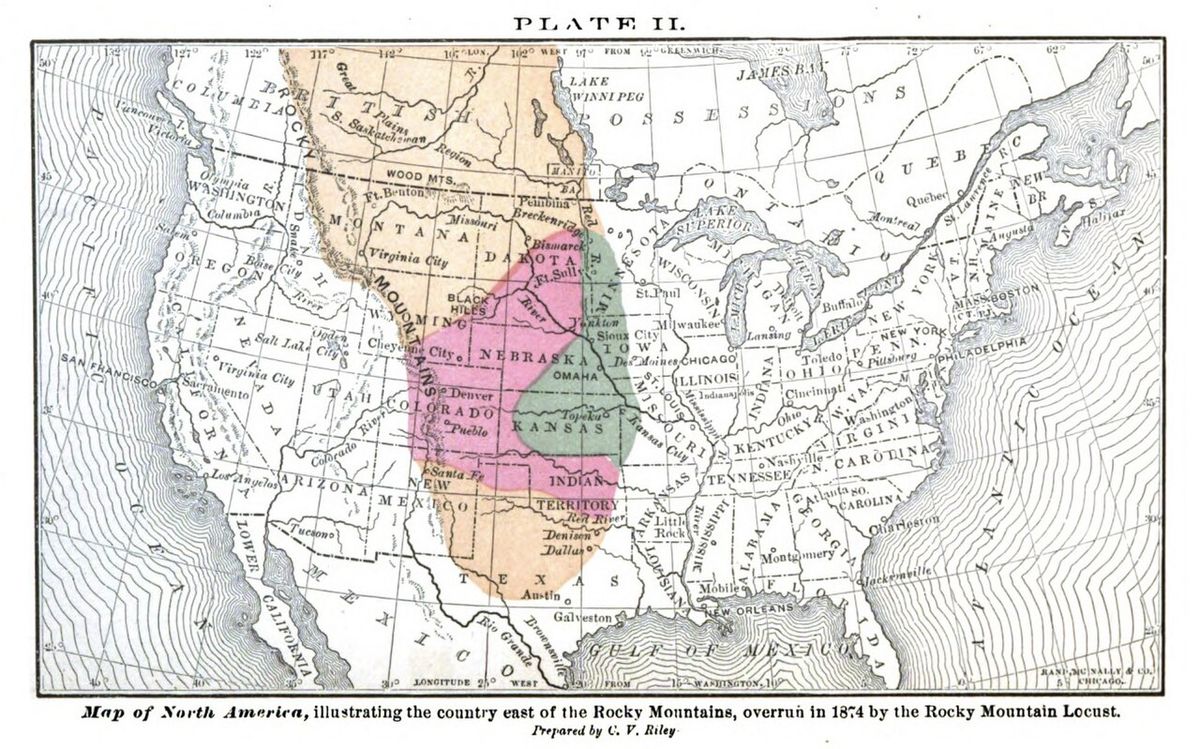
The Locust Plague of 1874 was an event of staggering geographical scale, affecting a swath of North America equivalent to the combined area of eleven northeastern U.S. states. The United States Entomological Commission later described this area as encompassing Connecticut, Delaware, Maine, Maryland, Massachusetts, New Hampshire, New Jersey, New York, Pennsylvania, Rhode Island, and Vermont. The primary swarm zone included the Dakota, Montana, Wyoming, and Colorado Territories, along with the states of Iowa, Minnesota, Missouri, Nebraska, Kansas, and Texas, as well as the Indian Territory. The locusts crossed into Canadian territory, reaching the Northwest Territories and Manitoba. Contemporary observers noted that a range of coniferous timber may have prevented the insects from advancing further into parts of Saskatchewan. The sheer density of the swarm was historically unprecedented, with settlers reporting that the locusts blocked out the sun for up to six hours at a time, creating an eerie, darkened landscape. Pioneer descriptions consistently compared the approaching swarm to a vast, glistening white cloud or a storm of snowflakes, highlighting the overwhelming visual and sensory impact of the event. The invasion's timing during a record drought on the Great Plains created conditions that allowed the locust population to explode and exhibit classic swarming behaviour.
Eyewitness accounts provide vivid testimony to the swarm's magnitude and psychological effect. A Kansas pioneer described the locusts as looking "like a great, white glistening cloud, for their wings caught the sunshine on them and made them look like a cloud of white vapor." Another Kansas settler said, "I never saw such a sight before. This morning, as we looked up toward the sun, we could see millions in the air. They looked like snowflakes." Nebraska historian Addison E. Sheldon offered a detailed narrative of the arrival: "In a clear, hot July day a haze came over the sun. The haze deepened into a gray cloud. Suddenly the cloud resolved itself into billions of gray grasshoppers sweeping down upon the earth. The vibration of their wings filled the ear with a roaring sound like a rushing storm. As far as the eye could reach in every direction the air was filled with them. Where they alighted, they covered the ground like a heavy crawling carpet." These descriptions capture how the plague was not merely an agricultural pestilence but an atmospheric and auditory phenomenon that dominated the entire environment.
Devastation and immediate impact
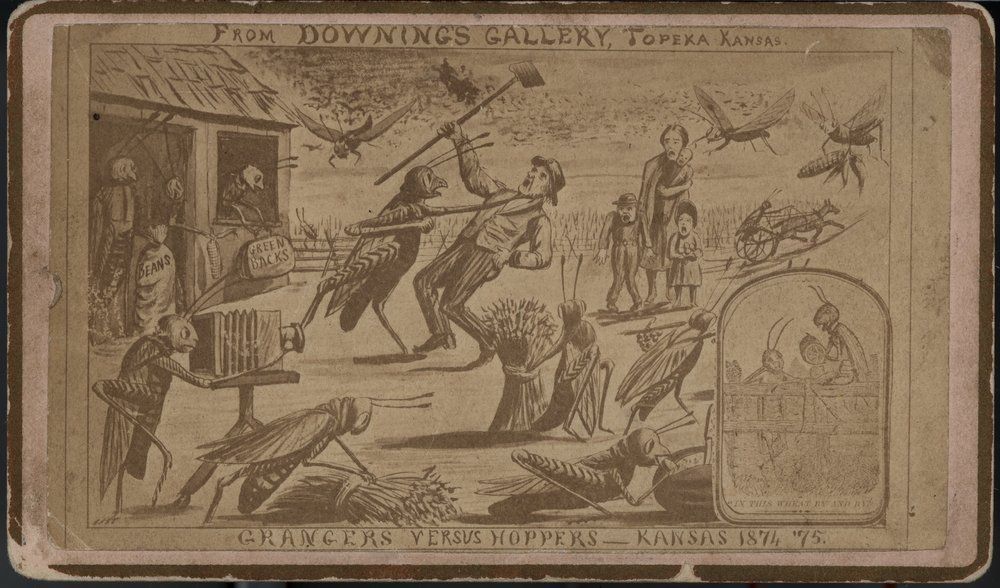
The locusts inflicted comprehensive and bizarre destruction across the affected regions. They consumed not only all standing crops, grasses, and tree leaves but also attacked non-plant materials in a desperate search for sustenance. Documented accounts report the insects eating the wool off living sheep, the leather harnesses from horses, the paint from wooden wagons, and even the handles of pitchforks. Inside pioneer homes, locusts ate stored food and damaged carpets and clothing as they moved through buildings. The physical presence of the insects was so immense that their bodies could pile over a foot high on the ground, and their excrement and carcasses polluted ponds and streams, creating secondary environmental hazards. The plague even disrupted transportation, as train tracks became slick with crushed grasshopper remains, causing locomotives to lose traction, a detail recorded in the book It Happened in Nebraska. The combination of total crop loss and the contamination of water sources created a dire immediate crisis for survival as settlers faced the onset of winter with no food stores.
Farmers mounted a desperate and largely futile defence against the onslaught using every method they could devise. They tried to burn the locusts, but in many cases, the sheer mass of insects smothered the flames before they could spread. Other methods included covering fields with sheets in a vain attempt to protect them and using smoke to drive locusts away from crops and into prepared ditches filled with water or oil to drown them. A more technological tool was the hopperdozer, a scraper coated with sticky coal tar that was pulled by horses across fields. When dragged against the wind, young locusts would be blown into the tar, but this device was only effective on flat terrain and could not cope with the scale of the invasion. The state entomologist for Missouri, Charles Valentine Riley, who documented the swarm extensively, made an unconventional suggestion to turn the plague into a resource by advocating for additional culinary uses of the locusts, noting that many other cultures considered them food.
Relief efforts and government response
The catastrophic crop damage, estimated at over $200 million, coincided with the Long Depression following the Panic of 1873, making recovery nearly impossible for many settlers. Initial relief was organized privately, as the prevailing political philosophy of the era held that only the 'deserving poor', those whose poverty was not due to immorality, idleness, or personal failure, should receive public aid. Farmers themselves often shared this perspective, and some refused any help except in the form of temporary loans. Governors in Kansas and Nebraska, worried that farmers would abandon their settlements, established private relief agencies rather than seek state or federal assistance. The Nebraska Relief and Aid Association, organized in September 1874, collected "money, provisions, clothing, fuel, seeds and other necessary supplies" from private sources. Similarly, Minnesota's local and state governments encouraged charitable donations and focused on eradication over direct relief. These efforts were justified by citing the precedent of the national charitable response to the Great Chicago Fire of 1871. Railroads transported 124 carloads of donated goods to Kansas for free, and by January 1875, Nebraska Governor Robert W. Furnas reported more than $68,000 had been received in cash and in-kind donations from across the country.
As the true scale of destitution became clear through official inspections, state governments realized their coffers would have to be opened. An Army major inspecting southwestern Nebraska reported to General Edward O. C. Ord that "The destitution existing here is much greater than I expected. Relief must be given these people or hundreds will starve before the winter is half over." In December 1874, Kansas Agricultural Secretary Alfred Gray reported to Governor Thomas A. Osborn that up to 70 percent of the population was impoverished in the worst-hit counties. In January 1875, Governor Furnas recommended, and the Nebraska legislature approved, the issuing of $50,000 in state bonds to purchase seed for victims. In Kansas, Governor Osborn convinced the legislature to approve $73,000 in aid bonds. In both states, farmers had to prove they were destitute and had nothing left to sell to qualify. The federal government's initial response was an executive order by President Ulysses S. Grant in November 1874 authorizing the distribution of surplus and condemned army clothing in Kansas and Nebraska. In 1875, Congress took further action, supplying $30,000 in seeds to the area and easing residency requirements for homesteaders so farmers could leave their farms to seek work or aid without forfeiting their claims.
The government's response to the swarm created the United States Entomological Commission, consisting of the top entomologists of the day, to prevent future locust plagues. The federal government's measures, including distributing army clothing and supplying seeds, were one of the first efforts to provide emergency aid to western farmers. According to historian Sam S. Kepfield, using public treasury funds for disaster relief was almost unheard of at the time. Steven R. Kinsella writes that the grasshopper plagues of the 1870s started a lasting relationship between agricultural producers and the government. This response forced a re-evaluation of government responsibility during disasters.
- Creation of the United States Entomological Commission, consisting of the top entomologists of the day, to study and prevent future locust plagues.
- Distribution of surplus U.S. Army clothing by executive order in late 1874.
- A congressional appropriation of $30,000 for seed grain in 1875.
- Relaxation of homesteader residency rules to allow farmers to seek work.
- State-level bond issues in Nebraska ($50,000) and Kansas ($73,000) for seed and relief in 1875.
- Widespread charitable donation campaigns coordinated by railroads and local committees like the Kansas Central Relief Committee.
These measures, along with food and clothing from the Army, marked a significant shift. Historian Sam S. Kepfield noted that using public treasury funds for disaster relief was "almost unheard-of" at the time, as public funds were seen as being for public uses only. Historian Steven R. Kinsella argues the plagues of the 1870s "started a relationship between agricultural producers and the government that continues to this day." Charles Valentine Riley wrote in his 1877 book The Locust Plague in the United States that the coordinated aid averted death and famine in the affected regions.
Subsequent years, control, and extinction
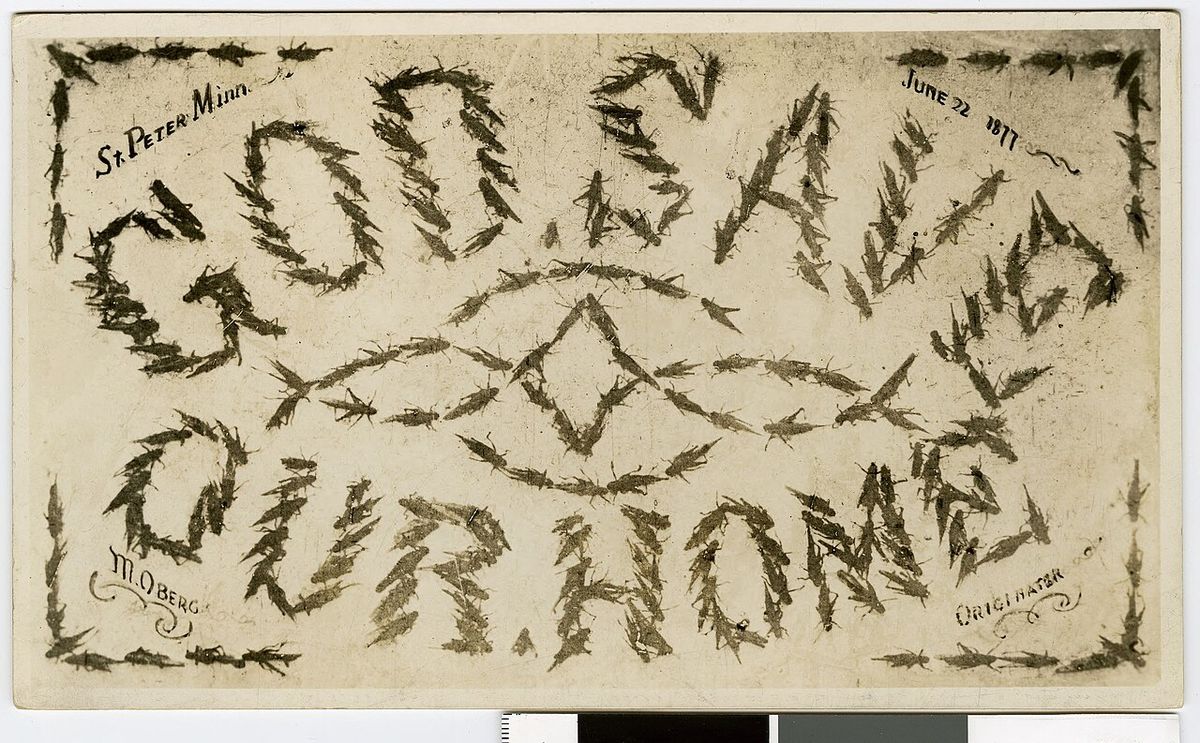
The summer of 1874 was not an isolated event but the beginning of a multi-year crisis that required continued vigilance. An even larger swarm, estimated at 3.5 trillion locusts, occurred in June 1875, demonstrating the persistent threat. However, several natural and human factors combined to reduce the threat in the following years and ultimately led to the species' demise. For several springs after the 1874 invasion, farmers plowing their fields turned up and destroyed millions of grasshopper eggs buried in the soil, a crucial but unintentional form of population control. An early frost in the spring of 1875 also helped kill off young locusts (nymphs) and limit that year's population boom. After these major swarms, the population of Rocky Mountain locusts entered a steady and permanent decline. Each year after 1874 saw fewer locusts, and the species is theorized to have become extinct by the early 1900s. The 1874 plague is historically considered the last great swarm of this particular species. The reasons for its extinction are not fully understood, but the development and cultivation of the American West is a leading theory. As settlers plowed the native breeding grounds of the locusts and introduced new crops and livestock, they permanently altered the ecosystem the insect depended upon. The establishment of the United States Entomological Commission was a direct result of the plague, aiming to apply scientific understanding to prevent a recurrence. The commission studied the locust's life cycle, migration patterns, and potential controls, though the species vanished before long-term, managed solutions were fully necessary. The government's own assessment in 1876 stated bluntly that "The Rocky Mountain Locust is the most serious impediment to the settlement of the West," highlighting how the insect's decline coincidentally removed a major barrier to the very agricultural expansion that likely caused its extinction.
Cultural depictions and historical significance
The trauma of the locust plague left a deep imprint on the literature and historical memory of the Great Plains. Author Laura Ingalls Wilder, who experienced the devastation as a child on her family's Minnesota farm, provided a firsthand account in her children's memoir On the Banks of Plum Creek. Norwegian-American author Ole Edvart Rølvaag also depicted the plagues in his seminal novel of pioneer struggle, Giants in the Earth, which was later adapted into an opera featuring the locust scourge as a central calamity. Historically, the plague is significant for several reasons beyond its immediate destruction. It occurred during a peak period of western settlement and presented a massive natural obstacle to that expansion, directly challenging the narrative of manifest destiny with an uncontrollable ecological force. The disaster also challenged the era's dominant ethos of self-reliance and prompted a reluctant but groundbreaking expansion of government responsibility for disaster relief. The movement from purely private charity to state-issued bonds and federal appropriations for seed set a critical precedent for future state and federal aid to agriculture. The event spurred formal scientific inquiry into agricultural pests through the creation of the Entomological Commission, institutionalizing the study of economic entomology. The plague demonstrated the interconnectedness of the North American environment, as the swarm respected no political borders, affecting territories from Texas to Manitoba and highlighting shared vulnerabilities across the continent's grassland biome.
Impact on Canadian territories
While the historical record focuses on the American Great Plains, the Locust Plague of 1874 was a transnational event that directly affected Canadian territories during a formative period. The swarm reached into the Northwest Territories and the young province of Manitoba, which had entered Confederation just four years earlier in 1870. For settlers in these regions, the locust invasion compounded the already immense challenges of homesteading on the prairie frontier, where communities were isolated and supply chains were fragile. The plague threatened the fragile agricultural base that was essential for the survival of new communities and for attracting further settlement, potentially stalling the growth that Canadian authorities were actively promoting. Contemporary observers noted geographical limits to the swarm's northern progression. One 1877 account theorized that a belt of coniferous timber acted as a natural barrier, preventing the locusts from moving into some parts of what would become Saskatchewan. The Canadian experience of the plague would have mirrored that of American neighbours, involving total crop loss, desperate countermeasures like the hopperdozer, and a struggle for subsistence through the following winter.
Comparative impact and legacy
The Locust Plague of 1874 stands out even among other natural disasters of the period for its unique combination of scale, strangeness, and long-term implications. Unlike a flood or fire, the locusts were a mobile, living disaster that consumed the very means of production, the crops and pasture, while also damaging property and infrastructure in surreal ways. Its legacy encompasses ecological mystery, policy innovation, and cultural memory. The sudden and complete extinction of the Rocky Mountain locust shortly after its most spectacular outbreak remains a unique event in entomological history, a subject of continued scientific interest. On a policy level, the plague forced a reluctant government to redefine 'public use' to include saving private citizens from starvation, a philosophical shift that would resonate through future agricultural crises like the Dust Bowl. The table below summarizes key relief actions taken in response to the plague, illustrating the layered response from private, state, and federal entities:
| Entity | Action | Year | Nature of Aid |
|---|---|---|---|
| State of Nebraska | Issuance of relief bonds | 1875 | $50,000 for seed purchase |
| State of Kansas | Issuance of relief bonds | 1875 | $73,000 for aid |
| U.S. Federal Government (Executive) | Executive Order by President Grant | 1874 | Distribution of surplus army clothing |
| U.S. Federal Government (Congress) | Appropriation & Homestead Act adjustment | 1875 | $30,000 in seed. Eased residency rules |
| U.S. Federal Government | Creation of Entomological Commission | Post-1874 | Scientific study for future prevention |
The Locust Plague of 1874 is remembered for the massive clouds of insects that covered the sun and caused extensive damage. It tested the societies in its path, leading to significant relief efforts from private agencies, states, and eventually the federal government. The plague serves as a case study in human vulnerability to environmental change and the evolution of disaster response. It also highlights the unforeseen ecological consequences of settlement, as the Rocky Mountain locust species later became extinct. The event is documented in pioneer literature like Laura Ingalls Wilder's On the Banks of Plum Creek.
Questions about Locust Plague of 1874
What caused the Locust Plague of 1874?
The plague was caused by a massive population explosion of Rocky Mountain locusts, a species native to the region. This explosion was triggered by specific environmental conditions, primarily a record drought across the Midwest and Great Plains during the early 1870s. The drought was followed by periods of vegetation, which is a classic pattern that induces locusts to swarm and migrate. The estimated population during the swarm ranged from 120 billion to 12.5 trillion insects, which then migrated in colossal clouds across the landscape, a behaviour typical after a drought period.
How much damage did the grasshoppers cause and what did they eat?
The total crop damage was estimated at over $200 million, a colossal sum for the era, with the infestation covering two million square miles. The locusts devoured almost any organic material. Beyond crops, grass, and tree leaves, they ate wool off live sheep, leather harnesses, the paint from wagons, and pitchfork handles. They invaded homes to consume stored food and damaged carpets and clothing. Their excrement and carcasses piled up, polluting water sources, and their crushed bodies made train tracks so slick that locomotives lost traction.
Did the locust plague reach Canada and where exactly?
Yes, the locust swarm was a transnational event that crossed into Canadian territory. Historical accounts confirm the locusts reached the Northwest Territories and the province of Manitoba during the summer of 1874. Some contemporary observers, including one in 1877, believed that natural features like a range of coniferous timber acted as a barrier, preventing the swarm from advancing further into parts of what is now Saskatchewan. The plague represented a significant natural disaster for Canadian pioneers on the prairie frontier during a period of early settlement.
What did the government do to help victims and was it controversial?
The government response evolved from private charity to unprecedented public aid. The federal government authorized army clothing distribution, allocated $30,000 for seed, and relaxed homestead rules. This was controversial because the prevailing attitude, as historian Sam S. Kepfield notes, was that using public treasury funds for disaster relief was "almost unheard-of," as such funds were for public uses only. The aid cited the precedent of the Chicago Fire relief to justify assisting 'deserving' victims.
What happened to the Rocky Mountain locust after 1874 and why did it go extinct?
The 1874 swarm is considered the last great plague of the species, though a massive swarm of 3.5 trillion occurred in 1875. The population then entered permanent decline. Farmers plowing fields destroyed millions of eggs, and an early frost in spring 1875 helped reduce numbers. The species is theorized to have become extinct by the early 1900s. A leading explanation is that the cultivation and development of the American West, which plowed over its native breeding grounds in the valleys, permanently altered the ecosystem it required for survival.
How is the locust plague remembered in culture and what was its long-term significance?
The Locust Plague of 1874 is remembered in pioneer literature and opera. Laura Ingalls Wilder wrote about the devastation on her family's Minnesota farm in her book On the Banks of Plum Creek. Author Ole Edvart Rølvaag described the plagues in his novel Giants in the Earth, which was later adapted into an opera. The long term significance was a shift in government disaster response. The plague prompted some of the first federal emergency aid to western farmers, including seed distribution and eased homesteader rules. Historian Steven R. Kinsella notes this started a lasting relationship between agricultural producers and the government. The event also led to the creation of the United States Entomological Commission to study and prevent future plagues.
Sources and further reading
- Locust Plague of 1874 (Wikipedia)
- The 1874 Rocky Mountain Locust Plague That Blotted Out ... (explorersweb.com)
- ATTACK OF THE LEGENDARY LOCUST (grainswest.com)
Checked by the Your Space Hamilton desk. Last updated 2026-10-22.