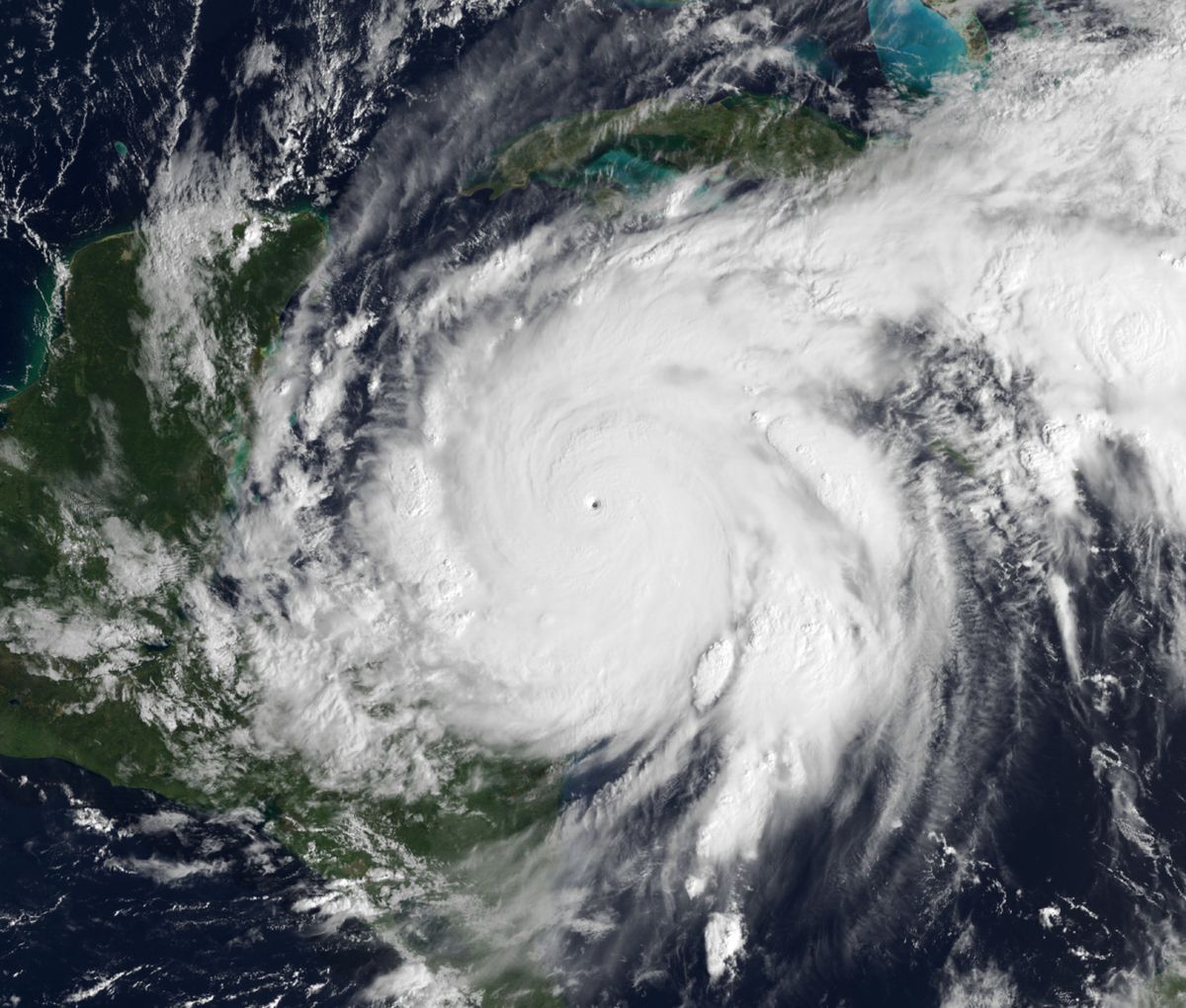
Hurricane Luis
Hurricane Luis was a long-lived and powerful Category 4 hurricane that devastated the Leeward Islands in September 1995. It was a major storm within the hyperactive 1995 Atlantic hurricane season, causing catastrophic damage on several islands including Antigua, Barbuda, Saint Martin, and Anguilla. The hurricane's remnants later transitioned into a potent extratropical cyclone, making a rare landfall on Newfoundland and affecting Atlantic Canada. Luis resulted in 19 confirmed deaths, left nearly 20,000 people homeless, and caused an estimated $3.3 billion (1995 USD) in total damage.
Meteorological history
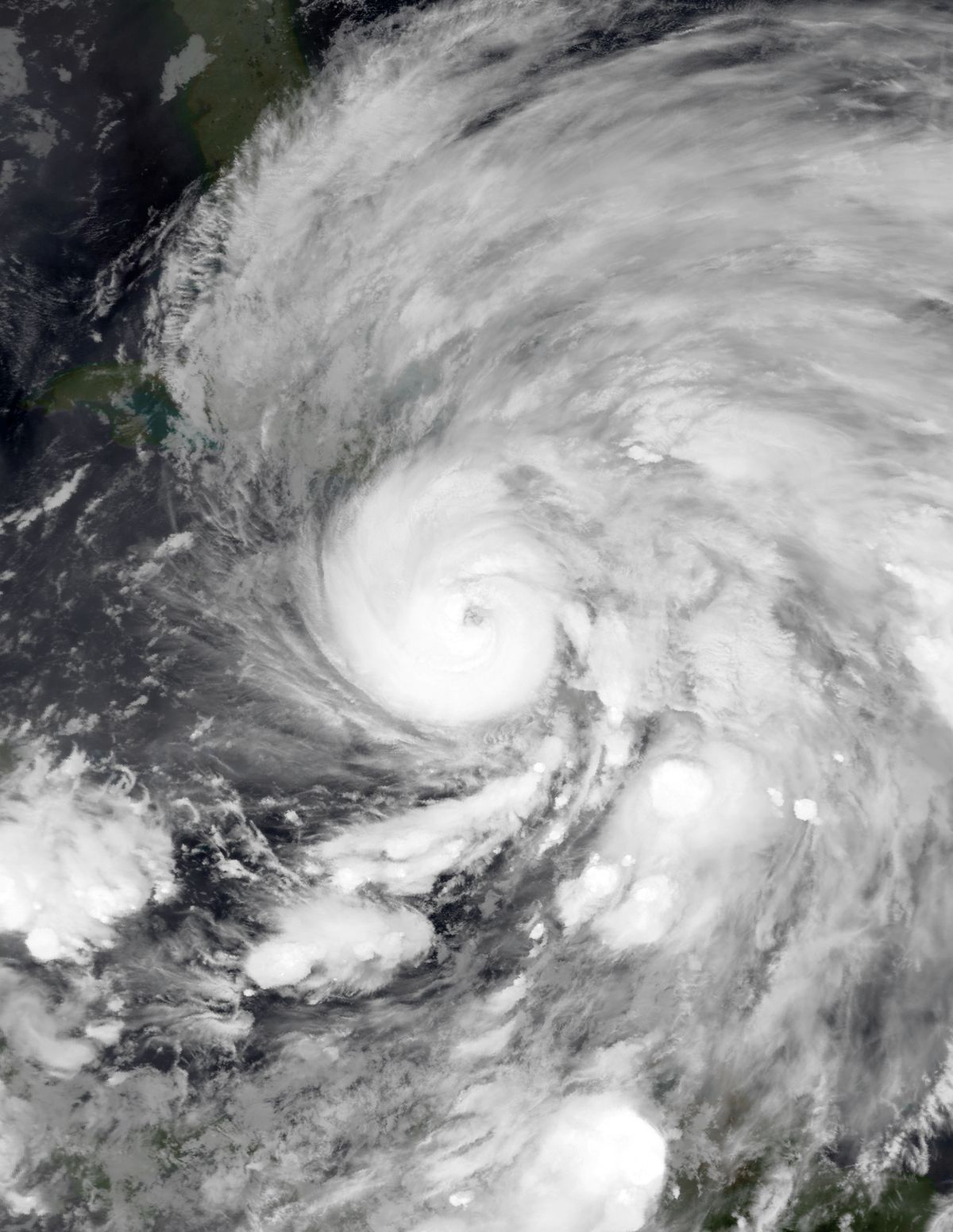
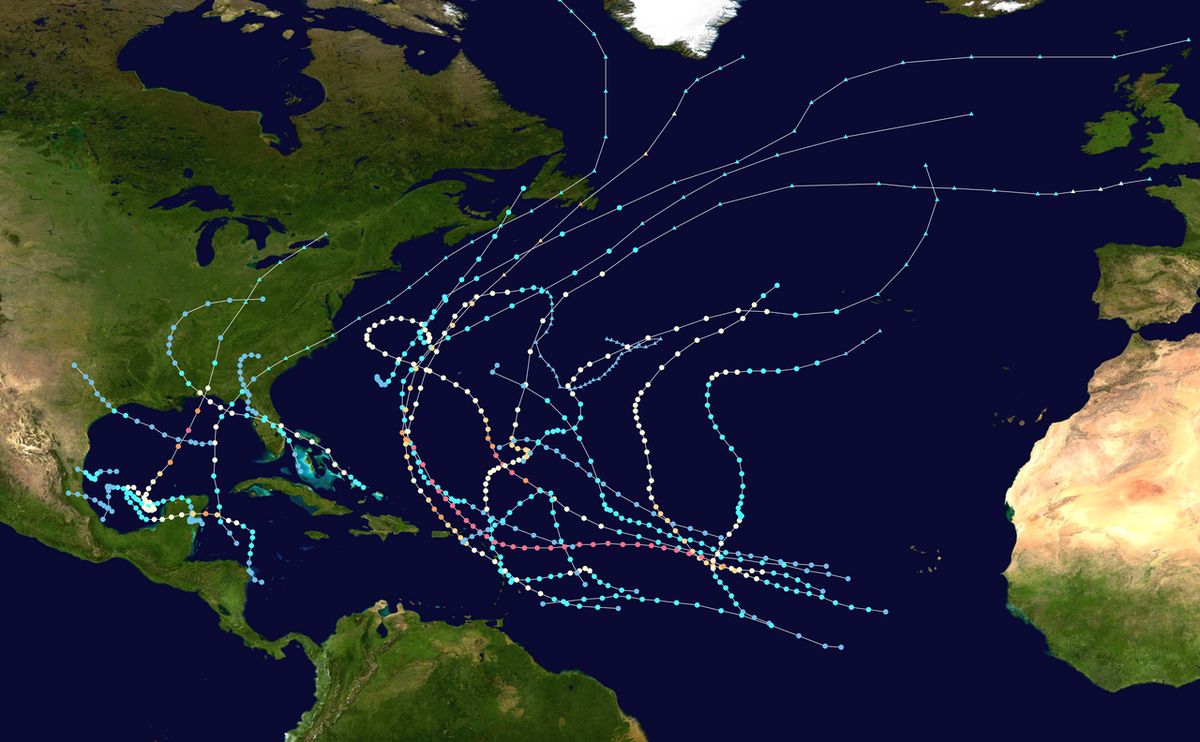
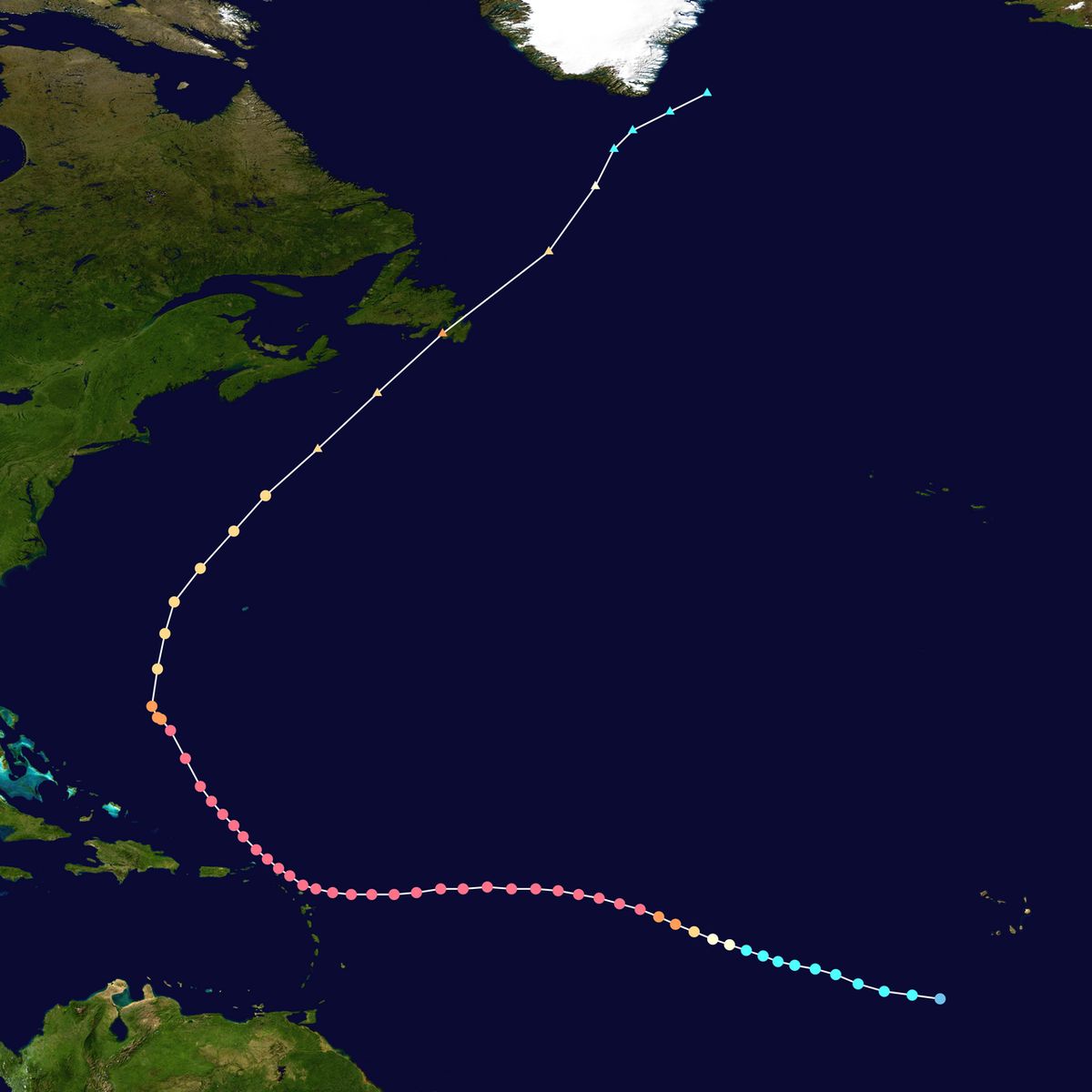
Hurricane Luis originated from a tropical wave that emerged off the west coast of Africa in late August 1995. The system organized into Tropical Depression Thirteen on August 27 and was upgraded to Tropical Storm Luis on August 29. The storm intensified into a hurricane on August 31 and rapidly strengthened further, becoming a major Category 3 hurricane within 18 hours. By September 2, Luis had reached its peak intensity as a Category 4 hurricane with maximum sustained winds of 150 mph (240 km/h) and a minimum central pressure of 942 mbar. The hurricane's expansive wind field measured between 345 and 365 miles (555 to 587 km) in diameter as it approached the Caribbean. Luis maintained Category 4 status for seven consecutive days from September 1 to September 7, an exceptionally long duration for a major hurricane.
The storm's westward track was influenced by a subtropical ridge and the absorption of the weaker Tropical Storm Karen by Hurricane Iris. This steering pattern directed Luis directly towards the northern Leeward Islands. On September 5, the eyewall of the hurricane passed directly over Barbuda and skirted Antigua, Saint Barthélemy, and Saint Martin before crossing Anguilla. After devastating these islands, Luis moved northwest of Puerto Rico and began to gradually weaken. It curved northeastward over the open Atlantic, passing west of Bermuda on September 9. As it accelerated ahead of a strong trough, Luis underwent an extratropical transition. The system made landfall on Newfoundland on September 11 as a powerful post-tropical cyclone with estimated sustained winds of 120 mph (190 km/h). A ship in the storm's path reported winds of 138 mph (222 km/h), and a nearby Canadian buoy recorded a rogue wave of 98 feet (30 m) in height.
Preparations and warnings
Due to the hurricane's slow forward motion, meteorological agencies had ample time to issue warnings across a wide area. The National Hurricane Center and local authorities issued a total of 17 tropical cyclone watches and warnings throughout the Caribbean in advance of Luis. On September 3, a hurricane watch was declared for islands from Antigua to Saint Martin, which was upgraded to a hurricane warning by 0000 UTC on September 4. Tropical storm warnings were also issued for Dominica and Guadeloupe at that time. As the storm's projected path became clearer, warnings were extended to include the British and United States Virgin Islands and Puerto Rico, with those areas under a hurricane warning by 2100 UTC on September 4. All warnings in the Caribbean were gradually downgraded or discontinued between September 6 and 8 as Luis moved away.
The Canadian Hurricane Centre began issuing advisories on the morning of September 8, approximately 48 hours before the storm entered its response area as its trajectory began to curve east of Florida. The Meteorological Service of Canada's Maritimes centre issued warnings for affected regions 36 hours prior to the storm's arrival in Atlantic Canada. Bermuda was placed under a tropical storm watch at 2100 UTC on September 7, which was upgraded to a warning at 1500 UTC the next day before being discontinued at 0900 UTC on September 10 as the storm passed to the west. The extensive warning timeline allowed for evacuations and preparations, though the storm's intensity still led to severe consequences.
Impact in the Leeward Islands
The northern Leeward Islands bore the brunt of Hurricane Luis, suffering catastrophic damage from wind, rain, and storm surge. The storm's slow movement, with a forward speed between 7 and 9 mph as it passed Saint Martin, prolonged the period of destructive conditions and exacerbated the devastation. The most severe impacts were concentrated on islands that experienced the hurricane's powerful eyewall. Infrastructure was crippled, thousands of homes were destroyed, and critical agricultural sectors were wiped out. The collective damage across the region amounted to billions of dollars and represented a significant portion of several islands' gross domestic product, demonstrating the economic fragility of small island states in the face of such disasters.
Hurricane Luis caused extensive damage to Antigua, St. Barthelemy, St. Martin, and Anguilla. On Barbuda, winds reached 135 mph and over 10 inches of rain contributed to very extensive damage. In Saint Martin, the eyewall passed 15 to 20 miles northeast of the island, causing catastrophic damage to 60% of the area. The storm's intensity was documented by various weather stations, with recorded pressures as low as 948 mbar in Saint Barthelemy and wind gusts estimated up to 155 mph there.
- Antigua and Barbuda: Barbuda suffered a direct hit, with winds of 135 mph and over 10 inches of rain. An amateur radio operator reported an unconfirmed gust of 175 mph in Barbuda. An estimated 70 percent of houses on Barbuda were damaged or destroyed, and 45 percent of residences on Antigua were damaged. Three deaths were confirmed, 165 people were injured, and approximately 3,000 were left homeless from a population of 32,000 greatly affected. Total damage was estimated at $350 million, about 60 percent of the nation's GDP.
- Saint Martin and Sint Maarten: The island, divided between French and Dutch territories, was devastated with the eyewall passing 15 to 20 miles northeast. The Dutch side, Sint Maarten, experienced the strongest winds, with the capital Philipsburg 70 percent decimated. About 70 percent of residences were damaged, with 15 percent rendered uninhabitable, including businesses, churches, the main airport terminal, and four hotels. Eight deaths were confirmed on the Dutch side, and one on the French side. Damage was catastrophic, estimated at $1.8 billion on the Dutch side and 2 billion French francs (approximately $350 million) on the French side.
- Anguilla: The eyewall passed directly over Anguilla, with winds estimated at 135 mph. The island suffered extreme damage, contributing significantly to the region's homeless population, and was one of the areas where nearly 20,000 people were left homeless across the affected islands.
- Saint Barthélemy: The island experienced extensive damage from winds estimated at 135 mph, with gusts possibly as high as 155 mph. The main weather station recorded a gust of 100 mph before its anemometer broke. The minimum recorded pressure was 948 mbar, and pressure stayed below 1,000 mbar for at least 24 hours.
- Guadeloupe: Passing 65 miles north, Luis caused moderate damage, primarily on Grande-Terre, with severe beach erosion. Hurricane-force winds of 75 mph were recorded on La Désirade. Banana crops were 90 percent damaged and sugar cane crops on the north were 20 percent damaged. One death was reported, a 19-year-old French tourist dragged away by waves, and total damage was estimated at 250 million French francs ($50 million).
- St. Kitts and Nevis: The eye passed 50 miles northeast, causing severe beach erosion and moderate structural damage, leaving 2,000 homeless and damaging local vegetation and road infrastructure. Damage reached $197 million.
- Dominica: Experiencing only tropical storm-force winds of roughly 40 mph, the main impact was on banana crops already damaged by Hurricane Iris. The lowest pressure recorded was between 1,003 and 1,005 mbar. One death was reported, a fisherman lost to rough seas, and property damage from Luis alone was $47 million.
Impact beyond the Caribbean
While the core of Hurricane Luis remained offshore, its expansive circulation and powerful remnants affected a much larger area. The storm generated dangerous seas and coastal conditions along the eastern seaboard of the United States before its final act in Atlantic Canada. These impacts, though less catastrophic than in the Leeward Islands, resulted in additional fatalities and significant localized damage. The storm's ability to maintain intensity far north of the tropics was a notable meteorological feature, with its extratropical transition demonstrating how hurricane energy can be transferred to mid-latitude weather systems.
In Puerto Rico, which passed 120 miles northeast of the storm's centre, impacts were minor, though two deaths were reported as people rushed to prepare for the arrival of the storm. Bermuda, which the centre passed 200 miles west of, reported sustained winds up to 46 mph and offshore waves approaching 100 feet, but little damage occurred on the island itself. Along the United States East Coast, rough seas caused significant beach erosion and coastal flooding from North Carolina to New York. Rip currents produced by Luis caused one death near Corncake Inlet, North Carolina, where eight homes in Brunswick County were washed away and 40 feet of beach was lost. Waves of up to 17 feet also washed out 33 feet of the Triple S Pier in Atlantic Beach, North Carolina. Total losses in North Carolina amounted to $1.9 million. In New York, rough seas undermined and destroyed one home on Fire Island, and led to the death of one person who was swimming in the high waves.
Impact and aftermath in Canada
The remnants of Hurricane Luis transitioned into a powerful extratropical cyclone as they approached Atlantic Canada. On September 11, the system made landfall on Newfoundland, bringing hurricane-force conditions to the province. Northwesterly winds gusted to 81 mph (130 km/h), and the storm dropped between 2.4 and 4.7 inches (61 to 119 mm) of rain. The flooding and wind caused an estimated $500,000 in damages across the province, and one storm-related death was reported in Canada. The storm's landfall in Canada as a Category 3-equivalent post-tropical cyclone highlighted the reach of tropical systems into northern latitudes and served as a reminder for Canadian coastal communities to monitor former hurricanes.
A notable maritime incident occurred as the storm approached. Approximately 200 nautical miles south of eastern Newfoundland, a rogue wave estimated at 98 feet (30 m) high, triggered by Luis, slammed into the ocean liner Queen Elizabeth 2. A nearby Canadian buoy recorded the massive wave at roughly the same time. Although the ship sustained no significant damage, its arrival in New York was considerably delayed. In the aftermath of the disaster, the Government of Canada contributed financial aid to the recovery efforts in the Caribbean. Canada donated $149,253 to the Pan American Health Organization and an additional $44,760 directly to the impacted region to assist with relief and rebuilding, part of a broader international aid package that included contributions from many other nations.
International relief efforts
The widespread devastation prompted a significant international humanitarian response. Multiple United Nations agencies and national governments provided emergency funds and aid to the affected islands. The financial contributions were crucial for immediate relief and the long-term recovery of economies that had lost a substantial portion of their infrastructure and agricultural output. The coordination of this aid demonstrated the global response to regional disasters, with contributions ranging from small cash grants for specific needs like school rebuilding to multi-million dollar recovery packages for the hardest-hit territories.
Total damage from Hurricane Luis was estimated at $3.3 billion across the affected areas. The storm left nearly 20,000 people homeless, mostly in Anguilla, Barbuda, and St. Martin, and affected more than 70,000 people. On the French Collectivity of Saint Martin, preliminary damage was estimated at 2 billion francs. On the Dutch side of Sint Maarten, total damages were catastrophic, totaling around $1.8 billion.
| Donor | Recipient(s) | Contribution |
|---|---|---|
| UN Office for Coordination of Humanitarian Affairs | Antigua and Barbuda, Netherlands Antilles | $50,000 |
| UN Development Programme | Barbados, Netherlands Antilles | $50,000 |
| UN Children's Fund (UNICEF) | All affected islands | $20,000 |
| UNESCO | Antigua and Barbuda | $20,000 |
| UNESCO | Dominica | $15,000 |
| UNESCO | St. Kitts and Nevis | $5,000 |
| Organization of American States | Antigua and Barbuda, Dominica, St. Kitts and Nevis | $250,000 |
| Government of the Netherlands | Netherlands Antilles | $15.2 million |
| Government of France | Antigua and Barbuda | $200,000 |
| Government of Japan | Affected areas | $150,000 |
| Government of the Bahamas | Affected areas | $50,000 |
| Government of Norway | Antigua and Barbuda, St. Kitts and Nevis | $50,000 |
The storm accounted for 19 confirmed deaths and left nearly 20,000 people homeless. In Antigua and Barbuda, approximately 3,000 people were left homeless and total damage was estimated at $350 million. In Sint Maarten, over 5,000 Haitians living in the Dutch quarter were left homeless. The storm damaged or destroyed a large percentage of homes on several islands, including 70% of residences on Barbuda and 50% of houses in the French Collectivity of Saint Martin.
Hurricane Luis in context
Hurricane Luis was a defining storm of the very active 1995 Atlantic hurricane season. It was the second of three hurricanes to affect the Leeward Islands in a short period, following Hurricane Iris and preceding Hurricane Marilyn, which struck just ten days later. This series of storms compounded the damage and recovery challenges for the region, with the combined effects of Luis, Iris, and Marilyn in Dominica alone totaling $184 million in damage. On Sint Maarten, Luis was considered the most devastating hurricane to hit since Hurricane Donna in 1960. The storm's long lifespan and intensity, maintaining major hurricane status for seven days, demonstrated the potential for tropical systems to sustain themselves over long distances. Its transformation into a severe extratropical storm that impacted Canada also serves as a reminder for northern coastal communities to monitor former tropical systems. The extensive damage and international response highlighted the vulnerability of small island nations to high-intensity hurricanes and their limited capacity to recover without external assistance.
Questions about Hurricane Luis
When did Hurricane Luis hit and what category was it?
Hurricane Luis was active from late August to mid-September 1995. It reached its peak intensity as a Category 4 hurricane on the Saffir Simpson scale on September 2, with maximum sustained winds of 150 mph (240 km/h). The storm maintained Category 4 status for seven consecutive days, from September 1 to September 7, which is an exceptionally long duration for a major hurricane. It made its final landfall in Newfoundland on September 11 as a powerful post-tropical cyclone.
Which areas were most affected by Hurricane Luis?
The Leeward Islands suffered the most catastrophic damage. Barbuda experienced a direct hit from the eyewall, and Antigua, Saint Martin, Sint Maarten, and Anguilla were severely impacted. The Dutch side of Saint Martin (Sint Maarten) was particularly devastated, with the capital city of Philipsburg 70 percent decimated and 85 percent of the 1,500 boats in Simpson Bay Lagoon sunk or run aground. The storm also affected Puerto Rico, Bermuda, the eastern United States coast, and finally made landfall in Newfoundland, Canada, as a powerful extratropical cyclone.
How much damage did Hurricane Luis cause?
Total damage from Hurricane Luis was estimated at $3.3 billion (1995 US dollars). The most severe financial losses occurred on Sint Maarten, with damages around $1.8 billion. Antigua and Barbuda suffered an estimated $350 million in damage, which represented about 60 percent of the country's Gross Domestic Product at the time. In Canada, flooding in Newfoundland caused an estimated $500,000 in damages. Additional significant losses included $197 million in St. Kitts and Nevis and $50 million in Guadeloupe.
Did Hurricane Luis affect Canada?
Yes, the remnants of Hurricane Luis transitioned into an extratropical cyclone and made landfall on Newfoundland on September 11, 1995. It brought hurricane-force wind gusts up to 81 mph (130 km/h) and heavy rainfall between 2.4 and 4.7 inches (61 to 119 mm), causing flooding and an estimated $500,000 in damage. One storm-related death was reported in Canada. A notable rogue wave triggered by the storm, measured at 98 feet (30 m), also struck the Queen Elizabeth 2 ocean liner south of Newfoundland, delaying its arrival in New York.
What was the international response to the disaster?
A significant international relief effort was mobilized. United Nations agencies including OCHA, UNDP, UNICEF, and UNESCO provided emergency grants for rebuilding schools and infrastructure. National governments also contributed. The Organization of American States provided a $250,000 emergency grant to several affected nations, and other donors included Japan, the Bahamas, Norway, Australia, Germany, Spain, and New Zealand.
Were there any fatalities from Hurricane Luis?
Yes, Hurricane Luis was responsible for 19 confirmed deaths. Fatalities occurred across multiple locations impacted by the storm. In Antigua and Barbuda, the storm accounted for three deaths. One death was reported in the French Collectivity of Saint Martin, and eight people were officially killed in Sint Maarten. A 19-year-old French tourist died in Guadeloupe after being dragged by waves, and a fisherman died in Dominica due to rough seas. Two deaths in Puerto Rico were linked to rushing preparations for the storm. In the United States, one person died from rip currents in North Carolina and another drowned while swimming in high waves in New York. Finally, one storm-related death was also reported in Canada from the system's remnants.
Sources: Wikipedia and current public reporting, checked by the Your Space Hamilton desk. Last updated 2026-10-24.