2007 Elie tornado
The 2007 Elie tornado was a violent and erratic F5 tornado that struck the town of Elie, Manitoba, approximately 40 kilometres west of Winnipeg, on the evening of June 22, 2007. As the first and only tornado officially rated F5 on the Fujita scale in Canadian history, it represents the most extreme intensity of tornado ever recorded in the country. The event is notable for its unusual meteorological behaviour, including a slow, looping path and its peak intensity occurring during a narrow 'roping-out' stage, yet it caused no fatalities or injuries. With an estimated $39 million in damage, the Elie tornado remains a landmark event in Canadian meteorology and disaster preparedness.
Meteorological Conditions
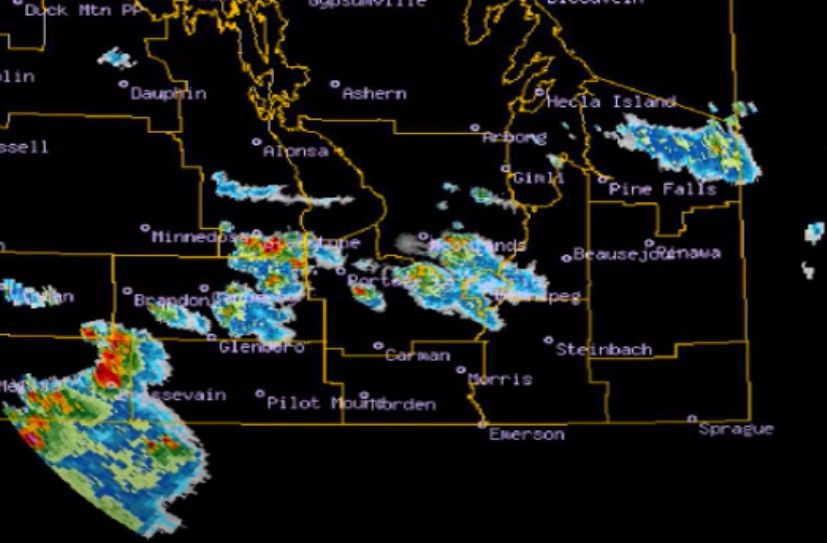
A complex atmospheric setup over the southern Canadian Prairies created the conditions for severe weather on June 22, 2007. An upper-level ridge was building over southern Alberta and Saskatchewan, accompanied by a minor shortwave trough. A thermal ridge was also present over southern Saskatchewan, which inhibited storm formation and allowed for increased heating in the upper atmosphere. At the surface, multiple disconnected low-pressure systems were present, with one over southern Saskatchewan advecting warm, moist air into Manitoba via a warm front extending into the Interlake region. By 1800 UTC, this surface low had moved east to a position directly over Dauphin Lake, with surface temperatures reaching 26 to 28 degrees Celsius and dew points a very high 18 to 20 degrees Celsius, indicating significant atmospheric moisture and instability.
An area of high pressure over the High Plains contributed to a strong jet stream at the 800 hPa level, with winds of 10 to 15 metres per second rounding its western half. This jet continually advected moisture from the Gulf of Mexico into the region, providing ample fuel for any storms that developed. Wind shear, the change in wind speed and direction with height, was also observed, creating an environment favourable for rotating thunderstorms. A significant layer in the atmosphere initially suppressed convection, allowing instability to build throughout the day. By 2100 UTC, the surface low had migrated to the southern basin of Lake Manitoba and became quasi-stationary for several hours. The Elie tornado ultimately developed along a dry line ahead of a cold front extending from this low. Meteorological analysis notes that a cold pool and gravity waves in the atmosphere likely affected the development of the Elie tornado as well as other tornadoes in the surrounding area that day.
Path and Intensity Evolution
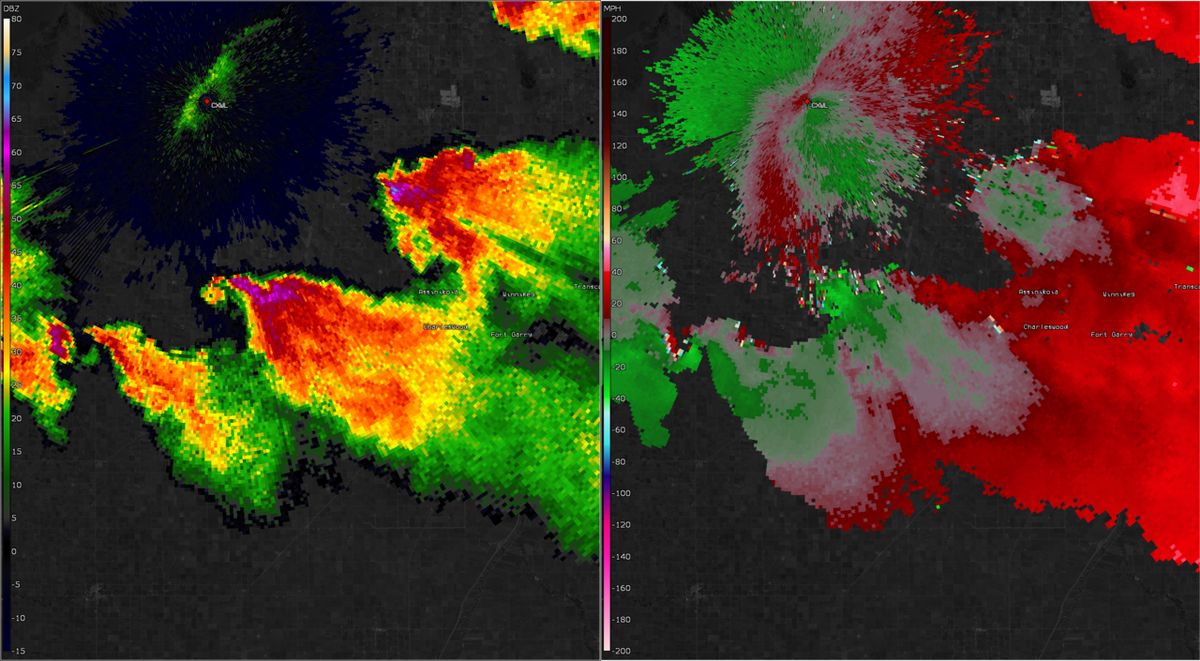
The tornado first touched down north of the Trans-Canada Highway at approximately 6:25 p.m. CDT. It initially moved slowly southeast, where its first acts of damage included overturning a semi-trailer and a tractor trailer. The tornado's path was immediately marked by sharp turns and loops, a highly unusual characteristic. Within roughly 1.6 kilometres, it turned east, then took a sharp turn south, and then took another sharp turn east. It then turned south and executed an extremely slow loop over the town's flour mill, causing over $1 million in damage at F2 intensity. During this phase, multiple semi trucks were overturned and damaged, and building walls buckled inward. The tornado was producing F1 to F2 level damage at this point and had grown to a width of 50 metres.
From the mill, the tornado headed south parallel to Janzen Road, weakening briefly to F0 intensity. It continued to grow in width during this segment, reaching its peak width of about 140 metres. After reaching the intersection of Janzen Road and Road 61 North, the tornado turned east directly toward the southwest edge of Elie. It quickly intensified as it approached the town, making a loop over Elie Street where it began to inflict severe structural damage. The tornado's most intense damage occurred here, where it lingered for approximately four minutes before exiting the town to the southwest and rapidly dissipating. Its total path length was about 6 kilometres, and its lifespan was approximately 35 minutes. The tornado repeatedly struck the same area of town, destroying most structures and vehicles in its focused path.
Extreme Damage and the F5 Rating
The tornado's most destructive acts occurred on Elie Street, where it inflicted damage justifying ratings from F2 to F5. Multiple homes were severely damaged or destroyed. Two houses sustained F4 damage, being almost completely swept from their foundations. The event's defining moment, which secured the F5 rating, was the complete destruction of a well-built, anchored home. This house was entirely lifted off its foundation, lofted into the air, and disintegrated midair as it was thrown around the tornado's funnel. Surveyors noted the home's structural integrity, including 2x6 sill plates secured with J-bolts and larger-than-usual washers, which were sheared off. One other house to the west sustained F2-F3 level damage, with its entire roof torn off and multiple exterior walls collapsed.
Other extreme damage included trees being completely debarked and vehicles being thrown extreme distances. One car was tossed over 100 metres, and a homeowner's Chrysler Fifth Avenue was thrown onto a neighbour's roof. A three-quarter-ton GM van filled with drywall was lofted hundreds of feet. Video evidence was crucial in the damage assessment, clearly showing the home's destruction and the van being airborne. The video also captured at least three houses being destroyed and the flour mill being damaged. Initially rated F4, the tornado was officially upgraded to F5 by Environment Canada on September 18, 2007, following detailed video analysis and structural reassessment by a storm damage survey team from the Prairie and Arctic Storm Prediction Centre.
- A well-built, anchored home was swept off its foundation and disintegrated midair, justifying the F5 rating.
- Two other houses were almost completely swept from their foundations, sustaining F4 level damage.
- One house had its entire roof torn off and multiple exterior walls collapsed, sustaining F2-F3 damage.
- Multiple vehicles were overturned, thrown, or lofted, including a car tossed over 100 metres and a heavy van thrown hundreds of feet.
- Trees in the path were completely debarked.
- The town's flour mill sustained over $1 million in damage at F2 intensity, with bins and roofs destroyed.
- Building walls at the mill buckled inward, and multiple semi trucks were overturned.
The survey team determined the structural failures were rapid and not attributable to the tornado's slow movement relentlessly pounding the structures. This confirmation made the Elie tornado the first officially rated F5 in Canada. As of 2026, it is the most recent tornado to receive an F5 rating on the original Fujita scale. Canada adopted the Enhanced Fujita Scale in 2013. Surveyors stated the tornado was an EF5-equivalent and would have received that rating had the enhanced scale been in use in Canada at the time.
Unusual Characteristics and Behaviour
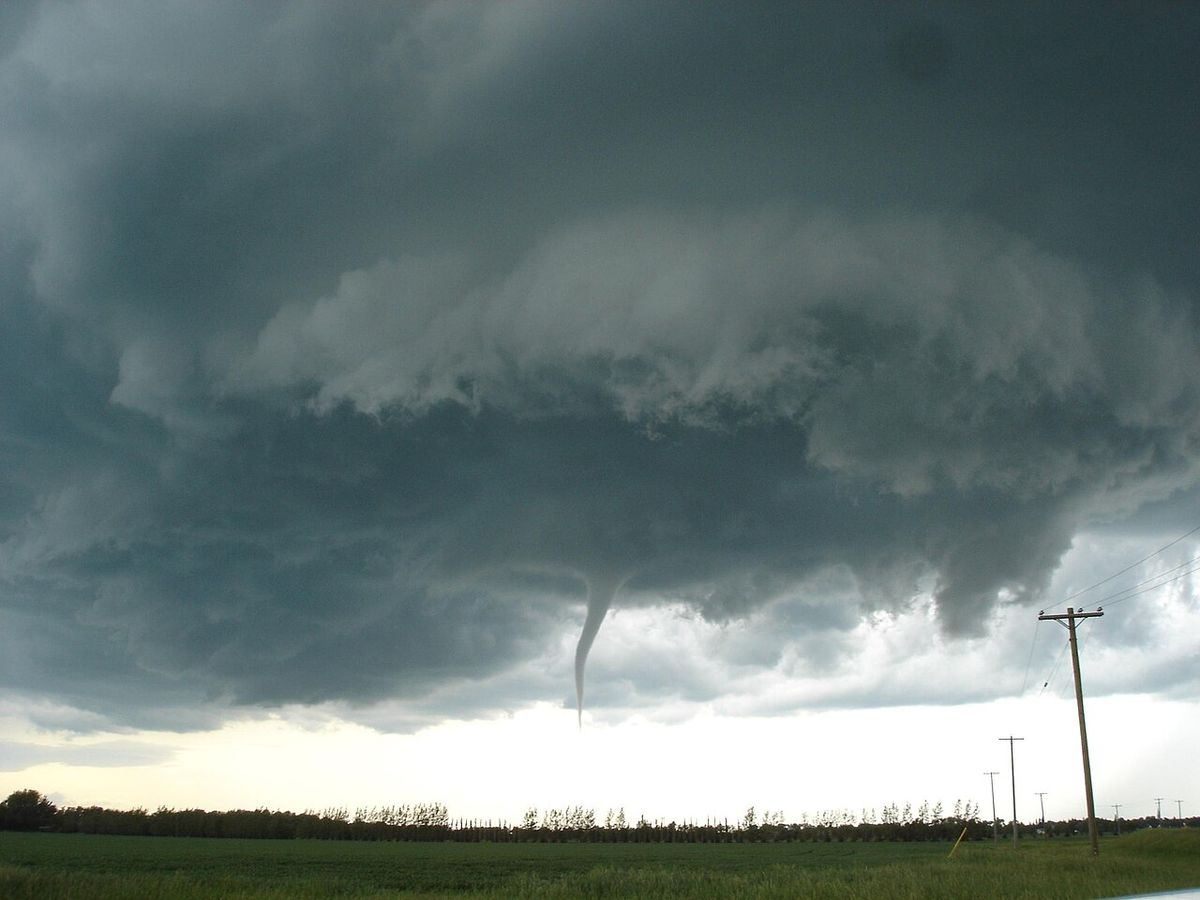
The Elie tornado exhibited several highly atypical features that set it apart from other violent tornadoes. Most notably, it reached its peak F5 intensity not during a large, wedge-shaped phase but during its narrow 'roping-out' or decaying stage, when it was a mere 35 yards wide. This contradicts the typical observation where the most intense damage is associated with a tornado's widest point. Its motion was also erratic and counter to climatology. While most tornadoes in the Northern Hemisphere move northeast, the Elie tornado tracked primarily southeast. Its path was punctuated by multiple sharp turns and loops, causing it to strike the same area of town repeatedly. A video of the tornado shows an entire two-story home being wiped off its foundation and tossed 75 feet in the air before rotating around the tornado and being destroyed.
Meteorologists have theorized that the tornado's extreme intensity in its roping stage may have been caused by a rapid implosion and constriction of its wind field. According to the physical principle of conservation of angular momentum, a decrease in radius results in an increase in rotational velocity, similar to a figure skater pulling in their arms to spin faster. This acceleration, though brief, could explain the catastrophic damage inflicted during such a narrow phase. The tornado's slow forward speed, estimated at times to be nearly stationary, allowed its violent winds to remain focused on structures for an extended period, compounding the destruction. The tornado's unusual structure, described as a rope to cone structure as opposed to a wedge, also contributed to its unique appearance and destructive signature.
Aftermath, Survey, and Scientific Presentation
Remarkably, despite the extreme violence of the tornado, there were no injuries or fatalities. This outcome is widely attributed to the preparedness of Elie residents, who heeded warnings and took shelter. The following day, a storm damage survey team from Environment Canada's Prairie and Arctic Storm Prediction Centre arrived to assess the damage. Their initial survey, combined with the video evidence recorded by residents, formed the basis for the damage rating. The tornado was part of a small two-day outbreak in southern Manitoba that featured other significant tornadoes rated F2 and higher. Damage costs from the Elie event were estimated at $39 million.
The event's significance was formally presented at the American Meteorological Society's 24th Conference on Severe Local Storms in 2008. A paper for and a presentation on the Elie tornado were submitted and hosted by Patrick J. McCarthy, along with D. Carlsen and J. Slipec. The conference discussion noted that some damage did point to an F5 rating, but the survey team initially had concerns that the tornado was weaker and only caused extreme damage due to moving slowly. After further investigation using video evidence, the surveyors determined that the structural failures were quick and that the homes were well-built and generally well-secured. They confirmed that one destroyed home in particular met all requirements for the highest damage rating, being equipped with 2x6 sill plates, larger-than-usual washers, and J-bolts.
Historical Context and Canadian Significance
The 2007 Elie tornado holds a unique place in both Canadian and global meteorological history. It is the first and only tornado to be officially rated F5 in Canada, making it the strongest confirmed tornado in Canadian recorded history. Globally, it was one of only two F5/EF5 tornadoes in 2007, the other being the devastating EF5 that struck Greensburg, Kansas, on May 4. It is one of only eleven tornadoes worldwide to be rated F5 or EF5 since the infamous 1999 Bridge Creek-Moore tornado in Oklahoma. Its rating is also historically notable as a marker of scale transition. The United States had adopted the Enhanced Fujita Scale earlier in 2007, but Canada continued to use the original Fujita scale until 2013. Consequently, the Elie tornado is the most recent tornado in the world to receive an F5 rating on the original scale.
The event is often compared to the 1997 Jarrell tornado in Texas, which was also slow-moving, erratic, and exceptionally violent. The Elie tornado continues to be a critical case study for meteorologists, illustrating how small, slow-moving tornadoes can achieve the highest levels of destructive potential. It demonstrated that a tornado does not need to be a large wedge to produce catastrophic damage. The successful community response in Elie, resulting in zero casualties despite F5 damage, also provides an important lesson in tornado preparedness and warning effectiveness for communities across Canada's tornado-prone regions.
Comparative Analysis of F5/EF5 Tornadoes
The Elie tornado stands among a very select group of the most intense tornadoes recorded globally. It is one of only eleven tornadoes to be rated F5 or EF5 since the 1999 Bridge Creek-Moore tornado. This list includes the Elie tornado from 2007. The other notable F5/EF5 tornado from 2007 was the large and destructive EF5 tornado that struck Greensburg, Kansas on May 4.
| Year | Date | Location | Scale | Notable Context |
|---|---|---|---|---|
| 1999 | May 3 | Bridge Creek-Moore, Oklahoma, USA | F5 | Part of a major outbreak, prompted scale review. |
| 2007 | May 4 | Greensburg, Kansas, USA | EF5 | Large, destructive tornado. First EF5 rated in US. |
| 2007 | June 22 | Elie, Manitoba, Canada | F5 | First and only Canadian F5. Most recent F5 rating. |
This comparative view highlights the exceptional nature of the Elie event. It was not part of a major, widespread outbreak like the 1999 Oklahoma tornadoes, but rather a focused, isolated event within a small two-day outbreak in Manitoba. Its F5 rating on the original scale, after the United States had switched to the Enhanced Fujita Scale, marks it as a unique historical artifact. The damage survey confirmed it was equivalent to an EF5, placing it in the same ultimate intensity category as the Greensburg tornado, though its physical presentation and behaviour were vastly different. The tornado's small size, erratic path, and peak intensity during decay make it a distinct member of this elite group of storms.
Questions about 2007 Elie tornado
Where and when did the 2007 Elie tornado hit?
The tornado struck the town of Elie, Manitoba, located about 40 kilometres west of Winnipeg. It touched down at approximately 6:25 p.m. Central Daylight Time on Friday, June 22, 2007. The tornado travelled a path of about 6 kilometres through and near the town over a lifespan of roughly 35 minutes before dissipating to the southwest of Elie.
Why was the Elie tornado rated F5?
The tornado was rated F5, the highest rating on the original Fujita scale, due to the complete destruction of a well-built, anchored home. This house was swept entirely off its concrete foundation, lofted into the air, and disintegrated midair. Surveyors confirmed the home was securely built with 2x6 sill plates and J-bolts, and video evidence showed the rapid structural failure, meeting the criteria for F5 damage. It was officially upgraded from an initial F4 rating on September 18, 2007, following a detailed reassessment.
Were there any deaths or injuries from the tornado?
No. Remarkably, there were no fatalities or injuries reported as a result of the tornado. This positive outcome is credited to the preparedness of Elie residents, who took appropriate safety precautions and sought shelter when the tornado threatened the community. The storm damage survey team confirmed this lack of casualties in their report.
How much damage did the Elie tornado cause?
Total damage from the tornado was estimated at $39 million in 2007 Canadian dollars. This included the complete destruction of several homes and severe damage to others. The tornado also destroyed and tossed multiple vehicles. Significant damage was caused to the town's flour mill, which sustained over $1 million in damage from the tornado's F2-intensity loop.
What was unusual about the Elie tornado's behaviour?
The tornado displayed several unusual characteristics. It reached its peak F5 intensity during a narrow 'roping-out' stage only 35 yards wide, whereas most violent tornadoes are widest at peak intensity. Its path was erratic, moving primarily southeast instead of the typical northeast, and it made multiple sharp turns and loops, including a very slow loop over the flour mill. It also moved extremely slowly, at times appearing almost stationary, which contributed to the concentrated damage on Elie Street.
Is the Elie tornado the only F5 in Canadian history?
Yes. As of 2026, the 2007 Elie tornado is the first and only tornado to be officially rated F5 on the Fujita scale in Canadian history, making it the strongest confirmed tornado in the country. It is also the most recent tornado in the world to receive an F5 rating, as Canada did not adopt the newer Enhanced Fujita Scale until 2013. Surveyors noted it was an EF5-equivalent tornado.
Sources and further reading
- 2007 Elie tornado (Wikipedia)
- The night Canada's strongest tornado struck Elie (portageonline.com)
- Elie twister makes top 10 weather stories 2007 (globalnews.ca)
Checked by the Your Space Hamilton desk. Last updated 2026-10-21.