Northern pike
The northern pike (Esox lucius) is a large, carnivorous freshwater fish native to the Northern Hemisphere, including widespread populations across Canada. Known for its elongated body, olive-green colouration, and aggressive ambush hunting tactics, it is a popular and challenging target for recreational anglers. The species holds significant ecological importance as a top predator in many lake and river systems, influencing fish community structures. While native to most of Canada, it is considered an invasive threat in some western waterways where it has been introduced, leading to active management and control efforts.
Physical Description and Variants
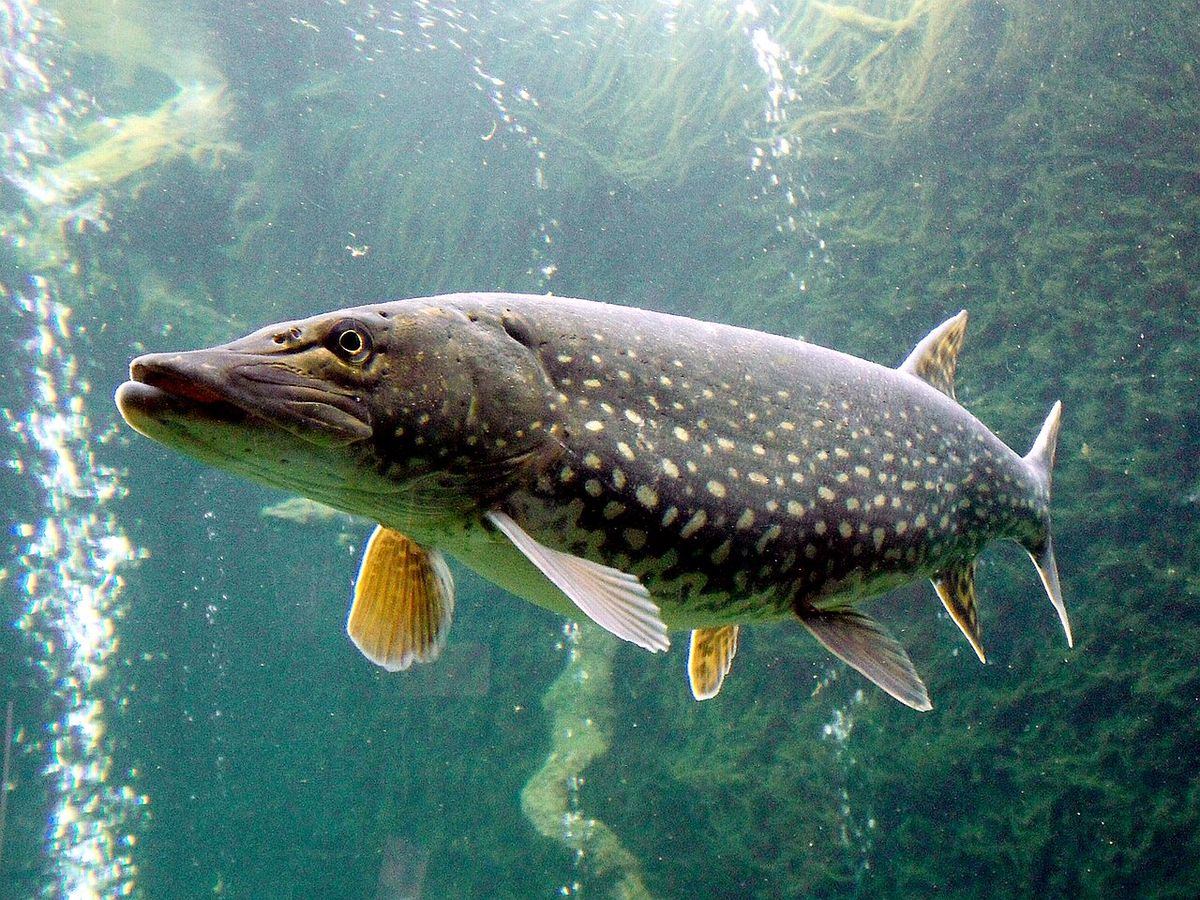
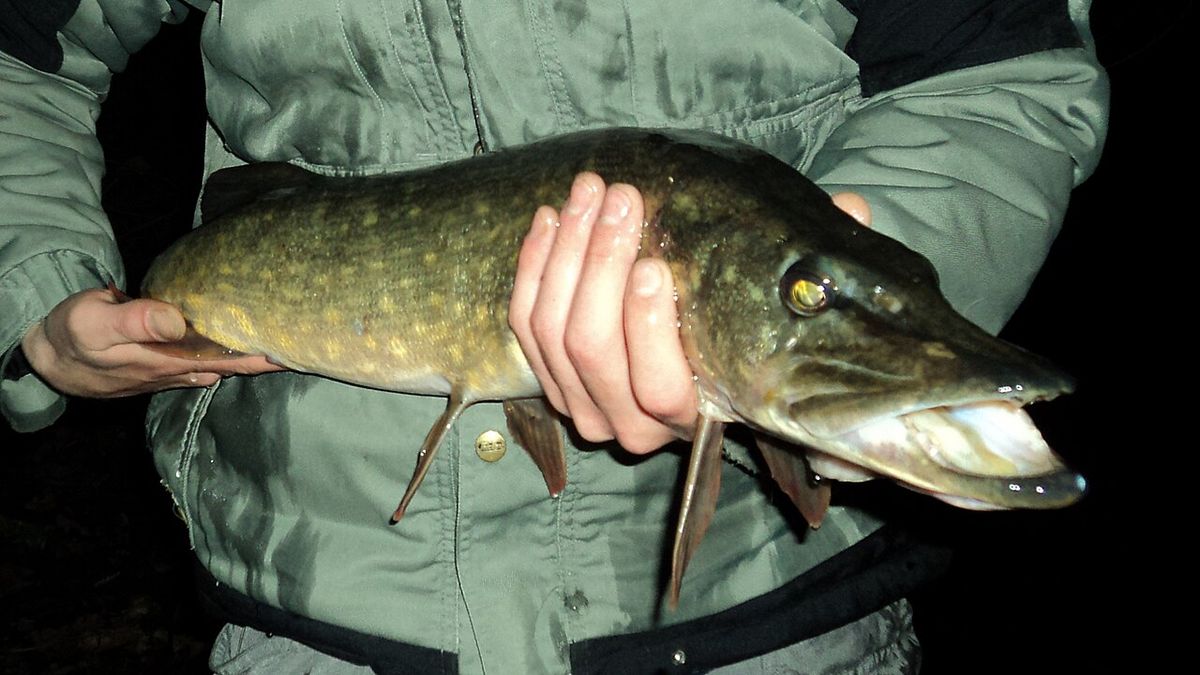
The northern pike possesses a distinctive, torpedo-shaped body adapted for rapid acceleration. Its colouration is typically olive green, shading to yellow or white along the belly, with the flank marked by short, light bar-like spots and often some dark spotting on the fins. Juvenile pike display yellow stripes on a green body, which later break up into the light spotting as the fish matures and the body darkens to an olive green. Key identifying features include the lack of scales on the lower half of the gill cover and the presence of large sensory pores on the head and underside of the lower jaw, which are part of its lateral line system. It is often confused with the muskellunge, but the pike can be distinguished by its light markings on a dark background and by having fewer than six sensory pores on the underside of each side of its lower jaw.
A known hybrid between the northern pike and the muskellunge is called the tiger muskellunge, with sterile males and often fertile females that can back-cross with parent species. Another variant, the silver pike, is not a subspecies but a colour mutation appearing in scattered populations, displaying a silver, white, or silvery-blue hue without the characteristic rows of spots. When ill, silver pike can display a purplish hue, and prolonged illness is a common cause of sterility in males. In Italy, a fish long thought to be a colour variation of the northern pike was identified in 2011 as a separate species named Esox cisalpinus, or the southern pike.
Size, Age, and Growth
Northern pike are a large-growing species, though maximum sizes differ significantly between continents due to environmental factors. In North America, they seldom reach the sizes of their European counterparts, with one of the largest documented specimens being a 21 kg (46 lb) fish caught by Peter Dubuc in New York's Great Sacandaga Lake on 15 September 1940. The all-tackle world record, recognized by the International Game Fish Association, is a 25 kg (55 lb) pike caught by Lothar Louis in Germany in 1986. Reports of larger specimens often involve misidentifications of muskellunge or lack proper documentation. The species is physically capable of reaching 150 cm in length and 28.4 kg in weight, with the largest pike caught on video being a 138 cm, over 23 kg individual from the Netherlands. Northern pike in coastal Eurasian regions grow larger than those inland, and they generally grow larger in Eurasia than in North America.
The relationship between a pike's length and weight is not linear but follows a logarithmic equation of the form W = cL^b, where W is weight, L is length, c is a constant, and b is an exponent. For nearly all fish species, b is close to 3.0, and for northern pike specifically, b = 3.096 and c = 0.000180 when using inches and pounds. This relationship means weight increases disproportionately with length. For example, a 50 cm (20 in) pike weighs approximately 0.9 kg (2 lb), while a 65 cm (26 in) pike weighs about 1.8 kg (4 lb). The typical lifespan of a northern pike is between 10 and 15 years, though individuals can live up to 25 years under ideal conditions. The growth rates and ultimate size are influenced by factors such as food availability, competition, and habitat quality.
Habitat and Geographic Distribution
Northern pike are a Holarctic species, found in freshwater habitats across the Northern Hemisphere. They thrive in a variety of environments, from sluggish streams and shallow, weedy areas of lakes to cold, clear, rocky waters. Dense submerged vegetation is crucial, providing ambush points for adults and shelter from cannibalism for juveniles. They are seldom found in brackish water except for the Baltic Sea area, where they spend time in river mouths and open brackish surface waters before returning to freshwater. Pike seem to prefer water with less turbidity, which is likely related to their dependence on sight-hunting and the presence of vegetation. They inhabit any water body that contains fish, but access to suitable spawning grounds with rich vegetation is an absolute requirement for population sustainability.
Their range in Europe and Russia is extensive, reaching as far north as the Arctic Circle in Norway, Sweden, Finland, and Russia. In Norway, it is present in the north and south but not in central regions. In Sweden and Finland, it is found nearly everywhere except some mountainous lakes. The species is also present in the British Isles, Central and Eastern Europe, the Balkans, and parts of northeastern Spain, but is absent from Portugal, Italy, and most of Spain. It has been introduced to lakes in Morocco. In North America, native populations are widespread across the northern United States and Canada.
- In the United States, pike are found from New England through the Midwest, Great Lakes, and in many western states including Montana, Colorado, Utah, and Alaska, often through stocking programs in reservoirs.
- Key American watersheds include the Ohio Valley, the upper Mississippi River and its tributaries, and the Great Lakes Basin.
- In Canada, the species is native and common in rivers and lakes across Quebec, Ontario, Manitoba, Saskatchewan, Alberta, the northwestern corner of British Columbia, Yukon, the Northwest Territories, and Nunavut.
Introductions for sport fishing in western North America have led to the northern pike being classified as a severe invasive predator. An example of this is in Box Canyon Reservoir on the Pend Oreille River in northeastern Washington. Some fisheries managers believe these introductions threaten other species of fish such as bass, trout, and salmon. This belief has caused government agencies to attempt to exterminate the pike by poisoning lakes, such as Stormy Lake, Alaska.
Behavioural Ecology
Northern pike are solitary, aggressive ambush predators known for remarkable acceleration strikes from a stationary position. They exhibit strong territoriality and homing behaviour, often inhabiting the same area year after year. Their activity patterns, or diel rhythms, change significantly over the year, with pike staying closer to shallow, vegetated shores on sunny days and moving further offshore on windy days. They are more stationary in reservoirs than in lakes, possibly because lakes offer more active prey or because prey in reservoirs eventually cross the pike's path, allowing for energy-conserving ambush tactics. During summer, they tend to group closer to vegetation than in winter, likely for foraging or to safeguard young.
Aggression arises from both feeding needs and competition for space. Young pike frequently have their food stolen by larger conspecifics. Pike use a form of foraging known as ambush foraging, relying on bursts of energy rather than actively chasing prey like perch. Hunting efficiency decreases with competition, and the larger the pike, the larger the territory it controls. An inverse relationship exists between vegetation density and pike size, as smaller pike need more vegetative cover to avoid cannibalism, while larger pike can afford the advantage of a larger line of sight in more open water. They are capable of 'fast start' movements, which are sudden, high-energy bursts of unsteady swimming used to capture prey. During these bursts, they make an 'S' conformation to accelerate and a 'C' conformation to decelerate rapidly. Pike have short digestion times and long feeding periods, allowing them to undertake many hunting bursts, and they are least active during the night.
Reproduction and Early Life History
Pike breed in the spring when water temperatures first reach about 9°C (48°F). They are physically capable of breeding at around two years of age. Males arrive at the breeding grounds a few weeks before females and remain after spawning is finished. Females have enlarged gonads when ready to shed their large number of eggs, a strategy to maximize offspring survival given high early mortality. The sticky eggs are yellow to orange and 2.5 to 3 mm in diameter. Egg survival is positively correlated with the number of eggs laid and requires stable water conditions. Mortality can result from toxic concentrations of iron or rapid temperature changes. The eggs will not hatch if water temperature is below 6°C (43°F).
The embryonic stage lasts from 5 to 16 days, depending on temperature, with faster development at 19°C than at 10°C. Upon hatching, the embryos are 7.5 to 10 mm long and can swim but remain on the bottom for some time. Two critical developmental points determine year-class strength: one during the embryo stage between fertilization and closure of the blastopore, and the second between hatching and the termination of the alevin stage. Under natural conditions, survival from free-swimming larva to a 75-mm juvenile is only around five percent. This low survival is heavily influenced by cannibalism, which can start when pike are around five weeks old, particularly when the predator-to-prey ratio reaches two to one and food is scarce. Cannibalism is more prevalent in cool summers when growth rates are slow, and pike do not discriminate between siblings, making cannibalism likely under low-food conditions.
Diet and Hunting Strategies
The diet of the northern pike shifts dramatically as it grows, reflecting its role as an apex predator. Fry begin by feeding on small invertebrates like Daphnia, quickly moving to larger invertebrates such as Asellus and Gammarus. Once they reach 4 to 8 cm in length, they start preying on small fish like banded killifish. Adults are opportunistic and voracious predators, consuming mainly fish and frogs, but also insects, crayfish, leeches, small mammals, and birds. When pike exceed 700 mm (28 in) in length, they increasingly feed on larger fish. Their distinctive hunting method involves remaining motionless by moving the last fin rays of the dorsal and pectoral fins, then using a powerful burst of speed from its caudal, dorsal, and anal fins to strike. Prey is typically grasped sideways, immobilized by sharp, backward-pointing teeth, and then turned headfirst to swallow.
They are not selective and will eat spiny fish like perch, and even small sticklebacks if nothing else is available. While largely solitary, divers have observed groups of similar-sized pike that may cooperate to start hunting at the same time, leading to 'wolfpack' theories. Large pike can be caught on dead, immobile fish, indicating they patrol a large territory to find food, and they are known to cruise large water bodies several metres deep, probably pursuing schools of prey fish like common roaches or herring. Smaller pike are more strictly ambush predators due to their vulnerability to cannibalism. Pike are often found near structures like culvert exits where prey fish congregate. Although rare, there are documented instances of pike attacking and consuming larger water birds. In 2016, one was observed trying to drown and eat a great crested grebe, another choked to death on a tufted duck, and in 2015, a large pike was implicated in the injury and death of a mute swan in Northern Ireland. A pike attack on a dog has also been recorded.
Importance to Humans and Management
The northern pike is a prized sport fish across its range, renowned for its aggressive strikes and aerial acrobatics when hooked. It ranks among the largest freshwater game fish in North America. Many anglers practice catch-and-release, but it also has a long and distinguished history as a food fish, particularly in Europe, with references dating back to Roman times. The flesh is white and mild-tasting, though the fish's substantial epipleural or 'Y-bones' present a filleting challenge. Skill in removing these bones while minimizing flesh loss, known as 'de-boning', is highly valued. Methods exist for filleting that leave the Y-bones in the body, sacrificing some flesh for simplicity. Larger pike are easier to fillet and de-bone, while smaller ones are often processed into forcemeat for dishes like quenelles and fish mousses to circumvent the bone issue.
The species' prolific and predatory nature creates a dual status in management. In much of its native Canadian range, it is considered a valuable commercial and sport fish. However, where introduced outside its native range, it becomes a severe invasive threat, prompting significant control measures. The table below summarizes key biological and record data for the northern pike, illustrating its size potential and growth parameters.
| Metric | Detail |
|---|---|
| Average Length | 40-55 cm (16-22 in) |
| Maximum Recorded Length | 150 cm (59 in) |
| Maximum Recorded Weight | 28.4 kg (63 lb) |
| IGFA All-Tackle World Record | 25 kg (55 lb) |
| Location of IGFA Record | Greffern Lake, Germany |
| Date of IGFA Record | 16 October 1986 |
| Typical Lifespan | 10-15 years |
| Maximum Lifespan | Up to 25 years |
| Growth Coefficient (b) | 3.096 |
| Length-Weight Constant (c) | 0.000180 (in-lb) |
Management conflicts arise when northern pike are stocked in, or have been introduced to, some western lakes and reservoirs for sport fishing. This is because they can threaten other species of fish such as trout and salmon. Consequently, government agencies have attempted to exterminate the pike by poisoning lakes. This highlights the complex relationship between this predatory fish and human-altered ecosystems.
Etymology and Common Names
The common name 'pike' is derived from the fish's resemblance to the medieval pole weapon, which itself comes from the Middle English word for 'pointed'. This connection to a weapon aptly reflects the fish's pointed snout and predatory nature. The species has a multitude of common names across its global range, reflecting its widespread presence and cultural significance. In the Canadian provinces of Alberta and Manitoba and the U.S. Upper Midwest, 'Northern' is a very popular name. Other frequently used names include jackfish, jack, pickerel, great northern pike, slough shark, slimer, gator, and hammer handle. Names referencing its physical traits, such as 'pointy nose' and 'long head', are also common. Its earlier common name, the 'luce' (when fully grown) or 'luci', was used to form its taxonomic name, Esox lucius, and is still used in the context of heraldry. This wide array of names indicates the fish's prominence in the communities that live alongside it.
Questions about Northern pike
Where can you find northern pike in Canada?
Northern pike are native and widely distributed across Canada. They are commonly found in the freshwater rivers and lakes of Quebec, Ontario, Manitoba, Saskatchewan, and Alberta. Their range also extends into the northwestern corner of British Columbia, as well as throughout Yukon, the Northwest Territories, and Nunavut. They inhabit a variety of habitats but are most associated with weedy, vegetated areas in lakes and sluggish streams. In some limited areas where they have been introduced outside this native range, they are considered an invasive nuisance species.
What is the world record northern pike?
The all-tackle world record for northern pike, as recognized by the International Game Fish Association (IGFA), is a 25 kg (55 lb) fish caught by Lothar Louis on Greffern Lake in Germany on 16 October 1986. While there are reports of larger pike, this is the largest officially documented and verified catch. In North America, pike generally do not grow as large as in Eurasia, with a notable large specimen of 21 kg (46 lb) caught by Peter Dubuc in Great Sacandaga Lake, New York, on 15 September 1940. The maximum recorded weight for the species is 28.4 kg (63 lb).
What do northern pike eat?
Northern pike are carnivorous ambush predators with a diverse diet that changes with their size. Young pike start on small invertebrates like Daphnia but quickly begin eating fish once they reach 4-8 cm in length. Adult pike primarily consume other fish and frogs, but they are opportunistic and will also eat insects, crayfish, leeches, small mammals, and birds. They are known for their aggressive feeding behaviour and are not particular, even eating spiny fish like perch. Cannibalism is also common, especially when other food sources are scarce or when predator-to-prey ratios are high, which contributes significantly to juvenile mortality.
How can you tell a northern pike from a muskellunge?
While similar in shape, key differences help distinguish a northern pike from a muskellunge. The northern pike has light, bean-shaped spots or bars on a darker olive-green body background. In contrast, the muskellunge has dark markings on a lighter background. A more definitive physical trait is found on the underside of the lower jaw. A northern pike has fewer than six sensory pores on each side, while a muskellunge has six or more. The hybrid of the two species is known as a tiger muskellunge, where males are invariably sterile but females are often fertile and can back-cross with the parent species.
Are northern pike dangerous to humans?
Attacks on humans by northern pike are exceptionally rare and not considered a meaningful threat. The fish is an aggressive predator of aquatic life but does not seek out people as prey. There has been at least one documented instance in the summer of 2026 where a pike bit a child's foot in Finland, and very rare historical accounts of bites exist, but these are considered anomalous events. The greater risk associated with pike is ecological, as they are prolific predators and can become invasive when introduced to new ecosystems, devastating native fish populations and requiring costly management interventions.
Is northern pike good to eat and how do you handle the bones?
Yes, northern pike is considered good eating with white, mild-tasting flesh, and it has a long history in European and North American cuisine. The main challenge is the fish's numerous small, forked intermuscular bones known as 'Y-bones' or epipleural bones. Filleting pike requires skill to remove these bones effectively, a process highly valued in fishing communities. Larger fish are easier to bone than smaller ones. Alternative methods involve filleting in a way that leaves the bones in the body, sacrificing some meat. In some culinary preparations, smaller pike are processed into forcemeat for items like fish mousses and quenelles to avoid the bone issue entirely.
Sources and further reading
- Northern pike (Wikipedia)
- Ontario Northern Pike Fishing Canada (land-o-lakes-lodge.com)
- Ontario Northern Pike Fishing (wabigoonlakeoutfitters.com)
Checked by the Your Space Hamilton desk. Last updated 2026-10-19.