HMS St Lawrence (1814)
HMS St Lawrence was a 112-gun first-rate ship of the line of the Royal Navy, constructed in 1814 at the Point Frederick naval shipyard in Kingston, Upper Canada. The vessel was the largest wooden warship ever launched on the Great Lakes and the only Royal Navy ship of the line ever built and operated entirely in fresh water. Its immense size and firepower gave the British uncontested control of Lake Ontario during the final months of the War of 1812, effectively ending naval conflict on the lake through deterrence alone. After the war, the ship was decommissioned, later served as a brewery storage hulk, and its sunken remains are now a designated National Historic Site and a popular recreational dive site.
Design and Construction
The construction of HMS St Lawrence was a monumental feat of naval engineering undertaken in the remote wilderness of Upper Canada. Master Shipwright William Bell, with a workforce of nearly 200 shipwrights, oversaw the building of the vessel at the Point Frederick shipyard in Kingston in under ten months, with the keel laid on 12 April 1814. The ship was designed specifically for the conditions of Lake Ontario, resulting in a hull with a shallower draft than ocean-going vessels and built without a quarterdeck, poop deck, or forecastle, giving it the profile of a spar-deck frigate. As it was not required to carry vast quantities of provisions for long voyages, designers could allocate more space and weight to its formidable armament. The project consumed enormous resources, requiring materials to be stripped from three 74-gun ships of the line, HMS Ajax, HMS Centaur, and HMS Warspite, at Montreal and transported to Kingston. When launched on 10 September 1814, HMS St Lawrence was a triple-decker that measured larger in tonnage and gun-deck length than Horatio Nelson's famous flagship, HMS Victory.
The ship's specifications were impressive for any warship, let alone one built on an inland lake. Its gundeck measured 194 feet 2 inches, with a beam of 52 feet 7 inches and a burthen of 2,304 tons. The vessel was originally designed for 102 guns but was completed with an armament of 112. Its final configuration included twenty-eight 32-pounder long guns and four 24-pounder long guns on the lower deck, thirty-six 24-pounder long guns on the middle deck, and thirty-two 32-pounder carronades on the upper deck. The crew complement varied between 700 and 837 officers and seamen, most of whom had to be dispatched from Quebec City to man the vessel.
Strategic Context on Lake Ontario
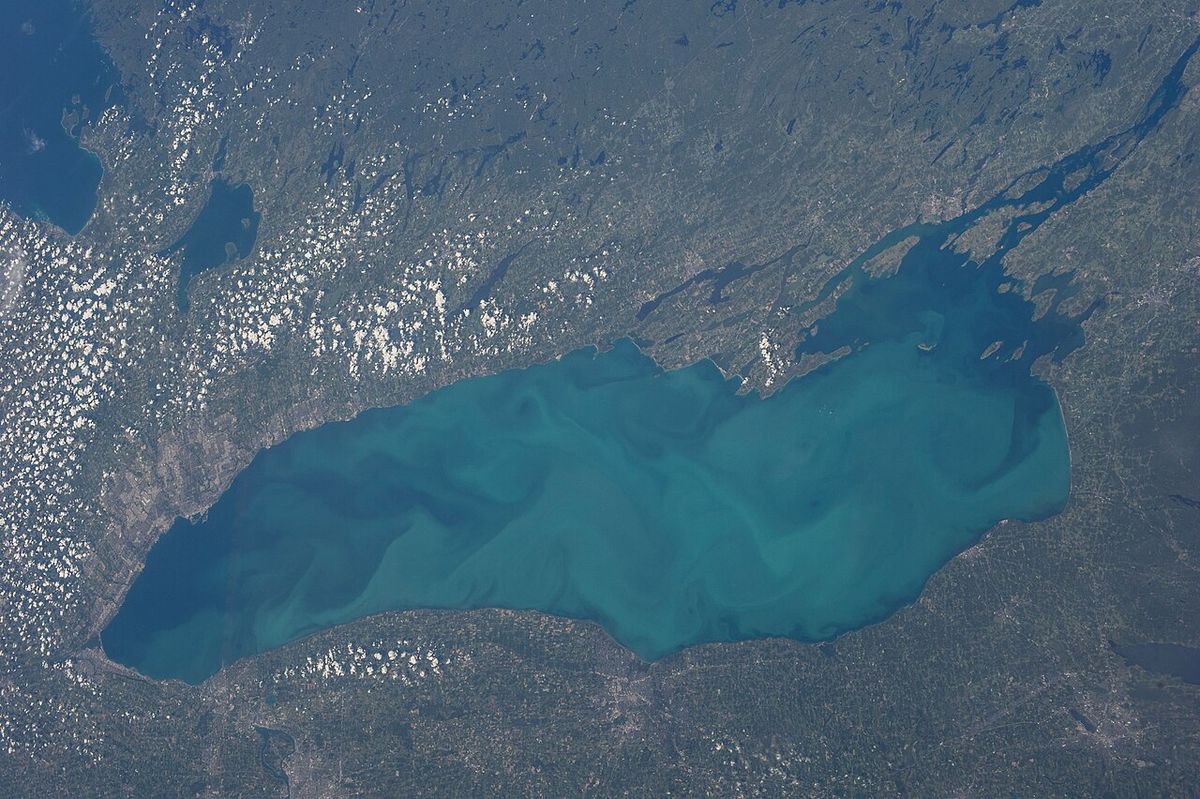
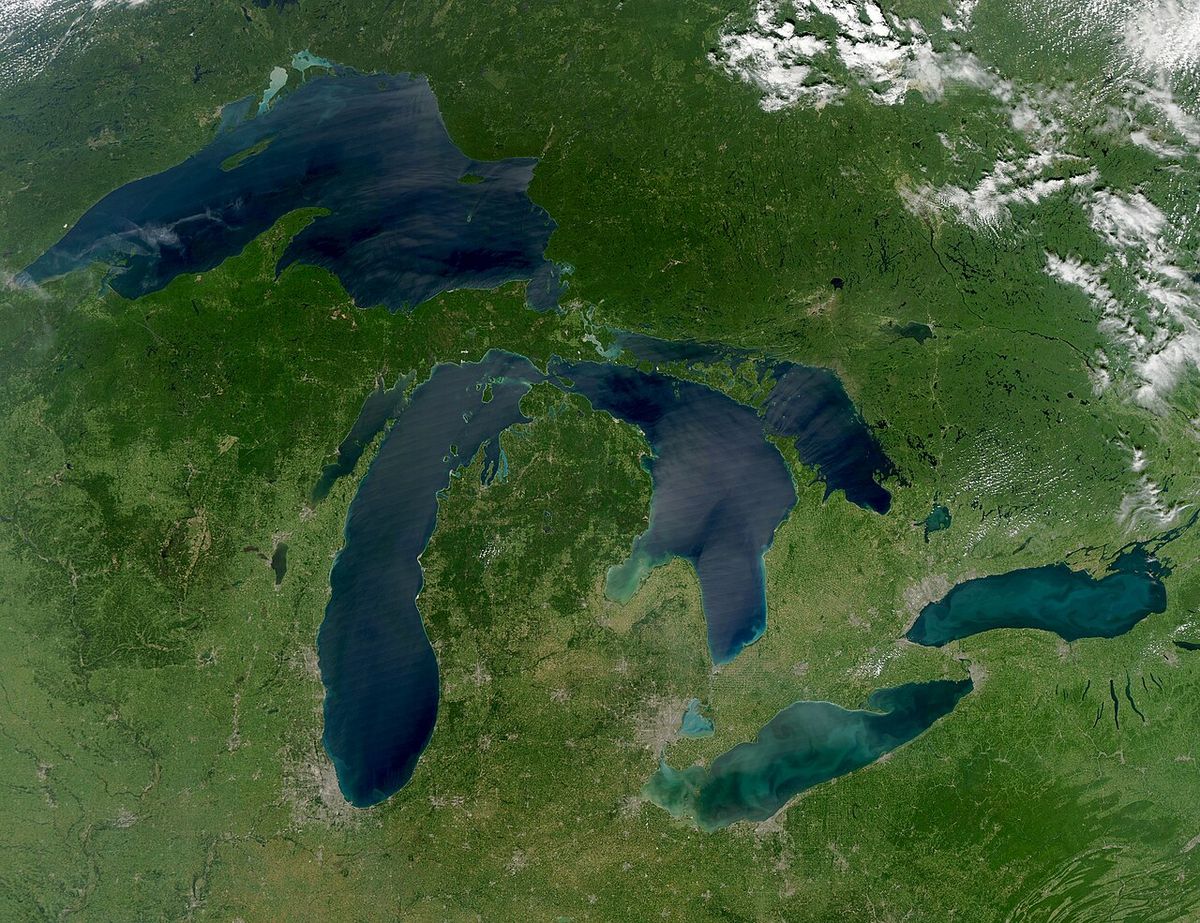
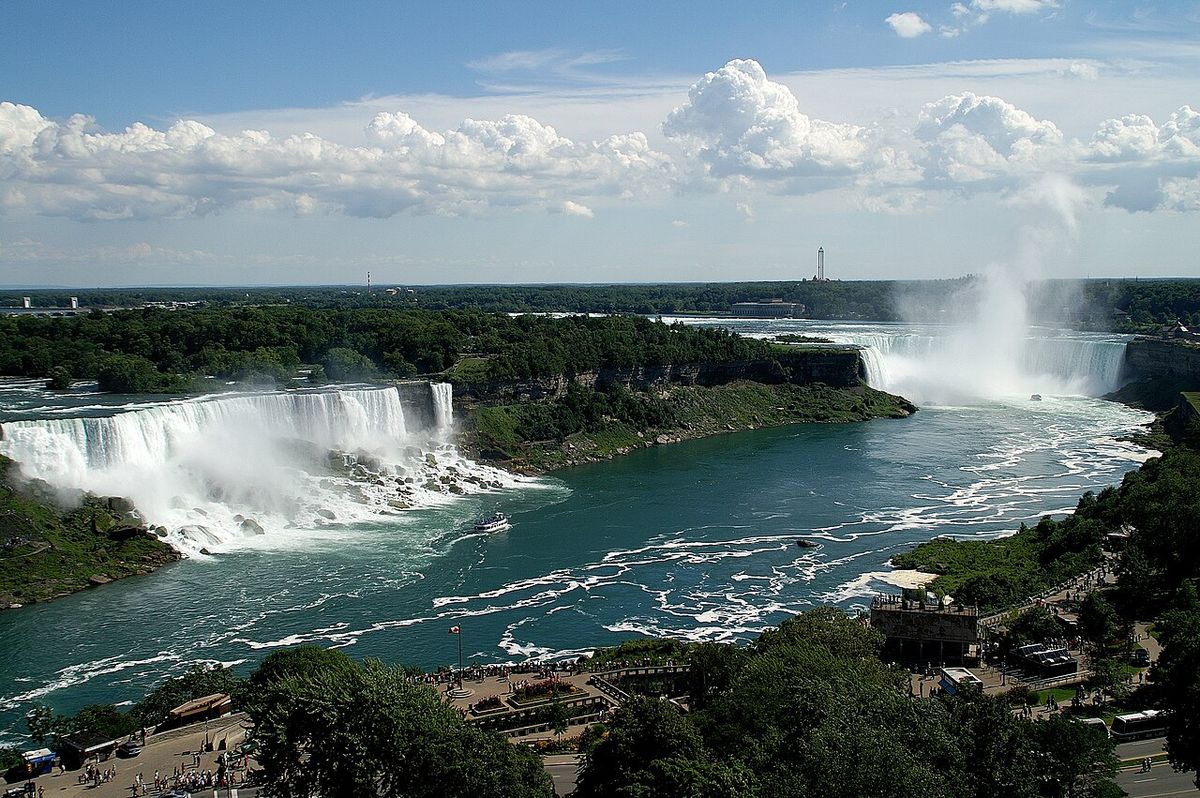
Control of Lake Ontario was the paramount strategic objective for both British and American forces during the War of 1812. The lake served as the most critical supply route for British military operations to the west, and for American ambitions to invade Upper Canada. A unique geographical challenge defined the naval arms race on the lake, as Niagara Falls to the west and the rapids on the St. Lawrence River to the east made it effectively landlocked for large vessels. This meant all warships had to be constructed on site, at either the British dockyard in Kingston or the American base at Sackets Harbor. The naval campaign had been characterized by a back-and-forth struggle, with control of the waters shifting as each side launched new, larger vessels. The American fleet under Commodore Isaac Chauncey had previously enjoyed periods of dominance, enabling attacks on York and Fort George. The British decision to construct a first-rate ship of the line, a class of vessel that had hitherto been the exclusive domain of the open ocean, was a direct and overwhelming response to this challenge, intended to secure permanent control of the lake.
Service in the War of 1812
HMS St Lawrence was commissioned as the flagship of British naval commodore Sir James Lucas Yeo immediately upon its launch, with Captain Frederick Hickey serving as the vessel's Flag Captain. The ship's construction had cost an estimated £500,000, a staggering sum that reflected its strategic importance. Its mere presence on the lake had an immediate and decisive impact. The day after its launch, an American fleet appeared off Kingston and offered battle, but the British, still preparing the new ship, declined. By the time St Lawrence undertook its maiden voyage on 16 October 1814, its reputation as a 'freshwater first-rate' had already cowed the American squadron. The ship never engaged in combat, as Commodore Chauncey's fleet refused to leave the safety of Sackets Harbor, granting the British uncontested control for the war's final months. The vessel's service was not without incident. On 19 October, just days after first putting to sea, it was struck by lightning, which damaged a mast and killed several crew members. The Americans also attempted a covert attack using an early naval mine, described at the time as a 'torpedo', but British forces drove off the attackers before they could reach the ship.
During its brief active service, HMS St Lawrence made several trips around Lake Ontario to transport troops and supplies, demonstrating British mastery of the waters. Key voyages included a trip to Niagara in late October to unload elements of the 90th Foot and provisions, and a round trip between Kingston, Niagara, and York in early November. While popular history sometimes credits the ship with single-handedly ending the War of 1812, its influence was primarily local and psychological. The final American retreat from the Niagara peninsula and the broader peace negotiations were influenced by a complex array of factors, including battles on other fronts and political pressures. Nonetheless, on Lake Ontario, the St Lawrence's overwhelming power made further naval action by the United States fleet unthinkable, effectively silencing the guns on the lake.
Post-War Fate and Wreck Site
With the end of the war in 1815, the immense HMS St Lawrence was quickly rendered obsolete by the peace and by the Rush-Bagot Agreement of 1817, which limited naval armaments on the Great Lakes. The ship was decommissioned and placed 'in ordinary' at Kingston. Its masts and guns were removed, and sloping roofs were constructed over the upper deck to protect the hull from the weather. In January 1832, the Admiralty sold the empty hull to local merchant Robert Drummond for the sum of £25. Between May and August of that year, the hull was towed from Navy Bay to a new location, where it was incorporated into a pier attached to Morton's Brewery in Kingston. For years, the former warship served as a storage facility for the brewery, holding materials such as cordwood. The hull eventually sank, or was scuttled to prevent further decay of its timbers, in about 30 feet of water close to the Kingston shoreline.
The submerged remains of HMS St Lawrence, along with those of the warships Princess Charlotte and Prince Regent, were designated a National Historic Site of Canada in 2015. Over nearly two centuries, the wooden structure has largely rotted away. As of 2009, only the keel and the ribs of the frame remained on the lakebed. The site, located at coordinates 44°13′14″N 76°30′18″W, is now a popular destination for recreational divers, offering a tangible connection to this unique chapter in Canadian naval history. The wreck is a protected archaeological site, and divers can explore the ghostly outline of what was once the most powerful warship on the Great Lakes.
Historical Significance and Artifacts
HMS St Lawrence holds a singular place in naval history as a demonstration of the scale and intensity of the War of 1812's inland naval arms race. Its construction showed the British Empire's ability to project industrial and logistical power into the wilderness of North America. The ship is frequently compared to HMS Victory, and while older, Victory is smaller in key dimensions, highlighting the extraordinary size of the freshwater vessel. A more contemporary comparison is the American ship New Orleans, which was under construction at Sackets Harbor. Designed by Henry Eckford to mount 110 guns on a 212-foot gundeck, it was even larger than St Lawrence but was never launched before the war ended. The existence of these rival leviathans highlights the extreme measures both nations were willing to take for control of Lake Ontario. A detailed scale model of HMS St Lawrence, crafted by master modeller Louis Roosen, is held in the collection of the Royal Military College of Canada Museum in Kingston. This model serves as an important educational artifact, allowing visitors to appreciate the ship's formidable design. A dramatic, though slightly inaccurate, watercolour painting of the vessel by marine artist C.J.H. Snider also exists, capturing its imposing presence on the lake. These artifacts, along with the preserved wreck site, ensure that the story of this unique freshwater first-rate continues to be told.
Key Specifications and Comparisons
The technical details of HMS St Lawrence reveal a warship built to dominate its specific theatre of operation. Its dimensions and armament were carefully balanced for the conditions of Lake Ontario, resulting in a vessel that was both powerful and uniquely configured. The ship's design prioritized firepower over ocean-going seaworthiness. Its shallow draft, reported as 11 feet forward and 13 feet aft when lightly loaded, was essential for operating in Lake Ontario's waters but contributed to the vessel being considered somewhat unstable compared to deep-draft saltwater ships. The armament was a mix of long guns, effective at ranges over a mile, and short-range, high-impact carronades, creating a devastating weapon system for the confined battlespace of the lake. The logistical effort to achieve this armament was immense, requiring the stripping of guns and fittings from other Royal Navy vessels stationed in Canada.
| Vessel | Gundeck Length | Tonnage | Armament |
|---|---|---|---|
| HMS St Lawrence (1814) | 194' 2" | 2,304 tons | 112 guns |
| HMS Nelson (1814) | 205' | 2,619 tons | 118 guns |
| USS New Orleans (unlaunched) | 212' | 3,200 tons | 110 guns |
Construction Timeline and Key Events
The keel of HMS St Lawrence was laid on 12 April 1814 at the Point Frederick shipyard in Kingston, Upper Canada. The ship was launched on 10 September 1814 after a construction period of well under ten months. It was commissioned as the flagship of British naval commodore Sir James Lucas Yeo in October 1814. Following the end of the War of 1812 in 1815, the ship was decommissioned and laid up.
- 12 April 1814: The keel of HMS St Lawrence was laid at the Point Frederick shipyard in Kingston.
- 10 September 1814: The ship was launched at 10 a.m., after a build time of under ten months.
- 16 October 1814: The vessel undertook its maiden voyage from Kingston under Captain Frederick Hickey.
- 19 October 1814: St Lawrence was struck by lightning, damaging a mast and killing several crew members.
- 1-10 November 1814: The ship completed a final round trip from Kingston to Niagara and York.
- 1815: Following the war's end, the ship was decommissioned and placed 'in ordinary' at Kingston.
- January 1832: The hull was sold to merchant Robert Drummond for £25.
- 2015: The wreck site was designated a National Historic Site of Canada.
Armament and Crew Details
HMS St Lawrence was a 112-gun first-rate ship of the line. Its armament included thirty-two 32-pounder carronades and two 68-pounder carronades on the upper deck. The middle deck mounted thirty-six 24-pounder long guns, and the lower deck held twenty-eight 32-pounder long guns, four 24-pounder long guns, and two 68-pounder carronades. The ship required a crew of 700 officers and seamen to operate.
- Lower Deck: Twenty-eight 32-pounder long guns and four 24-pounder long guns.
- Middle Deck: Thirty-six 24-pounder long guns.
- Upper (Spar) Deck: Thirty-two 32-pounder carronades.
- Heavy Carronades: Two 68-pounder 'smasher' carronades mounted on the upper deck.
- Total Armament: 112 guns, with a broadside weight estimated at 1,564 pounds.
- Crew Size: Between 700 and 837 officers and seamen.
- Crew Origin: Most crew members were dispatched from Quebec City to man the vessel in Kingston.
The size and armament of HMS St Lawrence were greater than those of the British flagship HMS Victory. Its presence on Lake Ontario gave the British uncontested control of the lake during the final months of the War of 1812. The American fleet was deterred from setting sail once the St Lawrence was battle-ready. Consequently, the ship never saw combat action during the war.
Questions about HMS St Lawrence (1814)
Why was HMS St Lawrence built on Lake Ontario?
HMS St Lawrence was built on Lake Ontario because the lake was effectively landlocked for large warships due to Niagara Falls and St. Lawrence River rapids, forcing both the British and Americans to construct their naval vessels locally. The British, under Commodore James Yeo, built this first-rate ship to achieve decisive naval superiority over the American fleet commanded by Isaac Chauncey. Its immense size and firepower were intended to secure permanent control of the lake, which was the vital supply route for British forces in Upper Canada. The ship's successful construction and launch in 1814 achieved this goal, ending all naval action on the lake for the remainder of the war.
Did HMS St Lawrence ever see battle?
No, HMS St Lawrence never engaged in combat during the War of 1812. The ship was launched on 10 September 1814 and commissioned as the British flagship on Lake Ontario. Its sheer size and power, mounting 112 guns, acted as an overwhelming deterrent. The American fleet, aware of its capabilities, refused to leave its base at Sackets Harbor to offer battle after the St Lawrence was ready for service. The vessel's only hostile encounters were being struck by lightning, which killed several crew, and an attempted attack by Americans using an early naval mine, which was thwarted. Its service was limited to transporting troops and supplies while dominating the lake by its presence alone.
How does HMS St Lawrence compare to HMS Victory?
HMS St Lawrence was a larger and more heavily armed ship than Horatio Nelson's famous flagship, HMS Victory, despite being built for freshwater service. The St Lawrence had a longer gundeck (194 feet 2 inches versus 186 feet), a slightly wider beam, and greater tonnage (2,304 tons versus 2,142 tons). It also carried more guns, with 112 to Victory's 100, resulting in a heavier potential broadside. However, Victory was a seasoned ocean-going vessel designed for global deployment, while the St Lawrence was built with a shallower draft and other modifications specifically for the confined waters of Lake Ontario. The comparison highlights the extraordinary scale of the naval construction effort in Upper Canada during the war.
What happened to HMS St Lawrence after the war?
After the War of 1812 ended in 1815, HMS St Lawrence was decommissioned and laid up in Kingston. Its guns and masts were removed, and it was placed in reserve. In January 1832, the hull was sold for £25 to Robert Drummond. It was then towed to a location where it formed the end of a pier for Morton's Brewery in Kingston, serving as a storage hulk for materials like cordwood. The hull eventually sank, or was scuttled to prevent further decay, in about 30 feet of water near the Kingston shoreline. Its remains, along with two other War of 1812 wrecks, were designated a National Historic Site of Canada in 2015.
Where can I see the wreck of HMS St Lawrence?
The wreck of HMS St Lawrence lies in approximately 30 feet (9.1 metres) of water close to shore in Kingston Harbour, at coordinates 44°13′14″N 76°30′18″W. The site is accessible to recreational divers and is a popular local diving attraction. Over time, the wooden hull has largely deteriorated, and as of 2009, only the keel and the ribs of the frame remain on the lakebed. The wrecksite, along with those of the warships Princess Charlotte and Prince Regent, is protected as a National Historic Site of Canada. For those who cannot dive, a detailed scale model of the ship is on display at the Royal Military College of Canada Museum in Kingston.
Who was responsible for building HMS St Lawrence?
HMS St Lawrence was built by the Royal Navy at its dockyard on Point Frederick in Kingston, Upper Canada. Master Shipwright William Bell is widely credited as the designer and builder, overseeing a workforce of nearly 200 shipwrights. The project was initiated under the authority of British naval commodore Sir James Lucas Yeo, who had approval to build a large vessel but significantly enlarged the plans to create a first-rate ship of the line. The keel was laid on 12 April 1814, and the ship was launched just 156 days later, on 10 September 1814, a remarkable feat of construction that required stripping materials from other Royal Navy ships stationed in Montreal to complete.
Sources and further reading
- HMS St Lawrence (1814) (Wikipedia)
- HMS St Lawrence (British Warship of the War of 1812) (thecanadianencyclopedia.ca)
- HMS St Lawrence (navalmarinearchive.com)
Checked by the Your Space Hamilton desk. Last updated 2026-10-25.