2023 Lake Huron high-altitude object
The 2023 Lake Huron high-altitude object was an unidentified octagonal aerial object shot down by the United States military over Lake Huron on February 12, 2023. It was the fourth such object downed over North American airspace in a span of just over a week, following a series of incidents that began with the destruction of a suspected Chinese surveillance balloon. The object, flying at approximately 20,000 feet, was deemed a hazard to civilian aviation and was intercepted by an F-16 fighter jet from the Minnesota Air National Guard. The event highlighted heightened continental defence vigilance and later revelations identified it as commercial weather equipment.
Background and Continental Context
The shootdown over Lake Huron occurred within a highly charged period for North American aerospace defence. One week earlier, on February 4, 2023, a U.S. Air Force F-22 Raptor shot down a large, suspected Chinese surveillance balloon off the coast of South Carolina after it traversed the continental United States and Canada. This event triggered a significant recalibration of radar monitoring protocols by the North American Aerospace Defense Command (NORAD). Assistant Secretary of Defense for Homeland Defense Melissa Dalton explained that the U.S. began more closely scrutinizing airspace at certain altitudes, including enhancing radar systems to detect smaller, slower-moving objects that were previously filtered out as noise. General Glen VanHerck, the NORAD commander, stated that prior to these adjustments, up to 98 percent of certain radar data was not routinely analyzed because the military aimed to filter out radio signal noise from sources like flocks of birds or weather balloons. The Lake Huron incident was directly preceded by two other shootdowns: an object described as cylindrical and silver-ish gray over northern Alaska on February 10 and another over Yukon, Canada, on February 11. This cluster of events represented an unprecedented series of engagements in North American peacetime air defence operations and fueled significant political and public attention.
Detection and Flight Path
The object was first detected by United States Northern Command on February 11, 2023, over Havre, Montana, in proximity to sensitive Department of Defense sites. Initial assessments were uncertain, leading the Federal Aviation Administration to briefly close airspace over the city while investigations proceeded, and it was initially thought to be a potential radar anomaly. Canadian authorities later noted the object was also tracked above Alberta. The object disappeared from tracking until it was spotted again on February 12, this time over Wisconsin and the Upper Peninsula of Michigan. It was travelling at an altitude of about 20,000 feet and moving eastward over Lake Huron. Brigadier General Pat Ryder, the Pentagon press secretary, confirmed that NORAD had maintained visual and radar tracking of the object since the morning of February 12. Based on its flight path and data, officials reasonably connected this object to the earlier radar signal detected over Montana. The object’s transit near sensitive military installations and its altitude, which posed a risk to commercial air traffic, were key factors in the decision to engage it. The Federal Aviation Administration and military authorities imposed a temporary flight restriction over parts of Door County, Wisconsin, northern Lake Michigan, and northern Michigan ahead of the intercept operation.
Description and Official Assessments
Officials described the object as unmanned, octagonal in shape, and having strings hanging from its structure. It lacked any form of self-propulsion and was assessed to be moving with prevailing winds, and a spokesman for the U.S. National Security Council stated the object did not emit any discernible communication signals. While the U.S. military did not assess it as a direct kinetic military threat to ground targets, it was deemed a safety hazard to civilian aviation. Brigadier General Ryder also cited concerns over its potential surveillance capabilities due to its flight path near sensitive sites. In the days following the shootdown, White House spokesman John Kirby told reporters that U.S. intelligence had found no evidence connecting the object to any foreign espionage program. He indicated the leading explanation being considered was that it could be a benign balloon tied to commercial or research entities, an assessment that would later be corroborated. A senior U.S. official stated at the time that the object, like the two others shot down over Alaska and Yukon, was not comparable to the earlier Chinese balloon and was much smaller with no apparent payload.
The Shootdown Operation
On the afternoon of February 12, U.S. President Joe Biden ordered the object to be shot down over Lake Huron out of an abundance of caution and on the recommendation of military leaders. The mission was assigned to F-16C Viper fighter aircraft from the Minnesota Air National Guard's 148th Fighter Wing, which had deployed from Duluth and took off from an airfield in Madison, Wisconsin. At 2:42 p.m. Eastern Time, one of the F-16s fired an AIM-9 Sidewinder air-to-air missile, successfully destroying the object over the lake. An earlier missile fired had missed its target and landed in the water. In preparation for the operation, U.S. and Canadian authorities imposed temporary flight restrictions over parts of Lake Michigan, Door County in Wisconsin, and near Tobermory, Ontario. A Pentagon statement noted the location was chosen to avoid impact to people on the ground while improving chances for debris recovery. The engagement was captured on video by the aircraft's Advanced Targeting Pod, footage later declassified and released by the Pentagon in 2026 as part of the Presidential Unsealing and Reporting System for UAP Encounters initiative. The video description notes the sensor footage shows a kinetic interaction at the 20-second mark, with the object fragmenting in a radial displacement pattern suggestive of a high-energy event.
Recovery Efforts and Later Identification
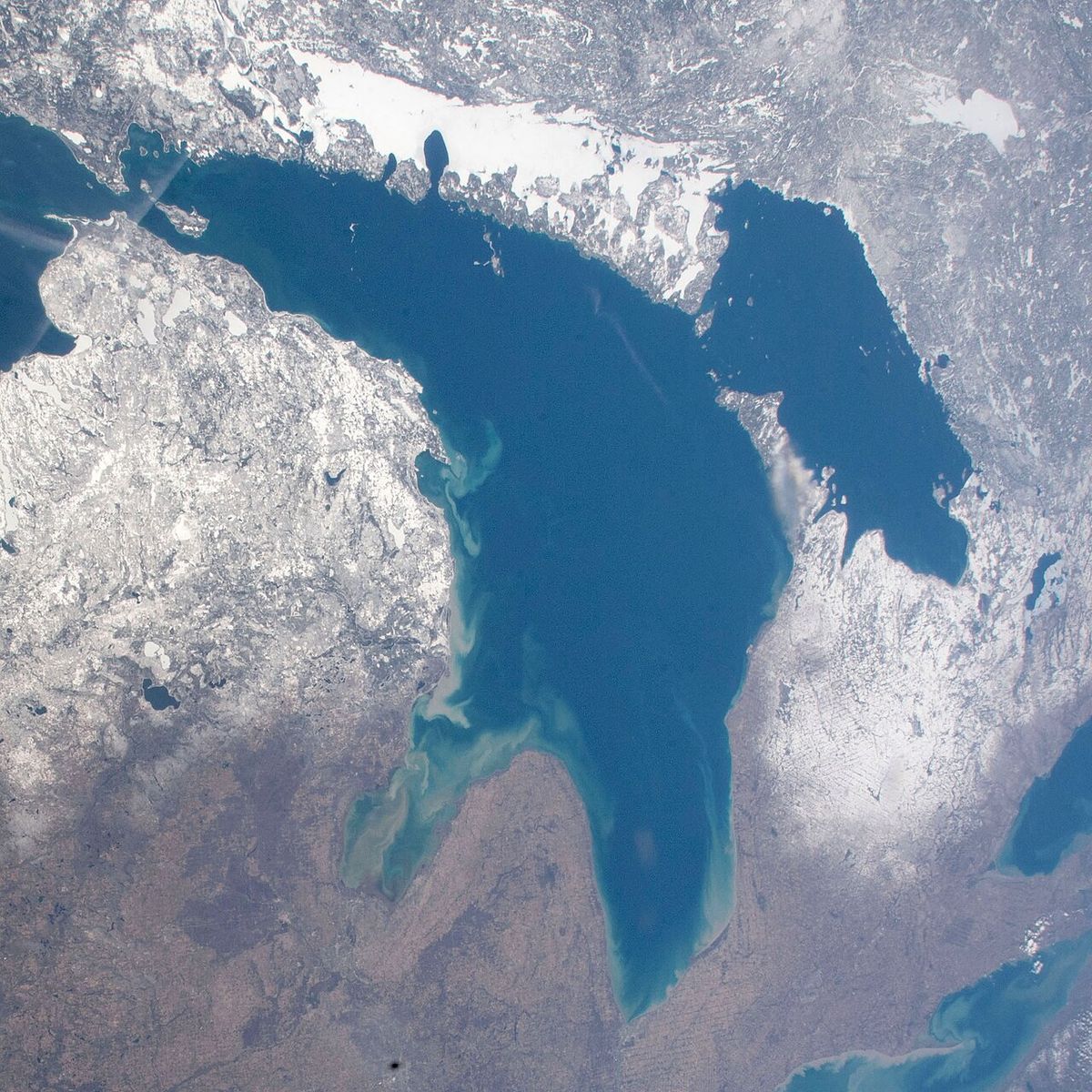
The object fell into Lake Huron approximately 15 nautical miles from the Michigan shoreline, an area where the lake is exceptionally deep. General VanHerck noted the object likely landed in Canadian waters, and searches for the wreckage were complicated by the depth of the mid-lake boundary waters. Recovery operations were immediately hampered by severe weather conditions, including wave swells up to 12 feet and wind gusts up to 30 knots on the day following the downing. On February 16, 2023, the Royal Canadian Mounted Police announced the active search had been suspended due to the deteriorating weather and a low probability of successful recovery. However, documents made public in November 2024 revealed a significant postscript to the incident, confirming that authorities had successfully recovered debris from the object. The documents stated the object was definitively identified as originating from a company that sells weather monitoring equipment, confirming earlier official speculation about its likely benign, commercial nature.
The sequence of high-altitude object engagements in February 2023 included four distinct events over nine days. The first event was the shootdown of a Chinese balloon off the coast of South Carolina on February 4, 2023. This was followed by the shootdown of a high-altitude object over northern Alaska on February 10, 2023. The third event was the shootdown of a high-altitude object over Yukon, Canada, on February 12, 2023, and the fourth was the shootdown of an object over Lake Huron later that same day.
- Feb. 4: A large suspected Chinese surveillance balloon is shot down by an F-22 off the coast of South Carolina at 2:39 p.m. after crossing the continent.
- Feb. 10: A high-altitude object described as cylindrical is shot down over northern Alaska by an F-22 from Joint Base Elmendorf Richardson.
- Feb. 11: An unidentified object is shot down over Yukon, Canada, by a U.S. F-22 at approximately 3:41 p.m. ET on orders from Prime Minister Justin Trudeau.
- Feb. 12: The octagonal object is shot down over Lake Huron by a Minnesota Air National Guard F-16 at 2:42 p.m. ET.
This series of events demonstrated the operational tempo of NORAD during this period. Following the Chinese balloon incident, the United States enhanced its radar monitoring to better categorize and track slower-moving objects. Melissa Dalton, Assistant Secretary of Defense for Homeland Defense, stated this closer scrutiny may partly explain the increase in objects detected. The policy shift led to a more proactive interception posture, with President Joe Biden ordering the Lake Huron object shot down out of an abundance of caution.
Political and Official Reactions
The shootdown prompted statements from political leaders in both the United States and Canada. Michigan Governor Gretchen Whitmer said she was glad the object had been swiftly, safely, and securely taken down over the lake. Minnesota Governor Tim Walz said he was proud of the Minnesota Air National Guard airmen who executed their mission flawlessly, protected the homeland, and got the birds home safe. Canadian Minister of National Defence Anita Anand unequivocally expressed Canada's support for the U.S. action, reaffirming the commitment to continued cooperation with the U.S. and NORAD to protect North America. Prime Minister Justin Trudeau, speaking about the broader context of the Yukon and Lake Huron incidents, emphasized that the safety of Canadians was the top priority and that the objects were considered threats to civil aviation. In the U.S. Congress, Representative Elissa Slotkin of Michigan called for full briefings based on the exploitation of any recovered wreckage, and Senate Majority Leader Chuck Schumer stated the U.S. believed the objects downed over Alaska and Yukon were balloons, though smaller than the first Chinese balloon.
Strategic and Defence Implications
The Lake Huron incident and the preceding engagements had a tangible impact on North American defence policy and procedures. The events demonstrated a rapid adaptation of NORAD's surveillance and response capabilities in the wake of the Chinese balloon transit, with General VanHerck confirming radar adjustments gave better fidelity on seeing smaller objects. The enhancement of radar filters to detect smaller, slower objects directly led to the increased number of objects being tracked and engaged, as explained by officials including Melissa Dalton who said it may partly explain the increase. This period tested the rules of engagement for peacetime air sovereignty missions, leading to quicker decisions to shoot down unidentified objects perceived as hazards to aviation. The release of declassified footage in 2026 as part of the U.S. government's PURSUE initiative on unidentified aerial phenomena provided public transparency on one of these engagements. The footage was identified by the All-domain Anomaly Resolution Office as likely derived from an infrared sensor aboard a U.S. military platform in 2023, uploaded to a classified network that February. Ultimately, the identification of the Lake Huron object as commercial equipment highlighted the persistent challenges of distinguishing between mundane aerial activities and potential threats, a central issue in modern air domain awareness that required refined technical and procedural solutions.
Technical Details and Declassified Evidence
The declassified video of the engagement, released in 2026, provides the most direct visual evidence of the event. The footage originates from the Advanced Targeting Pod of the Minnesota Air National Guard F-16C involved in the shootdown, with the uploader-defined title referencing the callsign and weapon system. According to the official description accompanying the release, the sensor focuses on an area of contrast at the 11-second mark, and at 20 seconds a kinetic interaction occurs, fragmenting the object in a radial displacement pattern. Analysis of the footage suggests the object was a balloon, with a cluster of wires visible dangling beneath it, though no specific payload is clear. The missile used was an AIM-9 Sidewinder, a heat-seeking, infrared-guided air-to-air weapon, and the Pentagon's statement that the first missile missed illustrates the technical challenges of engaging small, slow-moving objects at high altitude. The successful intercept occurred in U.S. airspace over Lake Huron, though the object's flight path had originated from the west and crossed through monitored corridors above Montana, Wisconsin, and Michigan.
Comparative Analysis of the 2023 Objects
The four objects engaged in February 2023 shared the characteristic of being unmanned aerial objects but differed in their assessed origin, size, and description. The first object, the Chinese balloon, was large, carried a discernible payload, and was tracked for days before being shot down over water after passing over sensitive sites including intercontinental ballistic missile installations. The Alaska and Yukon objects were described as smaller and lacking obvious payloads, with the Yukon engagement marking the first time a NORAD operation downed an aerial object according to Defence Minister Anita Anand. The Lake Huron object was uniquely described as octagonal with strings, and its later identification as commercial gear completed a narrative arc from unidentified threat to explained incident. The table below compares key attributes of these incidents based on official statements and reports.
| Date | Location | Description | Intercept Aircraft |
|---|---|---|---|
| Feb. 4 | Off South Carolina | Large surveillance balloon | F-22 Raptor |
| Feb. 10 | Northern Alaska | Cylindrical, silver-gray object | F-22 Raptor |
| Feb. 11 | Yukon, Canada | Unidentified object, similar to balloon | F-22 Raptor |
| Feb. 12 | Lake Huron | Octagonal object with strings | F-16C Viper |
The collective response to these objects revealed a continent-wide security apparatus operating under newly heightened alert conditions. Decisions to engage were made at the highest levels of both the United States and Canadian governments. U.S. President Joe Biden directed the Lake Huron shootdown at the recommendation of military leaders. Canadian Prime Minister Justin Trudeau ordered the shootdown over Yukon, and Canadian Minister of National Defence Anita Anand unequivocally supported the action over Lake Huron.
Questions about 2023 Lake Huron high-altitude object
What was the 2023 Lake Huron high-altitude object?
The object was an unmanned, octagonal aerial structure with strings hanging from it, flying at approximately 20,000 feet. Initially classified as an unidentified aerial phenomenon, it was later identified in 2024 as originating from a company that sells weather monitoring equipment. It posed no kinetic military threat but was considered a hazard to civilian aviation due to its altitude and flight path near sensitive sites. A senior U.S. official stated it had no discernible payload and was much smaller than the Chinese balloon shot down the previous week.
Why was the object over Lake Huron shot down?
U.S. President Joe Biden ordered the shootdown on the recommendation of military leaders out of an abundance of caution. The object's flight path took it near sensitive Department of Defense locations, and its altitude of 20,000 feet presented a clear hazard to civilian air traffic. Brigadier General Pat Ryder stated its path and altitude raised concerns it could be a hazard to civil aviation. The decision was part of a heightened defensive posture following a series of similar aerial intrusions earlier in February 2023.
Which military unit was involved in the shootdown?
The intercept and destruction were carried out by the Minnesota Air National Guard's 148th Fighter Wing based in Duluth. Pilots flying an F-16C Viper fighter jet, which had taken off from Madison, Wisconsin, fired an AIM-9 Sidewinder missile that successfully destroyed the object over Lake Huron at 2:42 p.m. ET on February 12, 2023. An earlier Sidewinder missile fired during the engagement missed the target and landed in the lake.
Was the object ever recovered and identified?
Yes. While initial search efforts were suspended on February 16 due to bad weather and deep water, documents released in November 2024 confirmed that debris from the object had been recovered. The investigation concluded the object was from a company that sells weather monitoring equipment, confirming it was a benign, commercial apparatus and not an espionage device. This identification aligned with early White House statements that it could be tied to a commercial or research entity.
How did Canada respond to the incident?
Canadian authorities fully supported the U.S. action. Minister of National Defence Anita Anand stated Canada unequivocally supported the shootdown and would continue to work with the U.S. and NORAD. Canadian airspace near Tobermory, Ontario, was temporarily closed in coordination with the operation, and the RCMP was involved in initial recovery planning before the search was suspended. Prime Minister Justin Trudeau emphasized that protecting civilian aviation safety was the priority in such decisions.
How does this event relate to other objects shot down in 2023?
The Lake Huron object was the fourth aerial object destroyed over North America in just over a week. It followed the shootdown of a suspected Chinese surveillance balloon on February 4, an object over Alaska on February 10, and an object over Yukon, Canada, on February 11. These events collectively led NORAD to enhance its radar monitoring, resulting in increased detection of slow-moving objects at high altitudes. Officials stated the latter three objects were not comparable to the first Chinese balloon in size or apparent capability.
Sources and further reading
- 2023 Lake Huron high-altitude object (Wikipedia)
- Another high-altitude object shot down over Lake Huron, ... (abcnews.com)
- U.S. downs another aerial 'object' over Lake Huron as ... (cbc.ca)
- Pentagon Finally Releases Footage Of Unidentified Object ... (theaviationist.com)
- Here is what we know about the unidentified objects shot ... (abc7news.com)
Checked by the Your Space Hamilton desk. Last updated 2026-10-30.