Whoopee cushion
The whoopee cushion is a practical joke device designed to simulate the sound of flatulence when sat upon. Its modern rubber version was invented in Toronto, Ontario, in the 1930s, establishing Canada as the birthplace of this widely recognized piece of comedic paraphernalia. While simple in design, the whoopee cushion has endured as a staple of juvenile humour and lighthearted pranks for generations. Its production and sale became a significant, if niche, part of the novelty toy industry, with models ranging from basic economy versions to more elaborate deluxe editions.
Origins and Invention
The concept of a device that creates an embarrassing noise when sat on has ancient precedents. Historical records indicate that in the 10th century, Ziyadat Allah III, the Aghlabid emir of Ifriqiya, enjoyed placing inflated animal bladders under cushions for unsuspecting palace guests. Around 1930, employees of the JEM Rubber Company in Toronto, Ontario, were experimenting with scrap sheets of rubber and created the prototype. The company's owner subsequently presented the invention to Samuel Sorenson Adams, the prolific inventor and owner of the S.S. Adams Company, known for its line of practical jokes. Adams deemed the item too indelicate and declined to distribute it, a decision that opened the door for another company to capitalize on the idea.
Following Adams's refusal, JEM Rubber offered the whoopee cushion to the Sawyer P. Lawrence Company. This firm embraced the product and brought it to market with considerable commercial success. The whoopee cushion quickly became a popular novelty item, with sales described as erupting following its release. In response to this success, the S.S. Adams Company later released its own competing version, which it marketed under the slightly more refined name the Razzberry Cushion. This period established the whoopee cushion as a mainstay in joke shops and dime stores across North America.
Design and Mechanics
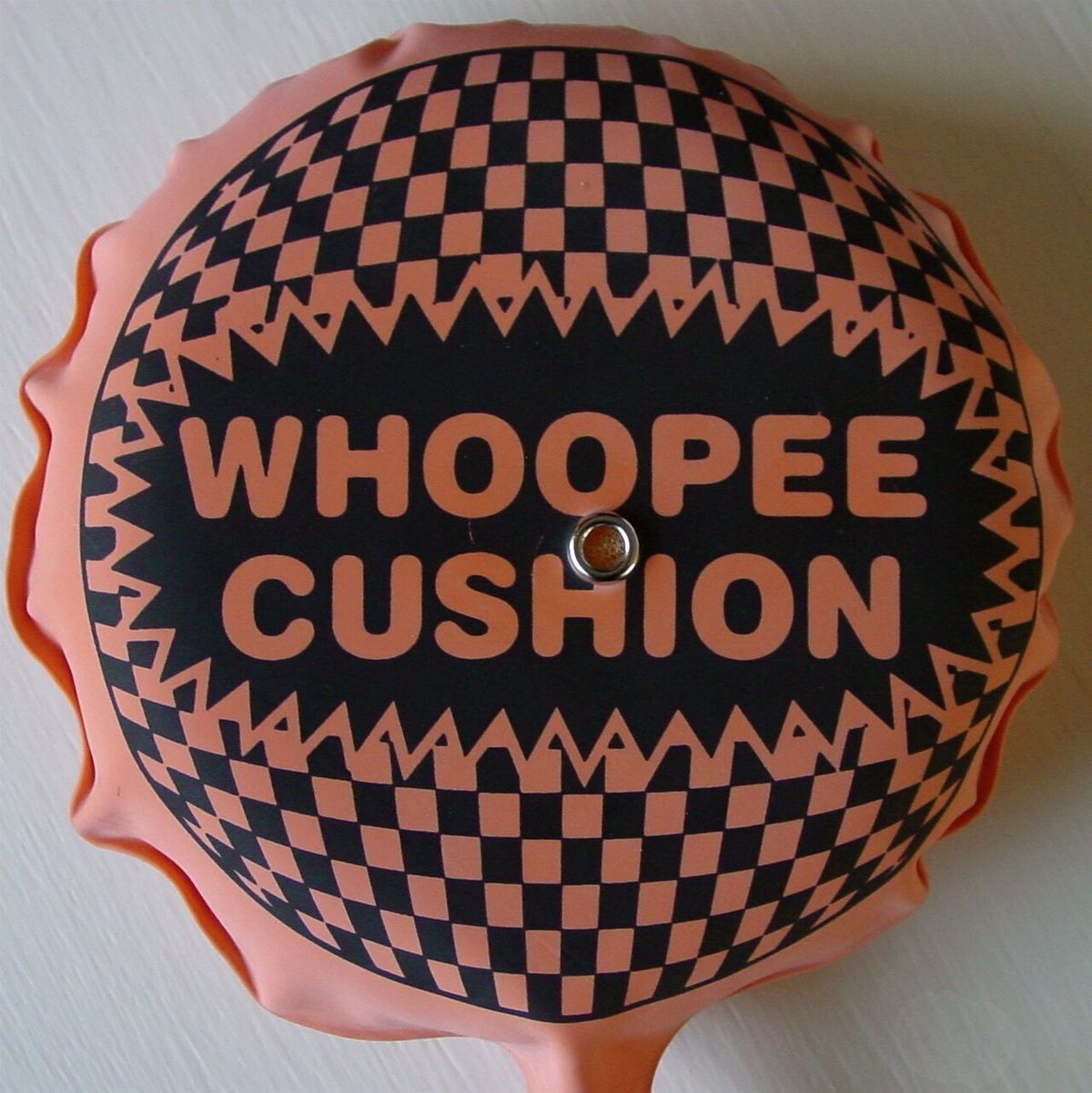
The classic whoopee cushion is a simple pneumatic device constructed from two sheets of thin rubber. These sheets are adhered together around their entire perimeter, forming a sealed pouch. A small, flapped opening at one end allows air to enter and exit the chamber. The fundamental operation relies on this flap, which vibrates rapidly when air is forced past it, producing the characteristic raspberry or flatulent sound. The materials and construction prioritize low cost and functionality over durability, meaning the cushions can break easily if subjected to excessive force or if the airflow is blocked during use.
Variations on the basic design have emerged over time. Standard models require manual inflation by blowing into the flapped opening before a prank is set. So-called self-inflating cushions incorporate an interior sponge or spring mechanism that keeps the device in a normally expanded state, eliminating the need for the prankster to inflate it personally and reducing the chance of detection during setup. Regardless of the type, the effectiveness and longevity of the cushion depend heavily on careful placement and the force applied by the person sitting on it.
Use and Cultural Impact
Employing a whoopee cushion follows a straightforward procedure. The device is first inflated, either by mouth or via its self-inflating mechanism. It is then concealed under a seat cushion, pillow, or any other soft furnishing where an unsuspecting victim is likely to sit. When weight is applied, the air is forcibly expelled through the flapped valve, creating the humorous sound. The prankster can also operate the cushion intentionally by hand, squeezing it to produce the noise on demand. The whoopee cushion's appeal lies in its blend of childish humour and harmless social embarrassment, making it a perennial favourite for pranks among friends and family.
The whoopee cushion transcended its origins as a simple novelty to become a recognizable symbol of lowbrow comedy in broader culture. Its design and purpose have remained largely unchanged for decades, illustrating the lasting appeal of its basic comedic premise. The product was historically offered at different price points to cater to various markets, with an economy model selling for 25 cents and a more substantial deluxe edition priced at $1.25. It is often cited as a perfect gift for the discerning prankster, and its resurgence in popularity is periodically noted, as seen in social media promotions from novelty retailers as recently as 2026.
- Place the inflated cushion under a seat cushion or pillow.
- The victim sits, forcing air out through the flapped valve.
- The vibrating flap produces a flatulent sound.
- Self-inflating models require no manual blowing.
- Excessive force or blocked airflow can cause the cushion to rupture.
- The cushion can also be operated manually by hand for on-demand noise.
Notable Records and Appearances
The cultural footprint of the whoopee cushion extends into the sphere of spectacle and record-setting. The device has inspired attempts to create larger-than-life versions for public entertainment. One notable example involved a giant whoopee cushion used in a stunt course that included a water slide and a jump from a cliff into a bubble-filled pool, with the participant referred to as the Whoopee Cushion. This event was featured in compilations of notable world records in 2026. Such stunts demonstrate how the simple concept of the whoopee cushion can be scaled up for dramatic and comedic effect, moving beyond the living room prank into the domain of public performance and viral video content.
Beyond physical stunts, the whoopee cushion occasionally appears as a metaphorical or artistic reference. It has been mentioned in contexts relating to gallery installations, with advice humorously attributed to Benjamin Franklin's supposed book 'Fart Proudly' being suggested for such displays. These appearances, while niche, highlight the whoopee cushion's status as an instantly recognizable cultural reference for humour and irreverence. Its basic function ensures it remains a point of comparison for any comedic situation involving unexpected bodily sounds.
Manufacturing and Commercial History
The commercial journey of the whoopee cushion began with its invention at the JEM Rubber Company in Toronto. The company's initial attempt to partner with the established S.S. Adams Company was unsuccessful due to Samuel Adams's reservations about the product's tastefulness. This rejection proved fortuitous for the Sawyer P. Lawrence Company, which seized the opportunity and successfully manufactured and distributed the cushion. The subsequent market entry by S.S. Adams with its Razzberry Cushion created a direct competition that helped fuel the product's popularity. The manufacturing process was simple, utilizing readily available rubber sheeting, which kept production costs low and allowed for high-profit margins on the retail price.
The whoopee cushion became a staple item for novelty distributors and joke shops. Its pricing strategy segmented the market, offering an affordable option for casual buyers and a sturdier, more expensive model for serious enthusiasts. The commercial success of the whoopee cushion demonstrated the viability of simple, mass-produced practical jokes. It paved the way for countless other novelty items and solidified a specific category of humour in the retail space. The enduring sales of the product, with periodic resurgences in popularity, confirm its place as a classic piece of comedic merchandise.
Questions about Whoopee cushion
Who invented the whoopee cushion?
The modern rubber whoopee cushion was invented in the 1930s by employees of the JEM Rubber Company in Toronto, Ontario, Canada. They created the device while experimenting with scrap sheets of rubber. The company's owner then presented the invention to Samuel Sorenson Adams, who declined it. The idea was subsequently offered to the Sawyer P. Lawrence Company, which sold it with great success.
How does a whoopee cushion work?
A whoopee cushion works on a simple pneumatic principle. It is made from two rubber sheets sealed at the edges, with a small flapped opening. When inflated and placed under a cushion, the weight of a person sitting forces the air inside out through the flap. The escaping air causes the flap to vibrate rapidly, producing a sound that mimics flatulence.
What is a self-inflating whoopee cushion?
A self-inflating whoopee cushion is a type that does not require manual inflation by blowing. This version contains an interior sponge that keeps the cushion in a normally expanded state. Therefore, it can be placed directly under a seat cushion without the need to inflate it first. This design simplifies the setup for the prank.
What was the original price of a whoopee cushion?
When first sold commercially, whoopee cushions were available at different prices. An economy model was sold for 25 cents. A more deluxe edition of the cushion was priced at $1.25. This pricing structure offered options for pranksters with different budgets.
Has there ever been a giant whoopee cushion?
Yes, there have been giant whoopee cushions created for stunts and record attempts. A notable example from 2026 involved a person referred to as the 'Whoopee Cushion' who slid down a course featuring a water slide and a jump from a cliff into a bubble pool. This event was featured in a Guinness World Records compilation video highlighting the best records of that year. These oversized versions take the basic practical joke concept and scale it up for public spectacle and entertainment, demonstrating the enduring and adaptable humour of the device.
What did the S.S. Adams Company call their version of the cushion?
The S.S. Adams Company called their version the 'Razzberry Cushion'. This occurred after the company's owner, Samuel Sorenson Adams, initially declined an offer to distribute the original modern rubber whoopee cushion invented by the JEM Rubber Co. of Toronto. Adams had considered the item 'indelicate' at first. However, after seeing the Sawyer P. Lawrence Company sell the JEM version with great success, Adams later decided to release and market his own competing product under this different name.
Sources: Wikipedia and current public reporting, checked by the Your Space Hamilton desk. Last updated 2026-10-25.



