Ironworkers Memorial Second Narrows Crossing
The Ironworkers Memorial Second Narrows Crossing, commonly known as the Ironworkers Memorial Bridge, is a major steel truss cantilever bridge spanning the Second Narrows of Burrard Inlet in Vancouver, British Columbia. It serves as a critical component of the Trans-Canada Highway (Highway 1), connecting Vancouver to the North Shore municipalities of the District of North Vancouver, the City of North Vancouver, and West Vancouver. The bridge, which was officially opened on August 25, 1960, cost approximately $23 million to build and is 1,292 metres (4,239 ft) long with a centre span of 335 metres (1,099 ft). This structure is a site of deep historical significance due to a catastrophic collapse during its construction on June 17, 1958, that killed 19 workers.
Design and Construction
The Ironworkers Memorial Second Narrows Crossing was conceived as a solution to the chronic traffic problems posed by the original Second Narrows Bridge, a combined rail and vehicle lift bridge completed in 1925. That original structure was frequently struck by ships and its lifting mechanism caused significant delays, with the bridge being raised over 5,000 times in 1952 alone. The provincial government selected a site just west of the old bridge for a new, high-capacity crossing. The design by Swan Wooster Engineering Co. Ltd. called for a deck-type steel truss cantilever bridge, where the roadway is supported from below by a steel framework. The consulting engineer in charge of the project was Murray McDonald. Construction began in February 1956, with Kiewit-Raymond contracted to build the concrete piers and the Dominion Bridge Company responsible for fabricating and erecting the steel superstructure. Dominion Bridge had a storied history in Vancouver, having worked on landmarks like the Hotel Vancouver, the Patullo Bridge, and the Lions Gate Bridge. The project proceeded for over two years before disaster struck in June 1958. Following the collapse and subsequent investigation, construction resumed and the bridge was officially opened to traffic on August 25, 1960, at a final cost of approximately $23 million. Tolls were charged for its use until April 1, 1963.
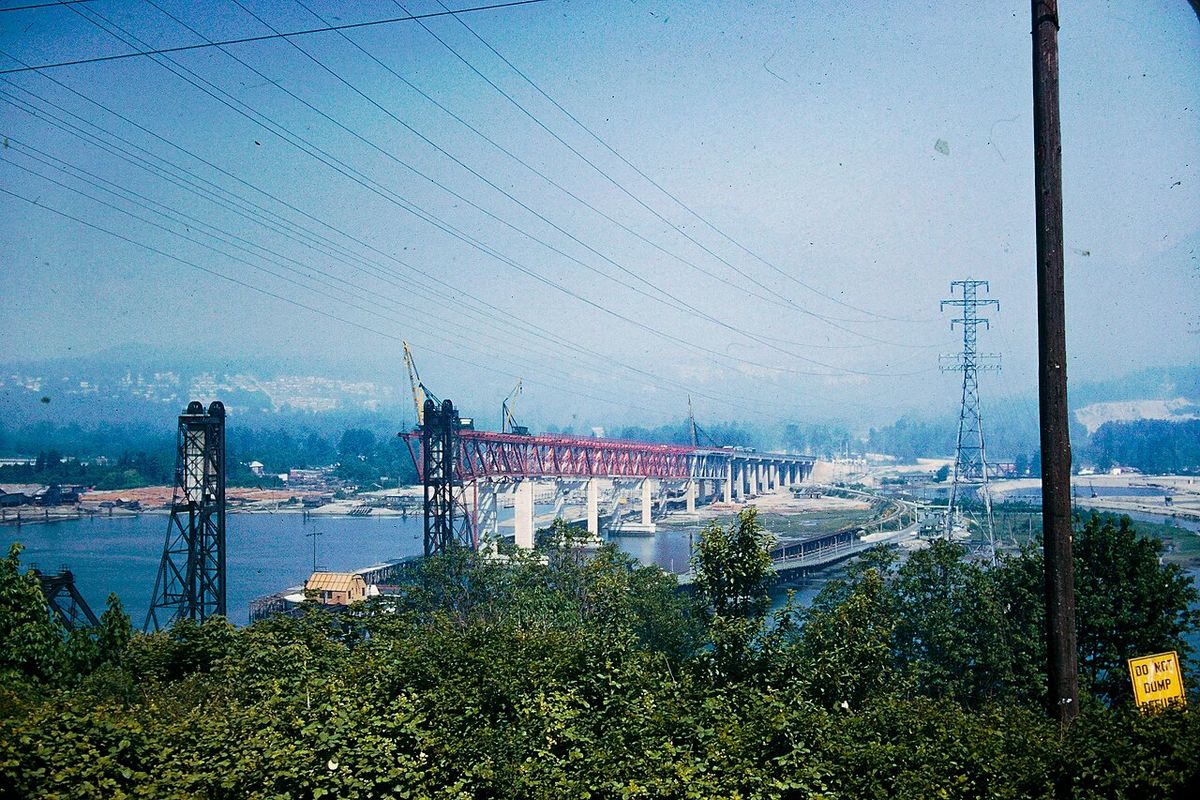
The 1958 Collapse and Investigation
On June 17, 1958, at approximately 3:40 p.m., the unfinished bridge suffered a catastrophic structural failure. As workers were preparing to join the two chords of an arch, Span 5 and then Span 4 collapsed into Burrard Inlet. Seventy-nine workers plunged roughly 30 to 40 metres into the water. The immediate toll was 18 fatalities, consisting of 14 ironworkers, three engineers, and a painter. A commercial diver, William H. D. McLeod, drowned several days later while attempting to recover a body, bringing the total death count to 19. In the aftermath, a Royal Commission of Inquiry was established to determine the cause. The commission concluded the collapse resulted from a critical engineering miscalculation related to temporary support structures, known as falsework. The design for the falsework supporting Span 5 was prepared by a junior engineer, John McKibbin, who tragically died in the collapse. His calculations for a temporary steel box support were flawed, and the error was not caught during review by the supervising engineer, Murray McDonald. The faulty support was cut too short and could not bear the load, leading to the failure. Historian Eric Jamieson, in his book on the tragedy, noted that other contributing factors included questionable steel quality and generally lax engineering practices of the era. The disaster remains the worst industrial accident in Vancouver's history.
The official inquiry identified a specific chain of technical failures. The flawed falsework was a temporary structure meant to support the new fifth anchor span until it could reach the next pier and become self-supporting. The error in its design was a fundamental miscalculation of the load it needed to bear. This single point of failure had devastating consequences for the workers on site that afternoon, and the inquiry's findings led to changes in engineering review practices.
- Date of Collapse: June 17, 1958.
- Time of Collapse: Approximately 3:40 p.m.
- Immediate Fatalities: 18 workers killed.
- Final Fatality: Diver William H. D. McLeod, bringing total to 19.
- Spans that Fell: Span 5 and Span 4.
- Key Engineer in Error: John McKibbin.
- Supervising Engineer: Murray McDonald.
Memorialization and Renaming
For decades, the bridge was known simply as the Second Narrows Bridge. The new name honours the 19 men who died in the 1958 collapse, as well as four other workers who lost their lives at other times during the construction process between 1956 and 1960. An annual memorial ceremony is held at New Brighton Park in Vancouver, organized by Ironworkers Local 97. The ceremony, which has been held for over 20 years, typically features the reading of the names of the fallen, speeches from labour leaders and government officials, and the laying of roses. In a poignant tradition started by the daughter of survivor Lucien Lessard, a single iron rose is passed to an apprentice ironworker. The 2026 ceremony marked the 68th anniversary of the tragedy. The memorial ensures that the workers, described by union president Paul Beacom as fathers, sons, brothers, and skilled tradespeople, are not forgotten. Their sacrifice is also commemorated in various cultural works, including the song "The Bridge Came Tumbling Down" by Stompin' Tom Connors and the book of poetry Falsework by Gary Geddes.
The annual ceremony involves specific rituals and participants. In 2026, the last known survivor, 97-year-old Lucien Lessard, attended and read the names of the deceased. Government officials such as North Vancouver-Lonsdale MLA and Infrastructure Minister Bowinn Ma and BC Labour Minister Jennifer Whiteside have given speeches emphasizing workplace safety and remembrance. The ceremony uses roses as symbols, with 19 red roses for the victims and one white rose representing the surviving worker, a tradition that visually shows the loss and the legacy.
- Renaming Date: June 17, 1994.
- Total Workers Honoured: 19 from the collapse plus 4 other construction deaths.
- Ceremony Organizer: Ironworkers Local 97.
- Ceremony Location: New Brighton Park, Vancouver.
- 2026 Anniversary: The 68th anniversary.
- Known Survivor (2026): Lucien Lessard, age 97.
- Memorial Tradition: Passing of an iron rose to an apprentice.
Technical Specifications and Traffic Role
The Ironworkers Memorial Bridge is a substantial piece of infrastructure with a total length of 1,292 metres. Its centre span measures 335 metres, making it the second-longest cantilever span in Canada, after the Quebec Bridge, and historically the 15th longest in the world. The bridge carries six lanes of the Trans-Canada Highway (Highway 1) across Burrard Inlet. It is a critical transportation link not only for local commuters but also for regional and national goods movement, connecting Metro Vancouver with the Sea to Sky corridor, Vancouver Island via ferry terminals, and the Fraser Valley. Recent traffic data confirms it is the most congested crossing in Metro Vancouver. In 2025, the bridge carried an average of 130,700 vehicles per day. This congestion frequently spills into surrounding neighbourhoods and is exacerbated by near-daily crashes that can cause significant delays. The bridge also accommodates significant public transit use. Buses crossing the bridge carried nearly 7.9 million passengers in 2024, with over 25,000 people using the bridge by bus on an average weekday. Key bus routes include the 130 and the R2 RapidBus, which was fast-tracked for extension over the bridge in September 2025 to provide higher-capacity service.
The bridge requires ongoing maintenance, which sometimes necessitates lane closures. For example, in March 2026, planned nighttime closures for deck and joint repairs were expected to cause delays of up to 20 minutes for drivers. During such work, traffic is often reduced to one lane in each direction on the westbound side, with the eastbound sidewalk remaining open for cyclists and pedestrians. The ministry advises drivers to use the Lions Gate Bridge as an alternative route during these periods. The structure's role in the regional transit network is expanding, with the R2 RapidBus offering express service every six to seven minutes during peak hours and connecting key destinations like Park Royal, Lonsdale Quay, Phibbs Exchange, Burnaby Heights, Brentwood, BCIT, and Metrotown.
| Statistic | Figure |
|---|---|
| Total Length | 1,292 m (4,239 ft) |
| Centre Span Length | 335 m (1,099 ft) |
| Average Daily Traffic | 130,700 vehicles |
| Annual Bus Passengers | 7.9 million |
| Average Weekday Bus Passengers | Over 25,000 |
| Ridership Growth (Bus) | 22% |
The Original Second Narrows Bridge
The Ironworkers Memorial Bridge was the second structure built at the Second Narrows. The original Second Narrows Bridge opened in 1925 as a combined railway and vehicle bridge featuring a bascule, or drawbridge, section to allow ship passage. This design proved problematic from the start. The bridge was struck by ships multiple times, including the freighter Eurana in 1927 and the Pacific Gatherer in 1930, which ripped away the centre span. After being sold to the provincial government in 1933, it was repaired and reopened in 1934 with a new centre lift span replacing the bascule. Despite this upgrade, traffic interruptions remained frequent due to the high volume of marine traffic. The old bridge was located immediately east of the current Ironworkers Memorial Bridge. When the new bridge opened in 1960, the old structure was relegated exclusively to rail use. A larger, modern rail lift bridge was built beside it in 1968, and the original 1925 bridge was finally dismantled and removed in 1970.
The history of ship collisions with the original Second Narrows Bridge is a record of its operational challenges. The original bridge, completed in 1925, was hit by ships multiple times. For example, it was struck by the freighter Eurana in 1927, the Norwich City in 1928, and the Losmar in 1930. In September 1930, the Pacific Gatherer became wedged under the bridge and ripped away its centre span. These persistent problems highlighted the incompatibility between marine traffic and the fixed crossing, contributing to the decision to build a new high-level cantilever bridge.
- Original Opening: 1925.
- Notable Collision: Freighter Eurana, 1927.
- Major Collision: Pacific Gatherer, September 1930, ripped centre span.
- Sold to Government: 1933.
- Reopened with Lift Span: 1934.
- Bridge Raises in 1952: Over 5,000 times.
- Became Rail-Only: 1960.
- Replaced and Removed: New rail bridge built 1968, original removed 1970.
Cultural References and Legacy
The story of the bridge collapse and its memorialization has resonated through Canadian culture and labour history. Several artistic works have been inspired by the event. Country music legend Stompin' Tom Connors wrote and recorded "The Bridge Came Tumbling Down," a folk song detailing the tragedy. American singer Jimmy Dean released a ballad titled "Steel Men." Canadian poet Gary Geddes published Falsework, a book of poetry that engages with the disaster. Historian Eric Jamieson authored the definitive account, Tragedy at Second Narrows: The Story of the Ironworkers Memorial Bridge, published in 2008. The disaster is frequently cited in workplace safety discussions as a stark reminder of the consequences of engineering error and inadequate oversight. British Columbia's Labour Minister, Jennifer Whiteside, noted in a 2026 memorial speech that the collapse drives ongoing efforts to improve safety through education and regulation. The bridge itself, as both a congested highway and a solemn memorial, embodies the dual legacy of mid-century industrial ambition and the human cost that sometimes accompanied it.
The cultural impact extends beyond music and literature to public commemoration and safety advocacy. The partnership between Ironworkers Local 97 and WorkSafeBC for the 50th anniversary ceremony in 2008 formalized the link between remembrance and the promotion of safer workplaces. The disaster is a case study in engineering failure and is referenced in professional literature, including a 2017 journal article in the American Society of Civil Engineers entitled "Collapse of the Second Narrows Bridge during Construction." Other references include Frank Rasky's 1961 book Great Canadian Disasters and Bill Schermbrucker's 2009 work Crossing Second Narrows, which contribute to the enduring record of the event.
Questions about Ironworkers Memorial Second Narrows Crossing
How many people died in the Ironworkers Memorial Bridge collapse?
A total of 19 people died as a direct result of the collapse on June 17, 1958. Initially, 18 workers were killed in the fall or drowned shortly after. Several days later, a commercial diver named William H. D. McLeod drowned while attempting to recover a body, becoming the 19th victim. Four additional workers died at other times during the overall construction period from 1956 to 1960, and they are also honoured in the bridge's memorial name.
Why did the Second Narrows Bridge collapse in 1958?
A Royal Commission investigation determined the collapse was caused by an engineering miscalculation. A junior engineer, John McKibbin, made errors in designing a temporary steel box support, or falsework, for Span 5. The support was cut too short and could not bear the weight. This mistake was not caught by the supervising engineer, Murray McDonald. The failure of this temporary structure caused Span 5 to collapse, which in turn caused Span 4 to fall.
How much traffic does the Ironworkers Memorial Bridge carry?
The bridge is a critical and heavily used transportation link. In 2025, it carried an average of 130,700 vehicles per day. Recent traffic studies have confirmed it is the most congested crossing in all of Metro Vancouver. The bridge also carries substantial bus traffic, with over 25,000 people crossing it by bus on an average weekday in 2024.
Is there a memorial ceremony for the bridge collapse?
Yes, an annual memorial ceremony is held at New Brighton Park in Vancouver on June 17, the anniversary of the collapse. The ceremony is organized by Ironworkers Local 97 and has been held for over two decades. It typically involves reading the names of the fallen, speeches from labour and government officials, and the laying of roses. In 2026, the ceremony marked the 68th anniversary of the disaster.
When was the bridge renamed the Ironworkers Memorial Second Narrows Crossing?
The bridge was officially renamed the Ironworkers Memorial Second Narrows Crossing on June 17, 1994. This renaming was done to honour the eighteen workers who died in the 1958 collapse. It also commemorates one rescue diver and four other workers who lost their lives during the construction process. The memorial ceremony for the collapse is held annually, often at New Brighton Park in Vancouver. The renaming ensures that the sacrifice of these workers is permanently remembered as part of the bridge's identity. The bridge was originally named the Second Narrows Bridge upon its opening in 1960.
How long is the Ironworkers Memorial Bridge and what type is it?
The Ironworkers Memorial Second Narrows Crossing is 1,292 metres (4,239 feet) long. It is a steel truss cantilever bridge, specifically a deck type cantilever designed by Swan Wooster Engineering Co. Ltd. Its centre span measures 335 metres (1,099 feet), which is the second longest cantilever span in Canada. The bridge is a vital part of the Trans Canada Highway, connecting Vancouver to the North Shore municipalities. It was constructed between 1956 and 1960 at a cost of approximately $23 million. The bridge carries an average of 130,700 vehicles per day as of 2026 traffic data.
Sources and further reading
- Ironworkers Memorial Second Narrows Crossing (Wikipedia)
- Nighttime lane closures planned on Ironworkers Memorial ... (news.gov.bc.ca)
- Ironworkers Memorial Bridge: Ceremony honours workers (nsnews.com)
- Second Narrows Bridge Collapse (thecanadianencyclopedia.ca)
Checked by the Your Space Hamilton desk. Last updated 2026-10-30.