David Saint-Jacques
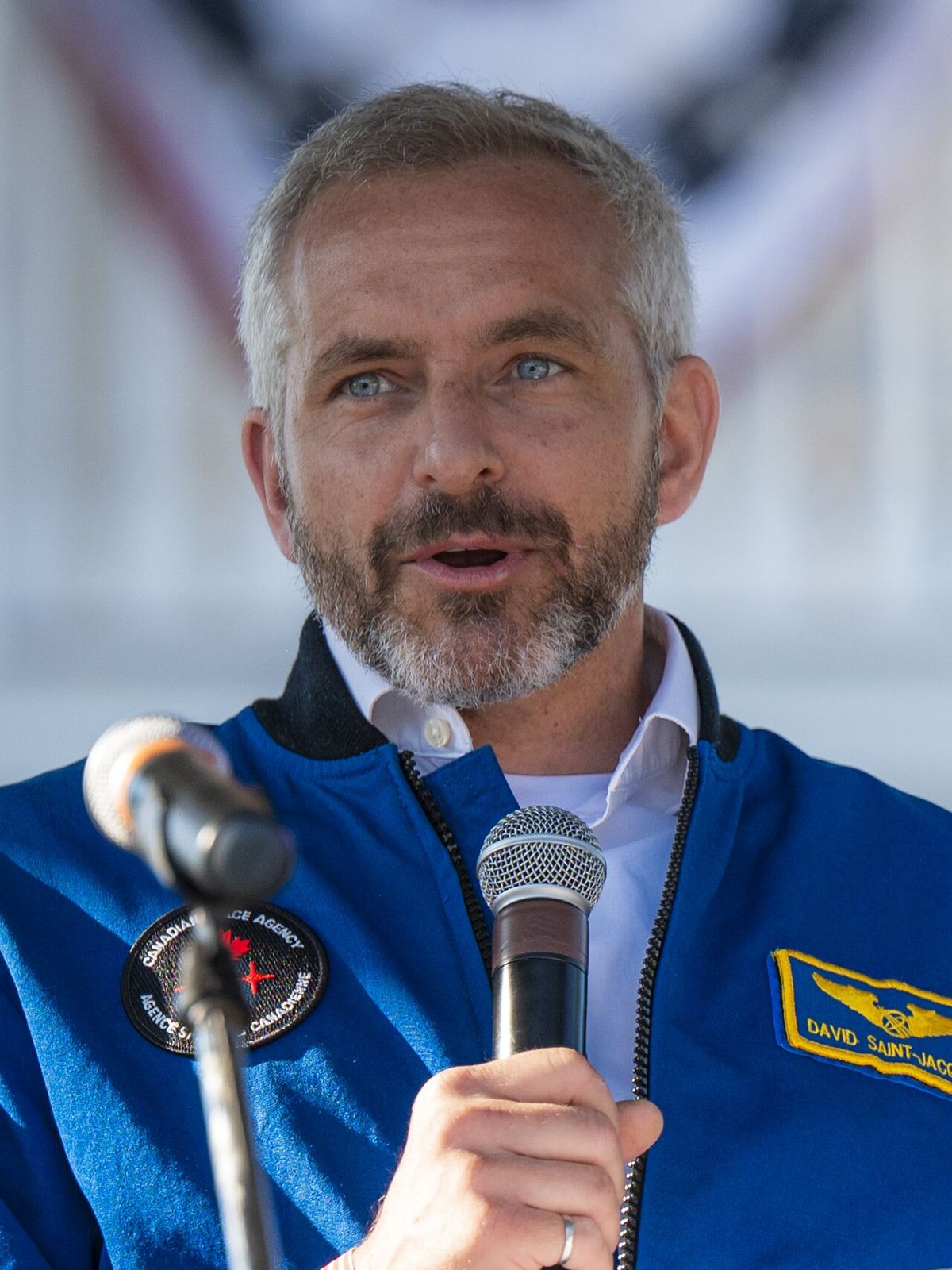
David Saint-Jacques is a Canadian astronaut, astrophysicist, engineer and physician with the Canadian Space Agency (CSA). Born on 6 January 1970 in Quebec City, he was selected as an astronaut in 2009 and launched to the International Space Station in December 2018 for a long-duration mission. His multidisciplinary background in engineering, astrophysics and medicine, coupled with his spaceflight experience, makes him a prominent figure in Canadian science and exploration. Saint-Jacques represents Canada's ongoing commitment to human spaceflight and international cooperation in space.
Early Life and Multidisciplinary Education
David Saint-Jacques was born in Quebec City and raised in Montreal, developing early interests in mountaineering, cycling and sailing that would later complement his technical pursuits. He pursued a remarkably broad and international education across several scientific disciplines. His undergraduate studies were in engineering physics at Polytechnique Montréal, an engineering school affiliated with Université de Montréal, from which he graduated in 1993. He then moved to the United Kingdom for doctoral studies, earning a Doctor of Philosophy in astrophysics in 1998 from the Cavendish Astrophysics Group at Corpus Christi College, Cambridge. His PhD research involved theoretical work on astronomical observation and the design and commissioning of instruments for telescopes like the Cambridge Optical Aperture Synthesis Telescope and the William Herschel Telescope in the Canary Islands. Following his doctorate, Saint-Jacques completed a postdoctoral fellowship from 1999 to 2001 at the National Astronomical Observatory of Japan, where he worked on the Mitaka Infrared Interferometer in Japan and the Subaru Telescope Adaptive Optics System in Hawaii. Demonstrating a continued expansion of his skills, he returned to Canada to study medicine, earning a Doctor of Medicine from Université Laval in 2005. He completed his medical training with a family medicine residency at McGill University in 2007, specializing in first-line, isolated medical practice.
Pre-Astronaut Career in Engineering and Medicine
Before his selection as an astronaut, David Saint-Jacques built a diverse career that applied his education in practical settings across the globe. His professional engineering work began in 1996 as a biomedical engineer at the Quebec firm Electromed, where he was seconded to Lariboisière Hospital in France to work on designing radiological equipment for angiography and developing image analysis algorithms for cineangiography. After his postdoctoral research in Japan, he joined the astrophysics group in the Department of Physics at the Université de Montréal in 2001. His career then took a decisive turn toward medicine and service in remote communities. From 2007 until joining the Canadian Space Agency, he worked as a physician and was the co-chief of Medicine at the Inuulitsivik Health Centre in Puvirnituq, Quebec, a remote community in Nunavik. In this role, he provided essential healthcare and also served as a Clinical Faculty lecturer for McGill University's Faculty of Medicine, supervising medical trainees in the region. This experience in isolated practice, where resources are limited and self-reliance is critical, is considered highly relevant training for the constraints of long-duration spaceflight.
Astronaut Selection and Training
In May 2009, David Saint-Jacques was selected by the Canadian Space Agency as one of two new astronauts from a pool of 5,351 applicants. He subsequently moved to Houston, Texas, to join NASA's 20th astronaut class as one of its 14 members. His astronaut candidate training was comprehensive and rigorous, preparing him for the challenges of spaceflight. The curriculum included scientific and technical briefings, intensive instruction in International Space Station systems, and training for extravehicular activity (spacewalks). He also underwent training in robotics, physiological adaptation to space, T-38 jet flight training, and Russian language studies. Survival training was a key component, with instruction in water and wilderness survival techniques. After graduating from this candidate training, Saint-Jacques was assigned to the Robotics Branch of the NASA Astronaut Office, focusing on Canada's robotic contributions to the ISS, such as the Canadarm2. His training continued with specialized missions to simulate spaceflight conditions in extreme environments on Earth.
These analogue missions included the NEEMO 15 undersea exploration mission in October 2011. He served as an aquanaut aboard the Aquarius underwater laboratory during that mission. In 2013, he also participated in the ESA CAVES training in Sardinia as a cavenaut. These missions simulated spaceflight conditions and crew dynamics.
International Space Station Mission
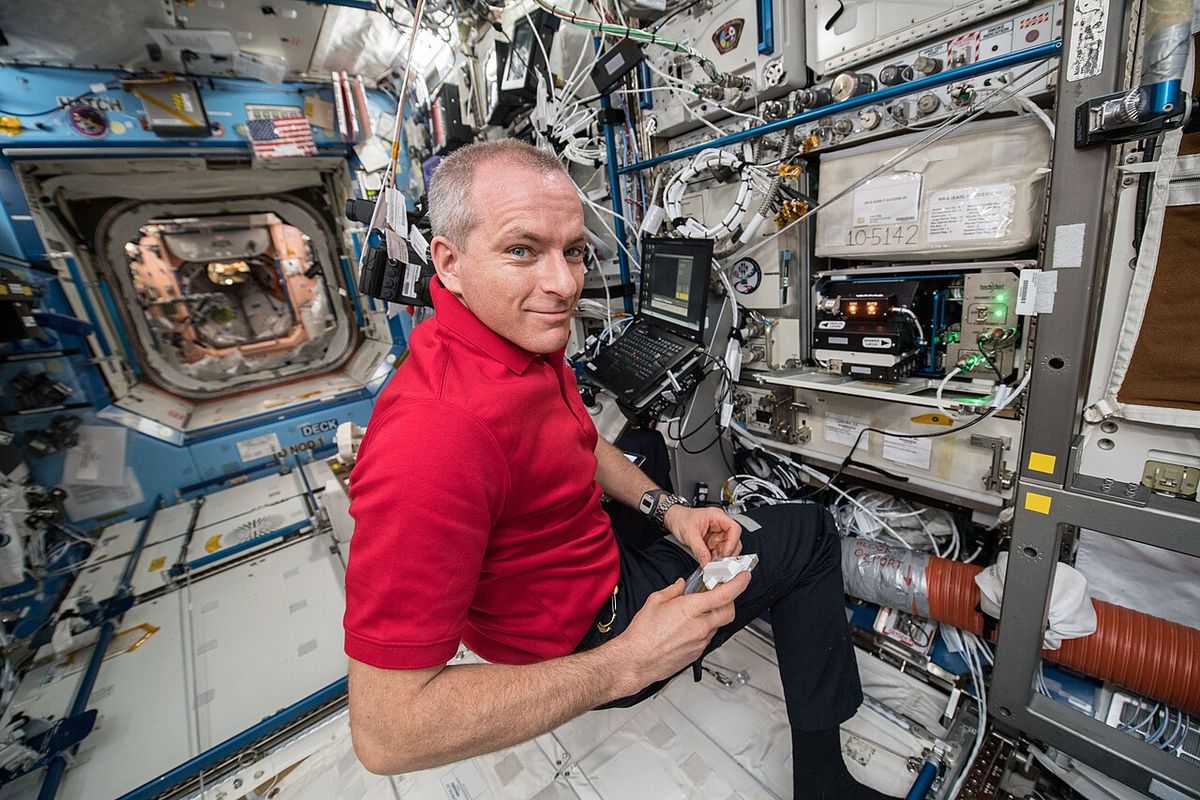
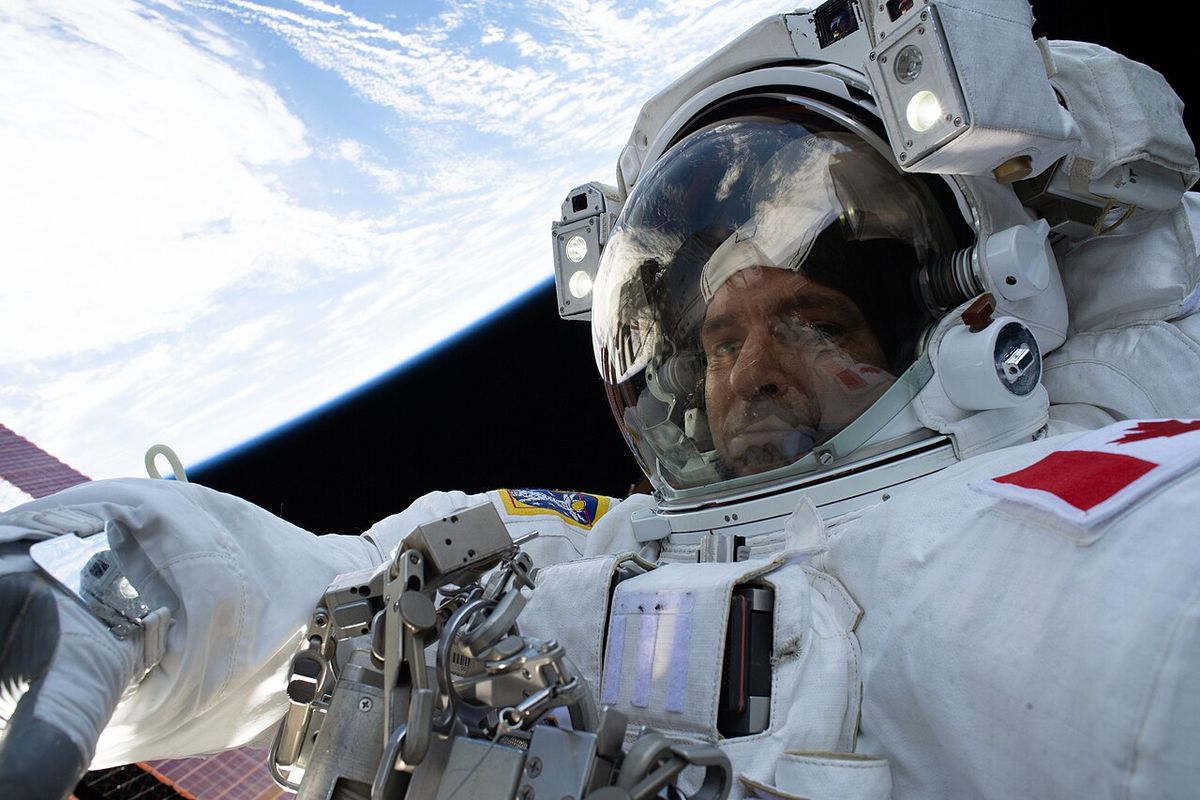
David Saint-Jacques' first and, to date, only spaceflight was a long-duration mission to the International Space Station. In May 2016, he was assigned as a flight engineer for Expeditions 58 and 59. He launched from the Baikonur Cosmodrome in Kazakhstan on 3 December 2018 aboard the Russian Soyuz MS-11 spacecraft, alongside commander Oleg Kononenko of Roscosmos and fellow flight engineer Anne McClain of NASA. After a two-week overlap with the existing crew, Saint-Jacques officially became a member of Expedition 58 on 20 December 2018. He later transferred to Expedition 59 on 14 March 2019 with the arrival of a new Soyuz crew. A major milestone of his mission occurred on 8 April 2019, when he conducted a spacewalk (EVA) with Anne McClain. Lasting roughly seven hours, the EVA was performed to upgrade the station's power systems. This made Saint-Jacques the fourth Canadian to perform a spacewalk and the first to do so in 12 years. He, Kononenko and McClain returned to Earth safely aboard Soyuz MS-11 on 24 June 2019, landing in Kazakhstan.
Honours, Awards and Academic Recognition
David Saint-Jacques has received significant recognition for his contributions to science, medicine and exploration. His honours include some of Canada's highest civilian awards. In 2020, he was appointed an Officier of the National Order of Quebec, and in 2022 he was appointed an Officer of the Order of Canada. The Royal Canadian Geographical Society has awarded him both its Gold Medal and a Fellowship. He has also received a special distinction from the Collège des médecins du Québec. Throughout his academic career, he was the recipient of numerous prestigious scholarships and fellowships that supported his studies. Key academic awards and distinctions include:
- Natural Sciences and Engineering Research Council of Canada (NSERC) "1967" Science and Engineering Scholarship (1994 to 1998)
- Cambridge Commonwealth Trust Honorary Scholar (1994 to 1998)
- United Kingdom Overseas Research Student Award (1994 to 1998)
- Postdoctoral Fellowship, Japan Society for Promotion of Science (1999 to 2001)
- Canada Millennium Scholarship (2001 to 2005)
- Doctorat Honoris Causa, École polytechnique de Montréal of Université de Montréal (2010)
Personal Life and Skills
David Saint-Jacques is married to Dr. Véronique Morin, and the couple has three children. His personal interests are deeply connected to the outdoors and adventure, reflecting the aptitudes required for an astronaut. He is a lifelong mountaineer, hiker, cyclist, skier and sailor. He also holds a commercial pilot licence, adding another layer of technical proficiency to his profile. His linguistic abilities are notable. He is fluent in both of Canada's official languages, French and English, and has a basic understanding of Russian, Spanish and Japanese, skills honed during his international studies and astronaut training. This combination of personal passion, technical skill and cultural adaptability has been a consistent feature of his career path from remote northern medicine to orbital spaceflight.
Saint-Jacques maintains professional affiliations with several organizations. He is affiliated with the Collège des médecins du Québec and the College of Family Physicians of Canada. He is also a member of the Ordre des ingénieurs du Québec and the International Society for Optical Engineering. He is a life fellow of the Cambridge Philosophical Society.
- Collège des médecins du Québec
- College of Family Physicians of Canada
- Ordre des ingénieurs du Québec
- International Society for Optical Engineering
- Cambridge Philosophical Society (as a life fellow)
Questions about David Saint-Jacques
Did David Saint-Jacques do a spacewalk?
Yes, David Saint-Jacques conducted one spacewalk during his ISS mission. On 8 April 2019, he performed an extravehicular activity (EVA) with NASA astronaut Anne McClain that lasted approximately seven hours. The primary task was to upgrade the International Space Station's power systems. He became the fourth Canadian astronaut to perform a spacewalk and the first Canadian to do so in 12 years.
What awards has David Saint-Jacques received?
David Saint-Jacques has been honoured with several of Canada's highest awards. He was appointed an Officer of the Order of Canada in 2022 and an Officier of the National Order of Quebec in 2020. He is a Fellow of the Royal Canadian Geographical Society and has received its Gold Medal. He also holds a special distinction from the Collège des médecins du Québec and an honorary doctorate from Polytechnique Montréal.
What training did Saint-Jacques do before his spaceflight?
After his 2009 selection, Saint-Jacques graduated from NASA's Astronaut Candidate Training. This training included instruction in International Space Station systems, robotics, extravehicular activity, and physiological training. It also covered T-38 flight training, Russian language, and water and wilderness survival training. He also participated in the NEEMO 15 undersea mission and the ESA CAVES 2013 training.
How long was David Saint-Jacques in space?
He launched to the International Space Station on 3 December 2018 aboard Soyuz MS-11 and returned to Earth on 24 June 2019 on the same spacecraft. He served as a flight engineer during Expeditions 57, 58 and 59. His mission began with Expedition 57 for two weeks before transferring to Expedition 58, which officially started on 20 December 2018. He then transferred to Expedition 59 on 14 March 2019. This lengthy stay involved significant scientific work and included a spacewalk on 8 April 2019.
What did David Saint-Jacques do before becoming an astronaut?
Before becoming an astronaut, David Saint-Jacques had a varied career in engineering, astrophysics and medicine. He began in 1996 as a biomedical engineer at the Quebec firm Electromed, working on radiological equipment design. From 1999 to 2001, he conducted postdoctoral astrophysics research at the National Astronomical Observatory of Japan, developing instruments for telescopes. He later joined the astrophysics group at Université de Montréal. After earning his medical degree, he worked as a physician and was the co-chief of Medicine at the Inuulitsivik Health Centre in Puvirnituq, Quebec, from 2007. He also served as a Clinical Faculty lecturer for McGill University's Faculty of Medicine, supervising medical trainees in Nunavik.
What university degrees does David Saint-Jacques have?
David Saint-Jacques holds four significant university degrees. He earned a Bachelor of Engineering in Engineering Physics from Polytechnique Montréal in 1993. He later graduated in 1998 with a Doctor of Philosophy in astrophysics from the Cavendish Astrophysics Group at Corpus Christi College, Cambridge. He also holds a Doctor of Medicine from Université Laval, which he completed in 2005. Following his medical degree, he completed a family medicine residency at McGill University in 2007, specializing in first line, isolated medical practice. This diverse educational background in engineering, astrophysics and medicine provided a strong foundation for his career as an astronaut.
Sources and further reading
- David Saint-Jacques (Wikipedia)
- Meet Canadian Astronaut David Saint-Jacques (exploringbytheseat.com)
- David Saint-Jacques on the upcoming Artemis II mission (canadiangeographic.ca)
- David Saint-Jacques (thecanadianencyclopedia.ca)
Checked by the Your Space Hamilton desk. Last updated 2026-11-01.