Crokinole
Crokinole is a Canadian disk-flicking dexterity board game, blending elements of shuffleboard, curling, and carrom into a tabletop contest. Players take turns shooting wooden discs across a circular board, aiming for high-scoring central regions and attempting to knock opponents' discs into the gutter. The game, whose earliest known board dates to 1876 in Perth County, Ontario, is celebrated as a distinctly Canadian pastime with a dedicated competitive scene. Its premier event, the World Crokinole Championship, has been held annually in Tavistock, Ontario, since 1999, drawing participants from across Canada and internationally.
Equipment and Board Design
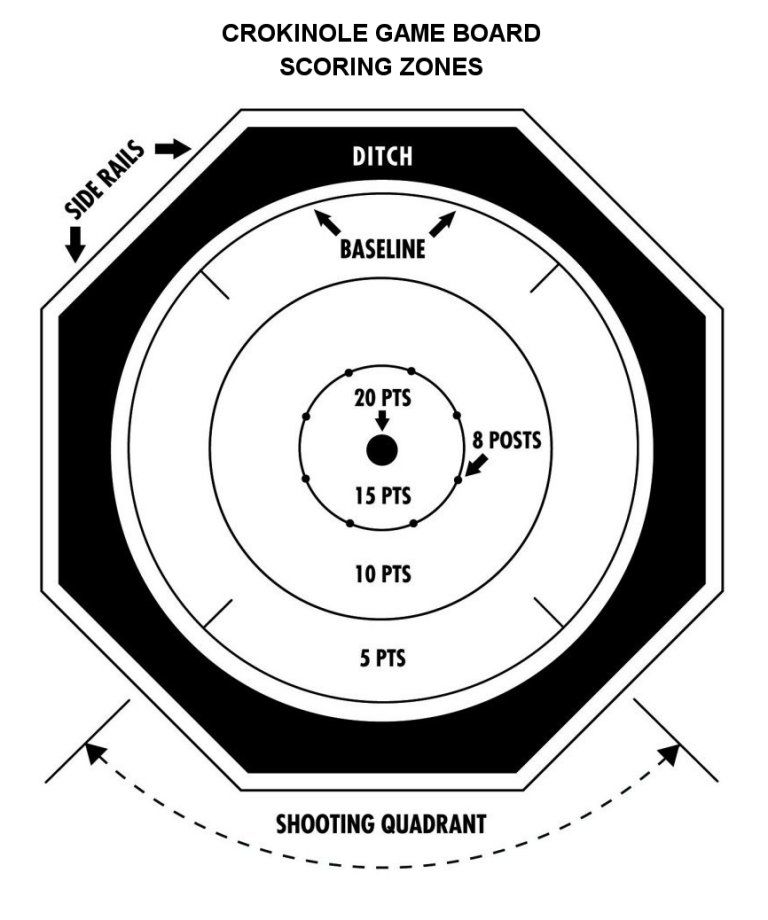
A standard crokinole board features a circular playing surface, typically about 26 inches (660 mm) in diameter and made of polished wood or laminate. The board is marked with three concentric rings. Moving inward from the outer edge, these rings are worth 5, 10, and 15 points. A shallow recessed hole at the very centre scores 20 points and is colloquially known as the 'Toad' or 'Dukie'. The inner 15-point ring is guarded by eight small bumpers or posts, which deflect shots. The outer ring is divided into four quadrants, one for each player or team. A slightly raised outer edge surrounds the playing surface, with a gutter or 'ditch' between to collect discs that have been knocked out of play. Boards are typically octagonal or round in shape, and the wooden discs are roughly checker-sized, with one side often slightly concave and the other convex due to the natural grain of the wood.
The use of any lubricating powder in crokinole is a controversial topic among players, with some purists opposing the practice entirely. Historically, boric acid was a popular choice to ensure pieces slid smoothly, but it is now considered toxic and has been replaced by safer substitutes like food-grade plant starch. The World Crokinole Championships have a specific policy on this matter, stating that only tournament organizers apply a quality granular shuffleboard wax, which is placed in the ditch for players to rub their discs on if they desire. Contestants are explicitly prohibited from applying any other lubricants to the board surface, ensuring a standardized playing field for all competitors in the tournament.
Rules and Gameplay
Crokinole is most commonly played by two players or by four players in teams of two, with partners sitting opposite each other. Players take turns flicking their discs from the outer edge of their designated quadrant onto the board. The primary shooting method is a finger flick, though small cue sticks are permitted in a dedicated category at tournaments. A fundamental rule dictates that if any opponent's discs are on the board, a player must make contact with at least one of them during a shot, either directly or indirectly. If the shot fails to make contact, the disc is considered 'fouled' and is removed from play, along with any of the shooter's other discs that were moved during the attempt. This rule forces offensive play and prevents defensive stalling when discs are in challenging positions on the board.
When no opponent's discs are present, many official tournament rules, including those of the International Association of Crokinole, enforce a 'no hiding' rule. This requires the shooter to aim for the centre, and the shot disc must finish completely inside or touching the 15-point guarded ring line. This prevents players from placing their first discs in positions that would force an opponent to shoot through the guarded centre. A notable regional exception is the Muskoka Variation, where discs may be shot anywhere without the obligation to hit an opponent's disc, allowing for strategic 'hiding' and different defensive tactics. Under the Muskoka rules, if a disc goes into the central 20-point hole, the subsequent opposing player gets one opportunity to attempt to knock it out with an extreme flick, adding a high-risk defensive option.
Scoring is differential and occurs after all discs (usually 12 per player or team) have been shot in a round. Only the player or team with the higher score gains points, equal to the difference between the two scores. Play continues over multiple rounds until a predetermined winning total is reached. Any disc that lands completely in the central 20-point hole is immediately removed and counts as twenty points for its owner at the round's end, provided the shot was valid. This scoring system ensures that every round has a consequence, as only one side can gain ground, which intensifies the competitive nature of each shot throughout the match.
Historical Origins and Development
The earliest known crokinole board was crafted in 1876 by Eckhardt Wettlaufer in Perth County, Ontario, as a fifth birthday present for his son Adam. This board is now part of the collection at the Joseph Schneider Haus national historic site in Kitchener, Ontario, which focuses on Germanic folk art. Research by Wayne Kelly, published in The Crokinole Book, cites an earlier Canadian reference to the game from 1867, and several other homemade boards from southwestern Ontario in the 1870s have been discovered since the 1990s. While the game is popularly associated with Mennonite or Amish communities due to its prevalence there, no factual data confirms it originated with these groups. It was, however, viewed as a harmless pastime compared to other diversions like card playing or dancing, which were considered 'works of the Devil' by many 19th-century Protestant groups.
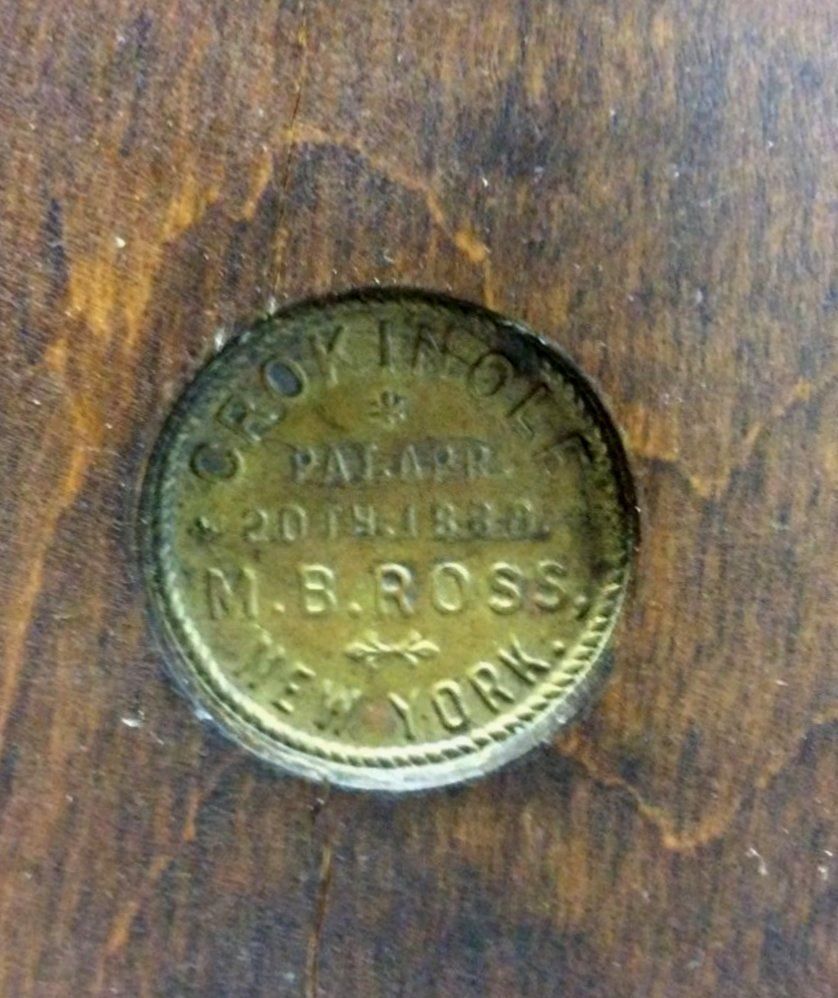
The game's antecedents are likely the British and South Asian games like carrom. In the United States, a similar board game was patented by Joshua K. Ingalls on 20 April 1880 (US Patent No. 226,615). The name 'crokinole' is widely accepted to derive from the French Canadian word 'croquignole'. Historically, 'croquignole' referred to the action of flicking or filliping with a finger, which is the primary motion in the game. The word also refers to a type of cookie or pastry, and in France it designates a kind of biscotto. In the Plautdietsch language spoken by Russian Mennonites, the game is called 'knipsbrat' (flick-board) or occasionally 'knipsdesh' (flick-table). A documentary film titled Crokinole, following competitors at the 2004 World Championship, had its world premiere at the Princess Cinema in Waterloo, Ontario, in early 2006.
- 1876: Eckhardt Wettlaufer crafts the earliest known crokinole board in Perth County, Ontario.
- 1867: First Canadian reference to the game appears in historical records.
- 20 April 1880: Joshua K. Ingalls patents a similar board game in the United States.
- 1999: First World Crokinole Championship is held in Tavistock, Ontario.
- 2006: Documentary film Crokinole premieres in Waterloo, Ontario.
- 2009: International Association of Crokinole is founded to lay out tournament rules.
The World Crokinole Championship
The World Crokinole Championship (WCC) is the premier competitive event for the game, held annually on the first Saturday of June in Tavistock, Ontario, since 1999. Tavistock was chosen as the host city because it was the home of Eckhardt Wettlaufer, maker of the oldest known board. The tournament attracts registrants from every Canadian province, several American states, and countries including Germany, Australia, Spain, the United Kingdom, and Japan. The official board builder for the WCC is Jeremy Tracey, who supplies the tournament equipment. The WCC has specific regulations regarding board maintenance, stating that organizers wax boards with paste wax and provide only a specific powdered shuffleboard wax in the ditch for players to use on their discs.
The WCC features a structured tournament format across multiple divisions catering to different skill levels and age groups. The main singles competition for competitive finger-shooting (adult singles) begins with a qualifying round where players compete in 10 matches against randomly assigned opponents. The top 16 qualifiers advance to a playoff, with the top four from the playoffs entering a final round-robin. The top two players from this round then face off in a championship final. A similar structure is used for the competitive doubles finger-shooting division, where teams play 8 qualifying matches, with the top six advancing to a playoff round-robin to determine the champions. This format ensures a thorough test of skill and consistency for all participants.
Other divisions include recreational (novice) singles and doubles, youth categories (intermediate for ages 11-14 and junior for ages 6-10), and dedicated categories for players who use cue sticks (cues singles and cues doubles). The tournament also awards prizes for the top '20-hole' shooter in the qualifying rounds of several divisions, recognizing skill in landing discs in the central hole. This structure ensures the WCC is an inclusive event that fosters the game's growth across generations and playing styles. The collection of competitors and the community atmosphere in Tavistock each June have solidified the WCC as the central gathering for the global crokinole community.
- Singles Finger-Shooting (Adult): Top 16 from 10 qualifying matches advance to playoffs.
- Doubles Finger-Shooting (Competitive): Top 6 teams from 8 qualifying matches advance.
- Recreational Divisions: For novice players in singles and doubles.
- Youth Divisions: Intermediate (11-14 years) and Junior (6-10 years).
- Cue Stick Divisions: Cues Singles and Cues Doubles categories.
- 20-Hole Shooter Prize: Awarded in qualifying for Competitive, Recreational, Cues, Intermediate, and Junior singles.
Organized Play and the National Crokinole Association
Beyond the World Championship, organized competitive play is coordinated by the National Crokinole Association (NCA). Founded to support existing clubs and foster new tournaments, the NCA sanctions events primarily in Ontario but has also held tournaments in Prince Edward Island, British Columbia, and New York State. The series of NCA-sanctioned tournaments is known as the NCA Tour. The Tour season begins each year at the World Crokinole Championship in June and concludes at the Ontario Singles Crokinole Championship the following May. Players earn points based on their results at each NCA Tour event, accumulating them throughout the season to determine their final ranking classification. This points system creates a structured competitive circuit that encourages consistent participation and recognizes annual performance.
The NCA's role in standardizing rules and promoting tournaments has been instrumental in transitioning crokinole from a casual family game to a sport with a formal competitive ladder. The association acknowledges that, as a grassroots game, there are equally valid local variations in rules, but its tour provides a consistent framework for major events. This helps to sustain and expand its player base across North America. The existence of a formal tour with a season-long points race adds a layer of professional structure to the game, giving top players clear goals beyond winning any single tournament and contributing to the development of a higher level of play.
Cultural Significance and Legacy
Crokinole holds a unique place in Canadian cultural heritage as a homegrown parlor game that evolved into an organized sport. Its origins in 19th-century rural Ontario and its enduring popularity, particularly within communities in southwestern Ontario, reflect a tradition of handcrafted entertainment. The game's simple yet challenging mechanics, requiring precision, strategy, and a steady hand, have ensured its appeal across generations. It is frequently found in community centres, family cottages, and tournament halls, serving as both a social activity and a serious competitive pursuit. The game was viewed as an innocuous pastime in the 19th century, which helped it gain acceptance in communities where other games were frowned upon.
The game's legacy is preserved and promoted through institutions like the Joseph Schneider Haus, which displays the historic 1876 Wettlaufer board, and through the dedicated efforts of historians like Wayne Kelly, author of The Crokinole Book. The annual World Championship in Tavistock acts as a major focal point, celebrating the game's history while driving its modern evolution. From its debated etymological roots in a French word for a flick of the finger to its status as a beloved national pastime, crokinole remains a distinctly Canadian contribution to the world of games. The documentary film and ongoing historical research continue to document and share its story with new audiences.
Questions about Crokinole
Where did crokinole originate?
Crokinole originated in Canada. The earliest known board was made in 1876 by craftsman Eckhardt Wettlaufer in Perth County, Ontario, as a birthday gift for his son. Earlier Canadian references to the game date back to 1867. While often associated with Mennonite communities due to its popularity there, no factual evidence confirms a specific denominational origin. The game's design likely has antecedents in British and South Asian games like carrom.
How do you play crokinole?
Players or teams take turns flicking discs from the edge of a circular board towards the centre. The main objective is to land discs in the high-scoring rings, particularly the central 20-point hole, while also knocking opponents' discs off the board into the gutter. A key rule is that if an opponent's disc is on the board, your shot must make contact with it. Scoring is differential, meaning only the player or team with the higher score in a round gains points, equal to the difference between the scores. Play continues until a set point total is reached.
What is the 'Muskoka Variation' of crokinole?
The Muskoka Variation is a set of regional rules that differ from standard tournament play. Under these rules, a player may shoot a disc anywhere on the board, even when no opponent's discs are present, allowing discs to be 'hidden'. Players are also not obligated to hit an opponent's disc for a shot to be valid. If a disc goes into the central 20-point hole, the next opposing player has one chance to attempt to knock it out, which is a difficult and risky shot.
Where is the World Crokinole Championship held?
The World Crokinole Championship is held annually on the first Saturday of June in Tavistock, Ontario, Canada. It has been held there since 1999. Tavistock was chosen as the host city because it was the home of Eckhardt Wettlaufer, the craftsman who made the earliest known crokinole board in 1876. The tournament attracts competitors from every Canadian province, several American states, and countries such as Germany, Australia, Spain, the United Kingdom, and Japan. This event is a central gathering for the international crokinole community.
What are the divisions at the World Crokinole Championship?
The World Crokinole Championship features multiple divisions to accommodate various skill levels and playing styles. These include a competitive finger shooting category for adults, a recreational category for novices, and youth categories for intermediate players aged 11 to 14 and junior players aged 6 to 10. There is also a special division for players who use cue sticks, with both singles and doubles events. The tournament awards a prize for the top 20 hole shooter in the qualifying rounds of several of these divisions.
What is the National Crokinole Association (NCA)?
The National Crokinole Association is an organization that supports existing crokinole clubs and helps develop new tournaments. While most of its events are based in Ontario, Canada, the NCA has also held sanctioned tournaments in other Canadian provinces like Prince Edward Island and British Columbia, as well as in New York State. The association runs the NCA Tour, a series of tournaments that begins with the World Crokinole Championship in June and concludes with the Ontario Singles Crokinole Championship the following May. Players accumulate points at each event to determine their final ranking for the season.
Sources and further reading
- Crokinole (Wikipedia)
- Crokinole (canadashistory.ca)
- Crokinole Canada, Boards, Accessories, and More ... (crokinole.ca)
- Crokinole, Our New Found Love (thetabletopfamily.com)
- Welcome to Crokinole, the greatest game you've never ... (pudding.cool)
Checked by the Your Space Hamilton desk. Last updated 2026-10-22.