Canadian football
Canadian football is a full-contact gridiron sport played predominantly in Canada, where two teams of 12 players compete on a large field to advance an oval ball into the opposing end zone. The sport developed from rugby football in the 1860s and has evolved into a distinct code with key differences from American football, including three downs to gain ten yards, a wider and longer field, and goalposts positioned at the front of the end zone. Its highest professional level is the Canadian Football League (CFL), whose championship game, the Grey Cup, is a major national sporting event. The game is also played widely at amateur, university, and junior levels across the country, governed nationally by Football Canada.
Historical development
The origins of Canadian football trace back to the early 1860s with the arrival of rugby football in Canada via British immigrants. The first documented practice match was played on November 9, 1861, at University College in Toronto, involving students including the future chancellor Sir William Mulock. The first written account of a competitive game followed on October 15, 1862, on the Montreal Cricket Grounds between two battalions of British guards. The sport's foundational clubs began forming later that decade, with the Hamilton Football Club established in 1869, the Montreal Football Club in 1872, the Toronto Argonauts in 1873, and the Ottawa Football Club in 1876. A significant moment in the sport's early history occurred in 1874 when McGill University challenged Harvard University to a two-game series using a hybrid set of rugby rules devised at McGill, which influenced the early development of American football as well.
Organized governance began with the Foot Ball Association of Canada in 1873, followed by the more enduring Canadian Rugby Football Union (CRFU) in 1880. Provincial unions for Ontario and Quebec were formed in 1883. A major rules codification occurred in 1903 with the adoption of the Burnside rules by the Ontario Rugby Football Union, which introduced many elements familiar to the modern game. These rules mandated 12 players per side, a snap-back system, a requirement to gain 10 yards in three downs, and specific scoring values. Forward passes were not legalized until 1929, and touchdowns were increased from five to six points in 1956. The sport was commonly called rugby football until the mid-20th century, when its divergence from international rugby and similarities to American football led to the adoption of the name Canadian football.
The championship Grey Cup trophy was donated by Governor General Albert Grey in 1909 for the Rugby Football Championship of Canada. Initially an amateur competition, it became dominated by professional teams by the 1940s. The last amateur organization withdrew after the 1954 season, paving the way for the modern professional era. The direct forerunner to the CFL, the Canadian Football Council, was formed in 1956 by the Interprovincial and Western Interprovincial Football Unions, and it reorganized into the Canadian Football League in 1958. The amateur governing body, the Canadian Rugby Union, finally changed its name to the Canadian Amateur Football Association in 1967, formally shedding the rugby moniker.
Field and equipment
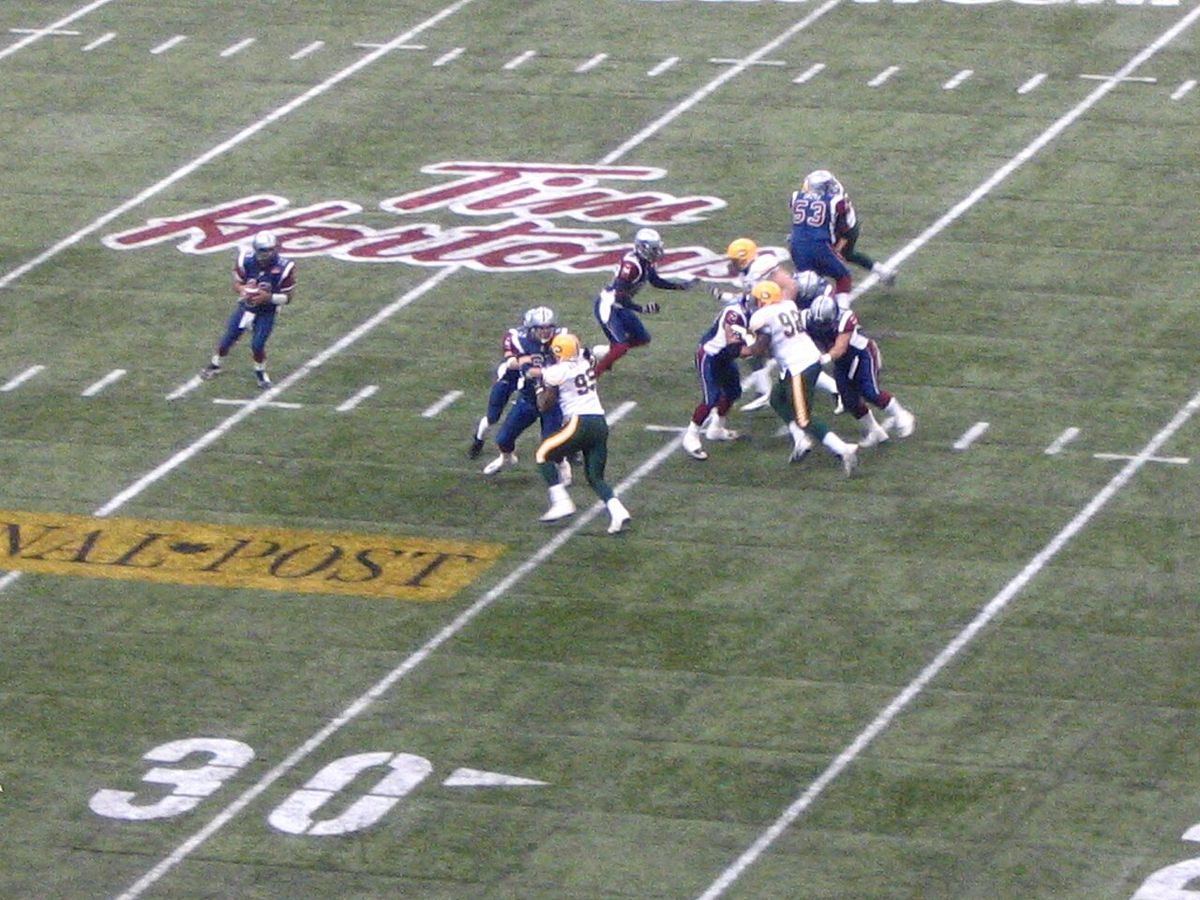
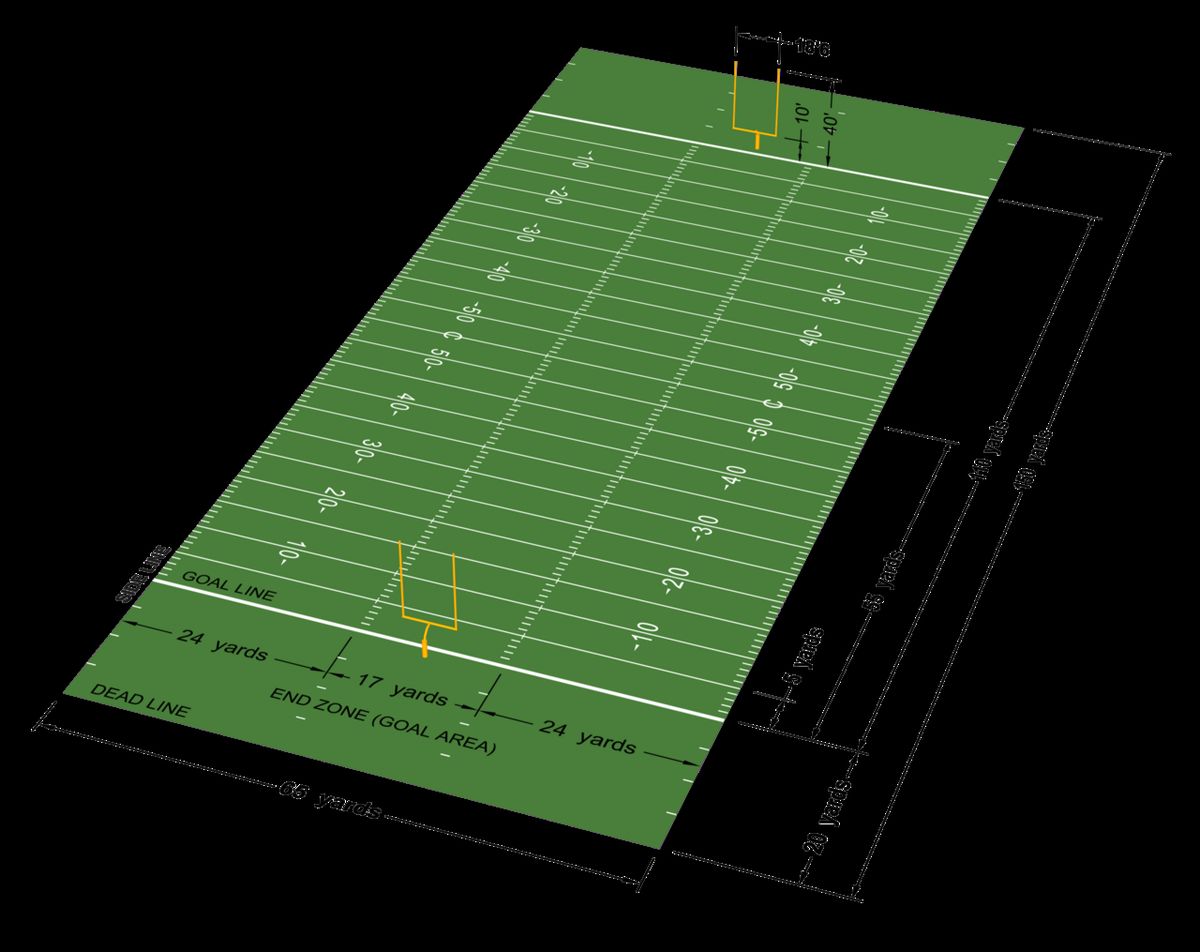
The Canadian football field is notably larger than its American counterpart, measuring 150 yards in total length and 65 yards in width. The playing area between the goal lines is 110 yards long, with end zones that are 20 yards deep, creating a total playing surface of 87,750 square feet. The field is marked by white sidelines and lateral yard lines every five yards, with hash marks placed 24 yards from the sidelines in amateur play and 28 yards in the CFL. At each goal line stands a set of goalposts, which are 40 feet high with a crossbar 10 feet above the ground. While an H-shaped design is permissible, a single-post tuning-fork design is preferred in high-level competitions.
The ball used is a prolate spheroid with pointed ends, brown in colour and featuring two one-inch-wide white stripes. Significant changes to field dimensions are scheduled for the CFL beginning in 2027, when the playing field will be shortened from 110 to 100 yards and the end zones reduced from 20 to 15 yards. Concurrently, the goalposts will be moved from the goal line to the end line. Historically, end zones were 25 yards deep until 1986, and some current venues like Toronto's BMO Field have end zones shorter than the standard 20 yards due to stadium constraints. Fields with surrounding running tracks, such as Montreal's Molson Stadium, often have end zones cut off at the corners to accommodate the track.
Rules and gameplay
Each team fields 12 players, one more than in American football. The offensive team has three downs, or attempts, to advance the ball 10 yards toward the opponent's end zone. Failure to do so results in a turnover on downs, typically leading the team to punt the ball away. Play begins with a coin toss, where the winning captain can choose to kick, receive, or select a direction, with many teams opting to defer their choice to the second half. The opening kickoff takes place from the kicking team's 35-yard line in the CFL or 45-yard line in amateur play.
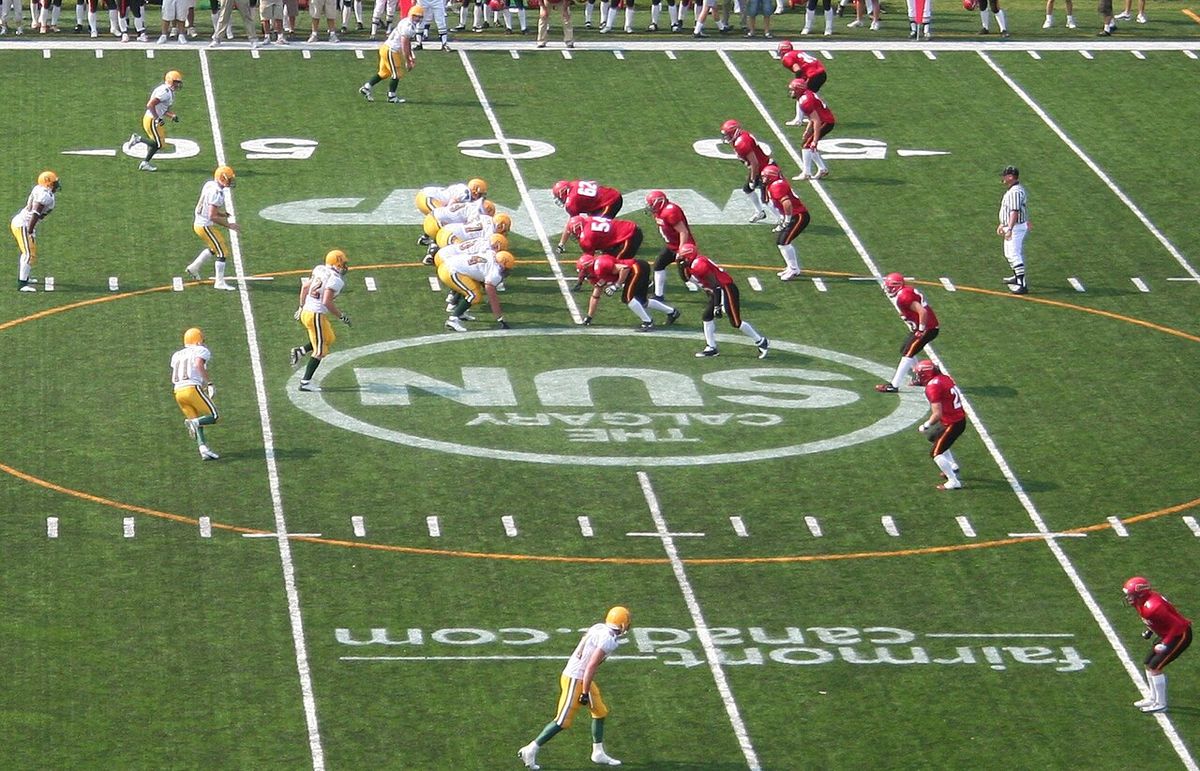
The core of gameplay is the scrimmage, which starts with a backward pass through the legs known as the snap. The offensive team must have at least seven players, excluding the quarterback, within one yard of the line of scrimmage. From the snap, the quarterback or other player receiving the ball has several options. They may run with the ball, hand it off to a teammate, throw a lateral or backward pass at any time, or attempt a forward pass subject to specific restrictions. A forward pass must be thrown from behind the line of scrimmage, only one is allowed per down, and it must be directed toward an eligible receiver. Other options include punting the ball, drop-kicking, or placing it for a place kick. Play is stopped when a ball carrier is tackled, a forward pass is incomplete, a score is made, or the ball goes out of bounds.
Special rules govern kicking plays. On punts and kickoffs, members of the kicking team cannot approach within five yards of the receiving player until the ball is touched, a regulation known as the no-yards rule. This rule is designed to protect the returner and creates more open-field running opportunities, contributing to the exciting special teams play for which Canadian football is known. The wider field and deeper end zones also influence strategy, often leading to a more wide-open, passing-oriented style of play compared to other gridiron codes.
League structure and competition
Canadian football is organized at multiple competitive levels across the country. The pinnacle is the nine-team professional Canadian Football League, whose regular season runs from June through November, culminating in the Grey Cup championship. The league has also hosted regular season Touchdown Atlantic games in Atlantic Canada to promote the sport in regions without CFL teams. Amateur football across all ages and genders is governed by Football Canada, which works with the International Federation of American Football to have the Canadian rulebook accepted for international friendlies.
At the university level, 27 teams compete in four conferences under U Sports, competing for the Vanier Cup national championship. Junior football for players aged 18 to 22 is served by two major leagues. The Canadian Junior Football League comprises 19 teams in three conferences competing for the Canadian Bowl, while the Quebec Junior Football League includes teams from Ontario and Quebec battling for the Manson Cup. Semi-professional football has grown in popularity, with prominent leagues including the long-standing Northern Football Conference in Ontario, founded in 1954, and the Alberta Football League. Their champions meet for a national championship. Women's football has also developed, with the Maritime Women's Football League starting in 2004 and the Western Women's Canadian Football League being the largest such circuit.
- Professional: Canadian Football League (CFL), 9 teams, Grey Cup championship.
- University: U Sports football, 27 teams, Vanier Cup championship.
- Junior: Canadian Junior Football League (19 teams, Canadian Bowl) and Quebec Junior Football League.
- Semi-Pro: Alberta Football League, Northern Football Conference, governed by Canadian Major Football League.
- Women's: Western Women's Canadian Football League, Maritime Women's Football League.
Scoring system
Points in Canadian football are scored through several methods, each with a distinct value. The primary and most valuable score is the touchdown, worth six points, which is achieved when a player carries the ball into the opponent's end zone or catches a legal forward pass there. Following a touchdown, the scoring team attempts a convert, worth one point if kicked through the goalposts from the 5-yard line or two points if run or passed into the end zone from the 5-yard line. A field goal, scored by place-kicking or drop-kicking the ball through the goalposts during general play, is worth three points. A safety touch, worth two points for the defending team, occurs when the offensive team is tackled or commits a foul in its own end zone.
Historically, the sport featured a unique score called the rouge, or single point, which remains a part of the game. A rouge is worth one point and is awarded to the kicking team if the ball is kicked into the opponent's end zone and not returned out of it, whether on a punt, a missed field goal, or a kickoff. This rule adds a strategic layer to kicking plays, as teams must decide whether to risk returning a kick from deep in their end zone or concede the single point by kneeling. The scoring values have evolved over time, with touchdowns increasing from five to six points in 1956 and field goals being standardized. The Burnside rules of 1903 established that all goals by kicking were worth two points, which later differentiated into the modern field goal and convert values.
Cultural significance and hall of fame
The Grey Cup championship is one of Canada's premier annual sporting events, drawing a large national television audience and often serving as a de facto national holiday. First awarded in 1909, the trophy symbolizes the pinnacle of achievement in Canadian football and has been won by legendary teams from across the country. The game and its surrounding festival have become ingrained in Canadian culture, with viewing parties and traditions that unite fans from coast to coast. While the sport's popularity is strongest in central and western Canada, efforts like the Touchdown Atlantic games aim to build its profile in the Atlantic provinces. The sport's history and heroes are preserved at the Canadian Football Hall of Fame, located in Hamilton, Ontario.
Canadian football has maintained a distinct national identity despite the cultural influence of the much larger National Football League in the United States. The differences in rules, such as three downs, the larger field, and the rouge, foster a uniquely Canadian style of play that emphasizes passing, speed, and special teams strategy. The CFL has also served as an important development league for Canadian talent and a destination for international players. The hall of fame honours players, builders, and media members who have made outstanding contributions to the game, ensuring the legacy of the sport is celebrated for future generations. The hall's location in Hamilton, a city with a founding club dating to 1869, reflects the deep historical roots of the game in the community.
Key differences from American football
While sharing common origins, Canadian and American football have diverged into distinct codes with several fundamental differences. The most frequently cited distinction is the number of downs, with Canadian football allowing three downs to gain ten yards compared to four in the American game. This fundamental difference necessitates a more aggressive offensive strategy in the Canadian code, often favouring the forward pass. Canadian end zones are 20 yards deep, while American end zones are only 10 yards deep.
Other major differences include the number of players on the field, with Canadian teams using 12 per side versus 11 in American football. The positioning of the goalposts is another key identifier, as in Canadian football they are placed on the goal line at the front of the end zone, whereas in the American game they are on the end line at the back of the end zone. The Canadian game also features the rouge, or single point, for kicks that enter the end zone and are not returned, a scoring play not present in American football. Motion before the snap is less restricted in the Canadian game, allowing all offensive backs to be in motion toward the line of scrimmage at the snap, unlike the limited motion rules in the American code. These differences collectively create a faster, more wide-open style of play in Canadian football.
| Feature | Canadian Football | American Football |
|---|---|---|
| Downs | 3 | 4 |
| Players per side | 12 | 11 |
| Field length (between goals) | 110 yards | 100 yards |
| End zone depth | 20 yards | 10 yards |
| Goalpost location | On the goal line | On the end line |
| Unique scoring play | Rouge (single point) | Not applicable |
Questions about Canadian football
How many downs are there in Canadian football?
Canadian football features three downs, or attempts, for the offensive team to advance the ball ten yards toward the opponent's end zone. This is one fewer down than the four allowed in American football. The three-down system is a fundamental characteristic that shapes Canadian football strategy, often leading to a more pass-oriented and aggressive offensive approach compared to the American game. Failure to gain the required ten yards in three downs typically results in the team punting the ball to the opposition.
What is the Grey Cup?
The Grey Cup is the championship game of the Canadian Football League and one of Canada's most significant annual sporting events. The trophy was donated in 1909 by Governor General Albert Grey as the championship for teams under the Canadian Rugby Union. Initially an amateur competition, it became dominated by professional teams by the 1940s and is now the culmination of the CFL season, played in late November. The game attracts a massive national television audience and is surrounded by a week-long festival celebrating Canadian football culture.
What is a 'rouge' in Canadian football?
A rouge, also called a single point, is a unique scoring play in Canadian football worth one point. It is awarded to the kicking team when the ball is kicked into the opponent's end zone and is not returned out of it by the receiving team. This can occur on a punt, a missed field goal attempt, or a kickoff. The rule adds a strategic element to kick returns, as a player may choose to concede the single point by kneeling in the end zone rather than attempting a risky return. The rouge does not exist in American football.
What are the dimensions of a Canadian football field?
A full Canadian football field is 150 yards long and 65 yards wide. The playing area between the goal lines is 110 yards long, with end zones that are 20 yards deep. The larger dimensions contribute to a more wide-open style of play. In 2027, the CFL will shorten the field to 100 yards between goal lines with 15-yard end zones.
Is Canadian football played outside of Canada?
While primarily confined to Canada, high-level Canadian football has been played in the United States. The Stallions were the most successful, winning the Grey Cup in 1995. The expansion ended due to financial losses and stadium issues. The International Federation of American Football and Football Canada have also agreed that the Canadian rulebook can be used for international friendlies, potentially opening doors for games abroad, but it is not used for world championship qualification.
Where is the Canadian Football Hall of Fame?
The Canadian Football Hall of Fame is located in Hamilton, Ontario. This institution serves as a museum and hall of fame dedicated to preserving the history of Canadian football. It honours players, builders, and media members who have made significant contributions to the sport. The Hall of Fame is situated in a city with deep football roots, as the Hamilton Football Club, later known as the Hamilton Tiger Cats, was formed as early as November 3, 1869. Its location in Hamilton connects it to one of the sport's longest standing communities in Canada.
Sources and further reading
- Canadian football (Wikipedia)
- A New Era: CFL Inks Landmark Media Agreements in ... (theglobeandmail.com)
- DAZN and CFL announce landmark media rights deal (dazn.com)
- Welcome to the Canadian Football Hall of Fame, Home (cfhof.ca)
Checked by the Your Space Hamilton desk. Last updated 2026-10-19.