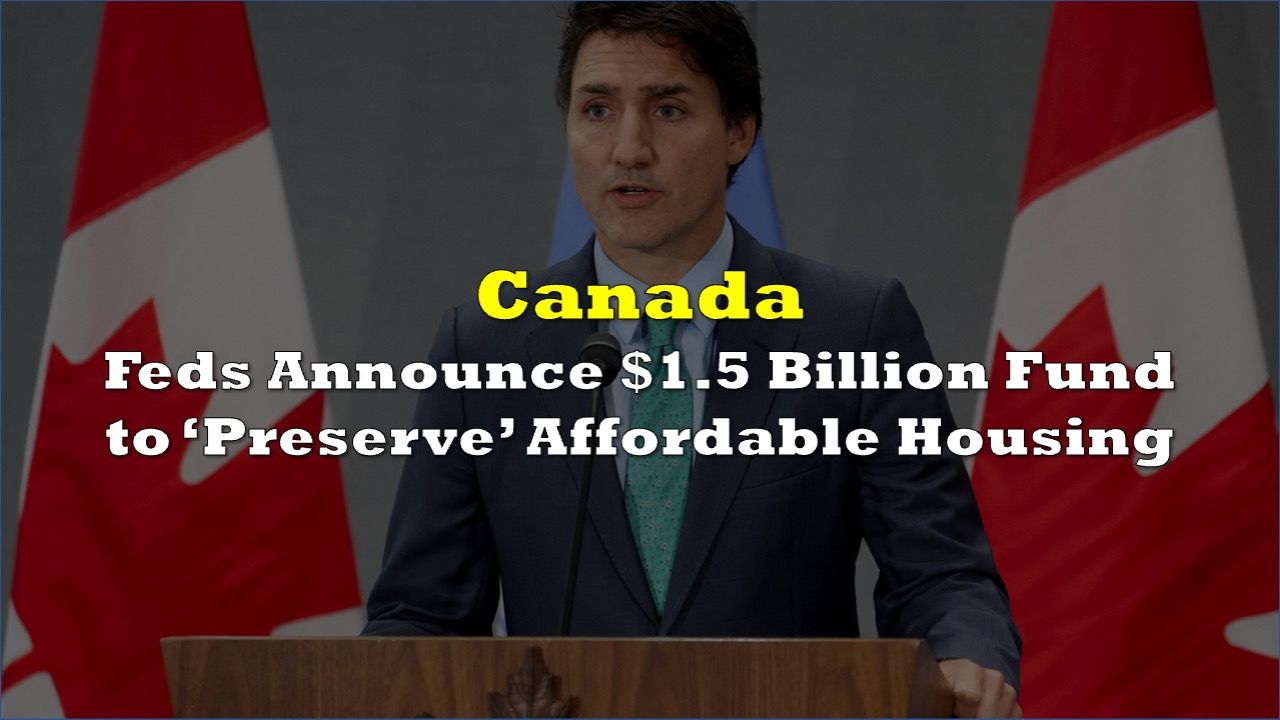
Canada launches $1.5-billion fund to preserve affordable rental buildings
The new fund will provide grants and loans to non-profits to buy existing rental buildings and shield them from redevelopment.
OTTAWA — The federal government has launched a $1.5-billion fund to help non-profits buy existing affordable rental buildings and protect them from redevelopment.
The Canada Rental Protection Fund, announced in Budget 2024, is the latest and largest program of its kind in the country. It will provide grants and low-interest loans to non-profits, housing societies and co-operatives to acquire buildings, with the goal of stabilizing rents and tenancies.
Ray Sullivan, board chair of the Canadian Housing Acquisition Fund which will administer the program, said it addresses a key gap in the National Housing Strategy.
READ MORE: Hazelview Investments opens first rental tower at Toronto's Bloor & Dufferin
READ MORE: Federal co-op housing funding should strengthen democratic governance, experts say
"The underlying principles seem to be supply, supply, supply, and we will build our way out of this problem, but we know from research we're actually losing more affordable housing in the private market than what we're building through programs in the National Housing Strategy," said Sullivan.
He said the national ratio is 1 to 11, meaning for every home built with government assistance, 11 existing affordable homes in the private market are lost. In Ottawa, he said the ratio is 1 to 30.
The federal program is modeled on British Columbia's Rental Protection Fund. Non-profits will become pre-qualified, search for buildings to buy and bring proposals to the CRPF's investment committee for review.
Buildings must generally have at least 40 per cent of units priced at 30 per cent of the median renter household income to be considered. Local factors like how rents compare to the market will also be assessed.
"We know that when non-profits, instead of a REIT, speculator, or private owner, buy these buildings, they will stabilize those rents and those tenancies are more protected," said Sullivan. "Far too often we see that when that 'for sale' sign goes up on the front lawn, too many tenants end up on the street."
The government says the $1.5 billion has the potential to protect 7,000 affordable rental units, implying an average price of $214,000 per unit. According to commercial real estate firm Colliers, the average price per unit for buildings sold in the second quarter of 2026 was $308,000 in the Greater Toronto Area and $325,355 in Metro Vancouver.
Sullivan said about $1 billion of the fund will be distributed as low-interest loans with 10-year terms, while about $480 million will be grants. The intent is to deploy most of the money within five years.
T'Brenn Kelly-McKinnon, interim CEO of the B.C. Rental Protection Fund and chief investment officer of the Canadian Housing Acquisition Fund, said the CRPF is envisioned as a 30-year program. The federal fund has brought in several members from the B.C. program to help launch it.
Some critics argue such programs use taxpayer money to protect old buildings that may need redevelopment anyway, and that funds would be better spent on new construction.
Sullivan said both approaches are needed.
"What we're doing is taking an asset and moving it into the non-market column. That not only stabilizes those tenancies and those rents, but then becomes an asset that is removed from the speculative private market," he said. "If that means 30 or even 25 years from now that non-profit redevelops that property, that's an opportunity. But the people who live there right now would otherwise be displaced."
The seven-person investment committee for the CRPF is still being filled. Sullivan said they have already received dozens of applications and aim to help groups close on acquisitions in early 2027.
With files from The Globe and Mail