Three-spined stickleback
The three-spined stickleback (Gasterosteus aculeatus) is a small, widely distributed fish native to coastal and inland waters across the Northern Hemisphere, including much of Canada. It is a species of significant scientific importance, serving as a model organism for studies in evolution, genetics, ethology, and ecology due to its remarkable morphological diversity and complex behaviours. In Canada, its populations, particularly the unique species pairs found in British Columbia lakes, are subjects of conservation concern and intensive research. The fish's rapid adaptation to new environments and its elaborate breeding rituals have made it a fundamental subject of biological study for over a century.
Physical Description and Identification
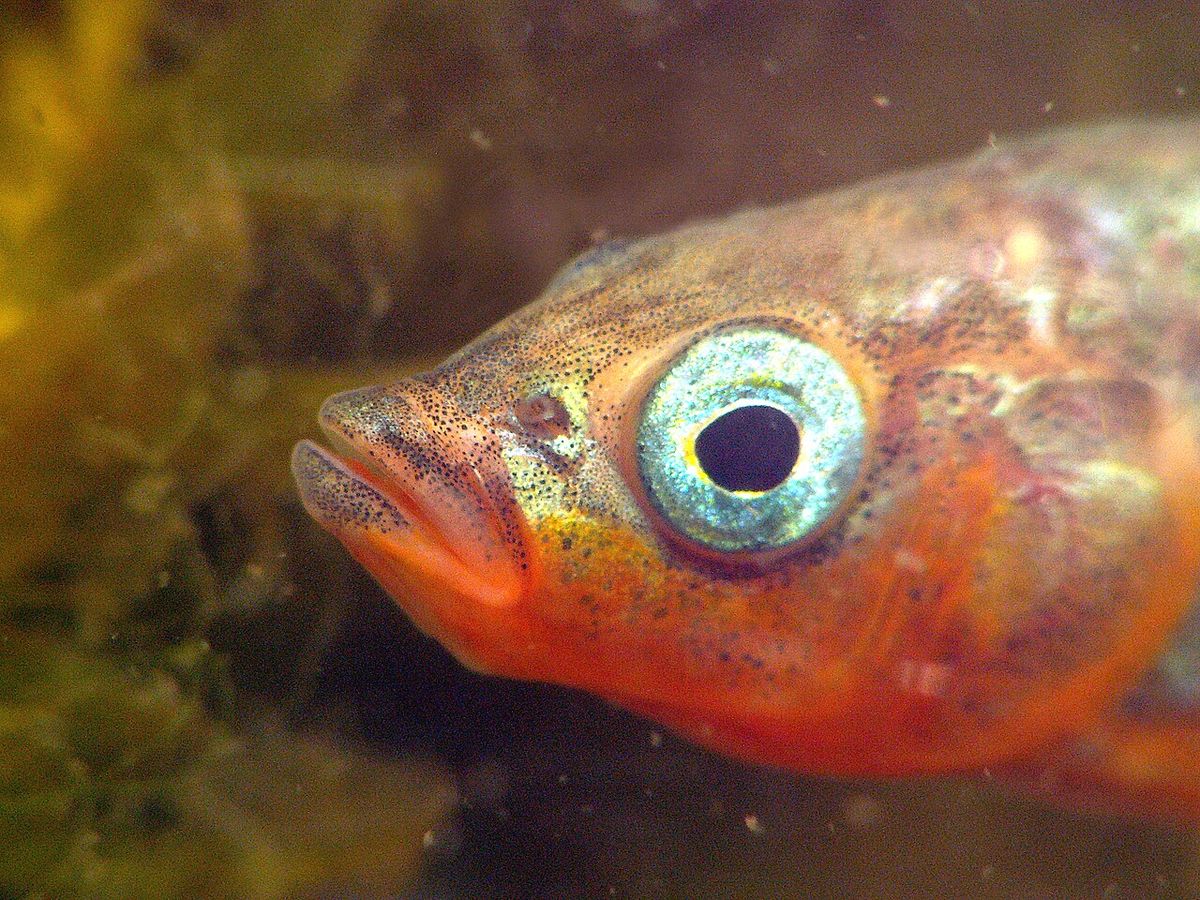
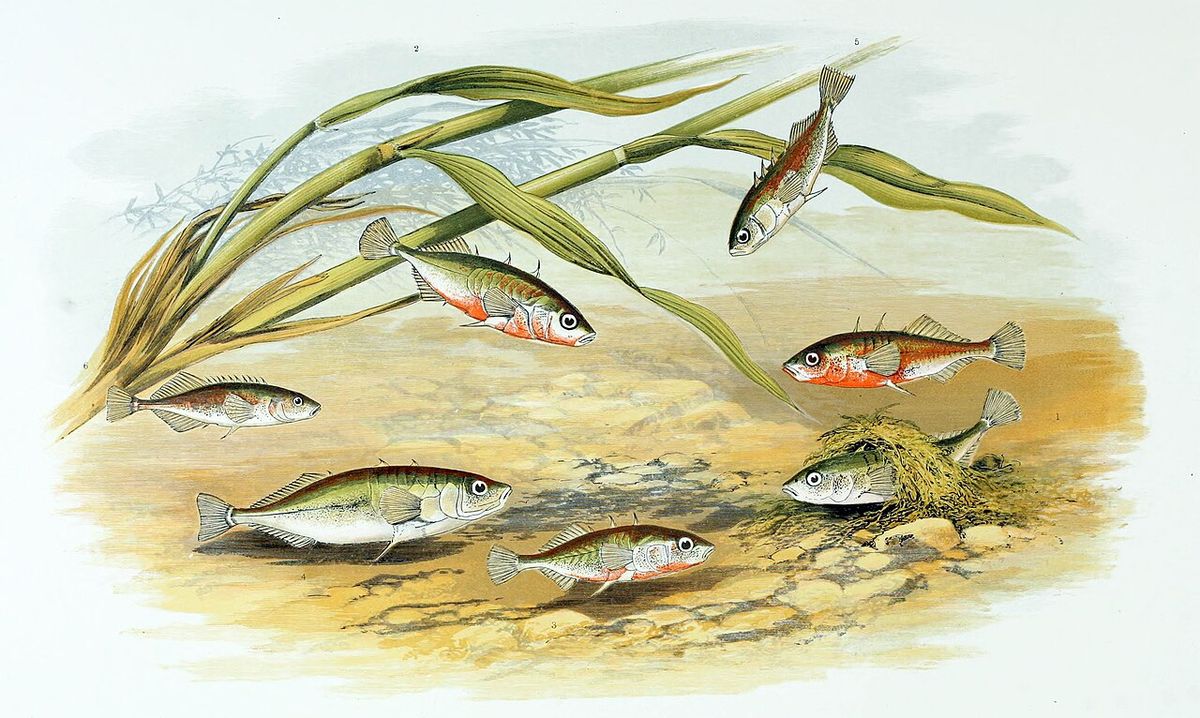
The three-spined stickleback is a small, laterally compressed fish with a slender tail base and a caudal fin possessing 12 rays. It typically reaches 3 to 4 centimetres in length at maturity, though it can occasionally grow to 8 cm. Its most distinctive feature is the set of three isolated spines (though some individuals may have two or four) located in front of the dorsal fin, which can be locked erect as a defence against predators. The third spine is much shorter than the first two. The dorsal fin has 10 to 14 rays, the anal fin has 8 to 11 rays, and the pelvic fins consist of just a spine and one ray. The body lacks scales but is protected by a variable number of bony lateral plates along the flanks, with marine populations typically having more plates than freshwater ones. Dorsal coloration is generally a drab olive or silvery green, sometimes with brown mottling, while the flanks and belly are silvery. During the breeding season, males undergo a dramatic transformation, with the eyes turning blue and the throat, lower head, and anterior belly becoming bright red, a colouration derived from dietary carotenoids. Some isolated populations, however, feature breeding males that are entirely black or white, often found in peat-stained waters.
Habitat and Global Distribution
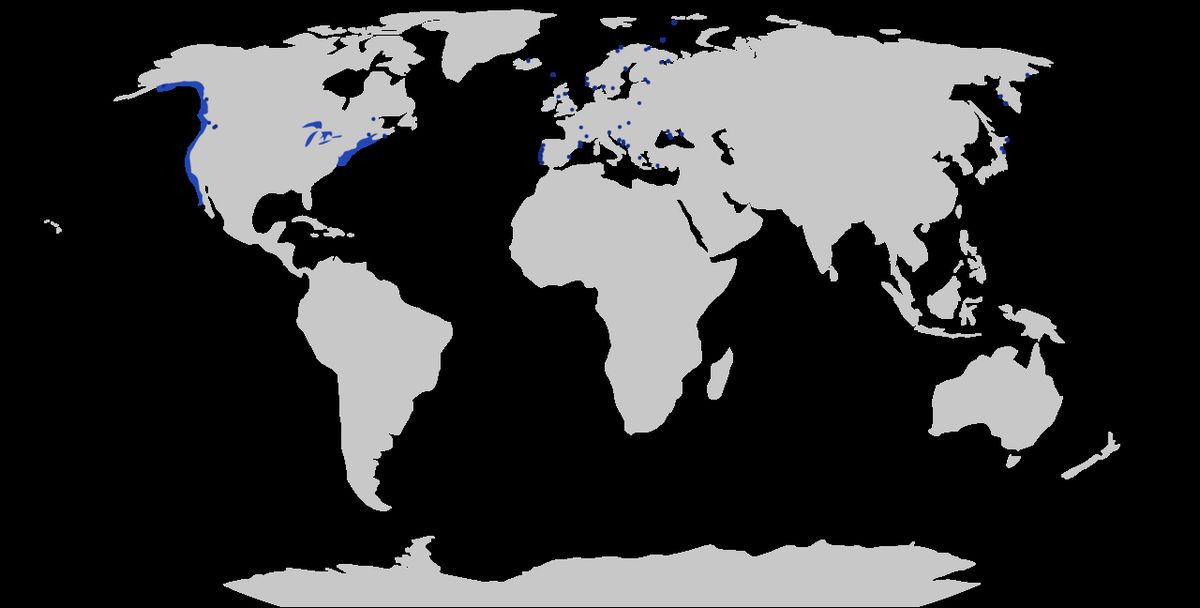
This highly adaptable species inhabits a wide range of aquatic environments across the Northern Hemisphere, including fresh, brackish, and salt water. It prefers slow-flowing waters with areas of emerging vegetation and can be found in ditches, ponds, lakes, backwaters, quiet rivers, sheltered bays, marshes, and harbours. In North America, its range extends along the East Coast from Chesapeake Bay to the southern half of Baffin Island and the western shore of Hudson Bay, and along the West Coast from southern California to the western shore of Alaska and the Aleutian Islands. It is present throughout Europe between 35 and 70°N, locally in the Volga River basin, and across Asia from Japan and Korea to the Bering Strait. Its distribution is not fully circumpolar, as it is absent from the north coast of Siberia, the north coast of Alaska, and the Arctic islands of Canada. In Canada, it is widespread, with notable populations including a unique group in the meromictic Pink Lake within Gatineau Park, Quebec.
Morphological Variation and Subspecies
The three-spined stickleback exhibits extraordinary morphological variation, which is broadly categorized into anadromous and freshwater forms. The anadromous form, which spends its adult life eating plankton and fish in the sea and returns to freshwater to breed, is morphologically similar all around the Northern Hemisphere. These fish are typically between 6 and 10 cm long and have 30 to 40 lateral armour plates along their sides with long dorsal and pelvic spines. In contrast, freshwater populations, probably formed when anadromous fish started spending their entire lifecycle in fresh water, are extremely morphologically diverse. One consistent difference is the reduction of body armour, with the majority of freshwater fish having between none and 12 lateral plates and shorter spines. The International Union for Conservation of Nature (IUCN) recognizes three subspecies, which represent points on this spectrum of variation.
- G. a. aculeatus: Found in most of the species range, this is the subspecies most strictly termed the three-spined stickleback. Its common name in Britain is the tiddler or "tittlebat".
- G. a. williamsoni (Unarmored Threespine Stickleback): Its recognized range is southern California, though isolated reports have been made of it occurring in British Columbia and Mexico.
- G. a. santaeannae (Santa Ana Stickleback): Also restricted to North America.
Within freshwater lakes, two major ecological forms have repeatedly evolved due to adaptation to different feeding niches. The limnetic form, found in deep, steep-sided lakes, feeds on plankton in surface waters and often has large eyes, short slim bodies, and upturned jaws. The benthic form, from small shallow lakes, feeds mainly on the lake bed and is often long and heavy-bodied with relatively horizontal jaws and small eyes. These divergent forms are a key example of ecological speciation.
Evolution, Speciation, and Rapid Adaptation
The three-spined stickleback is an evolutionarily old species, with the oldest fossil record from the Miocene Alta Mira Shale of California showing it has remained morphologically similar for over 10 million years. A fossil stickleback, Gasterosteus doryssus from Nevada, shows that the traits of rapid evolution and armor reduction are a longstanding tendency of the lineage. In contemporary times, this rapid adaptation is vividly demonstrated in populations that have colonized freshwater lakes. Since each watershed was probably colonised separately by anadromous sticklebacks, morphologically similar populations in different watersheds are believed to have evolved independently, a process known as parallel evolution. A dramatic example of rapid change occurred in Loberg Lake, Alaska, where a chemical eradication in 1982 killed the resident freshwater population. This evolution in less than 20 years is thought to be driven by genetic variations conferring advantages in fresh water. In several lakes in British Columbia, this process has led to the formation of distinct species pairs, sympatric benthic and limnetic forms that do not interbreed, representing speciation in action.
Reproduction and Parental Care
Reproductive behaviour in the three-spined stickleback is elaborate and well-studied, famously described by ethologist Niko Tinbergen, who identified the red throat of the male as a sign stimulus. Sexual maturation depends on environmental temperature and photoperiod, with longer, warmer days stimulating colouration in males and egg development in females. From late April, males move to shallow areas, defend a territory, and build a nest by digging a pit and filling it with plant material, sand, and debris glued with a kidney secretion called spiggin. Nest building takes 5-6 hours or may be spread over days. The male then courts gravid females with a zigzag dance, leads her to the nest, and after she deposits 40 to 300 eggs and he fertilizes them, he chases her away. He may court other gravid females to add more egg batches to the same nest. The male provides sole parental care, fanning the eggs to oxygenate them for 7-8 days at 18-20 °C, with fanning increasing at night or in poorly oxygenated water. Towards hatching, he often makes holes in the nest to improve ventilation. After hatching, he attempts to keep the young together for a few days before they disperse. The red colouration, produced from dietary carotenoids, signals male quality, and females prefer males with brighter reds. A unique population in Nova Scotia, dubbed "white sticklebacks" for their reduced dorsal pigmentation, builds nests in algae but disperses the eggs immediately after fertilization, representing a loss of parental care.
Diet, Life History, and Parasites
The diet of the three-spined stickleback varies with its life stage, morphology, and habitat. It can function as a benthic feeder, most commonly consuming chironomid larvae and amphipods, or as a planktonic feeder in lakes or the ocean. It will also consume terrestrial prey fallen to the surface and is known to cannibalize eggs and fry. Many populations take two years to mature and experience only one breeding season before dying, and some can take up to three years to reach maturity. However, some freshwater populations and populations at extreme latitudes can reach maturity in only one year. The species' life history is affected by parasites, notably infection with the cestode Schistocephalus solidus, which can cause a reduction in egg mass or complete absence of eggs in females. The health of individuals is also reflected in breeding displays, as males with fewer parasites tend to exhibit brighter red colours.
Cooperative Behaviour and Predator Inspection
Three-spined sticklebacks are known for cooperative behaviour, mainly during predator inspection. This behaviour allows fish to acquire information about a predator's risk and may deter an attack, though it carries the cost of increased chance of being attacked. Sticklebacks are known to cooperate using a tit for tat (TFT) strategy during these inspections. This strategy involves an individual cooperating on the first move and then doing whatever its opponent did on the previous move, allowing for collaborative, retaliatory, and forgiving responses. Experimental studies where fish approaching a live predator were provided with simulated cooperating or defecting companions showed the fish behaved according to the tit-for-tat strategy. Sticklebacks typically operate in pairs for inspection, with individuals having partners for repeated pairwise visits, and two reciprocal pairs per trial occur more often than expected by chance. This behaviour is frequently cited as a classic example of how cooperation can evolve among self-interested individuals.
Conservation Status and Canadian Significance
While the three-spined stickleback as a whole is considered a species of Least Concern by the IUCN due to its vast range, specific freshwater populations hold unique evolutionary value and face local threats. In Canada, the benthic and limnetic species pairs found in lakes on islands in British Columbia are of particular importance. These pairs in Paxton Lake and Priest Lake on Texada Island are listed as Endangered under Canada's Species at Risk Act. They represent a pristine example of ecological speciation that is vulnerable to disruption. One such pair in Hadley Lake on Lasqueti Island was destroyed in the mid-1980s by the introduction of a predatory catfish, and the pair in Enos Lake on Vancouver Island has started to interbreed and are no longer two distinct species. The species' rapid adaptation, as seen in Alaskan lakes like Loberg and in response to pollution in Washington's Lake Union, continues to make it a vital subject for understanding evolutionary processes. The unique evolutionary history encapsulated in many freshwater populations indicates that further legal protection for specific groups may be warranted beyond the broad species classification.
Scientific Importance and Research Applications
The three-spined stickleback is a premier model organism in biological research. Its ease of finding in nature and keeping in aquaria has facilitated decades of study across diverse fields including evolution, population genetics, physiology, ethology, and behavioural ecology. Its extensive morphological variation and rapid evolution provide a natural laboratory for investigating genetic mechanisms and adaptive radiation. The species is a classic subject in ethology, particularly for studies of instinctive behaviour, sign stimuli, and complex breeding rituals pioneered by Niko Tinbergen. Research on sticklebacks has provided key insights into cooperative behaviour and the tit-for-tat strategy. Their antipredator adaptations, host-parasite interactions with Schistocephalus solidus, sensory and reproductive physiology, and endocrinology have also been much studied. The ability to manipulate breeding in the lab by controlling light and temperature, even to stimulate two breeding cycles in a year, is valuable for multi-generational genetic and behavioural studies. This combination of traits solidifies its role as one of the most important vertebrate species in modern biological science.
Questions about Three-spined stickleback
Where can you find three-spined sticklebacks in Canada?
Three-spined sticklebacks are found in coastal and inland waters across much of Canada. Their range includes coastal waters from British Columbia to the Atlantic, inland lakes and rivers, and northern areas like the western shore of Hudson Bay. Notable specific locations include the unique population in the meromictic Pink Lake in Gatineau Park, Quebec, and the endangered species pairs in Paxton Lake and Priest Lake on Texada Island, British Columbia. They are also present in many other lakes and streams throughout the country.
Why is the three-spined stickleback important for scientific research?
This fish is a fundamental model organism in biology due to its remarkable traits. It shows great morphological variation across its range, allowing detailed studies of evolution and population genetics. It exhibits complex, instinctive breeding behaviour, making it ideal for ethology and behavioural ecology. Its rapid adaptation to new environments, as seen in Alaskan lakes where plate counts changed in just 12 years, provides real-time examples of natural selection. Its cooperative predator inspection behaviours are studied to understand the evolution of social strategies like tit for tat.
What are the different forms of three-spined stickleback?
There are two broad ecological forms: anadromous and freshwater. Anadromous sticklebacks live in the ocean and return to freshwater to breed. They are larger (6-10 cm), have 30-40 lateral armour plates, and are morphologically similar worldwide. Freshwater forms, descended from anadromous ancestors, are highly diverse and often have reduced armour (0-12 plates). Within lakes, they often split into limnetic forms (slim, plankton-feeders with upturned jaws) and benthic forms (heavy, bottom-feeders with horizontal jaws). These forms can become distinct species that do not interbreed, a process known as ecological speciation.
How does the male three-spined stickleback care for its young?
The male provides all parental care. After building a nest from algae and debris glued with spiggin and attracting a female to lay 40-300 eggs, he fertilizes them and then guards the nest. His primary duty is fanning the eggs with his pectoral fins to provide oxygen, a behaviour he performs day and night for about 7-8 days at 18-20°C until they hatch. He may make ventilation holes in the nest as the eggs develop. After hatching, he keeps the fry together for a few days, sucking wanderers into his mouth and spitting them back, before they disperse.
Are any three-spined stickleback populations endangered in Canada?
Yes, specific unique populations are legally protected. The benthic and limnetic species pairs found in Paxton Lake and Priest Lake on Texada Island, British Columbia, are listed as Endangered under Canada's Species at Risk Act. These pairs are vulnerable to threats like introduced predators or hybridization, as happened with the now-lost pair in Hadley Lake on Lasqueti Island and the hybridizing pair in Enos Lake on Vancouver Island. Their protection highlights the conservation value of these evolved systems.
What is unique about the Nova Scotia 'white sticklebacks'?
A population of three-spined stickleback in Nova Scotia exhibits a unique departure from the usual reproductive pattern. Unlike other sticklebacks, the males build nests in mats of filamentous algae but then disperse the eggs almost immediately after fertilization and resume courting females. This represents a loss of the extended parental care typical of the species. Because these males have reduced dorsal pigmentation, giving a pearlescent white appearance, they are dubbed "white sticklebacks. It is unknown whether they are a distinct species or simply a morph of the common Atlantic stickleback.
Sources and further reading
- Three-spined stickleback (Wikipedia)
- Biologists Seek to Reintroduce More Genetically Robust ... (nps.gov)
Checked by the Your Space Hamilton desk. Last updated 2026-10-23.