Toki Pona
Toki Pona is a minimalist constructed language, or conlang, created by Canadian linguist and translator Sonja Lang. First published online in 2001, its design is rooted in philosophical principles inspired by Taoism and the Sapir-Whorf hypothesis, aiming to simplify thought and promote positivity through a deliberately limited vocabulary. The language, whose name translates to 'the language of good' or 'simple language', has grown from a personal artistic project into a global online community with its own literature and writing systems. For Canadians, Toki Pona represents a significant contribution to the field of constructed languages from a New Brunswick native, exploring the intersection of language, cognition, and culture.
Origins and philosophical foundations
Toki Pona was conceived by Sonja Lang, a polyglot and translator born in 1978 in Moncton, New Brunswick, as a personal tool to manage depression and simplify complex thoughts. The language's development began in 2001, with early drafts shared online where they quickly attracted interest and formed the nucleus of an initial community. Lang's design was influenced by her fluency in multiple languages, including Esperanto, and by philosophical ideas, particularly Taoist principles of simplicity and living in the present moment. Another key inspiration was the Sapir-Whorf hypothesis, which posits that language shapes thought, leading Lang to design Toki Pona to encourage positive and essentialist thinking. Although not intended as a universal auxiliary language, its accessibility has allowed it to function as a bridge for cross-cultural communication among its dedicated speakers.
The core purpose of Toki Pona is artistic and philosophical, focusing on expressing maximal meaning with minimal complexity. Its structure mimics aspects of pidgin languages, concentrating on simple, near-universal concepts to make it learnable and usable across different linguistic backgrounds. The language is designed to help users deconstruct complex ideas into fundamental components, theoretically allowing them to perceive the core nature of the concepts they discuss. Lang has described the language as being meant to be 'fun and cute', emphasizing a lighthearted and creative approach to communication over rigid grammatical rules or an expansive lexicon.
Development and community growth
The evolution of Toki Pona from an online experiment to a established conlang is marked by key publications and community milestones. The language's first complete form was codified in Lang's 2014 book, Toki Pona: The Language of Good, which presented around 120 words and established the official grammar. This book, often referred to by speakers as lipu pu, was subsequently translated into several languages including French, German, Esperanto, and Persian. In April 2026, Lang declared the original English edition of this foundational book to be dedicated to the public domain, significantly increasing its accessibility.
Community input became central with the release of the Toki Pona Dictionary (lipu ku) in July 2021. This comprehensive work was based on extensive polls within the ma pona pi toki pona Discord server and includes over 11,000 entries. It formalized 137 'essential' words, categorizing them into core vocabulary and less frequently used terms gathered from community surveys. The language's formal recognition came with the adoption of the ISO 639-3 code 'tok' in January 2022, following a third application filed in August 2021. While most community interaction occurs online through chat rooms and social media, there have also been organized in-person meetups, demonstrating the language's tangible social dimension.
Phonology and orthography
Toki Pona's phonology is deliberately simple and accessible, featuring only 14 phonemes. The consonant inventory includes /p, t, k, s, m, n, l, j, w/, while the five vowels are /a, e, i, o, u/. Stress consistently falls on the first syllable of a word. The phonotactic rules are restrictive, allowing syllables to be only CV, CVN, V, or VN, with no diphthongs, consonant clusters (except those involving a final nasal), or tones. This simplicity ensures the language is easy to pronounce for speakers of diverse linguistic backgrounds. Statistical analysis shows the vowel /a/ is the most common, appearing in about 32% of words, while among consonants, /l/ is unusually frequent at 20% of syllable-initial sounds.
The small phoneme inventory permits extensive allophonic variation, meaning sounds can be pronounced in multiple accepted ways without changing meaning. For instance, /p t k/ may be voiced as [b d ɡ], /s/ may be pronounced as [z] or [ʃ], and /l/ can be realized as [ɾ]. The nasal coda, written as 'n', assimilates to the place of articulation of any following consonant. The primary writing system uses 14 letters of the Latin alphabet (a, e, i, j, k, l, m, n, o, p, s, t, u, w), with 'j' representing the sound of English 'y'. Proper names are indicated with an initial capital letter, while all other words are written in lowercase, even at the start of a sentence.
Writing systems and visual expression
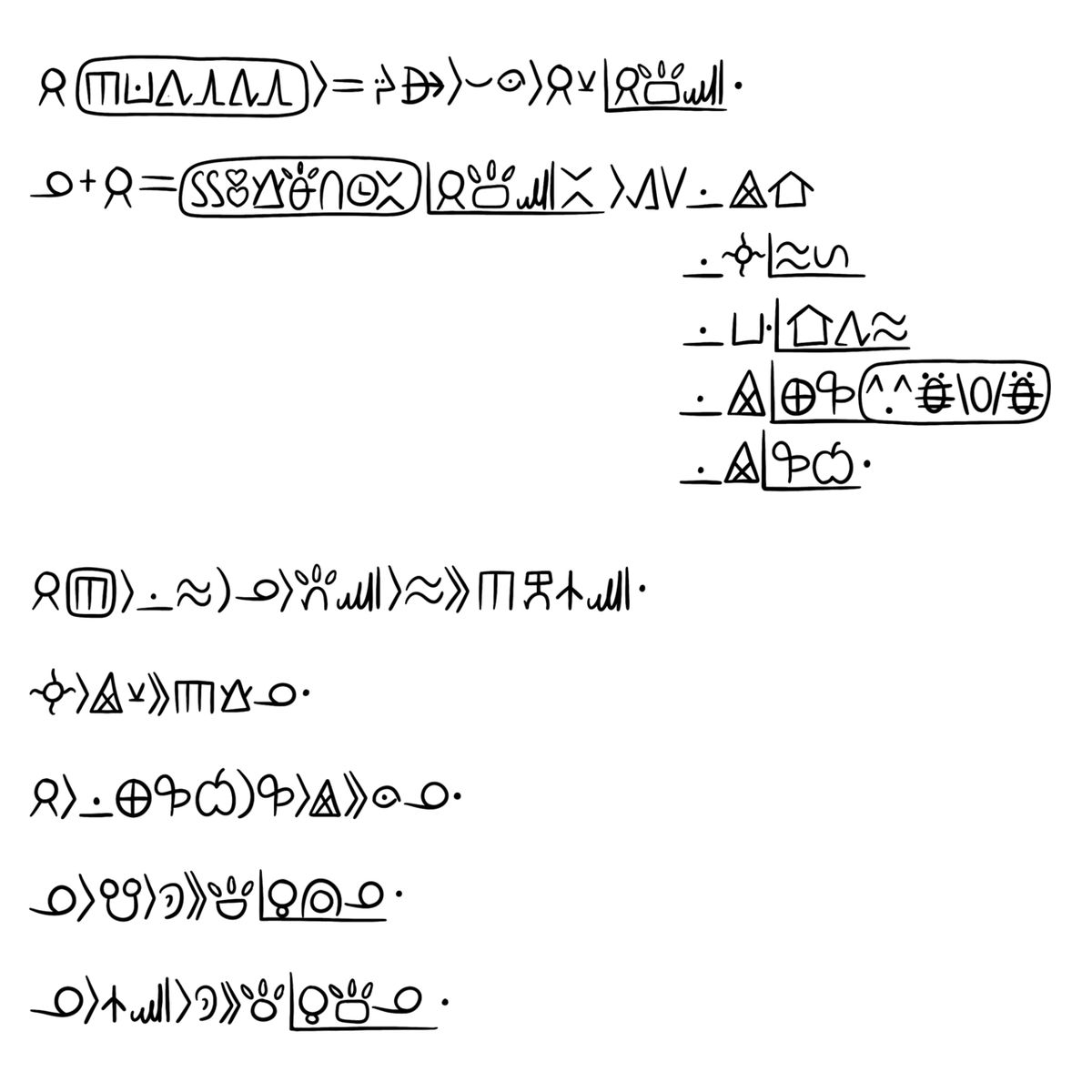
Beyond the standard Latin script, Toki Pona features creative alternative writing systems developed by its community. The most prominent is Sitelen Pona, a logographic script created by Sonja Lang and published in her 2014 book. Each word is represented by a unique, often pictographic symbol described as hieroglyphic-like and childlike in its simplicity. A distinctive feature allows modifiers to be written inside or above the symbol of the word they modify, creating compact visual phrases. For example, the name of the language itself is written with the symbol for 'pona' (good) drawn inside the symbol for 'toki' (language).
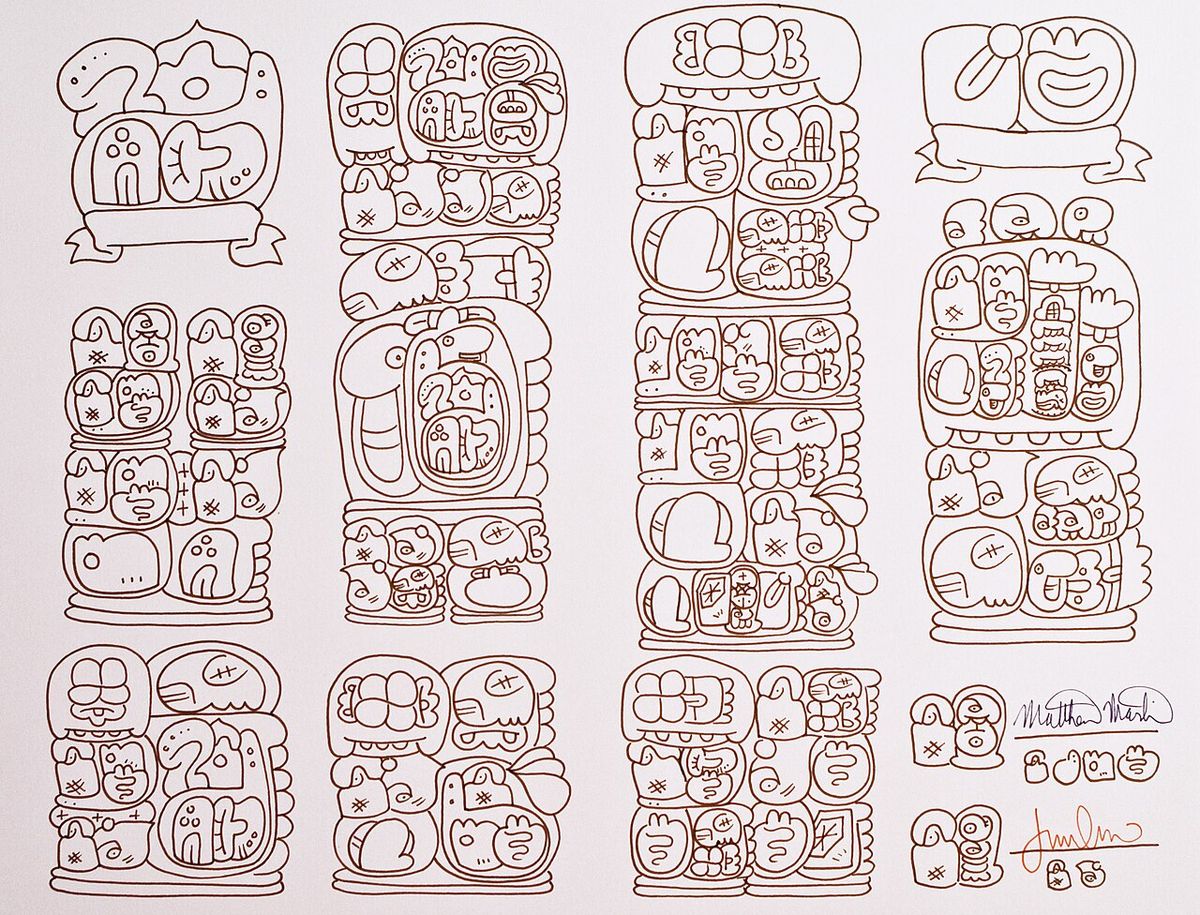
Another significant system is Sitelen Sitelen, also known as sitelen suwi, created by Jonathan Gabel. This is a mixed, non-linear system that combines logograms with an abugida for writing syllables, particularly for proper names. Its elaborate and artistic glyphs are designed to slow down the reading process and make users contemplate how communication methods influence thought. The aesthetic draws inspiration from US west-coast comix and east-coast graffiti art, while individual character designs reference diverse scripts like Egyptian hieroglyphs, Chinese characters, Maya script, and Mi'kmaw hieroglyphs.
- Sitelen Pona: A logographic system devised by Sonja Lang. Symbols are simple and pictographic.
- Sitelen Sitelen (sitelen suwi): A mixed logographic and abugida system created by Jonathan Gabel. Glyphs are complex and artistic.
- Latin alphabet: The most common writing system, using 14 letters with consistent phonetic values.
- Proper name adaptation: Names are converted into Toki Pona adjectives based on their native pronunciation (e.g., 'John' becomes 'San').
Grammar and sentence structure
Toki Pona grammar is isolating, meaning words do not change form through inflection for tense, number, or gender. The basic word order is subject-verb-object. Grammatical relationships are marked by particles: 'li' introduces the predicate (verb phrase), and 'e' introduces a direct object. Content words are multifunctional. A word like 'moku' can serve as a verb (to eat), a noun (food), or a modifier (edible) depending on its position in the sentence. This flexibility allows the small vocabulary to cover a wide semantic range. The language is also head-initial, meaning the main noun or verb comes before any modifiers that describe it.
Sentences can be statements, interjections, commands, or questions. Yes-no questions are formed either by using an 'A-not-A' construction (e.g., 'verb ala verb') or by adding the tag 'anu seme' (or what). Other questions use the interrogative word 'seme' in place of the unknown information. Context and temporal adverbs indicate time, as there are no verb tenses. The particle 'la' is used to set up a contextual phrase before the main clause, and 'pi' is used to group modifiers together when they need to modify a head noun as a single unit. Pronouns are simple: 'mi' (I/we), 'sina' (you), 'ona' (he/she/it/they), and 'ni' (this/that).
Vocabulary and semantic range
The lexicon of Toki Pona is famously small, comprising approximately 120 to 137 words as defined in its official publications. Each word is highly polysemous, covering a broad range of related concepts based on context. For instance, 'suli' can mean big, long, tall, or important. To express more specific ideas, speakers combine words into phrases, a process called compounding. A 'friend' is 'jan pona' (good person), 'alcohol' might be 'telo nasa' (strange liquid), and 'to teach' is 'pana e sona' (give knowledge). This system requires and fosters creativity, reliance on shared context, and a focus on fundamental attributes.
Colour terminology in Toki Pona is limited to five basic words: 'pimeja' (black), 'walo' (white), 'loje' (red), 'jelo' (yellow), and 'laso' (blue/green). To describe other colours, speakers combine these terms or use comparisons. For example, purple might be described as 'laso loje' (reddish blue) or 'loje laso' (bluish red). The numeral system is also minimalistic, with words for 'wan' (one), 'tu' (two), 'mute' (many), 'ala' (zero/none), and 'ale' (all/infinite). This constrained vocabulary is a direct expression of the language's philosophical goal to focus on essential, universal experiences.
| Concept Category | Example Words | Semantic Range |
|---|---|---|
| People & Beings | jan, soweli | person/people, animal |
| Actions & States | moku, lukin, pona | to eat/food, to see/look, good/simple |
| Nature & Objects | telo, kiwen, suno | water/liquid, hard thing/rock, sun/light |
| Descriptors | suli, lili, nasa | big/important, small/little, strange/crazy |
| Colours | loje, laso, jelo | red, blue/green, yellow |
Cultural impact and usage
Toki Pona has transcended its origins as a personal project to influence areas beyond hobbyist linguistics. It has been the subject of academic study, including research into its potential therapeutic applications. One psychiatrist explored a method for reducing negative thinking by having patients track their thoughts in Toki Pona, leveraging its simplifying nature. In technology, the language was selected for the initial vocabulary of the ROILA (Oral Interaction with Language) project in 2010, a study on machine speech recognition which found that a modified Toki Pona vocabulary significantly outperformed English in recognition accuracy.
The language's literary corpus continues to grow. Following the foundational textbook and dictionary, Sonja Lang released The Wonderful Wizard of Oz (Toki Pona edition) in February 2024, written in the Sitelen Pona script. This book is the first in a planned series of illustrated storybooks collectively referred to as lipu su. The active, global online community remains the primary driver of the language's use, generating original content, music, and art, and facilitating conversation in chat rooms and on social media platforms. This sustained engagement demonstrates Toki Pona's success as a living, creative medium for human connection and artistic expression.
Questions about Toki Pona
Who created Toki Pona and why?
Toki Pona was created by Canadian linguist and translator Sonja Lang, who was born in Moncton, New Brunswick in 1978. She began developing the language in 2001 as a personal tool to simplify her thoughts during a period of depression. Inspired by Taoist philosophy and the Sapir-Whorf hypothesis, Lang designed Toki Pona to promote positive thinking and help users focus on essential, universal concepts by using a minimal vocabulary. Although it began as an artistic and philosophical project, it has since grown into a language with a global community.
How many words are in Toki Pona?
The core vocabulary of Toki Pona is deliberately small. The first official book, Toki Pona: The Language of Good (2014), presented around 120 words. The subsequent Toki Pona Dictionary (2021), which incorporated community usage, lists 137 'essential' words along with a number of additional less commonly used words. This tiny lexicon is designed to be polysemous, with each word covering a range of related meanings, and speakers combine these words creatively to express more complex ideas.
Is Toki Pona easy to learn?
Yes, Toki Pona is generally considered one of the easiest languages to learn due to its extremely simple grammar, small vocabulary, and phonetic consistency. Its 14 phonemes and straightforward syllable structure make pronunciation accessible to speakers of most languages. With no verb conjugations, noun declensions, or grammatical gender, the grammatical rules can be mastered relatively quickly. Most learners can gain basic proficiency within a few weeks of study, though achieving fluency involves mastering the creative compounding of its limited word set.
Can you actually communicate complex ideas in Toki Pona?
Yes, speakers can communicate complex ideas in Toki Pona, but they do so through context, creative word combinations, and descriptive phrases rather than through specialized vocabulary. The language relies heavily on compounding. For example, 'to teach' is expressed as 'pana e sona' (give knowledge). This process requires abstraction and a focus on the fundamental nature of concepts. While it may take more words to describe a technical idea compared to a natural language, the community has demonstrated the language's capacity for poetry, storytelling, and everyday conversation.
What are Sitelen Pona and Sitelen Sitelen?
Sitelen Pona and Sitelen Sitelen are two alternative writing systems for Toki Pona. Sitelen Pona is a logographic script created by Sonja Lang where each word is represented by a simple, often pictographic symbol. Modifiers can be drawn inside the symbol they modify. Sitelen Sitelen, created by Jonathan Gabel, is a more elaborate mixed system combining logograms with an abugida (a syllabic writing system) for writing sounds, especially in proper names. Its artistic glyphs are designed to slow down reading and encourage reflection. Both systems were included in the official 2014 book.
Is there a Toki Pona community in Canada?
While Toki Pona's community is predominantly global and online, its Canadian origins are significant. Creator Sonja Lang is from Moncton, New Brunswick, and the language's development and major publications are Canadian contributions to constructed language culture. Community activity mainly occurs online in dedicated chat rooms, forums, and social media groups like the ma pona pi toki pona Discord server. There have been organized in-person meetups internationally, and Canadian speakers likely participate in these global gatherings, though no specific Canadian organization is noted in the available records.
Sources and further reading
- Toki Pona (Wikipedia)
- Toki Pona (official site) (tokipona.org)
- toki pona, Andrea Baisero's Website (khoury.northeastern.edu)
- Philosophy (sona.pona.la)
- Toki Pona (griffinbassett.com)
Checked by the Your Space Hamilton desk. Last updated 2026-10-19.