Rotary snowplow
The rotary snowplow is a specialized piece of railroad snow removal equipment designed to clear deep snow from railway tracks using a large, rotating circular blade assembly at its front. Invented in Toronto, Canada, in the late 19th century, it became a critical tool for maintaining rail service through the harsh winters of Canada and the mountainous regions of North America. Its ability to cut through and throw snow far from the tracks made it indispensable for operations in areas prone to heavy snowfall and avalanches, such as British Columbia's mountain passes and the American Donner Pass. While largely supplanted by more economical methods, the rotary snowplow remains a significant symbol of railway engineering and winter resilience, with several preserved examples in museums across the continent.
Invention and Early Development
The concept for the rotary snowplow originated in Toronto, Ontario, with dentist J. W. Elliot, who conceived the idea in 1869 but never progressed beyond the design stage. Orange Jull of Orangeville, Ontario, later expanded on Elliot's design, constructing working models that he tested using sand. During the winter of 1883 to 1884, Jull contracted the Leslie Brothers of Toronto to build a full-size prototype, which successfully demonstrated the viability of the rotary design. Following this success, Jull sold his design rights to the Leslie Brothers, who subsequently formed the Rotary Steam Shovel Manufacturing Company based in Paterson, New Jersey. The Leslie Brothers then contracted the Cooke Locomotive & Machine Works, also in Paterson, to handle the actual construction of the plows, marking the beginning of their commercial production. Another figure associated with the invention in later US patents is Colonel Lewis P. Campbell, listed on patent 1848554 filed in 1929, though the core development occurred decades earlier in Canada.
Design and Operational Principles
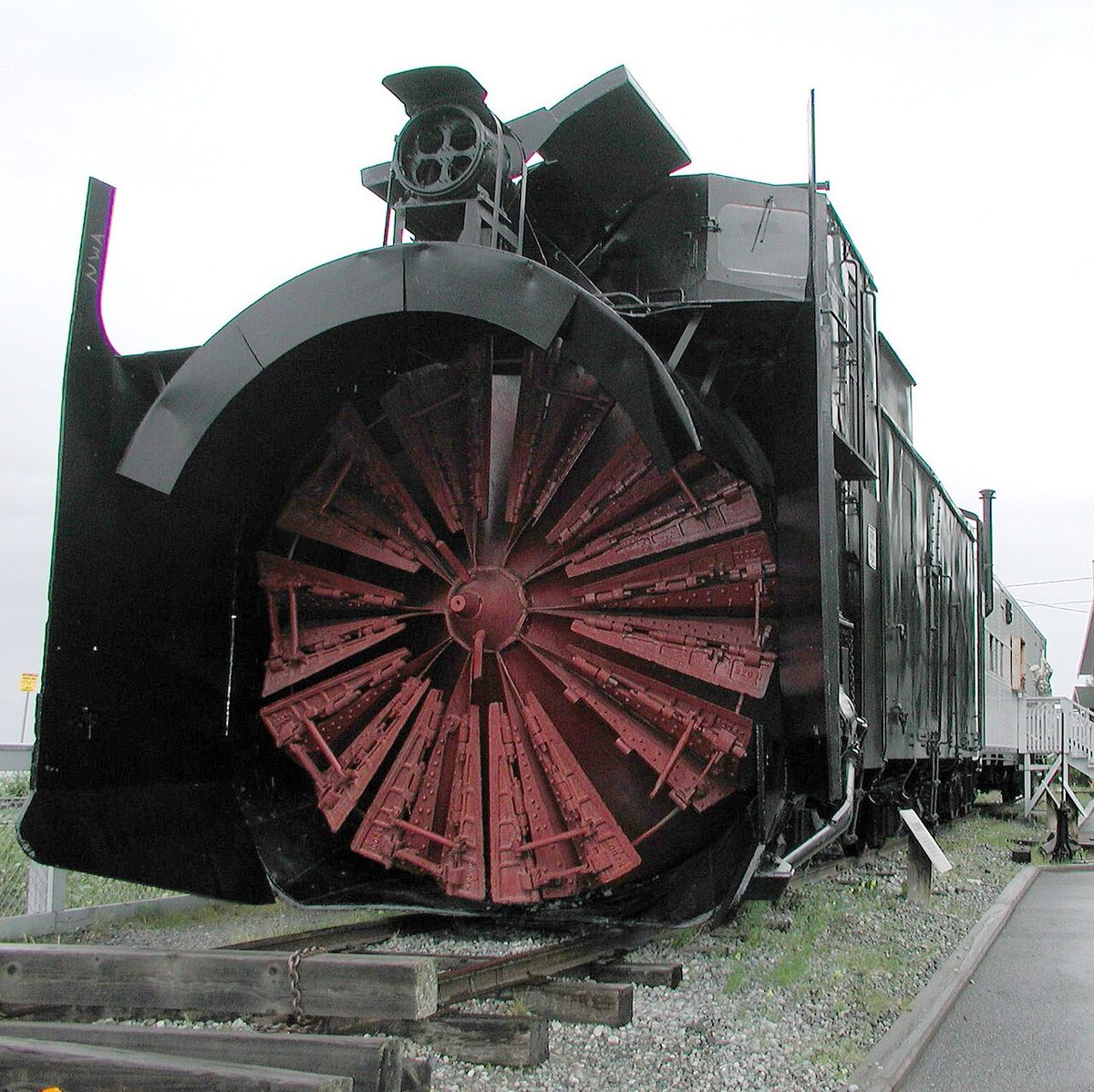
A rotary snowplow operates on a fundamentally different principle from traditional wedge plows, which simply push snow to the side of the tracks. The rotary features a large circular assembly of blades at its front that rotates, cutting into the snow and forcing it through a channel to an adjustable output chute. This chute can be directed to throw the cleared snow to either the left or right side of the tracks, often far into the surrounding area. An operator situated in a cab above and behind the blade assembly controls the rotation speed and the chute's direction. Many rotary plows are not self-propelled and require one or more locomotives to push them along the line, though modernized cabs often include multiple-unit controls to operate these pushing locomotives remotely.
The rotary's ability to operate slowly and methodically, without relying on the train's momentum to break up snow, provided a significant safety advantage in treacherous mountainous terrain. This slow, controlled cutting action minimized the risk of high-speed derailments in unstable snow conditions. The design proved particularly effective against deep, hard-packed snow drifts that would overwhelm conventional wedge plows. However, the rotary's operation creates an open cut in the snowbank, which then prevents fixed-blade plows from being used afterward. This means that once a rotary is deployed on a line, it must be used for all subsequent significant snowfalls until the seasonal snowpack melts, locking the railroad into a more expensive clearing method. The machinery is expensive to maintain regardless of annual use, and the energy required to power the blades makes operational costs higher than for fixed-blade plows.
Historic Use and Notable Deployments
Rotary snowplows saw extensive use across North America wherever railroads faced extreme winter conditions. One of the most famous locations for their deployment was Donner Pass in California, a critical route for the Southern Pacific Railroad known for severe snowfall and avalanches. Following the catastrophic stranding of the City of San Francisco passenger train in January 1952, where rescue attempts were hampered by further avalanches that trapped plows and killed crew members, the Southern Pacific adopted a new standard practice. They began operating trains with a rotary snowplow on each end, blade ends pointing outward, and two or three locomotives coupled between them.
- This double-ended configuration allowed the train to clear tracks in one direction and then return without turning around, even if new snow covered its path.
- It also enabled efficient clearing of multiple-track mainlines by making a pass in one direction on one track, then reversing to clear the adjacent track.
- The practice maximized efficiency and safety in an environment where avalanches could quickly isolate equipment.
While North American railroads have largely retired their fleets, Japan continues widespread use of rotary snowplows on its mountainous rail lines. In North America, the largest remaining operational fleet belongs to the Union Pacific Railroad, which maintains six rotary plows in reserve specifically for clearing Donner Pass. Their continued presence highlights the unique challenge posed by that location, where road access for bulldozers is poor and snowfall is routinely severe enough to justify keeping the specialized equipment. The few remaining rotary plows on the continent are otherwise owned by museum railroads or kept in reserve for areas with similarly poor access and routine severe snowfall.
Power Systems and Evolution
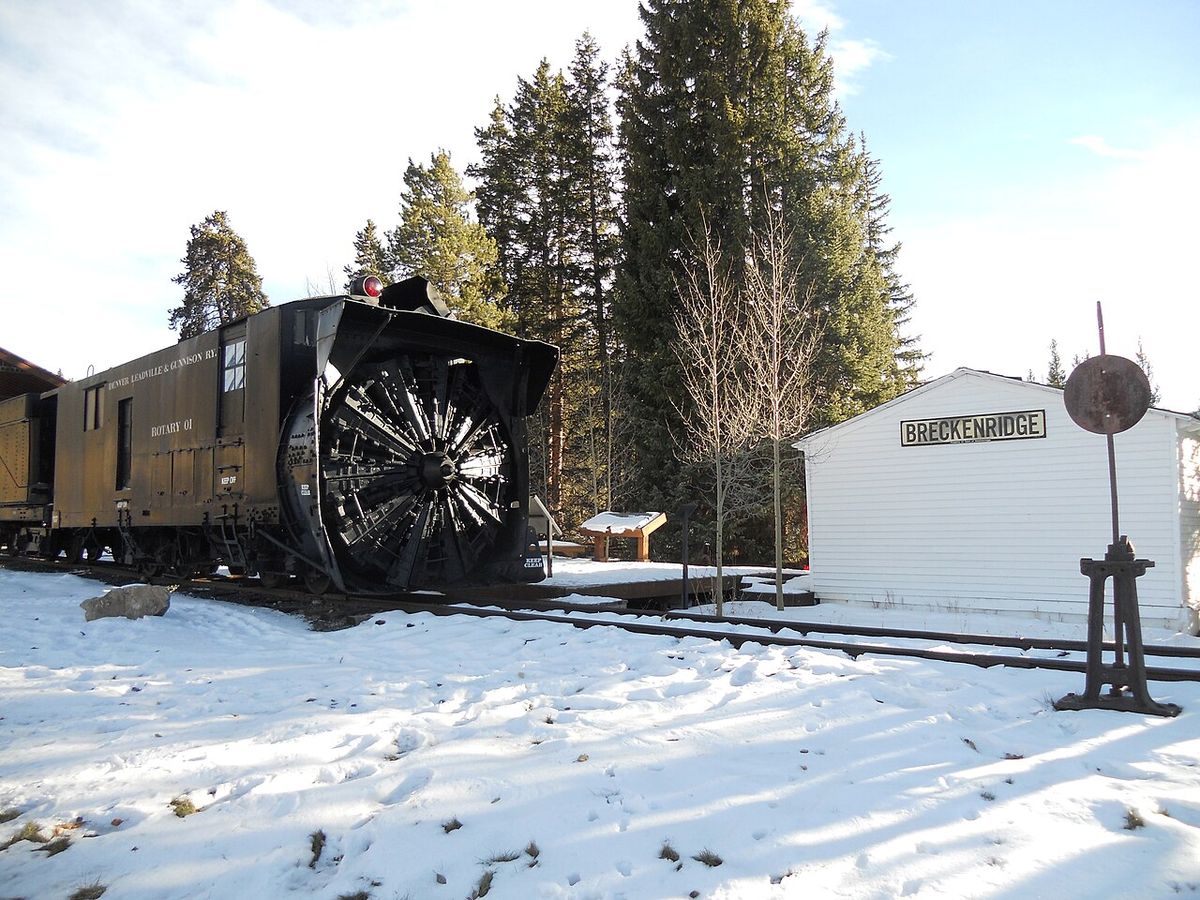
The power systems for rotary snowplows have evolved significantly since their invention. The earliest rotaries were powered by steam engines housed within the plow's carbody, which drove the rotating blade assembly. A small number of these steam-powered plows remain in working order, such as one operated by the White Pass and Yukon Route in Alaska, which performs annual demonstration runs through thick snow for photographers and railway enthusiasts. As diesel locomotives became the standard, newer rotaries were constructed with diesel or electric power plants, and many of the old steam plows were converted to electric power. Electric rotary plows can draw power in different ways, with some designed to take electrical power directly from a coupled locomotive and others semi-permanently paired with dedicated power units.
These dedicated power units are often old locomotives that have had their traction motors removed. In railroad slang, they are colloquially known as snails. This term is derived from slug, which refers to a motored but engineless unit that takes its power from another locomotive. The opposite configuration, with an engine but no motors, is therefore called a snail. Some electric plows can take their power from a locomotive, while others are semi-permanently coupled to these power units.
Preservation and Museum Displays
Most railroads have eliminated their rotary snowplows due to high maintenance costs. As a result, the few remaining rotary plows in North America are either owned by museum railroads or are kept in reserve for areas with poor road access and routine severe snowfall conditions. Numerous examples have been preserved in railway museums across North America and beyond. These preserved plows serve as historical artifacts of a unique era of railway winter operations.
| Plow Identification | Preservation Location | City, Province/State | Notes |
|---|---|---|---|
| Alaska Railroad #4 | Potter Section House State Historic Site | south of Anchorage, Alaska | On display |
| Colorado & Southern No. 99201 | Colorado Railroad Museum | Golden, Colorado | On display |
| Denver & Rio Grande Western OY | Cumbres & Toltec Scenic Railroad | Chama, New Mexico | Operational after 2020 restoration for photography special |
| Denver & Rio Grande Western OM | Cumbres & Toltec Scenic Railroad | Chama, New Mexico | Built 1880, converted to narrow gauge 1907, on display since 1976 |
| Northern Pacific #2 | Lake Superior Railroad Museum | Duluth, Minnesota | Built 1887 by John and Edward Leslie of Orangeville, Ontario |
| Northern Pacific #10 | Northwest Railway Museum | Snoqualmie, Washington | Built November 1907, on display |
| Southern Pacific MW208 | Western Pacific Railroad Museum | Portola, California | Operational. Involved in 1952 City of San Francisco rescue |
| Southern Pacific MW205 | California State Railroad Museum | Sacramento, California | Static display |
| Union Pacific #900075 | Illinois Railway Museum | Union, Illinois | On display |
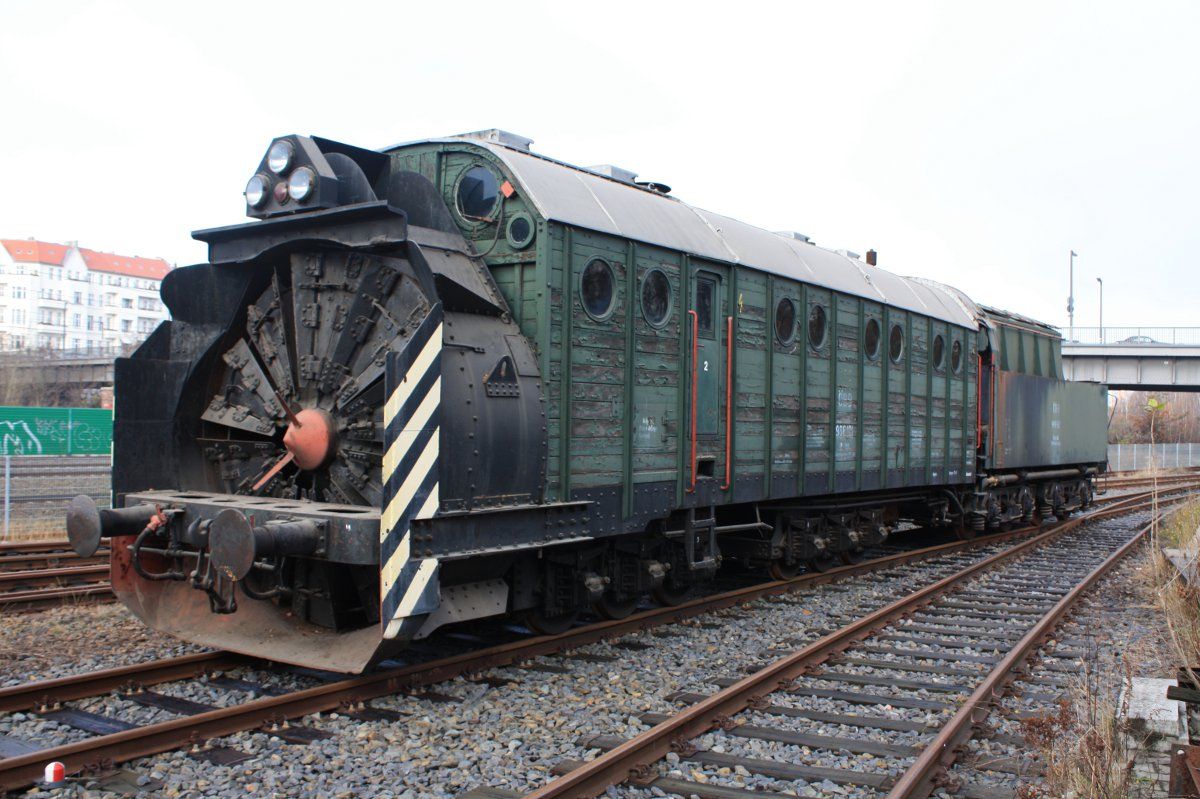
| Paris-Orléans ZR1 | Cité du Train | Mulhouse, France | Static display with right side open to show interior |
In addition to those in the table, many other plows are on static display at various institutions. The Oregon Short Line #762 is at the Mid-Continent Railway Museum in North Freedom, Wisconsin, and the Southern Pacific MW210 is at the Truckee Railroad Museum in California. The Rotary Snowplow 'B' is displayed at the Nevada Northern Railway Museum in Ely, Nevada, and the Long Island Railroad #193 is at the Steamtown National Historic Site in Pennsylvania. The preservation of these machines, from operational examples to historically significant ones, ensures the legacy of this innovative technology is maintained for future generations.
Hall of Fame Recognition and Historical Significance
In 2001, the rotary snowplow was inducted into the North America Railway Hall of Fame, which establishes an enduring tribute to people and things that have made significant contributions to the railway industry in North America. The plow was inducted in the 'Technical Innovations' category and was recognized as having 'National' significance. This formal recognition acknowledges the machine's major impact on winter railroading, enabling the reliable movement of goods and passengers through some of the continent's most challenging environments for nearly a century. The historical significance of the rotary is closely tied to specific events and locations, most notably the January 1952 stranding of the City of San Francisco train on Donner Pass.
During that event, rotary plows were central to the rescue efforts. The dangers faced by crews included the loss of a plow crew when their plow was hit by an avalanche and the trapping of two other plows by subsequent avalanches. This led the Southern Pacific Railroad to adopt a new standard practice for Donner Pass. The practice involved creating a train with a rotary snowplow at each end and two or three locomotives coupled between them.
Decline and Current Status
The use of rotary snowplows has dramatically declined on mainline railroads due to their high costs and the availability of alternative technologies. Rotary plows incur significant maintenance expenses whether they are used in a given winter or not, making them a costly asset for railroads. In contrast, fixed-blade plows have much lower upkeep costs and can be used in conjunction with bulldozers, which are versatile pieces of equipment that can be deployed on year-round maintenance projects. The operational cost of running a rotary, which requires substantial energy to power its cutting blades, is higher than that of simpler plows, cementing their status as a tool of last resort.
As a result, most North American railroads have eliminated their rotary fleets, reserving them only for the most extreme conditions where other equipment fails. The remaining operational rotaries are primarily found in two contexts: museum railways that operate them for historical demonstration, and reserve fleets for specific, inaccessible geographic areas with predictably severe snow. The Union Pacific's reserve fleet for Donner Pass is the prime example of the latter, consisting of six plows. The rotary snowplow's induction into the North America Railway Hall of Fame in 2001 confirms its important historical contribution, even as its practical role has diminished in the modern railway era where cost efficiency often takes precedence over specialized capability.
Questions about Rotary snowplow
Who invented the rotary snowplow?
The initial concept was patented by Canadian dentist J. W. Elliot in Toronto in 1869, though he never built a working model. The first functional prototype was developed by Orange Jull of Orangeville, Ontario, who expanded on Elliot's design. Jull contracted the Leslie Brothers of Toronto to build the full-size prototype during the winter of 1883 to 1884, which proved successful and led to commercial production. A later US patent from 1929 also lists Colonel Lewis P. Campbell as an inventor.
How does a rotary snowplow work?
A rotary snowplow uses a large, powered circular blade assembly at its front to cut into deep snow. The rotating blades scoop up the snow and force it through a channel to an adjustable output chute mounted above the blades. An operator in a cab controls the blade speed and can swivel the chute to throw the snow far to either side of the tracks. Unlike wedge plows, it does not rely on the train's momentum, allowing for slow, controlled clearing in dangerous conditions where high speed could cause a derailment.
Where were rotary snowplows most famously used?
Rotary snowplows were most famously used in areas of particularly deep snowfall, such as California's Donner Pass. The Southern Pacific Railroad used them there following the January 1952 stranding of the City of San Francisco train. The railroad sometimes created a train consisting of a rotary snowplow at each end with locomotives between them. This practice became standard for the Southern Pacific Railroad on Donner Pass after that event.
Are rotary snowplows still used today?
Rotary snowplows are not widely used by most railroads today due to their high maintenance and operating costs. The few remaining rotary plows in North America are either owned by museum railroads or are kept in reserve for areas with poor road access and routine severe snowfall conditions. The largest remaining fleet consists of Union Pacific Railroad's six plows reserved for Donner Pass. Japan sees widespread use of rotary snowplows in its many mountain passes.
What is a 'snail' in relation to a rotary snowplow?
In railroad terminology, a 'snail' is a slang term for a dedicated power unit that provides engine power to a rotary snowplow but has no traction motors itself. It is often an old locomotive that has been modified by removing its motors. The term is a playful opposite of 'slug', which refers to a unit with motors but no engine. A snail is semi-permanently coupled to the plow to supply the necessary energy to rotate the cutting blades, forming a combined unit for snow clearing operations.
Where can I see a preserved rotary snowplow?
You can see preserved rotary snowplows in many museums. For example, Alaska Railroad #4 is on display at the Potter Section House State Historic Site in Alaska. Colorado & Southern No. 99201 is at the Colorado Railroad Museum in Golden, Colorado. Southern Pacific MW208 is in operational condition at the Western Pacific Railroad Museum in Portola, California. Union Pacific #900081 is on display at the National Museum of Transportation in St. Louis, Missouri.
Sources and further reading
- Rotary snowplow (Wikipedia)
- The oldest railroad snow plow in the U.S. earns landmark ... (asme.org)
- The inventor of the rotary snowplow was… a dentist? (bnsf.com)
- ASME-Landmark:Northern Pacific Railroad Snow Plow (ethw.org)
Checked by the Your Space Hamilton desk. Last updated 2026-10-31.