Newsprint
Newsprint is a low-cost, non-archival paper primarily composed of wood pulp, most notably used for printing newspapers, flyers, and other mass-distribution publications. It was invented in 1844 by Charles Fenerty of Nova Scotia, a landmark Canadian innovation that transformed the global publishing industry. Characterized by its off-white colour and distinctive texture, newsprint is engineered for high-speed web printing presses. Its affordability and strength have made it a fundamental material for the dissemination of information worldwide, though its demand has shifted significantly with changes in media consumption and economic trends.
Invention and Development
The invention of newsprint is credited to Charles Fenerty, a Nova Scotian who began experimenting with wood pulp around 1838. His breakthrough came in 1844 when he successfully produced paper from spruce wood. On October 26, 1844, Fenerty presented a sample of his wood-pulp paper to the Acadian Recorder, a leading Halifax newspaper, along with a detailed letter explaining his process. In his correspondence, Fenerty described the paper as being as firm and durable as common wrapping materials made from hemp or cotton, asserting the feasibility of manufacturing paper from forest trees. He specifically noted the fibrous quality of fir, spruce, and poplar made them especially suitable for this purpose. Fenerty's invention provided a cheaper and more abundant alternative to the rag-based paper that was standard at the time. This discovery laid the groundwork for the modern newspaper industry by enabling the mass production of affordable print material. While others in Europe made similar discoveries around the same period, Fenerty's work is a seminal Canadian contribution to industrial technology.
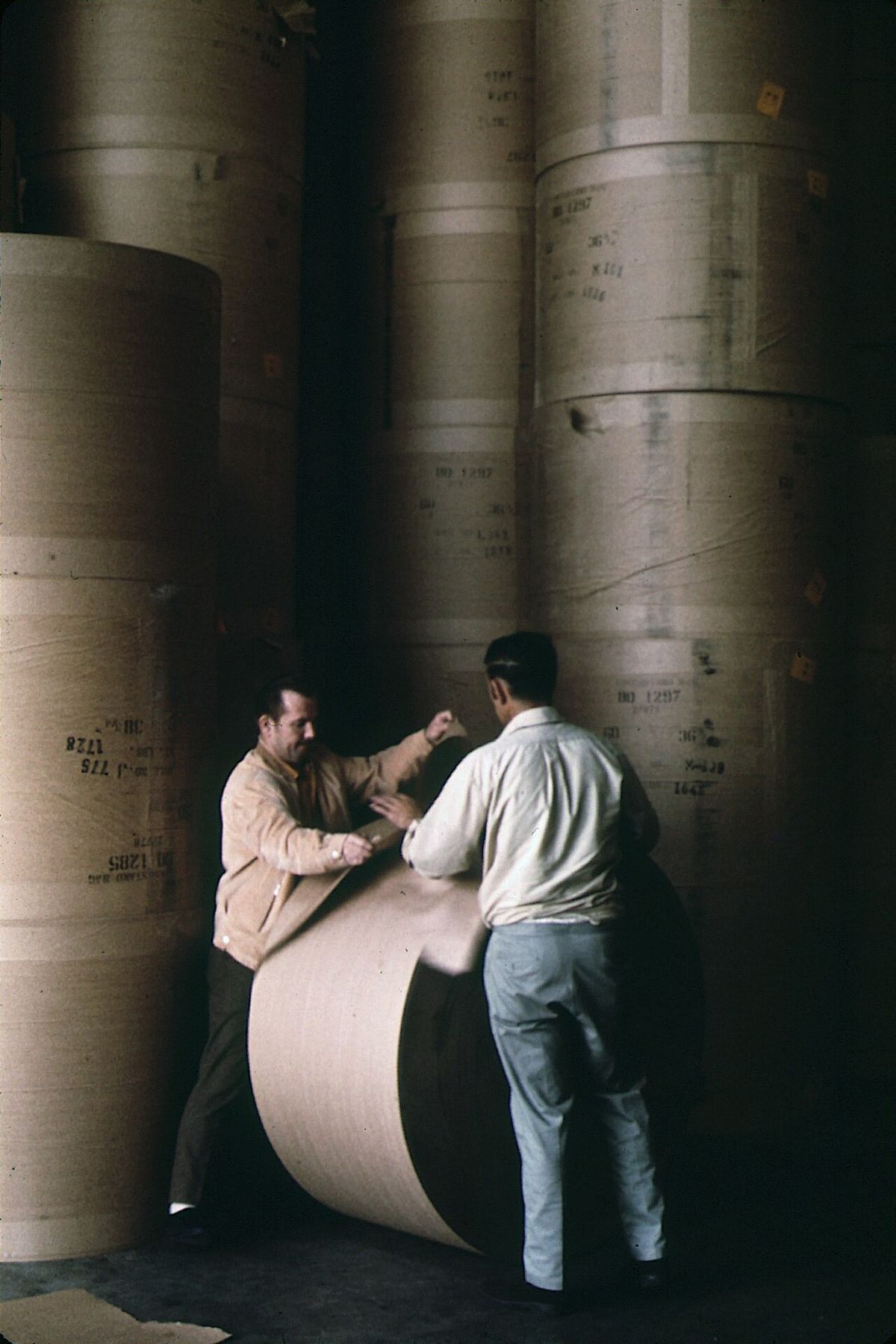
Manufacturing Process and Composition
Newsprint is traditionally manufactured through a mechanical milling process that grinds wood into pulp without using chemicals to remove lignin. This lignin content is what causes newsprint to yellow and become brittle when exposed to air and sunlight over time. The primary raw material has historically been fibre extracted from softwood tree species such as spruce, fir, balsam fir, and pine. An increasing proportion of the world's newsprint is now made using recycled fibres, though there are physical limits to how many times wood fibre can be recycled. According to industry analyses, wood fibre can typically only be recycled up to five times before the fibres become too damaged and short for papermaking. Consequently, a continuous input of new, or virgin, fibre is required to maintain global production levels, even if individual mills operate using 100 percent recycled content. Many mills use a blend of fresh and recycled fibres to balance sustainability with product quality. The manufacturing process is energy-intensive, with major cost inputs being energy, fibre, and labour. Mill operating margins were significantly affected between 2006 and 2008 by rising global energy costs, which increased the price of this key manufacturing input.
Global Demand and Market Trends
Global demand for newsprint has undergone significant geographical shifts since the turn of the 21st century. In 2006, total world demand reached approximately 37.2 million metric tonnes, which represented a decrease of about 1.6 percent from the year 2000. The most dramatic changes occurred in Asia and North America during this six-year period. Demand in Asia grew by roughly 20 percent, driven largely by economic expansion in China and India, where rising disposable incomes increased newspaper readership. China's demand alone nearly doubled to about 3.2 million metric tonnes by 2006. In contrast, North American demand fell by approximately 25 percent over the same timeframe. The regional distribution of demand in 2006 saw Asia account for 35 percent of global usage, North America for 26 percent, and Western Europe for 25 percent. Latin America and Eastern Europe each represented about 5 percent, with smaller shares going to Oceania and Africa. The decline in North America is attributed to several interrelated factors, including falling newspaper circulation, competition for advertising dollars from digital media, and concerted efforts by publishers to reduce newsprint consumption through conservation measures. According to the Newspaper Association of America, average U.S. daily newspaper circulation on a typical weekday fell from 62.5 million in 1986 to 52.3 million in 2006, illustrating the long-term trend of declining readership.
Primary Uses and Distribution
Newsprint is used worldwide in the printing of newspapers, flyers, and other printed material intended for mass distribution. In the United States, daily newspaper publishers purchase about 80 percent of all consumed newsprint, using it to print the main run-of-press sections of their publications. These publishers may also use their presses for contract printing jobs for external clients like advertisers or weekly newspapers, purchasing additional newsprint for those purposes. The remaining demand, roughly 20 percent, is typically purchased by commercial printers who produce weekly newspapers, flyers, and other printed products for various clients. Newsprint is also used for cheap book productions, such as the Dutch Bulkboeken, which are affordable reprints of literary classics. Distribution is a major consideration in the newsprint business, with product shipped globally via rail, truck, barge, container, or break-bulk shipment. For domestic shipments in regions with developed networks like North America, trucks are often more economical for short hauls of a day or less from the mill, while rail may be preferred for longer shipments. The cost-competitiveness of each freight mode depends on local infrastructure and the level of truck-versus-rail competition in a mill's region, as well as the pressroom's ability to accept sufficient volumes of trucks or rail cars.
Economic and Industry Challenges
The newsprint industry has faced considerable economic pressures in the 21st century, particularly in Western markets. Mill operating margins were squeezed between 2006 and 2008 by rising energy costs, a major input in the manufacturing process. Fibre costs were also affected, especially in Canada, by the shutdown of many sawmills during the U.S. housing market slowdown of 2007 and 2008, as newsprint mills often rely on wood chips, a residual product from sawmilling. The fundamental challenge, however, has been declining demand driven by changes in media consumption. Newspaper readership has fallen, especially among young adults, while advertising revenue has migrated to internet and other digital platforms. According to the Newspaper Association of America, daily advertising revenues in the United States peaked in 2000 and had fallen by 13 percent by 2007. In response, many North American and European newspaper publishers have undertaken cost-cutting measures, including reducing the physical size of their newspapers. This has been achieved by downsizing the width of the newsprint rolls used on their presses, a trend that accelerated in the 2000s.
Key examples of newspaper web width reductions include The Boston Globe and USA Today, which shifted to a 50-inch web in 2000. The Guardian adopted a smaller Berliner format in 2005. The Wall Street Journal adopted a 48-inch web on January 2, 2007, and The New York Times followed suit on August 6, 2007. The Seattle Times moved from a 50-inch web to a 46-inch web in 2009.
- The Boston Globe and USA Today shifted to a 50-inch web in 2000.
- The Guardian adopted a smaller Berliner format in 2005.
- The Wall Street Journal moved to a 48-inch web on January 2, 2007.
- The New York Times followed with a similar reduction on August 6, 2007.
- The Seattle Times moved from a 50-inch to a 46-inch web in 2009.
These size reductions directly lower newsprint consumption per copy, further depressing overall demand from traditional large customers. The web width of a newspaper roll defines how many front pages it can print. A full roll prints four front pages with four back pages behind it. Modern printing facilities most efficiently print newspapers in multiples of eight pages on a full newsprint roll in two sections of four pages each. The two sections are then cut in half.
Sustainability and Recycled Content
The use of recycled fibre in newsprint production has grown as a response to environmental concerns and sustainability goals. However, there are technical and practical limits to how much of the world's newsprint can be made from recycled sources. The recycling process itself is not perfectly efficient, with some fibre being lost during pulping due to inherent inefficiencies. As wood fibres are recycled repeatedly, they become shorter and more damaged, reducing their papermaking quality. It is generally accepted that wood fibre can only be recycled approximately five times. This means that to maintain global production volumes, a consistent supply of new virgin fibre is required annually. Many mills address this by operating with a mix of recycled and virgin fibres. This approach supports the circular economy by extending the life of wood fibres while ensuring the necessary strength and quality for high-speed printing presses. The sustainability of newsprint, therefore, involves a complex balance between maximizing recycled content and managing the continuous need for fresh fibre input from sustainably managed forests.
Competition from Digital Media
The rise of digital media has presented a major and lasting challenge to the newsprint industry. Competition for advertising business from the internet and other electronic media has directly eroded the revenue base of traditional newspapers, which are the primary consumers of newsprint. According to industry data, the decline in newspaper readership is particularly pronounced among young adults, a key demographic for advertisers. This shift has accelerated the downward trend in newsprint demand across North America and Western Europe. In contrast, the rapid economic growth in Asia during the same period benefited print newspapers, as millions of new readers with disposable income entered the market. The World Association of Newspapers reported that in 2007, Asia was home to 74 of the world's 100 highest-circulation daily newspapers. This divergence highlights how regional economic development can temporarily offset global digital trends, though the long-term pressure from digital alternatives remains a universal industry concern.
Technical Specifications and Printing
Newsprint is specifically designed for use in high-speed web printing presses, which employ a long, continuous roll of paper rather than individual sheets. A newspaper roll's width, called its web width, is defined by how many front pages it can print simultaneously. A full roll traditionally prints four front pages with four corresponding back pages behind it, arranged in two sections. Modern printing facilities operate most efficiently by printing newspapers in multiples of eight pages on a full newsprint roll, with the two sections later cut in half. The physical properties of newsprint, including its relative strength and ability to accept four-colour printing at a quality suitable for typical newspapers, are engineered to meet the demands of these fast-paced production environments. Its low cost compared to higher-grade papers used for glossy magazines remains a key advantage for publishers managing tight margins. The off-white cast and distinctive feel of newsprint are direct results of its mechanical pulp composition and the presence of lignin.
Questions about Newsprint
Who invented newsprint and when?
Newsprint was invented by Charles Fenerty of Nova Scotia, Canada, in 1844. He began his experiments with wood pulp around 1838 and successfully created paper from spruce wood. Fenerty presented his invention to the Acadian Recorder newspaper in Halifax on October 26, 1844, with a letter detailing the process. His work demonstrated that paper could be manufactured from common forest trees, providing a cheaper alternative to rag-based paper.
What is newsprint made from?
Newsprint is primarily made from wood pulp, most commonly derived from softwood tree species like spruce, fir, balsam fir, and pine. It is manufactured using a mechanical milling process that does not remove the lignin, a natural polymer in wood. This lignin causes the paper to yellow and become brittle over time. An increasing amount of newsprint now incorporates recycled fibres, though a blend with new fibre is often necessary to maintain paper strength.
Why has demand for newsprint declined in North America?
Demand for newsprint in North America has declined due to a combination of factors. Newspaper readership has fallen, particularly among younger demographics, while advertising revenue has significantly migrated to digital platforms like the internet. Publishers have also implemented conservation measures to reduce their newsprint usage, such as downsizing the physical width of their newspapers. These trends led to a drop in North American demand of approximately 25 percent between 2000 and 2006.
Which region has the highest demand for newsprint?
As of 2006, Asia was the largest regional market for newsprint, accounting for about 35 percent of global demand. This growth was propelled by rapid economic expansion in countries like China and India, where increasing disposable incomes led to greater newspaper circulation. China's demand alone nearly doubled during the early 2000s, reaching about 3.2 million metric tonnes by 2006. North America and Western Europe followed, each representing about a quarter of world demand.
How is newsprint typically distributed to printers?
Newsprint is distributed from mills to printing pressrooms via various freight modes, including rail, truck, barge, and container ship. The choice depends on cost, distance, and local infrastructure. In North America and Europe, trucks are often more economical for short-haul deliveries from a mill, while rail can be more cost-effective for longer shipments. The pressroom's capacity to receive and handle large rolls of paper also influences the logistics of delivery.
Can newsprint be made from 100% recycled material?
While individual newsprint mills can use 100 percent recycled fibre, there is an upper limit on the global percentage of newsprint manufactured from recycled material. This is because some fibre is lost in the pulping process due to inherent inefficiencies, and wood fibre can normally only be recycled up to five times due to damage. Consequently, unless worldwide annual newsprint usage declines in line with this lost fibre, a certain amount of new virgin fibre is required globally each year to sustain production levels. Many mills mix fresh fibres with recycled fibres to promote sustainability. Thus, a completely closed-loop system for all global newsprint is not currently feasible.
Sources: Wikipedia and current public reporting, checked by the Your Space Hamilton desk. Last updated 2026-10-30.