Anti-roll bar
An anti-roll bar, also known as a sway bar or stabilizer bar, is a key component of an automobile's suspension system designed to reduce body roll during cornering or when traversing uneven road surfaces. It functions as a torsion spring connecting opposite wheels, thereby increasing the suspension's roll stiffness and helping to maintain a more level vehicle attitude. The invention holds particular significance in Canada, as the first patent for a stabilizer bar was awarded to Canadian inventor Stephen Coleman of Fredericton, New Brunswick, on April 22, 1919. While uncommon on pre-World War II vehicles, anti-roll bars became standard on many production cars from the 1950s onward, especially those with softer coil spring suspensions, to improve handling and stability.
Purpose and Operational Principles
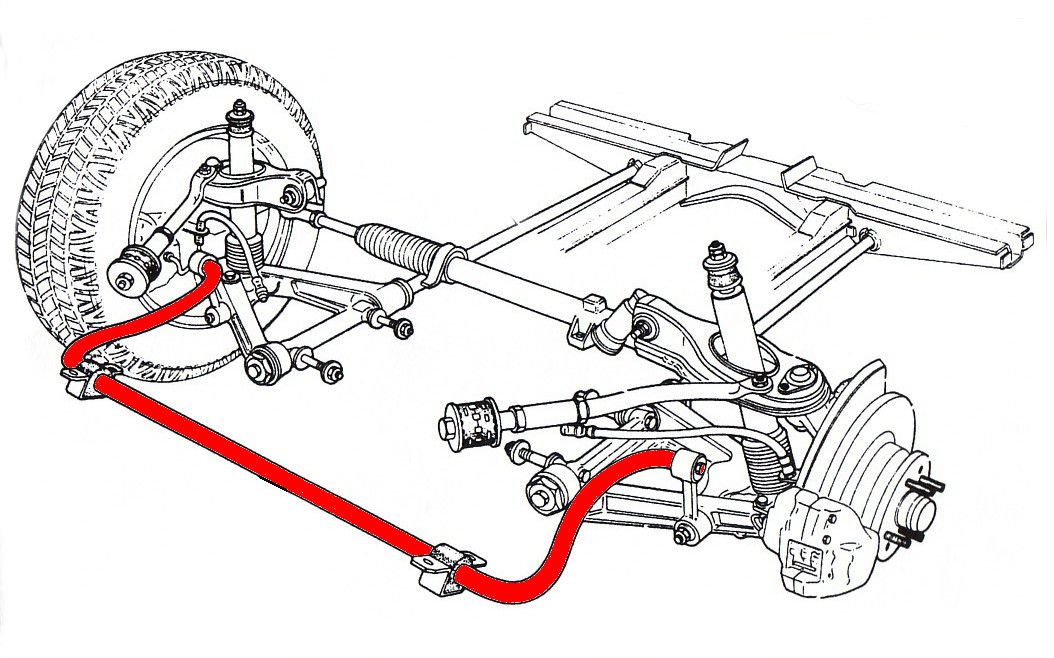
The fundamental purpose of an anti-roll bar is to reduce the lateral tilt, or roll, of a vehicle's body during dynamic maneuvers such as cornering or when one side of the suspension is compressed by a road irregularity. It achieves this by linking the left and right wheels on the same axle through a torsion spring, typically a U-shaped steel bar. When a vehicle enters a turn, the outer wheel's suspension compresses under the lateral load. The anti-roll bar transmits a torsional force to the opposite, inner wheel, encouraging its suspension to compress as well. This action helps keep the vehicle's body in a more level lateral attitude, which has the beneficial effect of lowering the centre of gravity during the turn and increasing overall stability. The bar's stiffness, and thus its effectiveness, is determined by the material properties, the fourth power of its radius, and the length of its lever arms, with shorter arms producing a stiffer bar.
Forces are transferred through a specific pathway within the suspension system. The process begins at the heavily loaded wheel on one side of the vehicle. The force travels from the suspension to a connected end link, usually via a bushing, and then into the anti-roll bar itself through a flexible joint. The torsion bar then transmits this force through its length to the connected end link on the opposite side of the vehicle, and finally to the opposite side's suspension. This interconnected system means that movement on one side directly influences the wheel on the other side. The bar resists body roll by generating torsion, and the amount of force required to make the body roll increases with the stiffness of the bar. This allows vehicle designers to tune roll stiffness independently of the main springs' vertical rate, offering improved body control without necessarily compromising ride comfort.
The physical operation of the bar involves its rotation on central mounting points attached to the vehicle's chassis or subframe. When both left and right wheels move up and down together, as when hitting a symmetrical bump, the bar simply rotates in its mounts without twisting. It is only when the wheels move relative to each other, as in a turn or when crossing a single-wheel bump, that the bar twists along its length. This twisting action creates the resisting torque that counteracts the body's tendency to roll. The roll couple, which is the moment that tends to roll the body, is generated because the vehicle's centre of gravity is usually not aligned with the roll axis, an imaginary line connecting the front and rear roll centres of the suspension.
Handling Dynamics and Vehicle Tuning
Beyond simply reducing lean, anti-roll bars play a critical role in fine-tuning a vehicle's handling balance, specifically its tendency towards understeer or oversteer. The total roll stiffness of a vehicle is the sum of the contributions from the front and rear anti-roll bars and the springs themselves. By altering the proportion of stiffness from the front versus the rear axle, engineers can adjust how the vehicle behaves in a corner. Increasing the roll stiffness at the front axle increases the proportion of the total lateral load transfer that the front wheels react to, while decreasing the load transfer proportion at the rear. This generally makes the outer front wheel operate at a higher slip angle compared to the rear, which increases understeer, where the vehicle wants to go straight despite steering input.
Conversely, increasing the proportion of roll stiffness at the rear axle has the opposite effect, decreasing understeer and potentially increasing oversteer, where the rear of the vehicle wants to swing outward. The total lateral load transfer from the inside wheels to the outside wheels during cornering is a fixed value determined solely by the vehicle's centre of gravity height and its track width. Anti-roll bars do not change this total load transfer. Their function is to control how that fixed total load is distributed between the front and rear axles. This distribution directly influences the vehicle's rotational behaviour and driver feedback during limit handling. A stiffer front bar typically induces more understeer, while a stiffer rear bar can promote oversteer.
One side effect of excessive body lean, particularly with typical unibody suspension geometry, is a change in wheel camber. During a turn, the body roll causes positive camber on the outside wheel and negative camber on the inside wheel. This camber change reduces the tire's effective contact patch and cornering grip, especially with older cross ply tire designs. By reducing body roll, anti-roll bars help maintain more optimal wheel camber angles, preserving tire grip. The use of anti-roll bars allows suspension designers to achieve the desired level of body control and handling balance without resorting to excessively stiff coil or leaf springs, which would degrade ride quality over straight-line bumps.
Drawbacks and Specific Applications
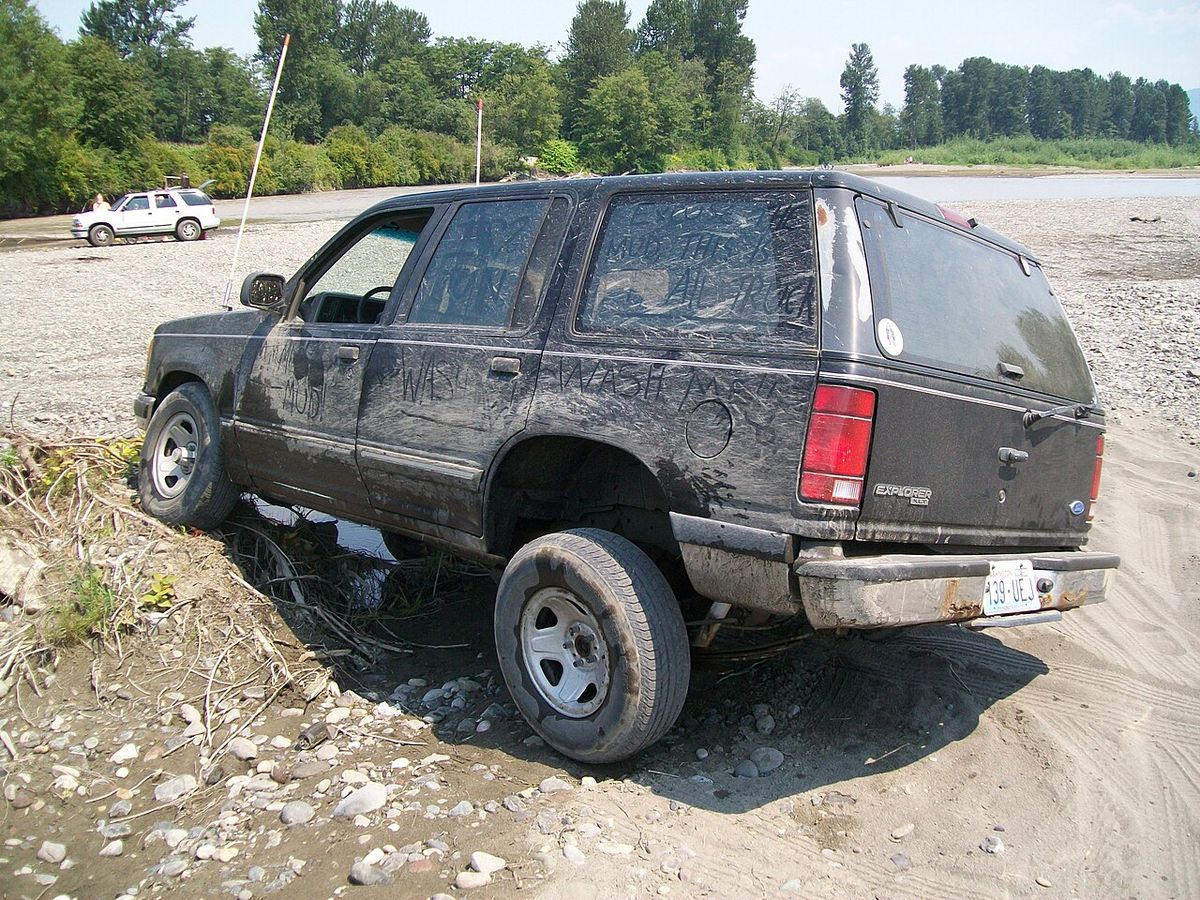
While beneficial for on-road handling, the interconnected nature of anti-roll bars introduces certain drawbacks, particularly on rough or broken pavement. Because the bar links wheels on opposite sides, the impact force from a bump on one wheel is transmitted across the vehicle to the opposite wheel. This can produce jarring, side-to-side body motions often described as a 'waddling' sensation, which becomes more severe with larger diameter and stiffer bars. Other suspension design techniques, such as specific damping strategies, can be employed to delay or dampen this effect. Another significant drawback of excessive roll stiffness, often from an overly aggressive anti-roll bar setup, is the potential for the inside wheels to lift off the ground during extremely hard cornering.
This lifting effect can sometimes be used strategically by designers. For instance, many front-wheel-drive production cars are tuned to lift a rear wheel during hard cornering. This action overloads the opposite rear wheel, which can help to limit understeer and make the car feel more responsive. The design must carefully balance the handling benefits of reduced roll with the potential for compromised ride quality and reduced wheel articulation, the latter being particularly important for off-road vehicles where maintaining tire contact with uneven ground is paramount. In the original MacPherson strut suspension patent, the anti-roll bar served the additional essential function of controlling the wheel's forward and backward position, allowing the use of a simpler track control arm instead of a full wishbone.
- Ride Quality: Can cause a 'waddling' sensation on rough roads by transmitting bumps across the chassis.
- Wheel Lift: Excessively stiff bars may cause inside wheels to lift in hard corners.
- Strategic Use: Front-wheel-drive cars may use rear wheel lift to limit understeer.
- Off-Road Limitation: Connected bars reduce wheel articulation, hindering off-road capability.
- MacPherson Strut Role: In the original design, the bar controlled longitudinal wheel position.
- Suspension Geometry: Reduces negative camber gain on the outside wheel during body roll.
Evolution and Specialized Systems
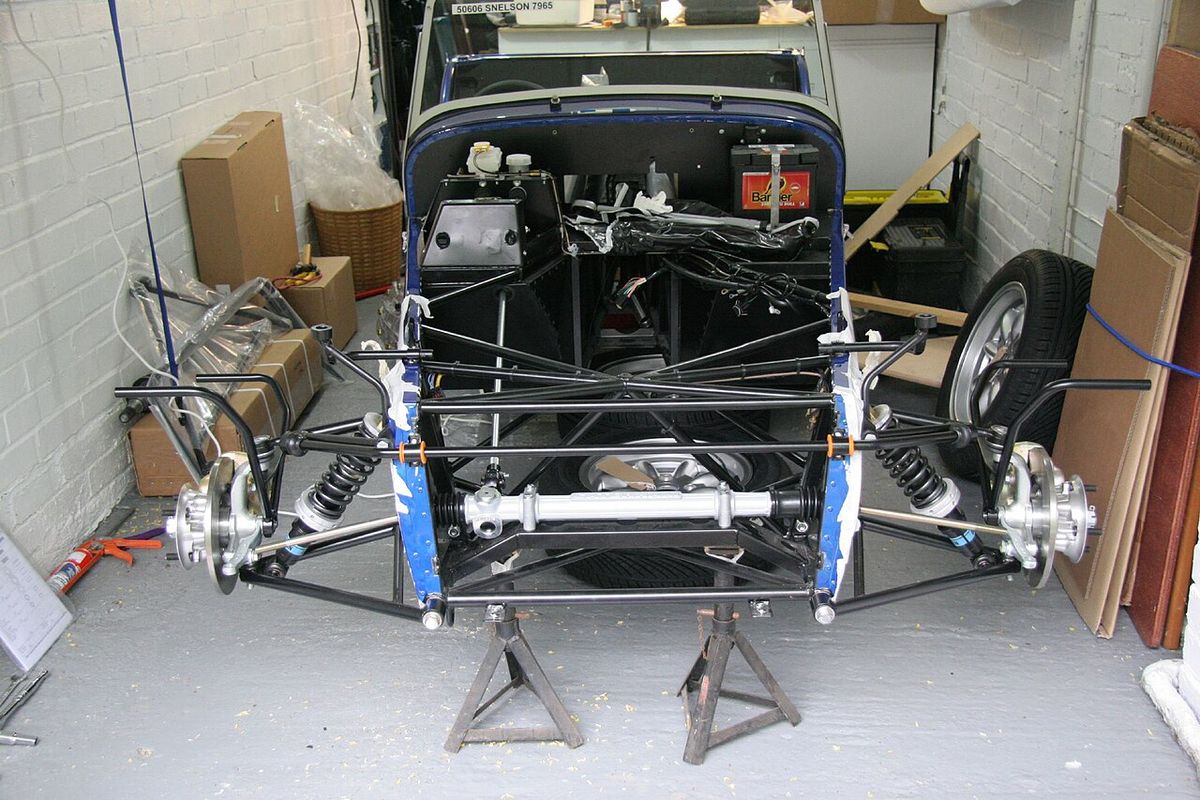
The design and application of anti-roll bars have evolved significantly since their invention, leading to specialized systems for different purposes. Adjustable anti-roll bars, common in auto racing, allow mechanics or drivers to alter roll stiffness to suit specific tracks or conditions. Adjustments can be made by changing the effective length of the lever arms or, on some systems, by rotating a flat lever to present a stiffer or more flexible profile. In the MacPherson strut suspension design, the anti-roll bar historically served an integral role beyond controlling roll. In Earl S. MacPherson's original patent, the anti-roll bar was essential for controlling the wheel's forward and backward position, allowing the use of a simpler, single-joint track control arm instead of a more complex wishbone, which reduced cost and unsprung weight.
The pursuit of combining flat cornering with a comfortable ride led to the development of semi-active and fully active systems. The first production car with a semi-active anti-roll bar was the 1988 Mitsubishi Mirage Cyborg, whose 'Dual Mode Suspension' used a dashboard-operated hydraulic actuator in the front anti-roll bar link to switch between sport and touring modes. Similar switchable decouplers are used on off-road vehicles like the Jeep Wrangler and Jeep Gladiator Rubicon models to disconnect the bar for increased wheel articulation. The first true active anti-roll bar system was Citroën's SC.CAR (Systeme Citroën de Contrôle Actif du Roulis), introduced on the 1994 Xantia Activa, which could hydraulically stiffen the bar during cornering to limit body roll to about 2 degrees.
Other manufacturers have developed different approaches to active roll control. The Mercedes-Benz S-Class Active Body Control system eliminates the physical anti-roll bar entirely. Instead, it uses sensors to detect lateral load and suspension height differences, then hydraulically adjusts the spring at each wheel to counteract roll in real time. Toyota employs a mechanical system called the Kinetic Dynamic Suspension System (KDSS) that uses hydraulic pressure to effectively disengage the front and rear stabilizer bars during off-road driving, allowing for greater articulation, then re-engages them for on-road stability. These advanced systems represent the ongoing effort to resolve the inherent compromise between handling precision and ride comfort posed by a fixed anti-roll bar.
The Canadian Invention and Historical Adoption
The foundational patent for the automobile stabilizer bar was granted to Stephen Coleman, an inventor from Fredericton, New Brunswick. The patent was officially awarded on April 22, 1919, marking a significant early contribution from Canada to global automotive engineering. Coleman's invention addressed the issue of body roll by proposing a torsion-based linking device between opposite wheels. Despite this early innovation, the widespread adoption of anti-roll bars on production vehicles did not occur until decades later. Pre-World War II automobiles generally featured much stiffer suspension systems overall, often using leaf springs, and a certain degree of body roll was more commonly accepted by both manufacturers and drivers as a characteristic of vehicle dynamics.
It was not until the 1950s that anti-roll bars began to appear more frequently on production cars. This shift coincided with broader trends in automotive design, particularly the move towards softer, more comfortable coil spring suspensions. Softer springs improved ride quality but increased body roll, creating a need for a component like the anti-roll bar to restore handling composure without sacrificing comfort. Coleman's patented concept thus found its practical, mass-market application in this post-war era, becoming a standard and critical component in the suspension systems of countless vehicles produced worldwide. The component's integration was further accelerated by the popularity of the MacPherson strut design in front suspensions, which in its original form relied on the anti-roll bar for longitudinal wheel location.
The historical delay in adoption highlights how automotive technology evolves in response to changing priorities. Early cars prioritized durability and simplicity over refined handling. As roads improved, speeds increased, and consumer expectations for comfort and safety grew, the functional value of Coleman's 1919 invention became undeniable. Today, the anti-roll bar is a nearly universal feature on passenger cars, light trucks, and performance vehicles, demonstrating the lasting relevance of its basic torsion-bar principle. Its evolution from a simple fixed bar to electronically controlled active systems shows the continuous refinement of this foundational Canadian invention.
Technical Design and Stiffness Factors
The stiffness of an anti-roll bar is its most critical performance parameter, directly determining its influence on vehicle roll and handling balance. Stiffness is defined as the amount of torque required to twist the bar through a given angle. This torsional stiffness is governed by several key factors rooted in material science and mechanical design. The stiffness is proportional to the shear modulus of the material from which the bar is made, with high-grade steel being the nearly universal choice. It is also proportional to the fourth power of the bar's radius, meaning that a small increase in diameter results in a very large increase in stiffness. For example, increasing the bar's diameter by just ten percent can increase its stiffness by over forty percent.
The length of the lever arms, which are the sections of the bar between the central mounting points and the end links, also has a major effect. Stiffness is inversely proportional to the length of these lever arms. A shorter lever arm provides less mechanical advantage, making the bar effectively stiffer, as more force is required at the wheel to twist the bar. The geometry of the mounting points and the rigidity of the bar's attachment to the chassis also contribute to the overall effective roll stiffness. Designers must consider all these factors when selecting or designing a bar for a specific vehicle application, balancing the desired handling response with packaging constraints and the potential for the drawbacks discussed earlier.
| Design Factor | Effect on Stiffness | Design Consideration |
|---|---|---|
| Bar Material (Shear Modulus) | Directly Proportional | High-strength steel is standard. |
| Bar Radius | Proportional to the Fourth Power | Small diameter increases yield large stiffness gains. |
| Lever Arm Length | Inversely Proportional | Shorter arms create a stiffer bar. |
| Mounting Point Rigidity | Directly Influences Effective Stiffness | Flexible bushings can reduce effective rate. |
| Bar Shape (Solid vs. Hollow) | Hollow bars can be lighter for same stiffness | Used in performance applications to reduce unsprung weight. |
Questions about Anti-roll bar
Who invented the anti-roll bar?
The anti-roll bar was invented by Canadian Stephen Coleman of Fredericton, New Brunswick. He was awarded the first patent for a stabilizer bar on April 22, 1919. His invention proposed the use of a torsion bar to link opposite wheels and reduce vehicle body roll during cornering. This patent represents a foundational Canadian contribution to automotive suspension technology.
What does an anti-roll bar do?
An anti-roll bar reduces the lateral tilt or roll of a vehicle's body when cornering or when one wheel hits a bump. It works as a torsion spring that connects the left and right wheels on an axle. When one wheel's suspension compresses, the bar twists and applies force to the opposite wheel, helping to keep the vehicle body more level and stable. This action also lowers the vehicle's effective centre of gravity during a turn.
What is the difference between a sway bar and an anti-roll bar?
There is no functional difference; 'sway bar' and 'anti-roll bar' are common synonyms for the same component. Other names include stabilizer bar and roll bar. They all refer to the U-shaped torsion bar in a vehicle's suspension that links opposite wheels to reduce body roll. The variety of names stems from regional preferences and marketing terminology within the automotive industry.
Can anti-roll bars be adjusted?
Yes, many performance and racing vehicles use adjustable anti-roll bars. Adjustability allows mechanics or drivers to change the bar's effective stiffness to tune handling for different tracks or conditions. Adjustments can be made by altering the length of the lever arms or, on some designs, by rotating the bar to change its torsional resistance. Some high-end systems, like those in Super GT race cars, allow for real-time adjustment by the driver from inside the cockpit.
What are active anti-roll bars?
Active anti-roll bars are advanced systems that can dynamically change their stiffness, often using hydraulic or electronic controls. The first such system was Citroën's SC.CAR in the 1994 Xantia Activa, which could stiffen the bar during hard cornering to minimize body roll to about 2 degrees. These systems aim to provide flat cornering without compromising ride comfort. Other approaches, like Mercedes-Benz Active Body Control, eliminate the physical bar and use hydraulic pressure at each wheel to counteract roll forces directly.
Do anti-roll bars have any disadvantages?
Yes, anti-roll bars can transmit bumps from one wheel to the other, potentially causing a jarring, side-to-side motion on rough roads. Excessively stiff bars can also cause the inside wheels to lift during hard cornering. For off-road use, a connected bar limits independent wheel articulation, which is why vehicles like the Jeep Wrangler Rubicon have systems to disconnect the bar. These drawbacks are the reason for the development of decoupling and active systems.
Sources and further reading
- Anti-roll bar (Wikipedia)
- How Anti-Roll Bars Affect Handling (tracktitan.io)
Checked by the Your Space Hamilton desk. Last updated 2026-10-23.