Revelstoke, British Columbia
Revelstoke is a city in southeastern British Columbia, Canada, situated on the banks of the Columbia River just south of the Revelstoke Dam. Founded in the 1880s with the construction of the Canadian Pacific Railway, the city is a historic transportation hub and gateway to the Selkirk Mountains and Glacier National Park. Its economy has evolved from its railway and forestry roots to become a major year-round tourism destination, renowned for its world-class skiing, heli-skiing, and outdoor recreation. With a population of 8,275 as of the 2021 census, Revelstoke is celebrated for its deep snow, mountain culture, and significant role in the development of winter sports in Canada.
History and founding
The community that would become Revelstoke was founded in the 1880s as the Canadian Pacific Railway (CPR) was built through the region, with mining serving as an important early industry. The location was initially known as the "Second Crossing" to differentiate it from the railway's first crossing of the Columbia River at Donald, and was later named Farwell after a local landowner and surveyor. The Canadian Pacific Railway renamed the settlement Revelstoke in appreciation of Lord Revelstoke, head of the UK investment bank Baring Brothers & Co., which helped save the CPR from bankruptcy in 1885 by purchasing its unsold bonds. The construction of the Trans-Canada Highway through the area in 1962 significantly improved road access, which helped tourism become an increasingly important feature of the local economy. A major development in modern tourism was the construction of Revelstoke Mountain Resort on Mount MacKenzie, which began in the early 2000s and first opened for the 2007 to 2008 ski season. The city has also worked to manage its relationship with the local environment, notably implementing an electric fence at the town dump in 1994 to deter bears, which led to community education programs on coexisting with wildlife. The destruction of many bears that had turned to town for food prompted the creation of these programs to keep bears wild and the community safe.
Geography and climate
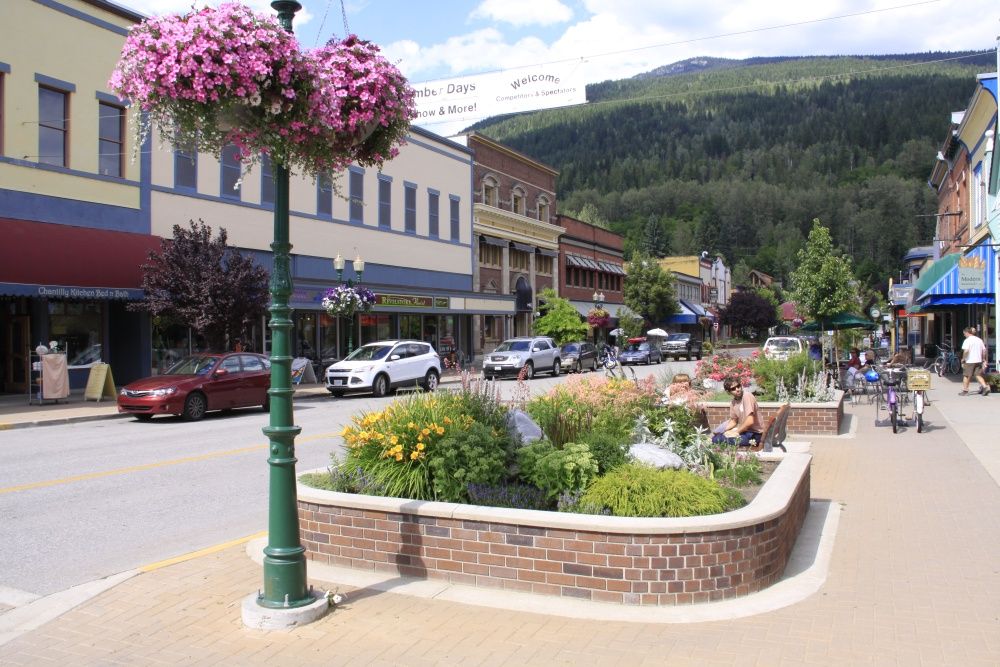
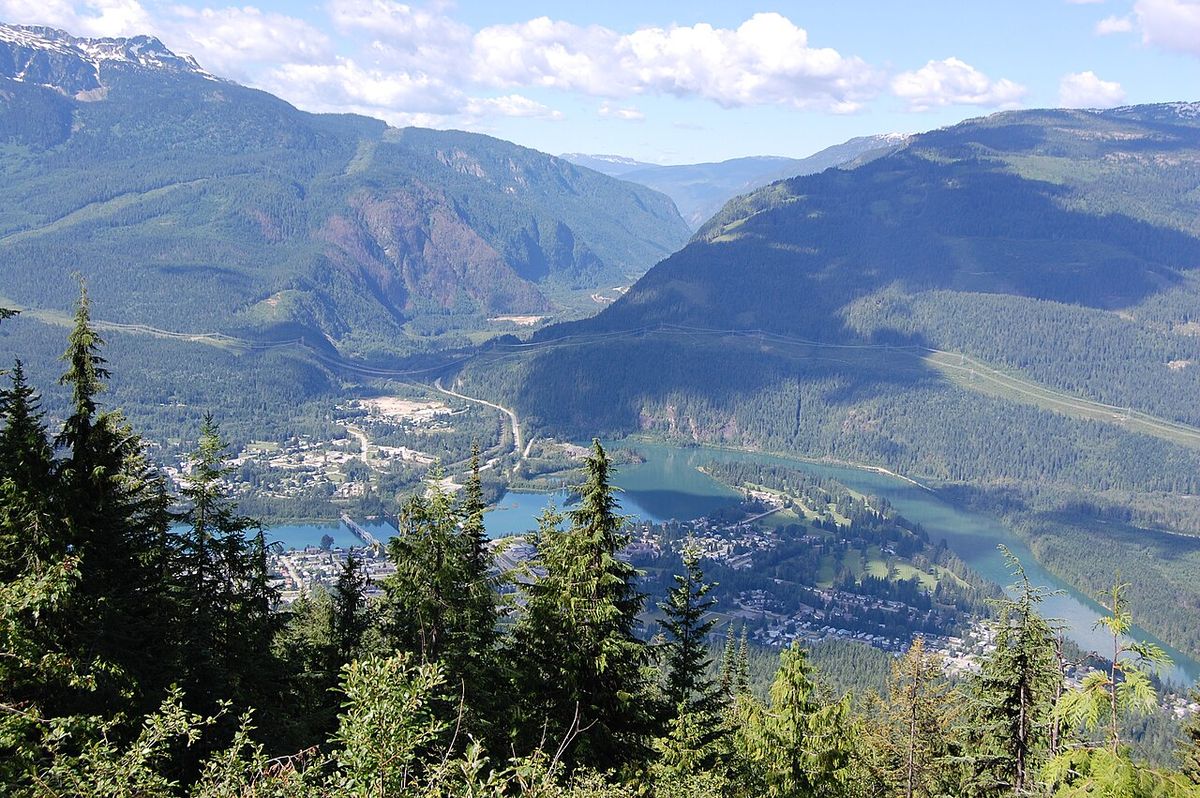
Revelstoke is located 641 kilometres east of Vancouver and 415 kilometres west of Calgary, Alberta, positioned on the banks of the Columbia River just south of the Revelstoke Dam and near its confluence with the Illecillewaet River. The city lies east of the Selkirk Mountains and Glacier National Park, with Rogers Pass providing a critical transportation corridor through the mountains for both the Trans-Canada Highway and the Canadian Pacific Railway. To the south down the Columbia River are the Arrow Lakes, Mount Begbie, and the broader Kootenay region. The area is characterized by its mountainous terrain and significant river systems, placing it in prime black bear and grizzly bear habitat.
Revelstoke experiences a humid continental climate with warm, rainy summers and cool nights, and cold, snowy, very cloudy winters. The city averages 50.3 days per year with temperatures below 0 °C and 13.5 days above 30 °C, with only one day on average exceeding 35 °C. The highest temperature ever recorded was 40.6 °C on July 17, 1941, while the coldest recorded temperature was -34.4 °C, reached on three separate occasions in 1909, 1935, and 1943. The region is famous for its heavy snowfall, holding the Canadian record for the snowiest single winter when 2,447 centimetres of snow fell on Mount Copeland outside town during the winter of 1971-72. The highest single-day snowfall recorded in town was 60.2 cm on December 10, 1980, and the deepest snow depth recorded was 173 cm on February 15, 1982.
Economy and major projects
Revelstoke's economy has been historically tied to the Canadian Pacific Railway, and the railway remains an important employer and cultural touchstone, celebrated at the Revelstoke Railway Museum. Over recent decades, forestry, construction, tourism, and retail have grown significantly. A major economic driver is the Revelstoke Dam, a hydroelectric facility on the Columbia River completed in 1984. Following the dam's completion and a temporary sawmill closure, the city undertook a successful downtown revitalization program in 1986 to stimulate the local economy and offset the economic effects of the finished project.
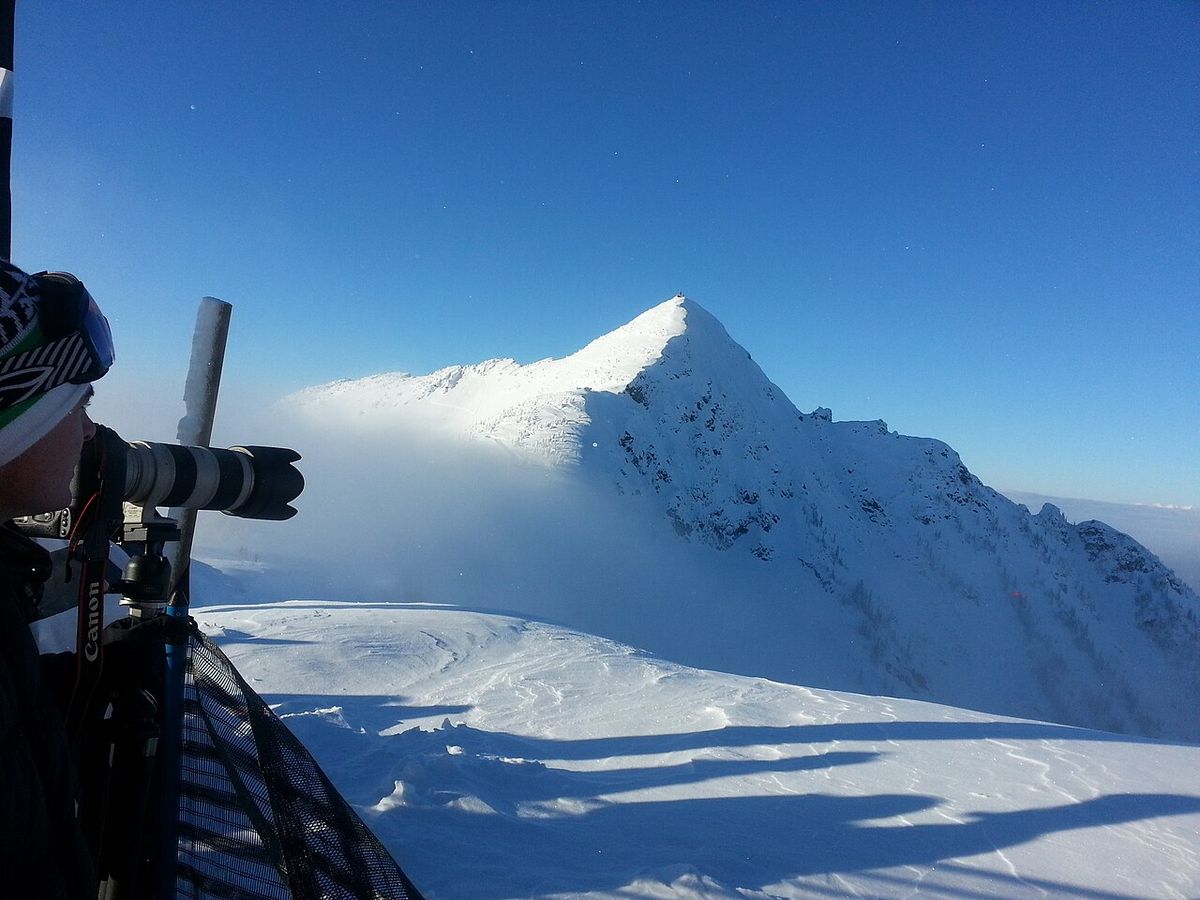
The most prominent modern economic development is Revelstoke Mountain Resort, which opened in the winter of 2007 to 2008 on Mount MacKenzie. The resort features North America's greatest vertical drop at 1,713 metres and offers 3,121 acres of skiable terrain, including high alpine bowls and gladed areas. It was also the only resort worldwide to offer lift, cat, heli, and backcountry skiing from a single village base. While initial expansion plans were deferred after 2008, development continues, with new lifts, hotels, condos, and a golf course in partnership with Cabot set to open in 2027. The resort has solidified the city's status as a premier international ski destination, building on a smaller ski operation that had existed on Mount MacKenzie since the 1960s.
Transportation and access
Revelstoke is a key transportation node in the British Columbia interior, served by major road, rail, and air links. The Trans-Canada Highway passes directly through the city, providing vital east-west road connectivity. The Canadian Pacific Kansas City railway network also runs through Revelstoke, maintaining the city's long-standing connection to continental rail freight. Historically, a CPR branch line ran southeast to Arrowhead until it was abandoned in 1968 ahead of the filling of the Hugh Keenleyside Dam, which required steamboat connections for further travel.
Local infrastructure includes Revelstoke Airport, which offers regional air service. Within the city, a significant pedestrian link is the Mark Kingsbury Memorial Bridge, installed in 2011 at the site of a former railway bridge crossing the Illecillewaet River. This bridge connects the town with the Illecillewaet Green Belt conservation area, enhancing recreational access. The combination of these transportation assets supports both the local population and the substantial tourism industry that visits the region year-round.
Demographics and community
According to the 2021 Census of Population, Revelstoke had a population of 8,275, living in 3,354 of its 3,739 total private dwellings. This represented an increase of 9.4 percent from its 2016 population of 7,562. With a land area of 41.28 square kilometres, the city had a population density of 200.5 people per square kilometre in 2021. The community is served by School District 19 Revelstoke for public education, and the Conseil scolaire francophone de la Colombie-Britannique operates one Francophone primary school, école des Glaciers.
According to the 2021 census, the religious composition of Revelstoke shows a majority of residents identify with no religion. The census recorded that 5,645 persons, or 69.0 percent of the population, reported being irreligious. Christianity was the largest reported religion with 2,265 persons, or 27.7 percent. Other religious groups in the city included Islam, Buddhism, Hinduism, Sikhism, and Judaism, each comprising less than one percent of the population. A further 95 persons, or 1.2 percent, reported other religious affiliations.
| Religious Group | Number of Persons | Percentage of Population |
|---|---|---|
| No religion | 5,645 | 69.0% |
| Christianity | 2,265 | 27.7% |
| Islam | 55 | 0.7% |
| Buddhism | 40 | 0.5% |
| Hinduism | 40 | 0.5% |
| Sikhism | 35 | 0.4% |
| Judaism | 10 | 0.1% |
| Other | 95 | 1.2% |
Sports and recreation
Revelstoke has a storied history in winter sports, deeply influenced by Norwegian immigrants who introduced skiing and ski jumping in the early 20th century. The Revelstoke Ski Club was founded in 1914 and quickly grew to 102 members by the following year, hosting its first annual Winter Carnival Tournament in 1915. The Nels Nelsen Hill, originally known as Big Hill, opened in 1916 and made Revelstoke an international centre for ski jumping, attracting the world elite for the annual tournament. Local jumpers set world records there, including Nels Nelsen's 73-metre jump in 1925 and Bob Lymburne's 82-metre jump in 1932. The hill was renovated by 1948, but interest declined in the 1960s, and the last tournament was held in 1975, ending an era that once saw the town consider a bid for the 1968 Winter Olympics.
The area's legendary snowfall supports a vast array of winter activities. Revelstoke is home to four heli-skiing and two cat-skiing operations, along with numerous backcountry skiing lodges, and is a major destination for snowmobiling. In summer, popular activities include mountain biking, rock climbing, and whitewater rafting and kayaking. The city has also become a hub for competitive freeride skiing and snowboarding, hosting major events like the Red Bull Cold Rush since 2015 and serving as a stop on the Swatch Freeride World Tour.
- Revelstoke joined the Freeskiing World Tour in 2010 and was the starting point for the unified Swatch Freeride World Tour by The North Face in 2012.
- The Red Bull Cold Rush event, a fusion of backcountry slopestyle and big mountain skiing with a $36,000 prize, has been hosted in Revelstoke since 2015.
- The Revelstoke Grizzlies compete in the Kootenay International Junior Hockey League, following a tradition that includes the former Revelstoke Bruins of the BCJHL.
- Notable NHL players from Revelstoke include Bruce Holloway, Ron Flockhart, Rudy Poeschek, and Aaron Volpatti.
- The Revelstoke Roller Derby Association was formed in 2011 by locals Michael Curran and Stephanie Ells, with its premier team, the Derailers, debuting in 2012.
Culture and media appearances
Revelstoke's dramatic mountain setting and historic architecture have made it an attractive location for film production. The city's connection to the railway was featured in the 1937 British movie The Great Barrier, which depicted the building of the Canadian Pacific Railway and used location shooting in Revelstoke. More recently, the 1999 thriller Double Jeopardy, starring Ashley Judd and Tommy Lee Jones, filmed scenes at the city's historic courthouse. The 2001 film The Barber, starring Malcolm McDowell, was almost entirely filmed in Revelstoke, though it fictionalized the town's location as Alaska. In 2017, the original movie Frozen in Love, starring Rachael Leigh Cook and Niall Matter, was also filmed in the area, continuing the town's presence on screen.
Cultural institutions like the Revelstoke Railway Museum highlight the city's enduring connection to its transportation heritage. The downtown core, revitalized in the 1980s, features many preserved heritage buildings that contribute to the city's distinctive character. Community events and a strong outdoor recreation culture define daily life, with residents actively engaged in skiing, mountain biking, and environmental stewardship, particularly regarding coexistence with local wildlife like black bears and grizzly bears. The city's identity is deeply intertwined with its natural surroundings and the history of the railway that founded it.
Notable residents
Revelstoke has produced some talented athletes in winter sports, notably ice hockey. The former local BCJHL team, the Revelstoke Bruins, had future NHL players like Bruce Holloway, Ron Flockhart, and Rudy Poeschek on its roster. The current Revelstoke Grizzlies of the Kootenay International Junior Hockey League is the former team of locally born Aaron Volpatti. Another notable professional hockey player born in Revelstoke is Andrew Kozek, who played in the Austrian Hockey League. The city is also the hometown of individuals who have achieved distinction in other fields such as politics, business, military service, and the arts.
- Sophie Atkinson, an English watercolour landscape painter and illustrator.
- Douglas Boyle, a Canadian Forces officer.
- Buck Crump, a prominent Canadian businessman.
- Bruce Holloway, a former professional ice hockey defenceman.
- William Stewart King, a former British Columbia politician.
- Andrew Kozek, a former professional ice hockey player.
- Peter Morales, a former president of the Unitarian Universalist Association.
- John Nunziata, a Canadian lawyer and former politician.
- Sid Parker, a former New Democratic Party Member of Parliament.
- Thomas Scott, a military figure and former Manitoba MLA and MP.
- Robert Fletcher Shaw, a Canadian businessman, academic, and civil servant.
- Aaron Volpatti, a former professional ice hockey winger.
Questions about Revelstoke, British Columbia
How much snow does Revelstoke get?
Revelstoke is famous for its exceptionally heavy snowfall. The area holds the Canadian record for the snowiest single winter, when 2,447 centimetres (963 inches) of snow fell on Mount Copeland just outside town during the winter of 1971-72. In the townsite itself, that same winter saw 779 centimetres (307 inches) of accumulation. The highest single-day snowfall recorded in Revelstoke was 60.2 cm on December 10, 1980. This abundant snow is the foundation for the city's world-renowned skiing and winter tourism industry.
What is Revelstoke Mountain Resort known for?
Revelstoke Mountain Resort, which opened in the 2007 to 2008 ski season, is renowned for having the greatest vertical drop of any ski resort in North America at 1,713 metres (5,620 feet). The resort offers 3,121 acres of diverse skiable terrain, including high alpine bowls and gladed areas. It was also unique for being the only resort worldwide to offer lift, cat, heli, and backcountry skiing all accessible from a single village base. The resort continues to develop, with a new golf course in partnership with Cabot scheduled to open in 2027.
Why is Revelstoke called Revelstoke?
The city was named by the Canadian Pacific Railway in the 1880s. The name was chosen in appreciation of Lord Revelstoke, who was the head of the UK investment bank Baring Brothers and Company. In the summer of 1885, Lord Revelstoke's firm, in partnership with Glyn, Mills and Company, saved the Canadian Pacific Railway from bankruptcy by buying the company's unsold bonds. This financial intervention enabled the railway to reach completion, and the CPR showed its gratitude by naming the settlement Revelstoke.
What are the main industries in Revelstoke?
Revelstoke's economy has traditionally been anchored by the Canadian Pacific Railway, and rail transportation remains significant. Other major industries include forestry, construction, retail, and hydroelectric power generation from the Revelstoke Dam completed in 1984. Over the past several decades, tourism has grown to be a dominant economic driver, centred primarily around world-class skiing, heli-skiing, snowmobiling, and summer activities like mountain biking and hiking. The downtown area was revitalized in 1986 to support this economic shift.
What movies have been filmed in Revelstoke?
Several films have used Revelstoke as a filming location due to its scenic mountain backdrop. The 1937 British film The Great Barrier, about building the Canadian Pacific Railway, shot scenes there. Parts of the 1999 thriller Double Jeopardy, starring Ashley Judd and Tommy Lee Jones, were filmed at the historic Revelstoke courthouse. The 2001 film The Barber, starring Malcolm McDowell, was almost entirely shot in Revelstoke. More recently, the 2017 movie Frozen in Love, starring Rachael Leigh Cook and Niall Matter, was filmed in the area.
What is there to do in Revelstoke in the summer?
Summer in Revelstoke offers a wide range of outdoor activities. Popular pursuits include mountain biking on an extensive network of trails, rock climbing, and whitewater rafting and kayaking on the local rivers. The Illecillewaet Green Belt conservation area, accessible via the Mark Kingsbury Memorial Bridge, provides opportunities for hiking and nature walks. The city's location near Glacier National Park and Mount Revelstoke National Park offers further hiking, sightseeing, and wildlife viewing. The historic downtown and the Revelstoke Railway Museum are also key attractions for visitors.
Sources and further reading
- Revelstoke, British Columbia (Wikipedia)
- Tourism Revelstoke: Small town charm. Big mountain adventure. (seerevelstoke.com)
- The Town | Revelstoke Mountain Resort | British Columbia, ... (revelstokemountainresort.com)
- Revelstoke, BC, Canada Map & Directions (mapquest.com)
- Revelstoke | Arrow Lakes and Slocan Valley (travel-british-columbia.com)
Checked by the Your Space Hamilton desk. Last updated 2026-10-31.