Conservative Party of British Columbia
The Conservative Party of British Columbia (CPBC), commonly known as the BC Conservatives, is a provincial political party in British Columbia, Canada. Historically the province's dominant centre-right force in the early 20th century, the party experienced a dramatic decline after the 1950s, spending decades with minimal legislative representation. Under the leadership of John Rustad, the party experienced a significant resurgence, culminating in the October 2024 provincial election where it won 44 seats to become the Official Opposition. This marked its best electoral performance in 72 years and established it as the main rival to the governing British Columbia New Democratic Party, although internal caucus disputes later reduced its seat count to 24 by September 2026.
Founding and Early Dominance
The Conservative Party of British Columbia was formed in 1900 as the Liberal-Conservative Party, prior to the formal introduction of partisan government in the province. Its first leader was Charles Wilson, and the 1900 general election saw various opposition factions contesting against the non-partisan government in loose affiliations. Party government was officially introduced on June 1, 1903, by Premier Richard McBride, who argued the non-partisan system was unstable and inhibiting provincial development. The Conservatives won the 1903 election, the first contested on party lines, securing a two-seat majority over the Liberals and various socialist and labour candidates. The party's early policies often mirrored the interventionist priorities of the federal Conservative Party, focusing on industrial and infrastructure development to stimulate growth. The Conservatives held power for 13 years under McBride and his successor, William John Bowser, until their defeat by the Liberals in the 1916 election. The party formally changed its name from the Liberal-Conservative Party to the Conservative Party in November 1926, solidifying its identity ahead of its next period in government.
Tolmie Government and the Great Depression Crisis
The Conservatives returned to power in the 1928 election under the leadership of Simon Fraser Tolmie, winning a commanding 35 of 48 seats in the Legislature. The Tolmie government was immediately confronted with the onset of the Great Depression, which created immense economic and social challenges. The government became wracked by internal infighting and political indecision, leaving it unable to mount an effective response to the crisis. The party fell into such disarray that the provincial association decided not to run any official candidates in the 1933 election. This led to a fragmented and chaotic effort where local associations acted independently, endorsing candidates under various labels. Supporters of Premier Tolmie ran as 'Unionists', while others grouped around former premier William John Bowser and ran as part of the 'Non-Partisan Independent Group'. The situation was further complicated by the death of Bowser and the postponement of elections in Vancouver Centre and Victoria City, which led to several candidate withdrawals. The party's collapse in 1933 marked the end of its first era of dominance and ushered in a prolonged period of instability and coalition politics.
Coalition Years and Internal Fracture
Following the disaster of 1933, the Conservative Party rebounded under leader Frank Porter Patterson to run a near-full slate in the 1937 election, electing eight MLAs. In the 1941 election, the party won 12 seats, placing third behind the Liberals and the growing Co-operative Commonwealth Federation. Fearing the democratic socialist CCF, the province's business community urged the Liberals and Conservatives to form a wartime coalition government, which was established in late 1941 under Liberal Premier John Hart. Conservative leader Royal Maitland agreed to the coalition and became deputy premier and attorney general. In 1942, the party rebranded as the BC Progressive Conservative Party, following the lead of the federal party. The coalition ran a joint ticket in the 1945 election, winning a majority government of 37 out of 48 seats. After Maitland's sudden death in 1946, Herbert Anscomb replaced him as party leader and continued as deputy premier and finance minister. When Premier Hart retired in 1947, a major conflict arose as the Conservatives pushed for Anscomb to succeed him, but the larger Liberal caucus insisted a Liberal must lead, resulting in the appointment of Byron Johnson. This succession dispute severely strained the coalition and opened deep internal divisions within the PC party.
The Progressive Conservatives split into three distinct factions during the final years of the coalition. One faction was led by Okanagan MLA W.A.C. Bennett, who advocated for the Liberals and Conservatives to fuse into a single permanent party. A second faction supported maintaining the coalition status quo under the current arrangement. The third faction wanted leader Herbert Anscomb to simply lead the PCs out of the coalition altogether. Meanwhile, the Liberals began to doubt they needed their fractious partners to govern effectively. The coalition was re-elected in the 1949 election, winning 39 seats, but the internal Conservative divisions resulted in Anscomb's leadership being challenged at the 1950 party convention. Bennett, having moved to the anti-coalition faction, quit the party and crossed the floor to sit as a Social Credit League member, a move that would reshape BC politics. In January 1952, the Liberals decided to dissolve the coalition, with Premier Johnson summarily dismissing his PC ministers, including Anscomb.
Decline and Political Wilderness
The 1952 election, conducted under a new instant-runoff voting system introduced by the former coalition, resulted in disaster for the Progressive Conservatives. The party won only four seats, failing even to re-elect leader Herbert Anscomb in his Oak Bay constituency. The Social Credit League won the most seats, and two months later, former Tory W.A.C. Bennett took control of that party, dropping its monetary reform policy. It became clear to business-oriented voters that only Social Credit could keep the CCF out of power, leading to a mass exodus from the old parties. Social Credit changed the electoral system back to first past the post after 1953, cementing its position as the new centre-right coalition and marginalizing both the Liberals and Conservatives. The period from 1956 to 1972 saw the Conservatives win no seats in the Legislature, and the party began to dwindle organizationally. After 1960, the party would not run a full slate of candidates again until 2024. The party's leaders during this long decline included Deane Finlayson (1952 to 1961) and federal MP Davie Fulton, who led a brief surge to 11% of the vote but no seats in 1963. The party nearly collapsed, running only three candidates in 1966 and just one, leader John de Wolf, in 1969.
In 1971, former Socred MLA Scott Wallace crossed the floor to join the PCs, becoming the party's first MLA in 15 years. In the 1972 election, the PCs earned nearly 13% of the vote and won two seats, Wallace's seat in Oak Bay and Hugh Curtis in Saanich and the Islands. However, Curtis soon left to join the Social Credit caucus in 1974, answering a call by new Socred leader Bill Bennett to reunite the pro-business vote. Wallace won his seat again in 1975 but resigned in 1977. His successor, Vic Stephens, won Oak Bay in a 1978 by-election but lost it in the 1979 general election, marking the last time a Tory MLA was elected for decades. During this era, the federal Progressive Conservative Party kept its distance from the provincial party to avoid alienating Social Credit supporters. For a brief period in 1986, former NDP MLA Graham Lea crossed the floor to sit as a PC MLA but quit politics before the next election. The party changed its name back to the BC Conservative Party in 1991 but failed to gain traction during the collapse of the Socreds.
Twenty-First Century Struggles and Leadership Instability
In the 21st century, the party made several unsuccessful attempts at revival under a series of leaders who faced significant internal turmoil. Wilf Hanni, a former leader of the BC Reform and BC Party, was elected Conservative leader in 2005 and led the party to field 24 candidates in the 2009 election, earning 2.1% of the vote. Hanni resigned after the election along with eleven directors and officials, citing destructive infighting. By late 2010, with former Newfoundland premier Brian Peckford as an advisor, the party had grown to about 2,000 members and had constituency associations in 45 ridings. Support received another boost in 2011 when some supporters of defeated BC Liberal leadership candidate Kevin Falcon defected to the Conservatives. Former federal MP John Cummins was proclaimed leader on May 28, 2011, and by late that year party support had surged to 18% in opinion polls. The party gained its first MLA in decades in March 2012 when Abbotsford South MLA John van Dongen crossed from the Liberals, but he left the caucus six months later citing a lack of confidence in Cummins' leadership. The party performed poorly in the 2013 election, winning less than 5% of the vote and no seats, leading to Cummins' resignation in July 2013.
The period following Cummins' departure was marked by extreme leadership instability and organizational dysfunction. Dan Brooks was elected leader on April 12, 2014, but resigned at the party's annual general meeting on February 20, 2016. Brooks was then re-elected as leader at a convention on September 17, 2016, only to be removed by the party's executive board on October 28, 2016, after they ruled the meeting that approved his candidacy lacked quorum. Brooks criticized the decision, stating the executive were 'like praying mantises, they eat their leaders'. The party entered the 2017 election campaign without a leader, nominating only ten candidates, none of whom were elected. Vernon city councillor Scott Anderson was appointed interim leader in September 2017 and oversaw a rebuilding of riding associations. Fort St. John city councillor Trevor Bolin became the party's new permanent leader on April 8, 2019. The party officially readopted the name Conservative Party of British Columbia prior to the 2020 general election.
The party's organizational direction was fundamentally altered in 2022 through an internal takeover. Following the disqualification of conservative commentator Aaron Gunn from the BC Liberal leadership race, Gunn founded the advocacy group Common Sense BC. This group endorsed a slate of candidates for the Conservative Party board at the May 2022 annual general meeting, effectively launching a takeover. The endorsed candidates, including conservative strategist Angelo Isidorou, were elected, giving right-wing activists control of the party machinery. This new leadership quickly rebranded the party, unveiling a new logo, website, and platform in August 2022. Isidorou went on to serve as executive director and provincial campaign manager for the 2024 election, playing a central role in the party's subsequent resurgence.
Resurgence Under John Rustad and Path to 2024
The party's modern resurgence began definitively on February 16, 2023, when John Rustad, the MLA for Nechako Lakes, joined the Conservatives. Rustad had been elected as a BC Liberal but was expelled from their caucus in August 2022 for refusing to undo a retweet that cast doubt on climate science. His defection gave the party its first MLA in over a decade. Leader Trevor Bolin announced his step-down on March 3, 2023, and Rustad was acclaimed as the new leader on March 31 as the only candidate in the race. Under Rustad, the party quickly gained momentum and demonstrated its growing appeal in two 2023 by-elections. In Vancouver-Mount Pleasant, the Conservative candidate placed fourth with 4.88% of the vote. More significantly, in Langford-Juan de Fuca, the Conservative candidate placed second with 19.86% of the vote, finishing ahead of the centre-right BC United, which indicated a major shift in support.
The party achieved official party status in the legislature on September 13, 2023, when BC United MLA Bruce Banman crossed the floor to join the Conservatives, giving them the two MLAs required. Banman was named party house leader, and the Legislative Assembly Management Committee approved $214,000 in annual funding for the caucus. This status provided critical resources and recognition. Further defections from BC United followed in 2024, significantly bolstering the Conservative caucus ahead of the general election.
- May 31, 2024: BC United MLA and caucus chair Lorne Doerkson crossed the floor to the Conservatives.
- June 3, 2024: BC United MLA for Surrey South, Elenore Sturko, crossed the floor and announced her intention to run in Surrey-Cloverdale.
- July 29, 2024: BC United MLA for Richmond North Centre and former Minister of Trade Teresa Wat crossed the floor to the Conservatives.
The party's platform and campaign under Rustad attracted both support and controversy. Rustad was the subject of media attention for several controversial claims, including that children may be forced to eat insects and that vaccine mandates were about 'shaping opinion and control on the population'. Opponents criticized the party for running candidates who espoused conspiracy theories. Despite this, the party's message resonated with a segment of the electorate dissatisfied with the governing NDP and BC United, setting the stage for a historic electoral breakthrough.
The 2024 Election, Official Opposition Status, and Caucus Challenges
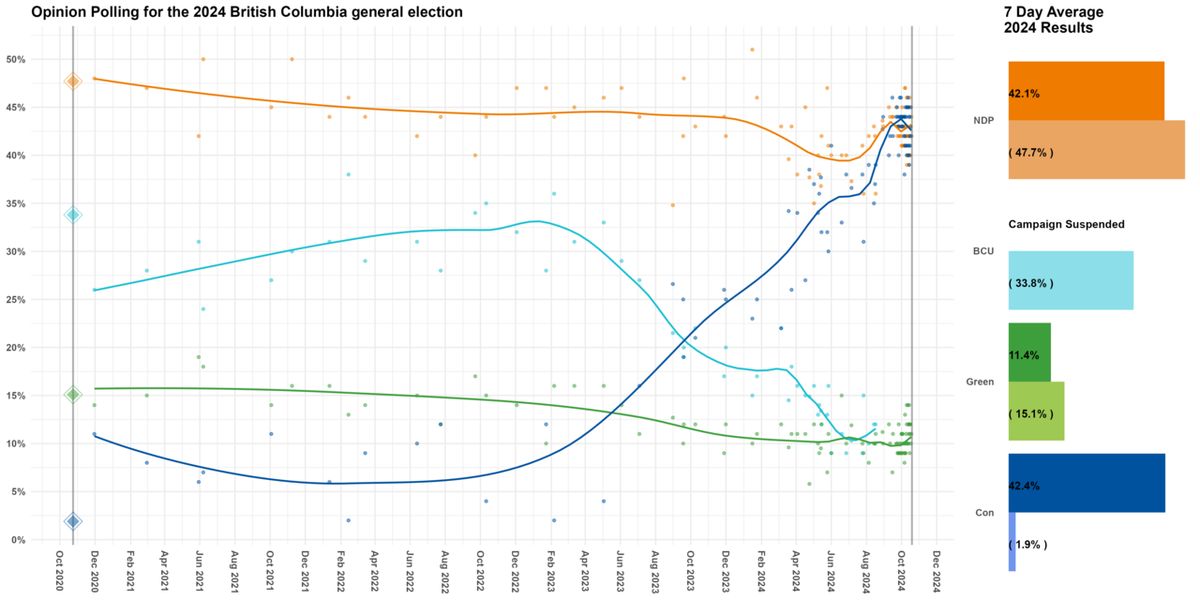
The October 2024 provincial election marked a historic breakthrough for the Conservative Party of British Columbia. The party won 44 seats in the Legislative Assembly, its best result since the 1952 election and a dramatic increase from having no seats just two years prior. This result was sufficient to form the Official Opposition, decisively displacing BC United and establishing the Conservatives as the primary rival to Premier David Eby's BC New Democratic Party government. The victory was attributed to a successful consolidation of right-of-centre voters under Rustad's leadership and an effective campaign managed by figures like Angelo Isidorou. The win represented the culmination of the organizational reboot that began with the 2022 party takeover and the strategic defections and by-election performances of 2023 and 2024.
However, the party's time in opposition has been marked by significant internal challenges. By September 2026, infighting within the CPBC caucus had reduced its seat count to a low of 24 members, a loss of 20 seats since the election. Despite this substantial reduction, the party retained enough seats to maintain its status as the Official Opposition, continuing to hold the government to account from that position. This period of internal dispute highlighted the challenges of managing a large and potentially fractious caucus assembled rapidly after a long period in the political wilderness.
Leadership and Electoral Record
The Conservative Party of British Columbia has been led by numerous figures throughout its history, with its periods of government concentrated in the early 20th century. Three party leaders have served as premier of the province: Richard McBride (1903 to 1915), William John Bowser (1915 to 1916), and Simon Fraser Tolmie (1928 to 1933). During the coalition governments of the 1940s, Royal Maitland and Herbert Anscomb served as deputy premiers. The party's electoral fortunes have fluctuated wildly, from commanding majorities to decades of irrelevance. The following table illustrates the party's performance in key elections from its founding through its recent resurgence.
| Election | Leader | Seats Won | Result |
|---|---|---|---|
| 1928 | Simon Fraser Tolmie | 35 | Majority Government |
| 1941 | Royal Maitland | 12 | Coalition Government |
| 1952 | Herbert Anscomb | 4 | Fourth Party |
| 2009 | Wilf Hanni | 0 | No seats |
| 2024 | John Rustad | 44 | Official Opposition |
The party's modern structure is led by John Rustad as leader, with Bruce Banman serving as house leader in the legislature. Angelo Isidorou, a key architect of the party's 2022 reboot, serves as party president. The party headquarters are located in Victoria, and its traditional colour is blue. The party's history can be charted through its key electoral milestones and the leaders who shaped its fate.
- 1900: Party founded as the Liberal-Conservative Party under Charles Wilson.
- 1903: Richard McBride forms first party government after winning the election.
- 1928: Simon Fraser Tolmie leads party to power with 35 seats.
- 1941: Enters coalition government with Liberals under Royal Maitland.
- 1952: Wins only 4 seats, beginning long decline.
- 2023: John Rustad becomes leader, party gains official status.
- 2024: Wins 44 seats and becomes Official Opposition.
Questions about Conservative Party of British Columbia
Who is the current leader of the BC Conservative Party?
The current leader of the Conservative Party of British Columbia is John Rustad. He was acclaimed as leader on March 31, 2023, after the previous leader, Trevor Bolin, stepped down. Rustad was originally elected as a BC Liberal MLA for Nechako Lakes in 2005 but was expelled from their caucus in August 2022 for a retweet questioning climate science. He joined the Conservatives as an MLA in February 2023, giving the party its first seat in the legislature in over a decade, and led it to a historic electoral result in October 2024.
When was the BC Conservative Party founded?
The party was founded in 1900 as the Liberal-Conservative Party, before British Columbia officially embraced partisan politics. Its first leader was Charles Wilson. The party introduced party government to the province on June 1, 1903, under Premier Richard McBride. It formally changed its name to the Conservative Party in November 1926, later becoming the BC Progressive Conservative Party in 1942 before reverting to the Conservative Party of British Columbia in 1991 and again prior to the 2020 election.
Have the BC Conservatives ever formed government?
Yes, the party formed government several times in the early 20th century. Three Conservative leaders served as premier: Richard McBride from 1903 to 1915, William John Bowser from 1915 to 1916, and Simon Fraser Tolmie from 1928 to 1933. The party also served as the junior partner in coalition governments with the Liberals from 1941 to 1952, with leaders Royal Maitland and Herbert Anscomb holding the post of deputy premier. The party has not formed a government, either alone or in coalition, since the coalition was dissolved in January 1952.
What caused the BC Conservative Party's resurgence in 2024?
The party's resurgence was driven by multiple factors converging under the leadership of John Rustad. A strategic takeover of the party machinery by right-wing activists in May 2022 rebooted its organization and platform. Rustad, a former Liberal MLA, brought credibility and media attention when he joined and then led the party in 2023. The party consolidated right-of-centre voters dissatisfied with both the governing NDP and the centre-right BC United. Effective campaigning, capitalizing on key defections from BC United in 2023 and 2024, and strong by-election performances all contributed to the historic win of 44 seats and Official Opposition status.
What is the relationship between the federal and BC Conservative parties?
The Conservative Party of British Columbia is a separate legal and organizational entity from the federal Conservative Party of Canada, though they share ideological roots and the Conservative name. Historically, the BC party often aligned with federal Conservative policies, especially in its early decades. During the mid-20th century, when the BC party was marginalized, the federal Progressive Conservatives kept their distance to avoid alienating supporters of the governing BC Social Credit Party, a stance exemplified by Joe Clark in 1979. In the modern era, the parties operate independently, though surges in support for one have sometimes coincided with increased interest in the other, as seen in 2023.
How many seats do the BC Conservatives have in 2026?
As of September 2026, the Conservative Party of British Columbia holds 24 seats in the Legislative Assembly. This number represents a significant decrease from the 44 seats the party won in the October 2024 provincial election, which had been its best electoral performance in 72 years. The reduction to 24 seats is directly attributed to infighting within the party's own caucus during that period. Despite this loss of 20 seats, the party retained enough members to maintain its constitutional status as the Official Opposition. The party first formed the Official Opposition following its resurgence in the 2024 election under the leadership of John Rustad.
Sources and further reading
- Conservative Party of British Columbia (Wikipedia)
- Home | Conservative Party of British Columbia (conservativebc.ca)
- Conservative party wins first election in nearly a century ... (internazionale.it)
Checked by the Your Space Hamilton desk. Last updated 2026-10-19.