Abbotsford, British Columbia
Abbotsford is a city in British Columbia, situated in the Fraser Valley region adjacent to the Canada-United States border and the Fraser River. With a 2021 census population of 153,569, it is the largest municipality in British Columbia outside metropolitan Vancouver and the fifth-largest in the province. The city is a major agricultural, transportation, and manufacturing hub, home to the University of the Fraser Valley and Abbotsford International Airport. Abbotsford is also notable for its significant cultural diversity, with the Abbotsford-Mission metropolitan area having the third-highest proportion of visible minorities among Canadian census metropolitan areas.
History and Settlement
The first residents of the Abbotsford area are the Stó:lō Nation, with the Upper Sumas 6 Indian reserve of the Sumas First Nation located within the city limits at Kilgard. European settlement accelerated after the Royal Engineers surveyed the region during the Fraser River gold rush of 1858, leading to the construction of Yale Road, the Fraser Valley's first major transportation route. By the late 1860s, local farms were producing butter, milk, and tobacco. In 1889, former Royal Engineer John Cunningham Maclure applied for a Crown grant for 160 acres of land, which he named Abbotsford. The origin of the name is debated, with explanations citing a family friend, CPR superintendent Henry Braithwaite Abbott, or the Scottish novelist Sir Walter Scott's home, Abbotsford House. Maclure's sons stated the property was named for Scott's home and pronounced with the accent on 'ford', while Maclure himself later called it a combination of two ideas.
The townsite was subdivided by Robert Ward in 1891, the same year the Canadian Pacific Railway built a line through the area connecting Mission to the Seattle, Lake Shore and Eastern Railway at Sumas, Washington. This route was the only rail connection between Vancouver and Seattle until 1904. The Village of Abbotsford was incorporated in 1892. The British Columbia Electric Railway arrived in 1910, providing an interurban tram service to Vancouver and Chilliwack until its discontinuation in 1950. A major flood of the Fraser River struck the community in 1948. In 1972, the Village of Abbotsford amalgamated with the District of Sumas to form the District of Abbotsford. A further amalgamation with the District of Matsqui in 1995 created the present-day City of Abbotsford, raising the population significantly.
In September 1984, Pope John Paul II held an open-air Mass for over 200,000 people at Abbotsford International Airport. The city has faced challenges including gang-related crime and severe flooding. In November 2021, residents of the Sumas Prairie were evacuated due to catastrophic flooding, an event that repeated in December 2025 when an atmospheric river caused another major flood in the same area. The city has also been the site of social conflict, including a 2013 incident where the city spread chicken manure on a homeless camp, for which Mayor Bruce Banman publicly apologized.
Geography and Climate
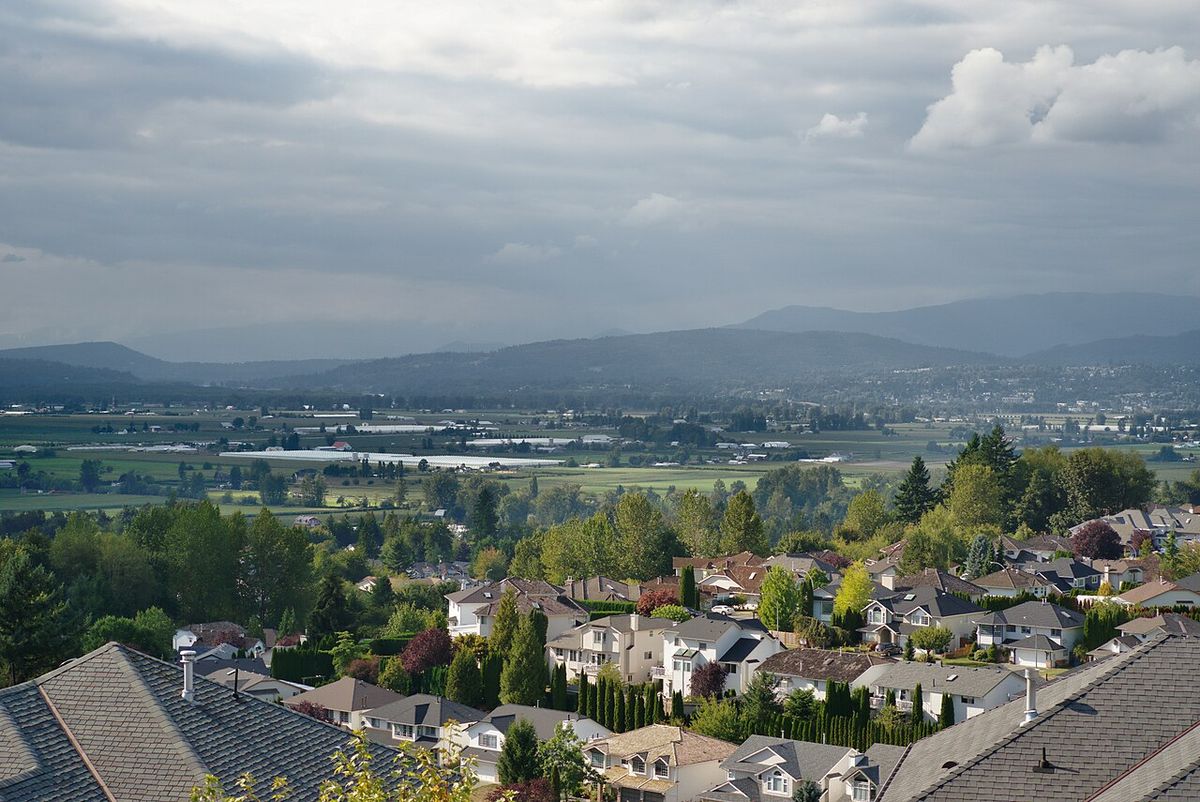
Abbotsford is the largest city by area in British Columbia, covering 375.55 square kilometres. Its southern boundary is the Canada-United States border, where it meets the town of Sumas, Washington. Within Canada, it is bordered by the Township of Langley to the west, the City of Mission to the north, and the City of Chilliwack to the east. The landscape offers views of Mount Baker to the southeast in Washington state and the Coast Mountains to the north. Abbotsford has an oceanic climate with just enough summer precipitation to avoid being classified as warm-summer mediterranean. Summers are generally warm and drier than other seasons, while winters are rainy and very mild by Canadian standards.
Snowfall can be heavy but usually not long-lasting, on average falling mostly in December and January. The city holds several temperature records, including an all-time high of 42.9 °C recorded on June 28, 2021. The record high daily minimum was 22.4 °C recorded on July 30, 2009. The warmest month on record was July 1958, with an average mean temperature of 20.8 °C and an average daily maximum of 28.4 °C. The climate supports the region's extensive agricultural activities, though it also makes the area susceptible to atmospheric river events that have caused significant flooding. The record highest dew point was 23.3 °C recorded on July 19, 1956.
Demographics and Cultural Composition
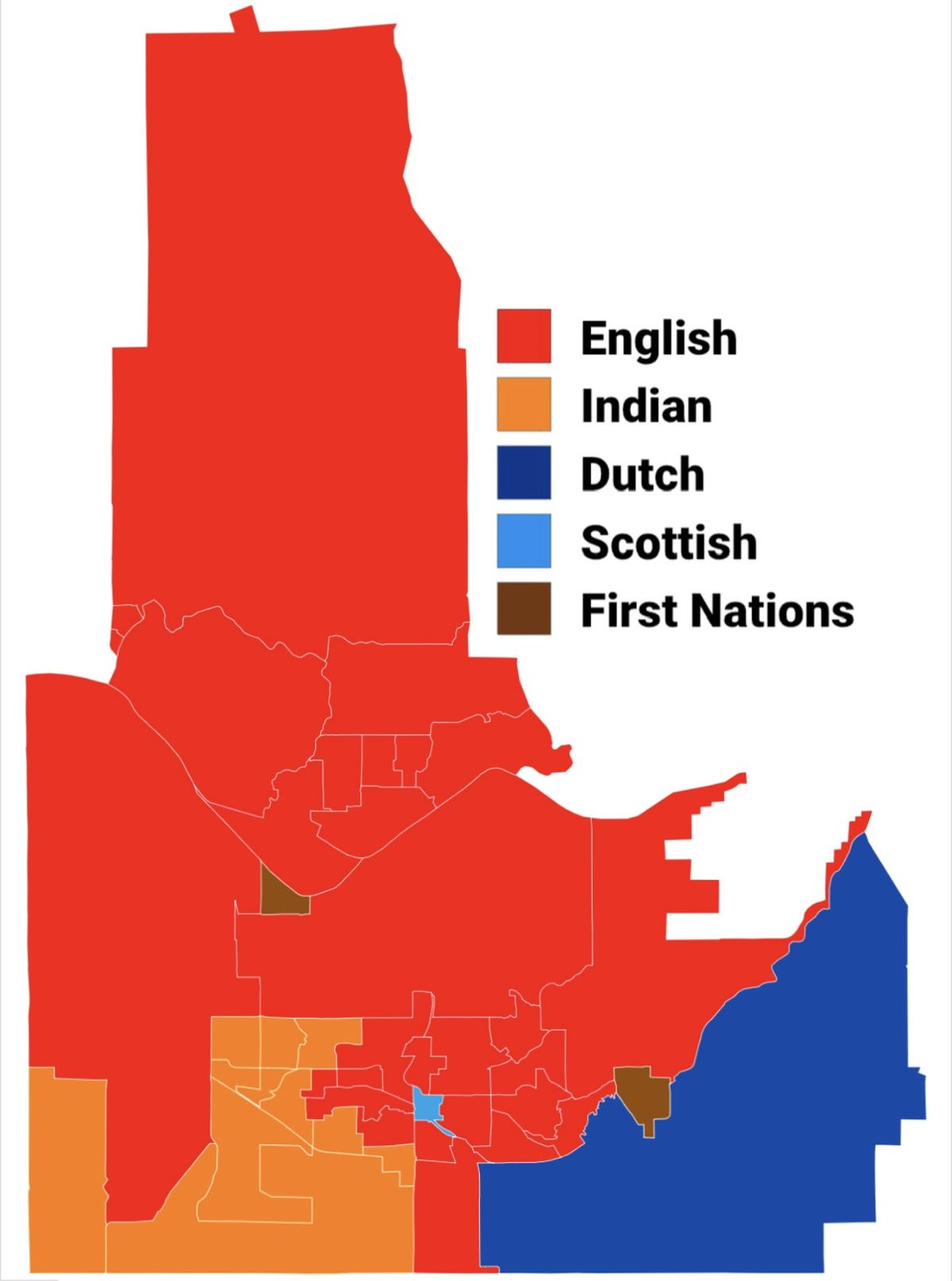
According to the 2021 census, Abbotsford had a population of 153,524, a growth of 8.6% from its 2016 population of 141,397. The population density was 409.0 persons per square kilometre. Immigrants comprise 28.6% of the population, with the top country of origin being India, accounting for 23,830 persons or 55.2% of the immigrant population. Other significant source countries include the United Kingdom (2,310 persons), the Philippines (1,735 persons), the United States (1,395 persons), and the Netherlands (895 persons). The primary mother tongue is English (61.0%), followed by Punjabi (22.6%), German (2.0%), and Spanish (0.9%). A large majority, 93.6% of the population, has knowledge of English, while 27.3% have knowledge of Punjabi and 4.2% have knowledge of French.
Religiously, Christianity is the largest affiliation at 37.7% of the population, with many of the largest congregations being Mennonite Brethren. Sikhism is the next largest religion at 25.5%, and the city is home to the Gur Sikh Temple, a National Historic Site opened in 1911 and the oldest existing Sikh gurdwara in North America, outlasting earlier temples built in Vancouver and Golden. A significant portion of the population, 31.5%, reports no religious affiliation. Other religious groups include Hinduism (2.4%), Islam (1.4%), and Buddhism (0.7%).
The pan-ethnic composition is predominantly European (55.2%), a group which includes German, Dutch, British, Irish, Scandinavian and Slavic ethnic origins. South Asians comprise 30.2% of the city population, a group that first arrived in the early 1900s to work on farms and in the lumber industry. Indigenous peoples make up 4.6% of the population, followed by Southeast Asians (3.1%) and East Asians (2.7%). The Abbotsford-Mission census metropolitan area, with a 2021 population of 195,726, has the third-highest proportion of visible minorities among Canadian CMAs, after Toronto and Vancouver, and the highest CMA proportion of South Asian Canadians. The city has been named by Statistics Canada as Canada's most generous city in terms of charitable donations for nine consecutive years.
Economic Structure and Major Employers
Approximately 62 percent of Abbotsford residents work within the city, while the remaining 38 percent commute to Mission, Chilliwack or Vancouver and its suburbs like Surrey and Langley. Conversely, more than 25 percent of Abbotsford's workforce commutes into the city from other municipalities. The Conference Board of Canada has identified the local economy as one of the most diverse in the country. Abbotsford's main industries are agriculture, transportation, manufacturing and retail. The city earns the highest dollar per acre of agricultural land in the country, greater than the Niagara Region and the North Okanagan.
This accounts for almost 50 percent of all chicken eggs and dairy milk production for all of British Columbia. The city earns the highest dollar per acre of agricultural land in the country. The BC government's Animal Health Centre, at the Abbotsford Agriculture Centre, offers more than 400 laboratory diagnostic tests for agents that may be found in wild and domestic birds, mammals, fish, reptiles and amphibians. It is the leading accredited full-service veterinary laboratory in Western Canada and has housed a Biosafety level 3 laboratory since October 2009.
- Fraser Health: The regional health authority, operating the Abbotsford Regional Hospital and Cancer Centre, is the city's largest employer with about 2,500 staff.
- Federal Corrections: Three federal prisons in the city each employ between 200 and 500 officers and support staff.
- Aerospace: A growing sector led by companies like Cascade Aerospace and Conair Group Inc.
- Education: The University of the Fraser Valley and several private colleges are significant institutions.
- Major Venues: Tradex, the Trade and Exhibition Centre, hosts numerous events. Abbotsford International Airport is also a major employer.
- Manufacturing: The local confectionery company Brookside Foods was acquired by The Hershey Company in 2011 but announced its closure in 2016.
Arts, Cultural Institutions, and Annual Events
Abbotsford supports an active arts and culture scene through several key institutions and annual events. The Abbotsford Arts Council organizes free events like music in Mill Lake Park, the Arty Awards, and a Christmas Artisan Gift Fair. It has been involved in projects such as the Abbotsford Unity Statue, the Abbotsford Christmas Craft Fair, Art in the Park, and the Historical Downtown Art Bench Project. The council also maintains the Kariton Art Gallery which features and hosts exhibitions from local artists of all mediums residing in the Lower Mainland. The Reach Gallery Museum presents exhibitions from across Canada and around the world, as well as the work of local artists, and houses a heritage archive while running special events and programs.
The Trethewey House Heritage Site is a restored 1920s Craftsman-style house built by J.O. Trethewey, an owner of the lumber and shingle mill that gave Mill Lake Park its name. This municipally designated heritage house and adjacent gallery are open for special events, educational programming, and drop-in tours. The Mennonite Heritage Museum, which opened in January 2016, features a permanent exhibit detailing the 500-year history of the Anabaptist and Mennonite movement, with a focus on those who settled in Abbotsford beginning in the early 1930s. The museum includes a gallery for local Mennonite artists, a coffee shop serving traditional foods, a bookstore, and a replica traditional Mennonite housebarn with an exhibit on Mennonites and agriculture. It also houses the library and archive of the Mennonite Historical Society of British Columbia. Gallery 7 Theatre and Performing Arts has been one of Abbotsford's performing arts organizations since 1991, operating out of the Mennonite Educational Institute and producing four mainstage productions every year.
Major annual community celebrations are central to local life. The Abbotsford International Airshow is a premier event held at the city's airport. Abbotsford Canada Day returns each July 1 with a full day of celebration. The 2026 event features a parade with the theme "Roots & Rhythm" along South Fraser Way followed by a family-friendly festival at Abbotsford Exhibition Park with live music, food trucks, and cultural experiences. Tourism Abbotsford promotes local businesses and experiences through initiatives like the annual "12 Days of Handmade & Homegrown" advent calendar, a curated collection of products from Abbotsford businesses, makers, and growers available for local pickup from November 12, 2026. The city's event calendar, Go! Abbotsford, lists the latest happenings in performing arts, agricultural experiences, and major festivals.
Government Structure and Transportation Networks
Abbotsford operates under a council-manager form of local government. The mayor and council were last elected in 2022, with Ross Siemens serving as mayor. In October 2026, Mark Neill was appointed as the new City Manager, replacing the outgoing manager. The next general municipal election is scheduled for October 17, 2026, with unofficial results posted after the close of polls at 8 p.m. The city's flag and coat of arms are the same, featuring straight, diagonal crosses representing Abbotsford as a crossroads. At the centre is a strawberry blossom to symbolize the local berry industry. The flag was originally blue but was changed to green in 1995 during the amalgamation that created the City of Abbotsford.
Public bus transportation is provided by the Central Fraser Valley Transit System. Passenger rail service to Vancouver is available via the West Coast Express from neighbouring Mission. Via Rail's The Canadian service flags a stop in Abbotsford for westbound trains towards Vancouver. Eastbound trains call at Mission on the other side of the Fraser River due to directional running agreements between CN and CPR through the canyons. Abbotsford International Airport provides air links, with WestJet offering regular scheduled service, capitalizing on the airport's proximity to Vancouver's eastern suburbs. The airport is also the home of the annual Abbotsford International Airshow. Major highways and the Canada-United States border crossing at Sumas provide critical road connections for both personal and commercial traffic.
Education Systems and Institutions
This includes the Abbotsford Virtual School, which offers more than 30 semestered online courses and features a unique animation and modeling program that teaches students aspects of the video game industry alongside standard courses like Mathematics, English, and Science. Several private schools serve the community, including Dasmesh Punjabi School, St. John Brebeuf Regional Secondary, the Mennonite Educational Institute, and Abbotsford Christian School. Post-secondary education is anchored by the University of the Fraser Valley, a key institution for the region. Post-secondary institutions in the city include the University of the Fraser Valley. Other post-secondary options include religious institutions such as Columbia Bible College and Summit Pacific College. Career and vocational training is provided by colleges such as Career Gate Community College, Sprott Shaw College, Vancouver Career College, Métis Skills and Employment Centre, and CDI College. The Abbotsford School District administers forty-six public elementary, middle, and secondary schools, including a virtual school.
Historic Landmarks and Sites
Abbotsford contains several sites of significant historical value, reflecting its multicultural settlement and development. The most prominent is the Gur Sikh Temple, located at 33089 South Fraser Way. Built in 1908 and opened in 1911, it is the oldest existing Sikh gurdwara in North America, outlasting earlier temples in Vancouver and Golden that were demolished or destroyed by fire. Designated a National Historic Site, the temple is over 110 years old and is a central place of worship and community for the local Sikh population. The Mennonite Heritage Museum provides a detailed account of Mennonite history and their agricultural contributions to the Fraser Valley.
Tourism Abbotsford acknowledges the deep history of the land prior to European settlement, formally recognizing the Semá:th and Máthxwi (or Máthekwi) First Nations as the original caretakers of the unceded territory on which the city operates. The organization states a commitment to reconciliation and to sharing the stories and teachings of Indigenous communities. This historical layering, from Stó:lō stewardship to Sikh, Mennonite, and other settler communities, defines the city's unique heritage landscape. The city's history of gang-related crime and the illegal sale of controlled substances is also a noted part of its contemporary social record.
Questions about Abbotsford, British Columbia
What is the population of Abbotsford, British Columbia?
According to the 2021 census, the population of the City of Abbotsford is 153,569. The broader Abbotsford-Mission census metropolitan area has a population of approximately 195,726, making it the 23rd-largest CMA in Canada. The city has experienced steady growth, with an increase of 8.6% from its 2016 population of 141,397. The population density within the city is 409.0 persons per square kilometre.
What is Abbotsford known for?
Abbotsford is known as a major agricultural centre, producing nearly half of British Columbia's chicken eggs and dairy milk. It is home to the University of the Fraser Valley and Abbotsford International Airport. The city contains the oldest existing Sikh Gurdwara in North America, the Gur Sikh Temple, which is a National Historic Site. The Abbotsford-Mission metropolitan area has the third-highest proportion of visible minorities among census metropolitan areas in Canada.
What is the climate like in Abbotsford?
Abbotsford has an oceanic climate characterized by warm, relatively dry summers and mild, rainy winters. Snowfall occurs but is usually not long-lasting, with the heaviest amounts typically in December and January. The city holds the record for the highest temperature ever recorded in the area at 42.9 °C on June 28, 2021. Winters are very mild by Canadian standards, though the region is susceptible to atmospheric river events that can cause severe flooding, as seen in 2021 and 2025.
What are the main cultural and religious groups in Abbotsford?
The largest religious group in Abbotsford is Christian (37.7%), with many large Mennonite Brethren congregations. Sikhism is the next largest at 25.5%, centered around the historic Gur Sikh Temple. A significant portion of the population (31.5%) reports no religious affiliation. Ethnically, the largest pan-ethnic group is European (55.2%), followed by South Asian (30.2%), which includes a large Punjabi community whose members first arrived in the early 1900s. Indigenous peoples make up 4.6% of the population.
How do I get to and around Abbotsford?
Abbotsford is served by Abbotsford International Airport, which offers scheduled flights via WestJet. Public bus transportation is provided by the Central Fraser Valley Transit System. Passenger rail service to Vancouver is available on the West Coast Express from the nearby City of Mission. Via Rail's The Canadian also stops in Abbotsford for westbound trains heading to Vancouver. The city is well-connected by major highways and borders the United States at Sumas, Washington, with the CPR having established the first rail link to Seattle through the area in 1891.
What major events happen in Abbotsford?
Abbotsford hosts several major annual events. The Abbotsford International Airshow is a premier aviation event held at the local airport. The city also holds a large Canada Day celebration on July 1, featuring a parade along South Fraser Way and a festival at Abbotsford Exhibition Park with live music and food trucks. Cultural events are organized by the Abbotsford Arts Council, including the Arty Awards and Art in the Park. The community also celebrates local agriculture and makers through promotions like the "12 Days of Handmade & Homegrown" advent calendar.
Sources and further reading
- Abbotsford, British Columbia (Wikipedia)
- Abbotsford Canada Day 2026 proudly supported by ... (globalnews.ca)
- Tourism Abbotsford: Handmade & Homegrown (tourismabbotsford.ca)
Checked by the Your Space Hamilton desk. Last updated 2026-10-25.