Entain's FTSE 100 Exit Marks Pivotal Moment in Company's Rocky Transformation Journey
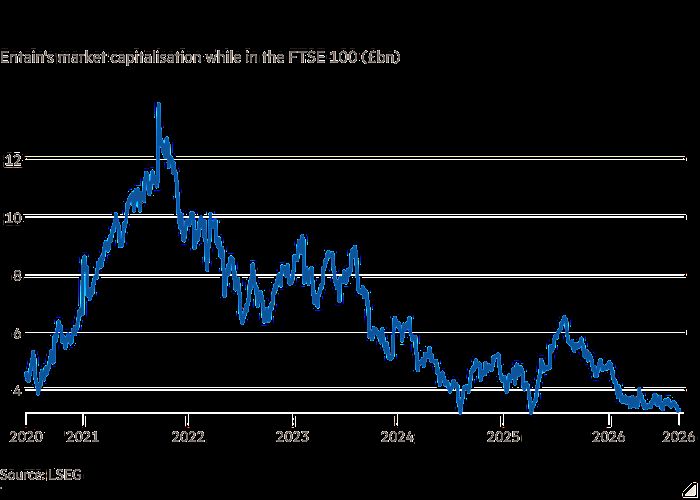
Entain's demotion from the FTSE 100 to the FTSE 250 reflects a 37% share price decline and £3.39bn market cap, stemming from regulatory penalties, digital challenges and leadership turnover. While facing significant headwinds, analysts highlight emerging signs of recovery through strategic restructuring and core market strength, maintaining optimistic long-term outlooks despite the index setback.
The London Stock Exchange Group's quarterly reshuffle has delivered a symbolic blow to Entain, demoting the gambling operator from the prestigious FTSE 100 to the FTSE 250 effective 21 September. This transition marks a dramatic reversal for a company that proudly joined the blue-chip index on 22 June 2020, when its market capitalisation and growth trajectory positioned it among Britain's corporate elite. The relegation comes as Entain's valuation has shrunk to £3.39 billion following a 37% share price decline over the past year, compounding a longer-term 73% drop from its September 2021 peak of 530p.
Anatomy of a Corporate Decline
Entain's fall from grace represents more than just numerical decline - it encapsulates years of strategic missteps and external pressures. The company's troubles intensified in November 2023 when it agreed to a £615 million settlement (including £585 million penalty and ancillary payments) regarding historical bribery issues in Turkey. This regulatory reckoning coincided with deeper structural challenges as the company struggled to integrate numerous acquisitions, particularly in its digital division where growth stalled amid technological fragmentation.
Leadership instability further complicated Entain's position, with four CEOs cycling through the top job in rapid succession before Stella David's appointment as permanent group CEO in Q1 2025. Former CEO Gavin Isaacs had identified the core platform modernization as Entain's most pressing challenge during ICE 2025, highlighting the technological debt accumulated during years of expansion. This turbulence occurred against a backdrop of increasing regulatory pressures across Europe, including the UK's April 2025 remote gaming duty tax hike that squeezed industry margins.
Strategic Pivot and Emerging Green Shoots
Entain's response to these challenges has been comprehensive if painful. The company has aggressively exited unregulated markets, including its complete withdrawal from Central and Eastern Europe through the Entain CEE divestment. CFO Michael Snape emphasized in August that this strategic retreat would reduce group leverage below 3x while returning capital to shareholders. Simultaneously, the operator has implemented significant cost reductions across retail operations and corporate functions.
These restructuring efforts appear to be yielding initial results. Q1 2025 delivered double-digit digital growth powered by strong performances in core markets like the UK, Brazil and the United States. The UK and Ireland segment has proven particularly resilient, with Entain actually gaining market share despite regulatory pressures. CEO Stella David's cautiously optimistic tone reflects these improving fundamentals, though she maintains prudent expectations given ongoing industry headwinds.
Analyst Perspectives and Valuation Paradox
Financial analysts maintain surprisingly bullish outlooks on Entain despite its index demotion. Goodbody's 13 August research note highlighted how H1 adjusted EBITDA comfortably exceeded expectations, particularly praising the UK market's standout performance. UBS reinforced this sentiment on 14 August by reiterating its buy rating, noting Entain shares offer the highest theoretical upside in European gaming - albeit with raised risk. This creates a valuation paradox where fundamental business improvements contrast with continued share price weakness.
The divergence may reflect broader sector trends rather than company-specific factors. Gaming stocks globally have faced investor skepticism, exemplified by Flutter Entertainment's 60% share price decline despite its August 2025 delisting from the LSEG to pursue higher US valuations. As Corfai's Ben Robinson observed about Flutter, larger markets don't guarantee success when industry currents remain unfavorable. Entain appears caught in this same sector-wide downdraft, with index composition rules magnifying the market's bearish sentiment.
Regulatory Realignment and Future Trajectory
Entain's strategic shift toward regulated markets represents more than risk mitigation - it signals a fundamental reimagining of the company's business model. This transition, while costly in the short term, positions Entain for sustainable growth in jurisdictions with stable regulatory frameworks. The company's technology modernization efforts, though belated, should enhance operational efficiency and customer experience across its digital platforms.
The FTSE 100 demotion undoubtedly stings, but may ultimately prove a symbolic rather than substantive setback. Entain's focused market strategy, disciplined capital allocation and leadership stability under Stella David suggest the company may be laying groundwork for eventual recovery. As the gaming sector navigates regulatory evolution and economic uncertainty, Entain's ability to execute its turnaround while maintaining core market strength could determine whether this demotion becomes a temporary stumble or permanent relegation in the eyes of investors.
Broader Market Implications
Entain's experience reflects wider challenges facing London-listed gambling operators. The LSEG has seen several gaming companies depart recently, with Flutter's secondary listing removal highlighting the attraction of US markets. However, as both Entain and Flutter demonstrate, geographic relocation doesn't automatically resolve sector-specific valuation pressures. The UK gaming industry's evolution under tighter regulation and taxation continues to reshape competitive dynamics, with Entain's ability to adapt serving as a test case for the sector's resilience.
For investors, Entain's story underscores how index composition rules can amplify business cycle movements. The mechanical nature of FTSE reshuffles means companies often enter during peaks and exit during troughs, potentially creating contrarian opportunities. With analysts maintaining positive long-term views despite short-term challenges, Entain's demotion may eventually be remembered as an inflection point rather than an endpoint in the company's complex transformation journey.