Canadian Municipalities and Companies Embrace Four-Day Workweek With Positive Results
Pilot programs across Canada show improved productivity, work-life balance and employee well-being under compressed work schedules, with several municipalities and businesses making the change permanent.
Across Canada, a quiet revolution is transforming traditional workplace structures as municipalities and private companies increasingly adopt four-day workweek models. These pilot programs, now spanning from Nova Scotia to Ontario, demonstrate consistent improvements in employee satisfaction, productivity metrics, and overall work-life balance. What began as temporary experiments have become permanent policies in several jurisdictions, signaling a potential sea change in Canadian labor practices.
Maritime Municipalities Pioneer the Change
The small Nova Scotia municipality of Guysborough emerged as an unlikely trailblazer when it launched Canada's first municipal four-day workweek trial in 2020. Approximately 60 town employees participated in the nine-month pilot, choosing either Monday or Friday as their weekly day off while maintaining standard weekly hours across four longer workdays. When the trial concluded in April 2021, the results proved so compelling that town councillors unanimously voted to make the arrangement permanent.
Barry Carroll, Guysborough's chief administrative officer, observed transformative effects on workplace culture and employee wellbeing.
"I'm seeing people have a bounce in their step. It seems like they have something to work for and they want to be successful,"Carroll told Narcity in 2021. The policy yielded measurable benefits beyond morale, with Carroll noting
"our sick leave in the organization is way down compared to what it was."Different demographics reported distinct advantages - older employees appreciated additional rest time, while younger staff valued extra family time.
Guysborough's success became a blueprint for neighboring communities. The New Brunswick town of Quispamsis launched its own pilot in May 2022, compressing work hours into four daily shifts from 7:30 a.m. to 5:30 p.m. By October that year, with 99% employee approval, the town made the schedule permanent. Acting CAO Aaron Kennedy reported no service disruptions or resident complaints, telling Country96
"I don't have any indication that there was any negative impact on our residents or on our business owners in the town."Employees cited better mental health, increased productivity, and more time for personal responsibilities.
Ontario Communities Follow Suit
The Ontario township of Zorra joined the movement in September 2020 with an eight-month pilot that later became an optional program for municipal staff. Employees rotated extended Fridays or Mondays off while maintaining standard weekly hours. Chief Administrative Officer Don MacLeod reported universal enthusiasm among participants.
"We do have a couple of employees that have kids, so they find it's one less day of daycare for them,"MacLeod explained, highlighting the policy's financial benefits for working parents. Remarkably, the transition occurred without public complaints or service degradation.
Zorra's experience created ripple effects across Ontario, inspiring multiple townships to explore similar arrangements. These municipal experiments consistently demonstrate that compressed workweeks can maintain - and often enhance - productivity when implemented with careful scheduling and clear performance metrics.
Private Sector Innovation Accelerates
Canadian businesses have simultaneously embraced four-day workweek models, particularly in knowledge-based industries. Ottawa-based tech consultancy Iversoft introduced an optional compressed schedule in 2020, with leadership emphasizing output over hours. The company's CEO framed it simply:
"As long as the work is getting done, manage [your time] however you want."
Recruitment firm owner Jamie Savage implemented the change to address alarming burnout trends among her staff.
"[Employees were] working more hours, struggling to create boundaries, and burning out,"Savage recalled. The results exceeded expectations, with immediate improvements in workplace wellbeing and sustained business growth.
"It was one of the best decisions I have made as an entrepreneur,"she affirmed.
A 2023 Robert Half survey reveals this openness extends across Canadian corporate leadership, with 91% of senior managers supporting four-day weeks for their teams. Nearly 75% of employees expressed willingness to work four 10-hour days in exchange for three-day weekends. This alignment between management and staff preferences suggests continued private sector adoption.
Major Urban Centers Enter the Fray
The city of Saint John, New Brunswick represents one of Canada's largest municipalities to test the model, launching a year-long pilot in October 2022. Unlike smaller towns that implemented permanent changes within months, Saint John designed a rigorous 12-month evaluation period before deciding on permanency. City Manager John Collin positioned the initiative as both an employee retention strategy and competitive recruitment tool.
"As a major employer, we are continually exploring ways to improve the workplace for employees and attract talent, while continuing to serve the community at a high standard,"Collin explained.
The city's research-informed approach reflects growing institutional acceptance of alternative schedules. Collin noted
"more and more organizations are focusing on innovative approaches to remain competitive and meet the evolving needs of employees and customers."Saint John's decision, expected by summer 2023, could influence other mid-sized Canadian cities.
Global Precedents Reinforce Canadian Experiments
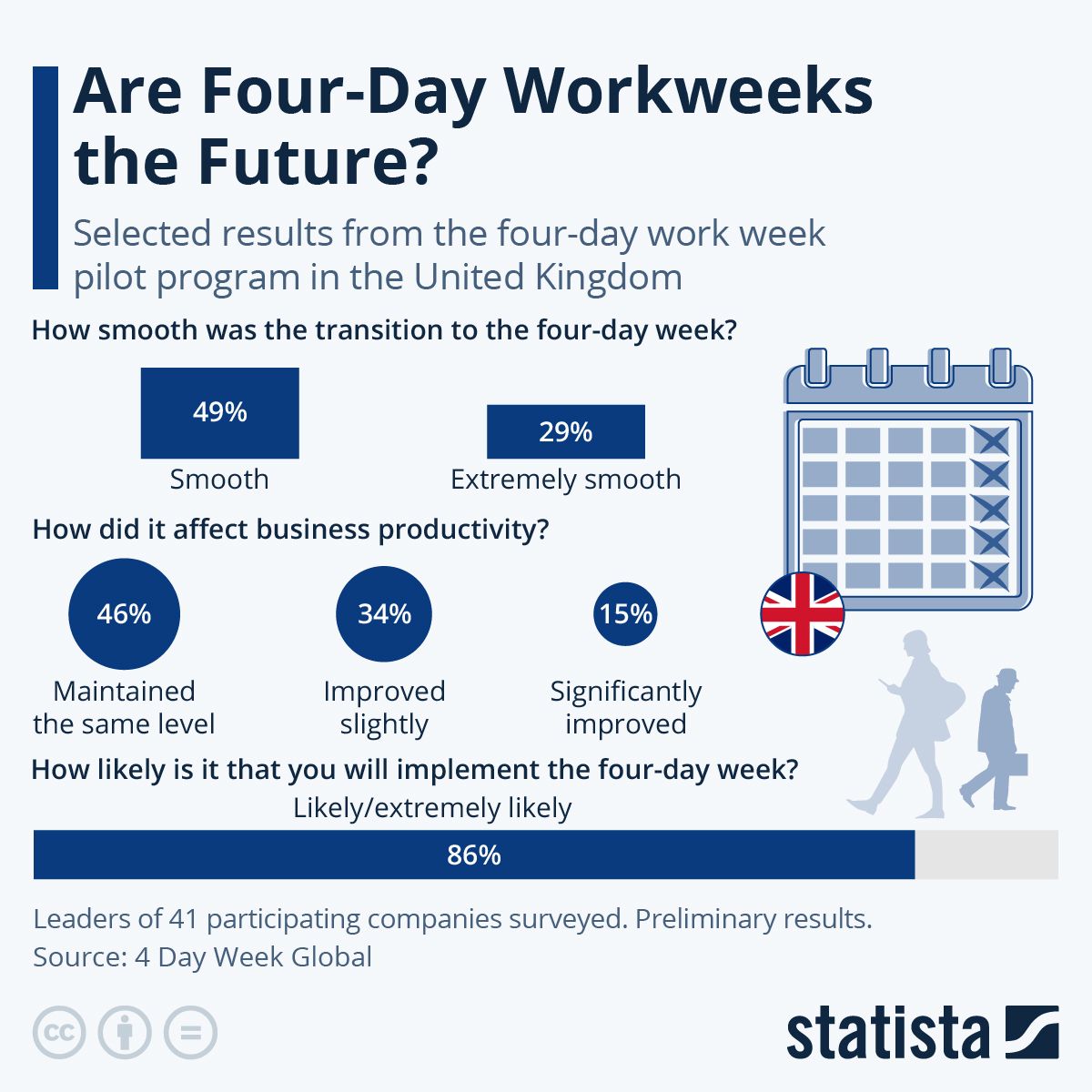
Canada's four-day workweek movement aligns with successful international models. Iceland conducted the world's largest reduced-hour trial between 2015-2019, involving over 1% of its workforce. The overwhelmingly positive results led 86% of Icelandic workers to gain access to shorter hours. Similarly, the UK's 2022 pilot - the world's largest coordinated trial - saw 70 companies and 3,300 workers achieve such productivity and wellbeing gains that most participants adopted the schedule permanently within a year.
These international cases demonstrate consistent patterns: maintained or increased productivity, improved employee health metrics, and enhanced workplace satisfaction. They provide empirical support for Canadian organizations considering similar transitions.
Federal Perspective and Future Outlook
While municipalities and businesses lead Canada's workplace innovation, federal adoption remains unlikely in the immediate future. When questioned about a national four-day workweek policy in 2020, Prime Minister Justin Trudeau acknowledged post-pandemic workplace evolution but maintained focus on crisis management.
"I think there are a lot of people thinking creatively about what the post-COVID world could look like,"Trudeau remarked, adding
"I look forward to hearing a wide range of suggestions."
The Canadian experiments collectively suggest a potential paradigm shift in labor practices. By demonstrating that compressed schedules can reduce absenteeism while improving quality of life, early adopters provide actionable models for organizations across sectors. As labor markets continue evolving post-pandemic, such flexible arrangements may become increasingly vital for talent attraction and retention. The municipal leadership on this issue highlights how local governments can serve as valuable innovation incubators for broader workplace reforms.
Implementation Considerations and Challenges
While the Canadian experiences largely report success, they also reveal important implementation considerations. The compressed model (four longer days maintaining standard weekly hours) has proven more immediately adoptable than reduced-hour models. Frontline service industries face greater logistical challenges than knowledge-based workplaces. Crucially, each successful case involved extensive employee consultation, phased rollouts, and clear performance metrics - elements that may explain the absence of negative impacts on municipal services reported thus far.