Chaotic Final Quebec Leaders' Debate Sees Clashes Over Health Care Privatization, Referendum Plans
Quebec's five main party leaders engaged in heated exchanges during the final televised debate before October's election, with health care privatization and sovereignty dominating the contentious 2-hour event marked by crosstalk and policy divisions.
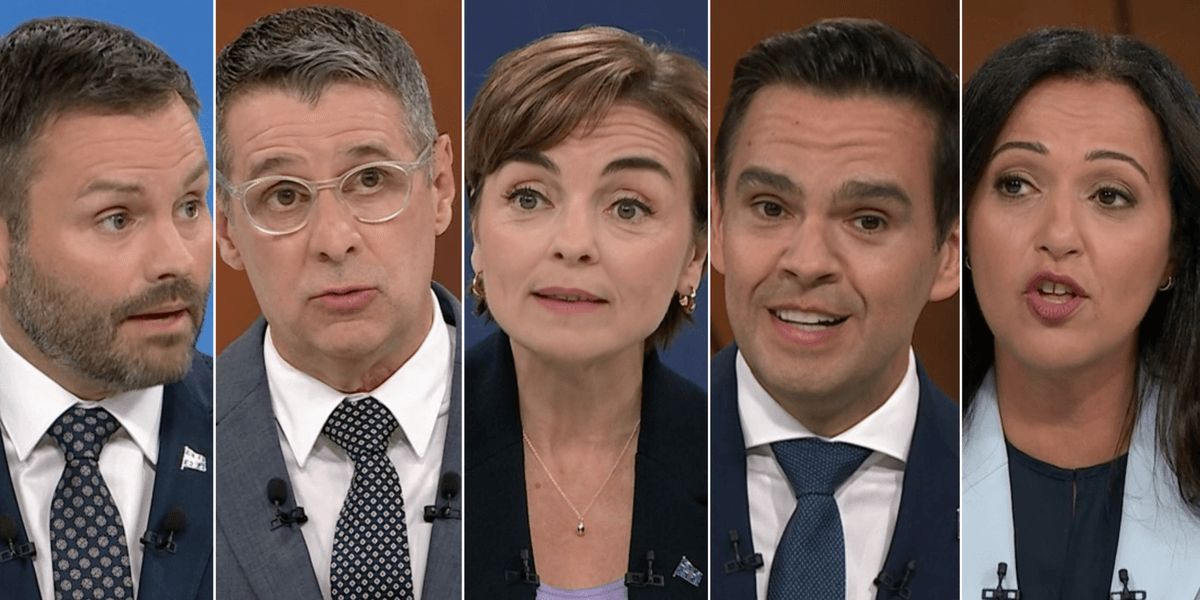
The third and final Quebec election debate hosted by Radio-Canada on September 23 became a microcosm of the province's political fractures as five party leaders clashed over fundamental questions of health care privatization, sovereignty referendums and public spending priorities. Moderator Patrice Roy struggled to maintain order during the 120-minute televised event that saw repeated outbursts, crosstalk and ideological confrontations just days before Quebec's October 5 provincial election. The debate, held at Radio-Canada's new headquarters, featured the same five leaders who participated in earlier debates organized by TVA and Noovo/Crave, with each attempting to define the election's narrative during this crucial final confrontation.
Debate Structure and Format Challenges
The Radio-Canada debate maintained the same five-party format that included Paul St-Pierre Plamondon (PQ), Éric Duhaime (PCQ), Christine Fréchette (CAQ), Charles Milliard (PLQ) and Ruba Ghazal (QS). Organized around five major themes - Quebec's future, economic insecurity, fiscal constraints, youth policies and health care - the debate's structure proved inadequate to contain the leaders' competing agendas. Journalist Patrice Roy, a seasoned anchor for Radio-Canada, faced significant challenges in moderating the discussion as leaders frequently spoke over one another. The format's limitations became particularly apparent during discussions about Quebec's health care system and housing policies, where multiple segments descended into simultaneous arguments that required Roy to intervene repeatedly to restore order.
Health Care Privatization Sparks Contentious Exchange
The debate's most substantive policy clash emerged during the health care segment, where Conservative leader Éric Duhaime vigorously defended his controversial proposal to expand private sector involvement in Quebec's health system. His characterization of Quebec's single-payer model as "un monopole" ignited immediate pushback from other leaders, creating what observers described as a cacophonous moment in the debate. Québec Solidaire co-spokesperson Ruba Ghazal directly challenged the viability of Duhaime's plan, questioning "Où est-ce qu'on va trouver les médecins?" when the public system already faces critical staffing shortages. Her critique that the proposal amounted to "déshabiller Jacques pour habiller Paul" - a Quebecois expression meaning robbing Peter to pay Paul - captured opponents' arguments that privatization would merely redistribute existing resources rather than solve systemic capacity issues. This exchange highlighted the fundamental divide between those viewing health care as a public good and those advocating market-based solutions.
READ MORE: Ajax parents demand action as students endure grueling 2-hour bus commutes to specialized program
READ MORE: Ottawa City Council Votes to Rename Trump Avenue Amid Political Tensions
Fiscal Policy and Public Sector Cuts
When discussion turned to Quebec's fiscal challenges, Ruba Ghazal launched a pointed critique of what she characterized as her opponents' reflexive reliance on public sector austerity. Her remark that other parties wanted to cut "un peu, beaucoup ou très passionnément" framed the debate as a choice between protecting public services or pursuing ideological budget balancing. She emphasized that public servants "donnent des services" rather than engaging in meaningless bureaucratic work. PQ leader Paul St-Pierre Plamondon reinforced this critique by highlighting questionable CAQ spending decisions, specifically citing the controversial allocation of $128,422 from Quebec's green fund to electrify a gorilla tourist reserve in Gabon through a Bas-Saint-Laurent company. This project, initially approved for $148,400, became symbolic of what opponents view as the CAQ's misplaced spending priorities. Conservative leader Duhaime countered by arguing Quebec needed to reduce bureaucratic red tape, using the colorful phrase "enfantdechienniser" to describe how regulations complicate citizens' lives.
Sovereignty Debate Resurfaces With New Conditions
The perennial question of Quebec independence provoked some of the debate's most emotionally charged exchanges. PQ leader Plamondon introduced a novel condition for any future sovereignty referendum, stating he wouldn't hold one while Donald Trump occupied the White House - a position first articulated in earlier debates that he reiterated here. His invocation of former PQ premier Jacques Parizeau's democratic principles - "N'ayez pas peur de votre démocratie" - sought to reframe sovereignty as an ongoing conversation rather than a settled question. Plamondon also connected sovereignty to language preservation, criticizing opponents for ignoring what he called "le pire déclin du français et de notre culture de l'histoire du Québec." Conservative leader Duhaime countered by portraying sovereignty as economically reckless, asking why Plamondon would "envoyer le Québec dans le mur" and framing the debate as a choice between pessimism and hope. He referenced Quebec's "pouvoir ratatiné" (diminished power) following the 1980 and 1995 referendums, illustrating the continued resonance of these historical events in contemporary debates.
Immigration Policy Exposes Ideological Rifts
The leaders' exchange on immigration policy revealed starkly different worldviews, with Duhaime characterizing many of Quebec's 200,000 asylum seekers as "faux demandeurs d'asile" while Ghazal emphasized migrant workers' essential contributions during the pandemic. Her retort that "Il y a des travailleurs étrangers qui torchaient le Québec pendant la pandémie" underscored the human dimension of immigration policy debates and challenged the Conservative leader's framing. This exchange highlighted the competing narratives around immigration in Quebec - one emphasizing border control and another recognizing immigrants' economic contributions - that have become central to provincial politics.
Moderator Struggles to Maintain Order
The debate's chaotic moments, particularly during housing policy discussions, forced moderator Patrice Roy to repeatedly intervene. His exasperated "Eh lala. WO-OH, les amis... prochain thème" before cutting microphones became a symbolic moment of the evening, illustrating both the leaders' combativeness and the challenges of moderating multi-party debates on contentious issues. The situation deteriorated when Duhaime urged voters to elect Conservatives as "un chien de garde" (watchdog) in the National Assembly, prompting cross-talk that Roy eventually had to forcefully terminate. These moments revealed the difficulty of conducting substantive policy discussions in a five-party format where leaders frequently prioritize soundbites over dialogue.
Housing and Economic Insecurity Debates
The discussion of Quebec's housing crisis and economic insecurity generated particularly heated exchanges, though substantive policy differences sometimes became obscured by rhetorical clashes. Leaders debated approaches to affordability and economic stability, with Ghazal emphasizing public investment while Duhaime advocated deregulation. These exchanges, while less focused than the health care debate, touched on voters' everyday concerns about rising costs and access to affordable housing.
Policy Implications and Electoral Consequences
This final debate before Quebec's October 5 election revealed deepening ideological divisions that could shape the next government's mandate. The clear policy contrasts - particularly on health care reform and Quebec's constitutional future - provide voters with distinct governing visions. The combative tone suggests potential governing challenges regardless of which party forms government, as leaders demonstrated limited capacity for consensus-building on fundamental policy questions. With polls showing tight races in several regions, the debate's most memorable exchanges may prove decisive for undecided voters weighing Quebec's political direction amid economic uncertainty and demographic change. The event ultimately served as a snapshot of Quebec's current political landscape, where longstanding debates about identity, sovereignty and social policy intersect with contemporary concerns about public services and economic management.