Ghost particles from Earth's interior hint at uneven radioactive material
The detection of geoneutrinos in a Canadian mine suggests radioactive elements may be clumped inside the planet's mantle.
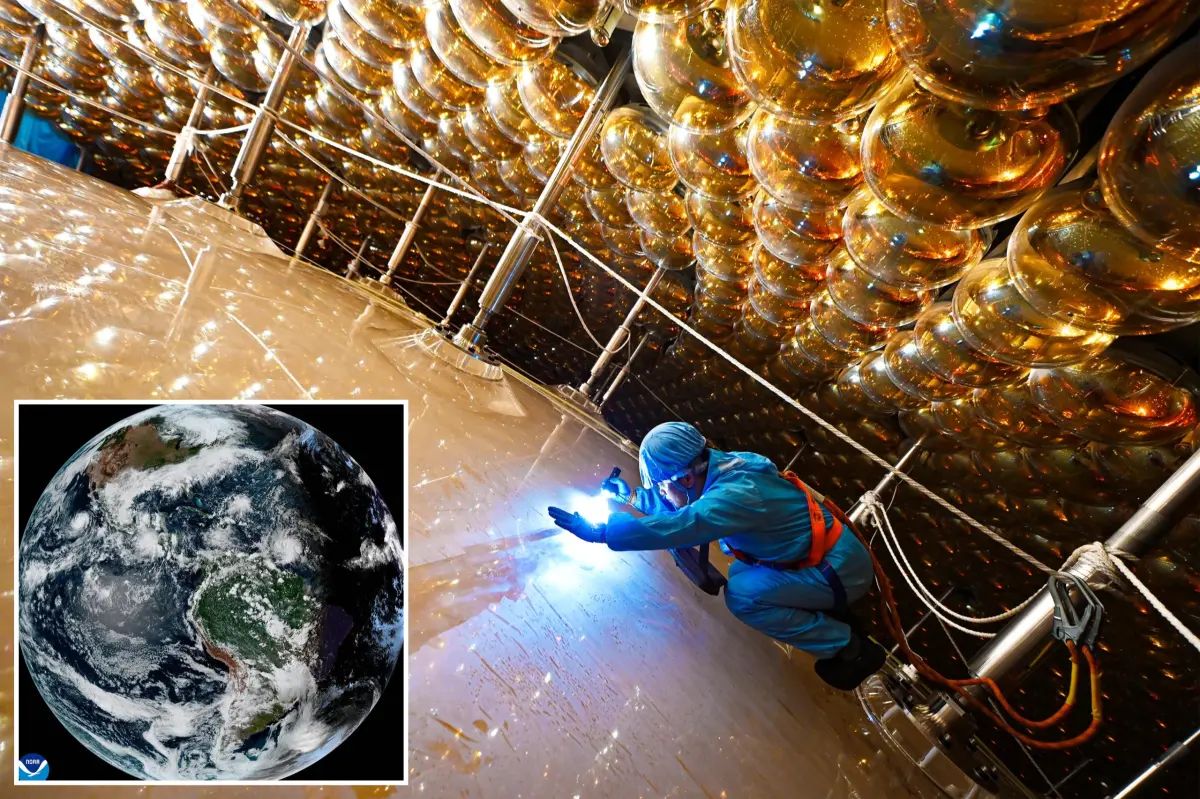
Scientists have detected ghost particles from deep inside Earth at a laboratory buried more than a mile underground in a Canadian mine, hinting that radioactive material may be unevenly distributed in the planet's mantle.
The particles, called geoneutrinos, were detected last November, marking the first such detection in the Western Hemisphere.
Only two other successful detections have been reported, from experiments in Japan in 2005 and Italy in 2009.
READ MORE: Massive Northwest Territories landslides moved millions of cubic metres in days
READ MORE: Scientists discover hidden drainage system at the back of the eye
The three experiments reported different signal levels, with Italy's reading high, Japan's low and Canada's landing in between, according to Quanta Magazine.
Taken at face value, those differences could suggest the Western Hemisphere contains more radioactive material than the Eastern Hemisphere.
"The results could offer a hint that the mantle isn't uniform," said Mark Chen, a particle astrophysicist at Queen's University.
He suggested that deep structures inside Earth might concentrate certain elements.
That is a big possibility, especially because scientists already know of two enormous, mysterious regions deep in the mantle near the core: one beneath Africa and another beneath the Pacific Ocean.
Whether those structures are connected to the new findings remains an open question.
For decades, scientists have generally expected the mantle, the thick layer of hot, slowly churning rock between the crust and the core, to be mixed well enough that radioactive elements are distributed relatively evenly throughout it.
It is like a giant pot of soup slowly stirring itself.
Given enough time, you'd expect the ingredients to spread around rather than remain clumped in one corner.
But Earth may be more complicated than that.
Radioactive elements release heat as they decay, helping drive the slow movement of rock deep underground.
That movement plays a role in the geological activity that shapes our planet, including the processes behind volcanoes and earthquakes.
Earth's internal heat also contributes to the dynamics of its magnetic field, which helps shield us from harmful charged particles coming from space.
If radioactive material is unevenly distributed, some regions of the mantle could generate more heat than others.
Geoneutrinos are neutrinos produced by radioactive decay inside Earth.
They are sometimes described as ghost particles because they barely interact with ordinary matter.
Trillions of neutrinos pass through your body every second, and most travel straight through Earth without stopping.
Detecting the tiny fraction that interact with a detector is an entirely different challenge.
The underground laboratory reportedly detected around 50 geoneutrinos.
Geochemist William McDonough of the Chinese Academy of Sciences is not ready to make that call.
He has cautioned that the estimates come with uncertainties, leaving scientists to question whether the differences reflect Earth's actual composition or limitations in the measurements.
A massive new neutrino detector in China is expected to report results that could help researchers compare measurements and test whether the apparent differences hold up.
More data will be crucial.
With so few geoneutrinos detected so far, scientists need better measurements before they can confidently map how radioactive elements are distributed deep inside Earth.
With files from geekspin